
- 12 mins
What if the most valuable gift you leave your children isn't found in a bank account or a property deed? While a legal will handles your money, it often feels cold and silent. It doesn't capture your "why" or the hard-earned wisdom you've gathered over a lifetime. Many families worry that their unique history and values will be lost to time. By exploring ethical will examples, you can find a way to preserve your voice and ensure your legacy is about more than just physical things.
You likely believe that your family's identity is worth more than any financial asset. You want to know that your stories will be told correctly and that your values will guide the next generation. This article will show you how to turn those memories into a lasting treasure. We'll look at practical ways to organize your non-financial assets, provide templates to get you started, and help you build a plan for secure delivery. You'll move from a state of uncertainty to the peace of mind that comes with a completed legacy plan.
Key Takeaways
- Learn why an ethical will is the "soul" of your estate plan and how it helps pass on your values rather than just your money.
- Discover how a legacy letter acts as the glue that keeps families together and protects generational wealth.
- Review practical ethical will examples that show you how to share your life lessons without feeling like you need to be a professional writer.
- Identify common mistakes like procrastination so you can start capturing your family stories today.
- Understand how to use a digital vault to ensure your legacy messages are delivered to the right people at the right time.
What Is an Ethical Will and Why Your Family Needs One
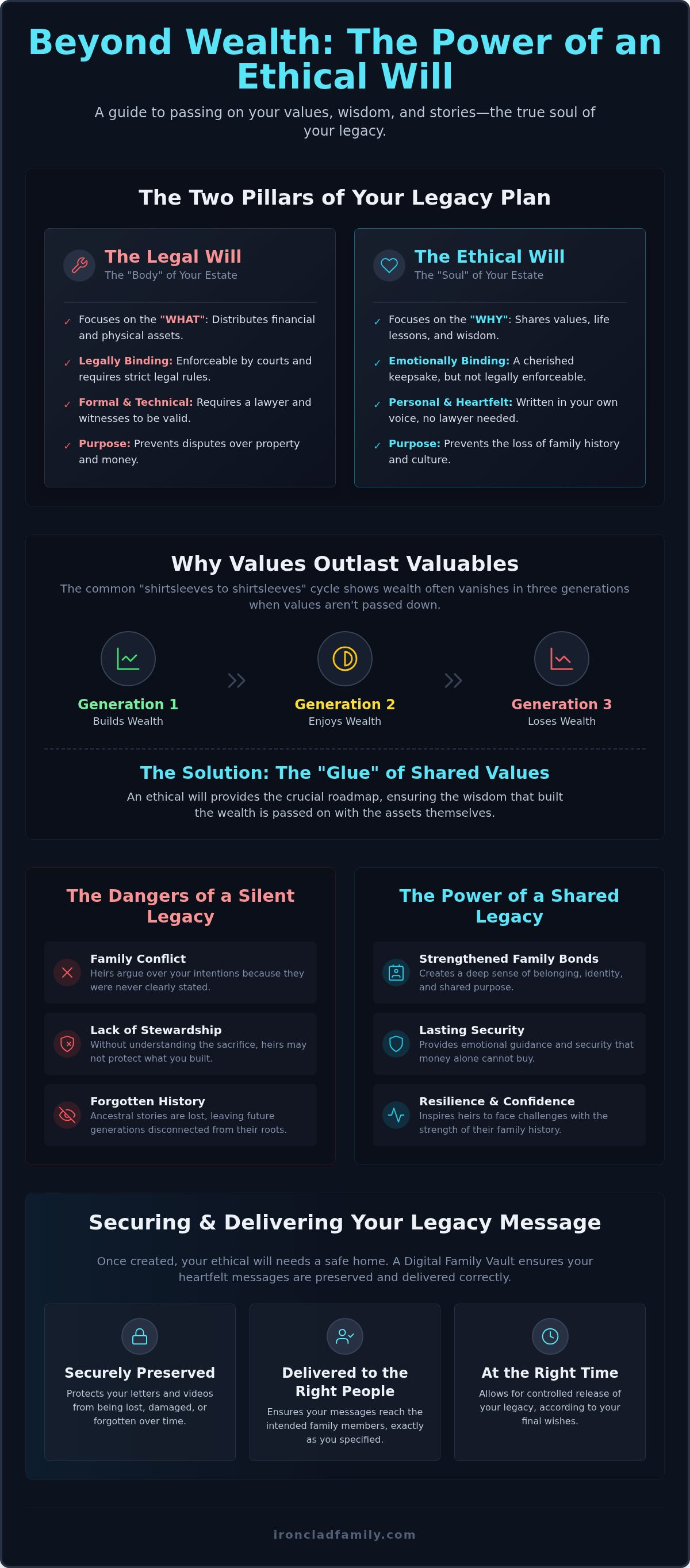
An Ethical will is a personal document used to share your values, blessings, and life lessons with those you love. It's not a legal paper that lists bank accounts or property. Instead, it's a heartfelt record of who you are and what you believe in. Think of it as the "soul" of your estate plan, while the legal will is the "body." In 2026, many families call these "Legacy Letters" or "Legacy Messages." They aren't legally binding in a court, but they're often the most cherished items a family ever receives. They bridge the gap between leaving an inheritance and leaving a legacy.
The Difference Between Legal Wills and Ethical Wills
A legal will focuses on the "what." It distributes your home, your car, and your savings. It requires strict legal rules and a notary to be valid. An ethical will focuses on the "why." It distributes your purpose and your wisdom. You don't need a lawyer to write one. You only need your honest voice. Legal wills are designed to prevent disputes over physical items, but an ethical will is designed to prevent the loss of family culture. When you look at ethical will examples, you'll see they don't follow a rigid format. They can be short notes, long letters, or even video recordings. Including ethical will examples in your overall estate plan ensures your family inherits your character along with your assets.
Why Traditional Estate Planning Often Feels Incomplete
Most estate planning feels cold and clinical. It's full of technical language that sounds more like a business contract than a family transition. This creates an emotional gap for your heirs. Your children might receive a check, but they won't know the stories behind the hard work that earned it. Without this context, family history often fades within two generations. A legacy letter provides that missing context. It explains the spirit behind your final wishes. It ensures your "why" is heard loud and clear alongside your "what." A legacy message acts as a bridge. It connects your current life to the future you won't see, making sure your voice is never forgotten. This turns a simple inheritance into a meaningful family narrative that lasts for generations.
Why Sharing Your Values Matters for Generational Wealth
There is an old saying that wealth vanishes in three generations. It's often called "shirtsleeves to shirtsleeves." The first generation works hard to build the wealth. The second generation enjoys the comfort it provides. By the third generation, the money is often gone. This doesn't happen because of poor accounting or bad luck. It happens because heirs often receive assets without receiving the wisdom that built them. They have the funds but no direction. They lack the internal compass needed to manage a legacy with purpose.
Successful wealth transfer is about more than just tax planning or legal structures. It's about passing on the "glue" that holds a family together across time. When you share your principles, you give your heirs a roadmap for how to handle their inheritance. Shared history and beliefs are what make family document organization feel meaningful instead of like a administrative chore. Without these values, a bank account is just a number. With them, it's a tool for the family's future and a reflection of your life's work.
Beyond Money: The Consequences of a Silent Legacy
Silence can be dangerous for a family's future security. When your intentions are unclear, family conflict often follows. Heirs might argue over what you would have wanted because you never told them directly. This silence often leads to a lack of stewardship. If your children don't understand the struggles or the stories behind your success, they might not feel a responsibility to protect what you've built. Ancestral stories are the heartbeat of a family. Once they're forgotten, that connection to the past is gone forever. This leaves the next generation feeling untethered and disconnected from their roots.
Strengthening Family Bonds Through Shared History
Sharing ethical will examples with your children can inspire them to face their own challenges with confidence. It creates a deep sense of belonging and identity. When a child knows they come from a long line of resilient people, it shapes how they see themselves and their potential. There are real psychological benefits for heirs who receive a message of love and guidance. It provides a type of security that money alone cannot buy. By looking at ethical will examples, you can see how simple stories about your first job or a favorite family tradition build a bridge between generations. This ensures your family culture survives as long as your financial assets do.
If you're ready to start documenting these stories, you can store family records safely to ensure these lessons are never lost to time.
Common Mistakes When Creating a Legacy Message
The biggest mistake most people make is waiting. They wait for a special anniversary or a quiet weekend that never arrives. Procrastination is the silent killer of family history. By the time many people feel "ready" to write, their memories might have faded, or life might have taken an unexpected turn. You don't need a perfect moment to begin. You only need a few minutes and a sincere heart. Start now, even if you only write a few sentences.
Another common error is trying to be Shakespeare. You might feel pressure to use grand language or poetic metaphors. This often leads to writer's block. Looking at ethical will examples shows that the most powerful messages are usually the simplest ones. Your children don't want a literary masterpiece; they want to hear your voice. Use the same words you would use across the kitchen table. It's also vital to remember that your legacy is living. Failing to update your message as your family grows or your life changes is a missed opportunity to share new wisdom.
Mistake 1: Making the Document Impossible to Find
Many people write a beautiful letter and then hide it in a desk drawer or a safe deposit box. This is known as the "Drawer Problem." If your family doesn't know where it is, or if the paper is lost during a move, your wisdom dies with the document. Even digital files can be a trap. An unencrypted file on an old laptop or a USB drive is easily lost, broken, or forgotten. To protect important documents, you need a system that ensures your family can access them when the time is right. Without a clear plan for delivery, your most important words might never be read.
Mistake 2: Focus on Guilt Rather Than Growth
It's tempting to use a legacy message to settle old scores or explain past grievances. This is a significant mistake. An ethical will should be a tool for growth, not a weapon for guilt. If the tone is cold or critical, your heirs may ignore the advice entirely. Keep your message protective and reassuring. Focus on the potential of the next generation and the lessons you've learned from your own mistakes. Use ethical will examples that highlight resilience, love, and hope. This ensures your final words provide a foundation of strength rather than a weight of regret for those you leave behind.
Ethical Will Examples and Practical Writing Steps
Seeing how others have shared their wisdom can help you find your own voice. There is no right or wrong way to write a legacy message. It only needs to be true to who you are. By looking at different ethical will examples, you can choose a style that fits your role in the family. Whether you're a parent of young children or a business founder, your perspective is a vital part of your family's future security.
The "Heartfelt Parent" approach focuses on the emotional bond. You might share specific childhood memories that show your children their own strengths. For example, you could write about a time they showed resilience during a difficult move. The "Family Founder" approach is different. It shares the principles that built the family home or business. This helps heirs understand that their inheritance is the result of specific values like integrity or sacrifice. Finally, the "Grandparent’s Wisdom" approach offers a long-term view. It passes on lessons learned through decades of change, providing a steady hand for the generations to come. Many find that drawing from timeless philosophical traditions, such as those curated by StoicOs.ai, helps them better articulate the virtues they wish to pass on.
You can use these ethical will examples as a starting point and then add your own details. A parent might say: "I want you to remember that kindness is your greatest asset. It will open doors that intelligence alone cannot." A business owner might write: "The values that guided my career were integrity and hard work. Never sacrifice your reputation for a short-term gain." Tailoring these messages means thinking about the specific challenges your family faces. If your family values education, share the story of the first person in your lineage to graduate college. This makes the values feel real rather than abstract.
Practical Steps to Start Today
Writing a legacy message doesn't have to take weeks. You can follow a simple 4-step process: Reflect, Draft, Review, and Secure. Start by setting a 15-minute timer. Don't worry about grammar or structure. Just focus on three core values you want your children to keep. If you feel stuck, try to write a single sentence that defines your life's greatest lesson. Once you have a draft, review it to ensure the tone is protective and loving. The final step is to secure it. You can store family records safely using Legacy Messages to ensure your voice is preserved and delivered exactly when your family needs it most.
Securing Your Legacy with a Digital Family Vault
Writing your legacy is only half the battle. If your family can't find your words when they need them most, the wisdom you've captured is lost. A digital vault acts as a secure document organizer that bridges the gap between your legal preparation and your emotional legacy. It's the place where the "body" of your estate plan meets its "soul." By using a vault, you can link your legacy letter directly to your legal will. This creates a holistic plan that protects your family from both financial and emotional uncertainty.
One of the greatest benefits of a modern system is automated delivery. You don't have to worry about a physical letter being misplaced during a move or a digital file becoming unreadable on an old hard drive. Your message arrives exactly when it's needed. When you look at ethical will examples, you'll see that the timing of the delivery often makes the message even more powerful. It provides comfort during a time of transition. IronClad Family offers a way to protect important documents and ensure your legacy messages are never forgotten.
Organizing Ethical and Legal Documents Together
Your digital vault should be the central hub for your entire estate. It's not just for your ethical will. It should also hold your legal will, Power of Attorney (POA), and medical directives. Storing these together ensures your heirs have a complete picture of your wishes. You can designate specific people, known as Receivers, who will get access to these credentials at the right time. This is where zero-knowledge encryption becomes vital. It means your private thoughts and sensitive records stay completely private. Only you and your chosen loved ones hold the keys to this digital safe.
How IronClad Family Protects Your Final Messages
The Legacy Messages feature allows you to record your wisdom in the way that feels most natural to you. You can write a traditional letter or record a video message. This flexibility helps you capture the essence of your life's work. You can also set up emergency access protocols. These act as a fail-safe, ensuring your loved ones aren't locked out when they need information quickly. This fortress-like security provides absolute preparedness. It moves you from a state of worry to a feeling of calm confidence. You can rest easy knowing that your "voice" is preserved in a secure, living legacy for the next generation.
Take the First Step Toward a Living Legacy
Your family's story is a living legacy that deserves a high level of protection. By using ethical will examples to guide your writing, you ensure that your children inherit your wisdom along with your assets. This simple act turns a standard estate plan into a sacred record of your life's values. You now understand that sharing these principles is the glue that preserves generational wealth and prevents family history from fading away. It's the difference between leaving a check and leaving a roadmap for a meaningful life.
A legacy is only effective if it's stored and delivered with absolute security. Leading financial advisors trust digital vaults to manage this delicate transition for their clients. With zero-knowledge encryption and automated legacy delivery, your private thoughts remain inside a fortress of safety until the perfect moment arrives. You don't have to leave your family's future to chance. Learn how to protect your family’s most important documents with a secure digital vault. Taking action now provides the calm confidence that your voice will guide your loved ones for generations to come.
Frequently Asked Questions
Is an ethical will legally binding in the United States?
An ethical will is not a legally binding document in any state. It does not replace a legal will or distribute property. While a legal will handles your financial assets; this document focuses on your personal values and life lessons. It serves as a guide for your heirs but does not have the power of a court order. You don't need a notary or a lawyer to create one.
How long should an ethical will be?
There is no required length for a legacy message. It can be a single page or a series of letters written over many years. Some people use short ethical will examples to write a few punchy paragraphs; while others record long video messages. The goal is clarity and sincerity rather than reaching a specific word count. Your family will value the honesty of your voice more than the length.
Can I write an ethical will if I don't have much money?
You don't need a large estate to leave a meaningful legacy. An ethical will is about your character, your stories, and your hopes for the future. These are assets that every person possesses regardless of their bank balance. In fact, for families with fewer financial assets, these messages often become the most precious inheritance. They provide a sense of identity and belonging that money cannot buy.
What is the best way to store a digital legacy letter?
The best way to store a legacy letter is in a secure digital vault with zero-knowledge encryption. Paper copies are easily lost during moves or damaged by time. Storing your message in a digital repository ensures it stays private and protected from hackers. Using a system with automated delivery means your loved ones will receive your instructions and wisdom exactly when they need them without having to search through old files.
Should I share my ethical will with my family while I am still alive?
Sharing your message while you're alive can be a powerful way to strengthen family bonds. It allows you to have deep conversations about your values and answer questions your children might have. However, many people prefer to keep their ethical will examples private in a digital vault until they pass away. Both choices are valid. The most important thing is that the document exists and is stored so your family can eventually find it.
How often should I update my legacy messages?
You should review your legacy messages every three to five years. Life events like the birth of a grandchild, a career change, or a health update can change your perspective on what matters most. Updating your message ensures it reflects your current wisdom and current family dynamic. It's a living document that grows as you do. Regular reviews help you keep your family's future roadmap accurate and relevant.
Can a financial advisor help me with an ethical will?
Many financial advisors now offer holistic planning that includes help with ethical wills. They use professional tools like an advisor portal to help you organize both your financial and non-financial assets. An advisor can provide prompts and templates to help you get started. This ensures your legacy plan covers both the "what" of your inheritance and the "why" behind your life's work, providing total peace of mind for your family.
What happens if my family can't find my ethical will?
If your family can't find your message, your unique wisdom and family history may be lost forever. This is a common problem with paper documents hidden in desk drawers. Without a clear plan for access, your heirs are left with only clinical legal papers. Using a secure digital vault with emergency access protocols prevents this. It ensures your voice is heard and your legacy is delivered to the right people at the right time.
