
- 14 mins
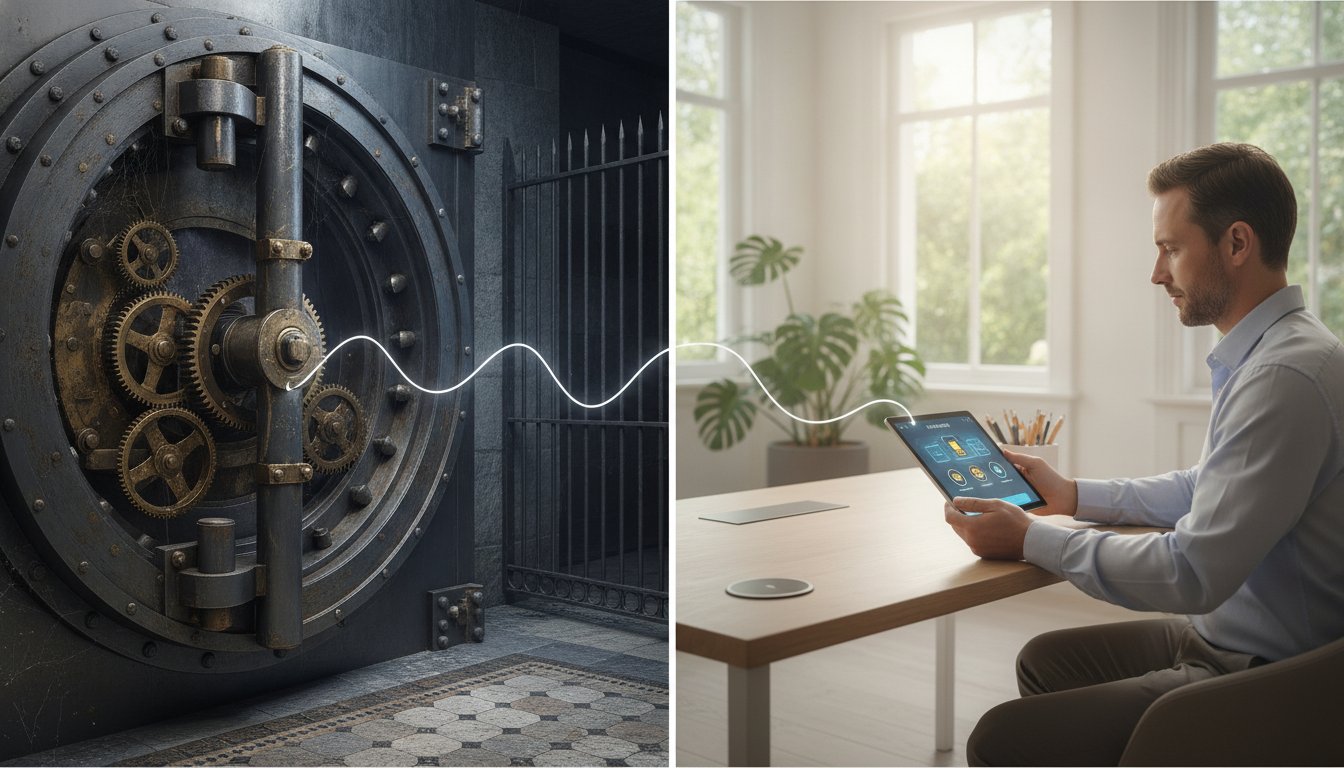
Imagine your family needs your will or an emergency password immediately, but it's Saturday afternoon and the bank doors are locked tight. Even worse, what if they're told they can't access your safe deposit box for months because of legal probate rules? You've worked hard to build a life, and you deserve to know your legacy is reachable when it matters most. Most people still believe a bank vault is the only way to keep their valuables safe. However, as major banks like JPMorgan Chase and Santander continue to phase out these services in 2026, finding a reliable alternative to bank safe deposit box storage is now a vital step for every prepared family.
You're right to feel concerned about the limitations of traditional banking hours and the risk of being locked out during a crisis. This guide will show you how to move past these outdated systems to secure your documents and digital assets. You'll learn about modern, accessible ways to protect your family from fire, theft, and the frustration of bank closures. We'll explore how to combine physical security with a digital fortress to ensure your children aren't left guessing about passwords or crypto keys. It's time to create a living legacy that finds your family exactly when they need it.
In addition to document security, many families are adopting specialized tools like Vaultly to secure deposits for private marketplace transactions, ensuring all aspects of their financial life are protected by modern technology.
Key Takeaways
- Understand why bank closures and limited branch hours make traditional boxes a risk to your family's immediate needs.
- Learn why physical storage alone fails to protect modern digital assets like crypto keys and account passwords.
- Identify the best alternative to bank safe deposit box storage to ensure your family isn't locked out during a crisis.
- Discover the practical steps to inventory and digitize your most important documents for secure, instant sharing.
- Find out how a digital vault acts as a living bridge to pass on your legacy and essential credentials to your heirs.
The Hidden Risks of Traditional Bank Safe Deposit Boxes
For decades, families relied on the local bank branch as a fortress for their most valuable papers. But the world has changed. Banks are closing branches at record rates to focus on digital services. When a branch closes, you're often forced to move your belongings to a distant location or lose the service entirely. To understand the basics, it helps to look at what is a safe deposit box and how it was designed for a different era. Today, the physical distance and limited banking hours create a massive barrier during a family emergency. If you need a medical directive on a Sunday morning, a locked vault doesn't help you.
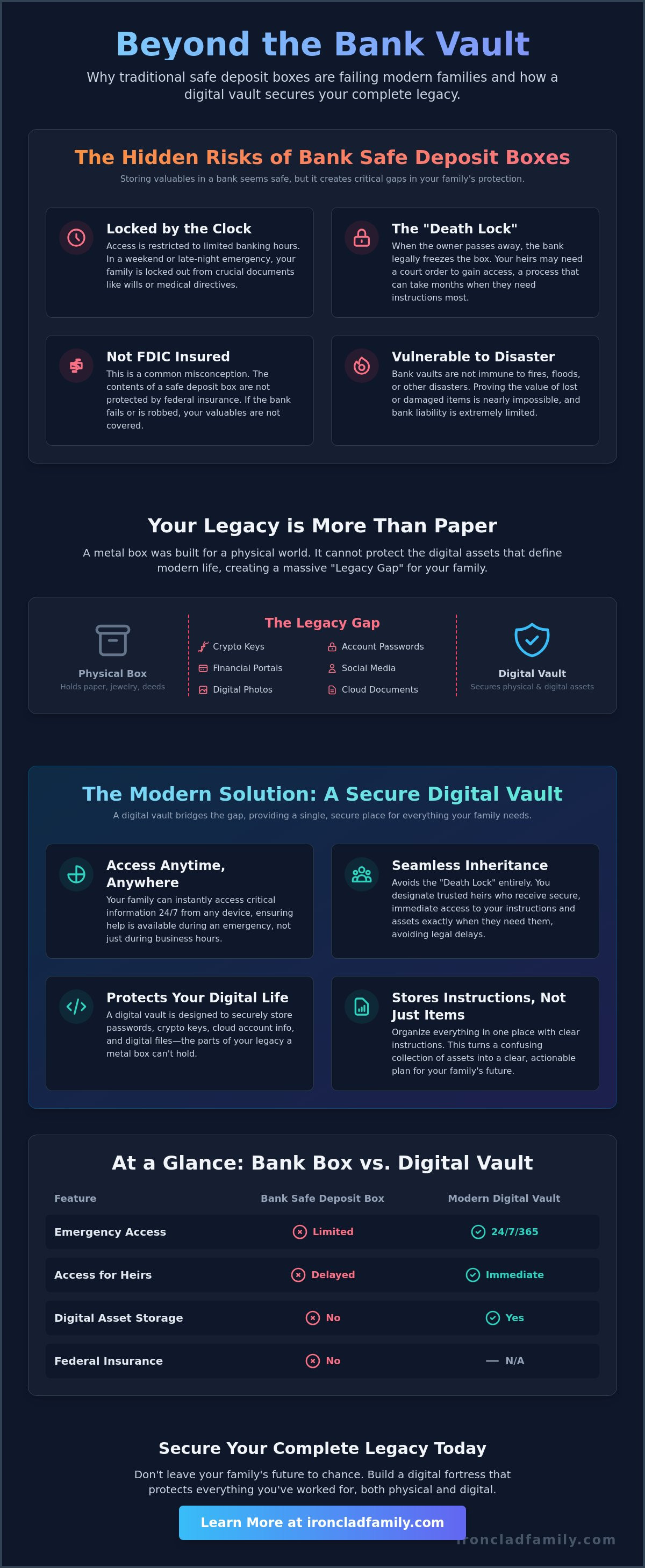
The most painful risk is the "Death Lock." When a box owner passes away, the bank is legally required to freeze access to the box immediately. This happens exactly when your family needs your instructions the most. To better understand why this system is failing, watch this helpful video:
Many people assume their items are protected by federal insurance. This is a dangerous mistake. Safe deposit boxes are not FDIC insured. If a bank fails or a branch is robbed, the government doesn't back the value of what's inside that box. You're essentially renting a metal shelf with very little protection if things go wrong. This reality is why many are searching for a modern alternative to bank safe deposit box storage.
The Legal Hurdle for Your Heirs
Probate court is a slow and expensive process. If your heirs need to get into your box after you're gone, they may need a court order. This can take months. There is a cruel irony in storing your last will and testament inside a box that requires that very will to open. It creates a circular legal trap that leaves your family in limbo. Learning about storing a will online securely is a much better way to ensure your family has instant access when they need it most.
No Protection Against Physical Loss
A bank vault looks strong, but it isn't invincible. History shows that vaults can be flooded during hurricanes or damaged in fires. Unlike a bank account, there is no automatic inventory of what you put in your box. If items go missing or are damaged by water, proving the value of your loss is nearly impossible. Banks also write their contracts to limit their own liability. In most cases, they're only responsible if you can prove they were incredibly negligent. This leaves your physical legacy vulnerable to disasters you can't control.
Why Modern Problems Require More Than a Metal Box
Our parents and grandparents kept their legacy in paper and gold. Today, your legacy is likely stored on servers and in the cloud. A traditional metal box is a static object. It cannot hold your crypto keys, your family photos stored on Google Drive, or the login for your life insurance portal. While you might still need a place for a physical property deed, relying solely on a bank box creates a massive gap in your family's protection. This is why a modern alternative to bank safe deposit box storage must address more than just physical space. It must bridge the gap between your physical belongings and your digital life.
The government even highlights the risks of safe deposit boxes, noting they aren't the right place for documents you might need in a hurry. A metal box is designed to store "things," but in a crisis, your family needs "instructions." If you aren't there to provide them, a physical key won't help them find your digital assets or understand your final wishes.
Digital Assets and the Legacy Gap
Think about the assets that define your life right now. A bank box cannot protect or pass on these essential items:
- Cryptocurrency wallets and private seed phrases.
- Social media accounts containing decades of family memories.
- Cloud storage accounts for tax returns and medical records.
- Subscription details and recurring bill payments.
Without a clear plan, your family faces "digital ghosting." This happens when your digital life is locked away forever because no one has the passwords. While laws like RUFADAA (the Revised Uniform Fiduciary Access to Digital Assets Act) give executors some legal rights, digital platforms are often better equipped to handle these transfers than a traditional bank. Using a secure digital vault ensures your digital essence isn't lost to the void.
The Need for Instant Accessibility
Emergencies don't follow a 9-to-5 banking schedule. If a loved one is in the hospital at midnight, you need their medical power of attorney immediately. Waiting for a bank branch to open on a Monday morning is a risk you don't have to take. Mobile access allows you to retrieve critical documents from a waiting room or a lawyer's office in seconds. True security is no longer just about how thick the vault walls are; it's about how quickly your family can get the information they need. Accessibility is the new security standard for the modern family. Following a family emergency plan checklist will help you identify exactly which instructions need to be reachable 24/7.
The Best Physical and Digital Alternatives to Bank Storage
Finding a reliable alternative to bank safe deposit box storage means looking at your security from two angles: the physical and the digital. For tangible items like a wedding ring or gold coins, you need a physical barrier. For your life's instructions and digital assets, you need a digital fortress. Government agencies suggest using digital and physical alternatives to ensure your family is ready for any disaster. This hybrid strategy is the gold standard for 2026. It ensures your valuables are protected while your family has the information they need to move forward in an emergency. Relying on one or the other leaves a gap that could hurt your heirs during a crisis.
Choosing a High-Security Home Safe
A home safe puts you back in control of your physical belongings. When you shop for one, look for a UL fire rating of at least one hour. This ensures your papers survive the heat of a house fire. You also need a burglary rating, such as TL-15 or TL-30, which tells you how long the safe can resist a professional thief with tools. Always bolt your safe to the concrete floor. If a thief can't open it, they might try to carry the whole safe away. However, remember that a home safe has a major flaw. If you're the only one with the code, your family is still locked out. A physical safe fails the inheritance test unless you have a secure way to share the combination with your heirs.
The Power of a Secure Digital Vault
A secure digital vault is the brain of your legacy. It uses zero-knowledge encryption to keep your data private. In simple terms, this means the company providing the vault has no "key" to see what's inside. Only you and the people you choose can see your files. This protects you from hackers because there's no master password for them to steal. Unlike a bank box, a digital vault protects against physical disasters like floods or fires by keeping your data in multiple secure locations. You can share your will with your lawyer and your emergency medical files with your children instantly. This ensures that the right people have the right information at the exact moment they need it.
A Step-by-Step Guide to Transitioning Your Legacy
Moving your legacy from a bank vault to a more modern system doesn't have to be overwhelming. It's a series of logical steps that put you back in control. By choosing a modern alternative to bank safe deposit box storage, you're making sure your family isn't left in the dark during a crisis. Start by visiting your bank and making a complete list of everything inside your current box. This inventory is the foundation of your transition plan. Take photos of each item for your records while you're there.
Once you have your list, decide what needs to be digitized. High-resolution scanning is the best way to preserve the details of property deeds and insurance policies. After you've moved your items, don't forget to notify your professional advisors. Your lawyer and financial planner should know that you've updated your storage system. This ensures that everyone on your team is working from the same playbook. Finally, close the bank box. This stops the cycle of recurring fees and removes the worry of branch closures.
What to Move Out of the Bank
You need to prioritize documents that your family will need immediately in an emergency. These include:
- Wills and Trusts: These should never be locked in a place heirs can't reach.
- Powers of Attorney: Your family needs these the moment a medical crisis starts.
- Birth and Marriage Certificates: Digitized copies are often sufficient for most immediate legal needs.
- Digital Keys: Any physical backups for crypto wallets or cloud accounts should be moved to a more accessible location.
You might decide to keep physical items like rare coins or heirloom jewelry in a bank box for now. These items have high market value but low "emergency" value. However, most legal originals belong in a high-security home safe or a protected digital environment. This keeps the instructions for your life within reach.
Setting Up Your Emergency Access
A vault is only as good as the family’s ability to use it. You must designate a trusted person to be your "IronClad Receiver." This is the individual who will receive your information if you aren't there to provide it. It's a sacred role that requires a conversation about your wishes. Testing the system is vital. Your heirs should know how to log in and find the most important folders before a crisis strikes. This practice builds confidence and ensures your legacy isn't a mystery they have to solve later.
If you're ready to start this transition with expert help, our family preparedness service can guide you through every step of the process.
How IronClad Family Secures Your Most Critical Assets
IronClad Family serves as the protective bridge between modern security and your family's traditions. While a metal box sits silent in a bank, The Vault is an active guardian of your life's work. It uses unshakeable encryption to keep your records safe from prying eyes. But security is only half the battle. The real value lies in the iVaultX system, which handles the automated delivery of your instructions. If you aren't there to speak for yourself, the system ensures your family receives exactly what they need to move forward. This active approach ensures that your legacy isn't just stored; it's delivered.
Most storage systems are passive, meaning they wait for someone to find them. Our system is different. It's designed to recognize when your family needs help and provide the necessary credentials and documents instantly. This eliminates the anxiety of heirs being locked out of accounts or missing critical medical directives. You're not just buying a digital space. You're investing in a partner that understands the weight of your family's future security.
Zero-Knowledge Security for Peace of Mind
We believe your privacy is sacred. That's why we use zero-knowledge security. This means IronClad Family cannot see your documents or read your messages. Only you and the heirs you choose hold the keys. It's a digital fortress that offers far more privacy than a standard cloud storage provider. Our system is built with a fortress mentality, designed to withstand both digital threats and the test of time. For those working with a professional team, our Advisor Portal allows your planners to help you stay organized without ever compromising your personal secrets.
More Than Just Storage: A Living Legacy
Your legacy is more than just a list of assets. It's the wisdom and love you leave behind. Through Legacy Messages, you can record videos or write notes that your children will receive at specific milestones. We also support generational wealth transfer by keeping your estate plan current with remote online notaries. This ensures your documents are always legal and ready for whatever the future holds.
IronClad Family is the logical conclusion for any family that values preparedness. It's a system designed to find your loved ones when they need it most, providing a level of care that a cold metal box never could. By moving your records into this protective environment, you've chosen the most reliable alternative to bank safe deposit box storage available today. You can rest easy knowing your family's future is secure, organized, and reachable in any emergency.
Secure Your Family's Future Beyond the Bank Vault
Your legacy is too important to leave behind a locked bank door or at the mercy of branch closures. Moving your critical documents into a system that stays with your family, not a financial institution, is the ultimate act of protection. You now understand how a hybrid approach of a high-security home safe for physical items and a digital vault for instructions provides the total coverage your heirs deserve.
Transitioning to a modern alternative to bank safe deposit box storage means your family will never have to wait for probate or banking hours to access your final wishes. Our platform uses zero-knowledge encryption and automated emergency delivery to ensure your information remains private until the exact moment it's needed. You can also use our state-specific legal document tools to keep your estate plan current and legally binding in your home state.
Secure your legacy with the IronClad Family Digital Vault today. You've done the hard work of building a life; now, take this simple step to ensure it's preserved for the next generation. Your family will thank you for the clarity and peace of mind you've provided.
Frequently Asked Questions
Is a digital vault safer than a bank safe deposit box?
A digital vault is safer because it provides instant access and protects against branch closures or physical disasters. Digital vaults use zero-knowledge encryption, which means only you hold the keys to your data. Unlike bank boxes, they aren't restricted by banking hours or legal locks that freeze assets after a death. They offer a dynamic way to share information that a static metal box simply cannot match.
What should I never store in a bank safe deposit box?
You should never store original documents that your family might need immediately in an emergency. This includes your Last Will and Testament, medical powers of attorney, and funeral instructions. Banks are closed on holidays and weekends. If you pass away, the bank often seals the box until a court order is presented. This leaves your family locked out of the very papers they need to help you.
How does my family access my digital vault if I pass away?
Your family gains access through a secure process involving a designated receiver or emergency contact you've already chosen. Systems like iVaultX use automated triggers to deliver your instructions and credentials to the right people at the exact time they are needed. This removes the need for your heirs to navigate the slow probate court system just to find your basic life instructions and account passwords.
Do I still need a physical safe at home if I have a digital vault?
A physical home safe is still useful for tangible valuables like jewelry, family heirlooms, or physical gold. While a digital vault is the best place for your instructions and digital assets, it cannot hold a physical wedding ring. A hybrid approach using both a high-security home safe and a digital vault provides the most complete protection for a modern family in 2026.
Are digital vaults legal for storing a Last Will and Testament?
Digital vaults are legal for storing digital copies and, in many states, electronic wills. While some areas still require a physical paper will with ink signatures, having a scanned copy in a secure vault ensures your family and attorney can find it instantly. This prevents the will from being lost or destroyed. It acts as a vital roadmap for your executors during the probate process.
What happens to my digital vault if the company goes out of business?
Reputable digital vault providers have contingency plans to ensure your data remains accessible or is returned to you. This often involves third-party data escrow services or partnerships with other security firms. It's important to choose a provider that focuses on long-term legacy planning and has a clear policy on data portability. This ensures your information is never held hostage by a single company's future.
Can my financial advisor help me set up a digital vault?
Many financial advisors now use an Advisor Portal to help their clients organize their digital estates. Your advisor can guide you on which documents to upload and help you designate the correct heirs for your assets. This collaborative approach ensures your financial plan and your document storage are perfectly aligned. It makes the eventual transition of wealth much easier for your family and your professional team.
How much does an alternative to a bank safe deposit box cost?
The cost depends on whether you choose a high-security home safe or a digital subscription. A quality home safe is a one-time purchase, while digital vaults involve a recurring fee for secure hosting and emergency delivery services. Choosing a digital alternative to bank safe deposit box storage often costs less than the annual fees and potential drilling fees associated with traditional bank boxes that require physical maintenance.

