

- 12 mins
If you weren't here tomorrow, could your family find the keys to the life you've built, or would they be locked out of their own future? Most people believe a folder on a computer or a paper file in a drawer is enough to protect their loved ones. But when a real crisis hits, these simple methods often fail. You need an ironclad plan to ensure your legacy is protected and accessible. You likely feel the weight of this responsibility every time you look at a stack of documents or a list of passwords. It's stressful to wonder if your spouse or children would be left guessing during their hardest moments.
You deserve a sense of calm confidence instead of constant worry. This guide will show you how to move from disorganized digital clutter to a secure, unbreakable system for your assets. We'll explore the steps to build a roadmap that protects your family's future. You'll learn how to organize your most important records so they're safe from hackers but easy for your heirs to find. By the end, you'll have a clear path toward total peace of mind for your legacy and your life's work.
Table of Contents
- Defining a Standard for Family Security
- The High Cost of a Weak Family Plan
- Common Mistakes in Document Organization
- Practical Steps to Build a Secure System
- Securing Your Digital Legacy
- Frequently Asked Questions
Key Takeaways
- Understand what it means to have an ironclad plan that survives both digital failures and life's unexpected emergencies.
- Identify the hidden dangers of digital ghosting and why storing passwords in unencrypted notes puts your legacy at risk.
- Learn the specific steps to audit your family's vital documents and the importance of using state-specific legal forms.
- Explore how a secure digital vault uses high-level encryption to protect your assets while keeping them accessible for your heirs.
Defining an Ironclad Standard for Family Security
Centuries ago, an ironclad was a ship wrapped in thick metal plates to withstand cannon fire. It was built for battle. Today, we use the word to describe a plan that is firm, secure, and unbreakable. But for a family, a plan isn't just a piece of paper. It is a shield that survives technology failures, natural disasters, and the sudden emergencies of life. Most families think they are prepared, but their vital information is often scattered across junk drawers, old laptops, and forgotten filing cabinets. This isn't just disorganized; it's a vulnerability.
True security happens when your most sensitive data is both protected and useful. You need a system that acts like a digital fortress but provides a clear map for your loved ones. To build this foundation, it helps to look at a comprehensive overview of estate planning to see how legal documents and digital assets fit together. An ironclad system ensures that the right people get the right information at the exact moment they need it most.
To better understand how this concept applies to modern legal protections, watch this helpful video:
Why Strength Alone Isn't Enough
A bank vault is incredibly strong. It has thick steel walls and a heavy door. However, if your family doesn't have the key or the combination during an emergency, that strength becomes a barrier. Your security system shouldn't just lock things away; it should facilitate a smooth transition. An ironclad system combines high-tech armor with simple, reliable access for your family. It must work perfectly even if you aren't there to explain where things are. Without this accessibility, even the strongest encryption is just another locked door for your grieving spouse or children.
The Three Pillars of a Secure Plan
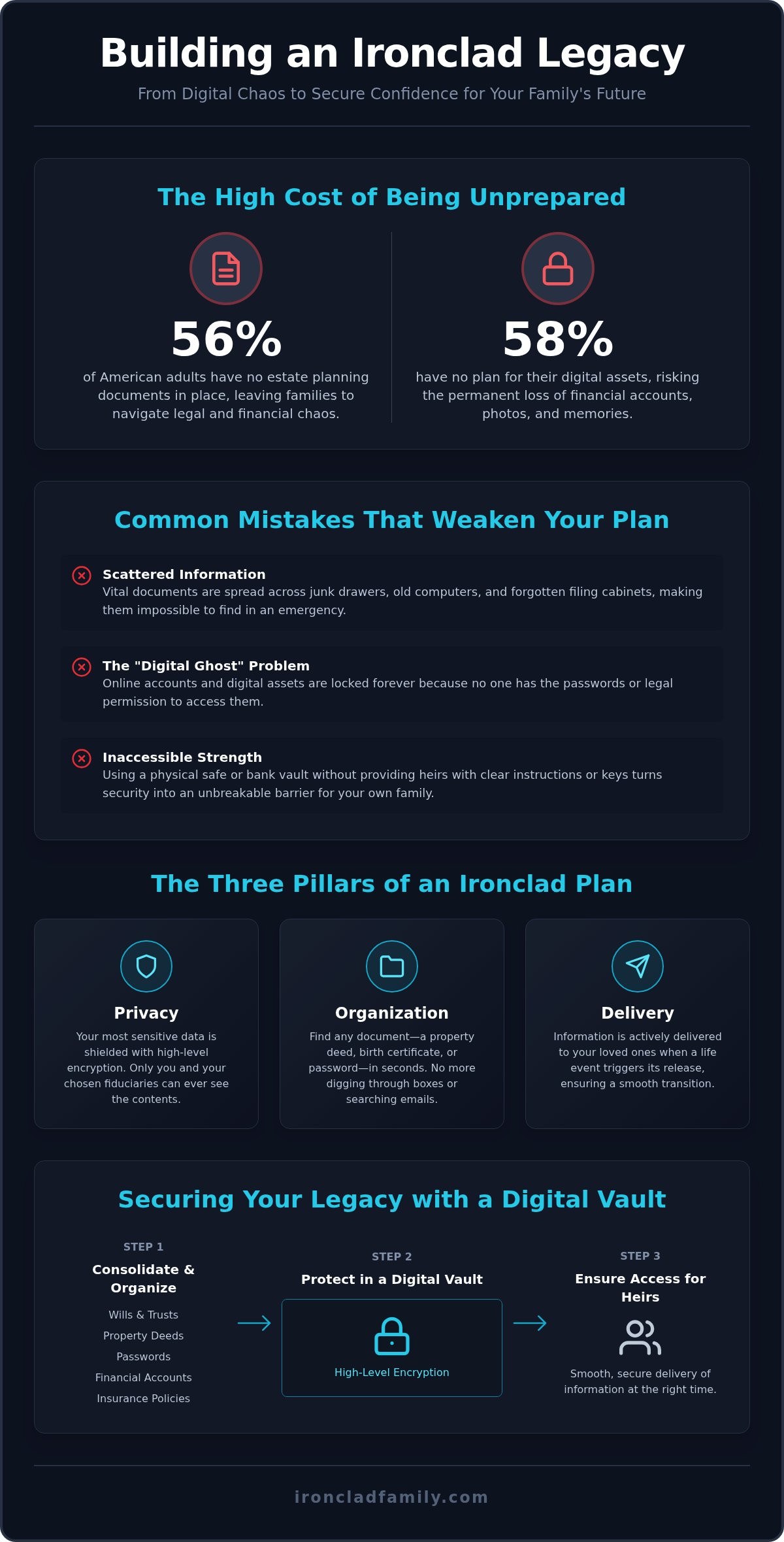
Building a legacy requires more than just a will. It requires a structure that supports your family's needs across three specific areas:
- Privacy: Your data is shielded so that only you and the people you choose can ever see the contents of your files.
- Organization: You can find a birth certificate, a property deed, or a medical directive in seconds. There is no digging through boxes or searching through thousands of emails.
- Delivery: Information doesn't just sit in a box. It is actively delivered to your loved ones when a life event triggers its release.
The High Cost of a Weak Family Plan
When a family leader passes away without a clear system, the immediate result isn't just grief. It's often total chaos. According to research from 2026, 56% of American adults have no estate planning documents in place. This lack of preparation forces grieving family members to become detectives. They have to hunt for bank accounts, insurance policies, and hidden passwords while dealing with their loss. Without an ironclad strategy, the transition of a life's work becomes a stressful burden for those left behind.
One of the biggest modern risks is the "digital ghost" problem. This happens when accounts are locked forever because nobody has the credentials. In 2026, roughly 58% of Americans still have no plan for their digital assets. This isn't just about social media. It's about access to financial records and family memories. The Revised Uniform Fiduciary Access to Digital Assets Act (RUFADAA) exists to help; however, it usually requires specific legal permission in your documents. Without it, your family might be locked out of your digital life forever.
The Reality of Digital Asset Loss
Digital assets are often the most fragile part of a legacy. Photos stored in a cloud account or cryptocurrency held in a private wallet can vanish instantly if the access keys are lost. Families often face significant legal hurdles when trying to prove they have the right to these assets. To avoid these traps, it's vital to understand the basics of generational wealth transfer and how it applies to modern assets. Protecting your family's future means ensuring that your digital footprint doesn't become a digital dead end.
Financial and Legal Vulnerabilities
When your plan is weak, your finances are at risk. Missing Powers of Attorney can lead to expensive court battles if you become unable to manage your own affairs. Probate delays can also freeze family bank accounts for months, leaving your spouse or children without the cash they need for daily expenses. Many people rely on outdated wills that don't reflect their current family situation, which only adds to the confusion. Hoping for the best is a strategy that often leads to the highest costs. You should take the time to create a family emergency plan that covers both physical and financial needs. Using a secure digital vault for families can help you organize these pieces into an ironclad defense for your loved ones.
Common Mistakes in Document Organization
Many people believe they have a solid system because they've gathered their files in one place. However, a collection of documents isn't the same as a functional plan. One of the most frequent errors is relying on a physical binder. While a "Just in Case" binder feels tangible, it's easily destroyed in a house fire or lost during a move. To truly protect your legacy, you must organize important papers in a way that survives physical disasters. An ironclad strategy requires digital resilience that paper simply cannot provide.
Digital storage mistakes are just as common. Storing passwords in unencrypted notes on your phone or on a sticky note under your keyboard creates a massive security hole. Even using a simple cloud drive like Google Drive for your will is risky. These platforms aren't designed for legacy delivery. They don't have triggers to release information to your heirs if you pass away. Without naming specific "receivers" for your digital assets, your most precious memories and financial access could be lost forever.
The Myth of the Safe Deposit Box
The safe deposit box was once the standard for security. Today, it's often a bottleneck. If you're the only person on the account, the bank may seal the box upon your death. Your family might need a court order just to get the will that's sitting inside. This creates a "Death by a Thousand Passwords" problem where every step of the process is blocked by a lack of access. You can avoid these roadblocks by reviewing our family emergency plan checklist to see what should be accessible immediately.
Security vs. Privacy: A Common Confusion
Most people confuse security with privacy. A cloud drive might be "secure" from hackers, but that doesn't mean it's private. Standard cloud storage providers often have the keys to your data. True privacy requires zero-knowledge encryption, where only you and your chosen recipients can see the content. Sharing passwords via email or text is another dangerous habit. These messages are rarely encrypted and can be intercepted. When you fail to account for these risks, you leave your digital executor with a complicated mess. An ironclad plan removes this uncertainty by using tools built specifically for long-term protection and private delivery.
Practical Steps to Build an Ironclad Security System
Moving from disorganized files to a secure system requires a deliberate approach. You need an ironclad framework that leaves no room for doubt. This process isn't just about scanning papers; it's about building a bridge for your family to cross when they need it most. By following a few clear steps, you can turn a confusing pile of records into a protected legacy.
- Step 1: Audit your documents. Gather everything from property titles to medical directives. Look for digital assets like travel rewards or photo storage.
- Step 2: Create a state-specific will. Laws vary by region, so generic forms often fail. Legal clarity is the foundation of your plan.
- Step 3: Choose a digital vault. Use a system with zero-knowledge encryption. This ensures only you and your recipients hold the keys to your data.
- Step 4: Designate Receivers. Pick specific individuals to receive your most sensitive data. These people will act as the guardians of your information.
- Step 5: Record legacy messages. Write or film messages to provide comfort and guidance that legal documents cannot express.
Starting Your Document Audit
Gathering your documents is the first step toward peace of mind. Every family needs the "Big Five" to avoid probate delays: your Last Will and Testament, Power of Attorney, Healthcare Directives, Trust documents, and a list of financial accounts. Don't overlook digital assets like rewards programs or subscriptions. A living legacy is the sum of your values, memories, and wisdom, not just the balance in your bank account.
Choosing Your Emergency Contacts
Talking to your family about their role is vital. They need to know what to do before a crisis happens. An executor handles the legal distribution of your estate, but a digital receiver manages the access to your digital life. These roles might be filled by the same person, or you may split them based on technical skill. Choosing these guardians carefully ensures that your instructions are followed exactly as you intended. By setting up these roles now, you remove the guesswork and provide your loved ones with a clear roadmap during their most difficult moments.
How IronClad Family Secures Your Digital Legacy
Building a legacy is a deeply personal journey. It's about more than just money; it's about the stories, values, and instructions you leave behind. IronClad Family provides the modern equivalent of an armored safe for your entire life. We call it The Vault. This system is designed to be your technical guardian, ensuring that your most precious assets are never lost to time or technology. By using a secure approach to protection, you can rest easy knowing your family's future is firmly defended.
Our platform is built on the principle of zero-knowledge encryption. This sounds technical, but the meaning is simple: only you and your chosen recipients can ever see your data. Even the engineers at the company don't have a key to your files. This level of privacy is essential for sensitive documents like wills and medical directives. It ensures that your information remains a private conversation between you and your loved ones, exactly as it should be.
The automated delivery system acts as your voice when you can't speak. You can set specific triggers that release credentials or documents to your heirs only when necessary. This removes the guesswork for your family and ensures they have the tools they need to manage your affairs. The peace of mind that comes from such a reliable preparedness system is invaluable for any family leader.
Privacy You Can Trust
We act as a technical guardian for your records. By organizing your life within a secure digital vault for families, you help your heirs avoid the expensive delays of probate. When everything is in one place and easy to find, the legal process moves much faster. This organization isn't just about efficiency; it's about reducing the emotional burden on your heirs during a difficult time. You're giving them a clear map instead of a mystery to solve.
Preparing the Next Generation
Legacy messages are a unique feature that helps you bridge the gap between financial wealth and family values. You can record video or written messages that are delivered only when they're needed most. These messages provide comfort and guidance, acting as your voice when you can't speak for yourself. To ensure these wishes are legally binding, we also offer state-specific legal tools that provide national coverage for your estate plan. Don't leave your family's security to chance. Start building your secure repository today to protect what matters most.
Building Your Unbreakable Legacy
Protecting your family's future is one of the most important things you'll ever do. It requires moving past disorganized folders and risky paper binders. By following a clear roadmap, you can transform scattered assets into a protected legacy. You've learned that a truly ironclad plan survives tech failures and life's sudden emergencies. It combines the strength of high-tech security with the warmth of family-focused delivery. This isn't just about data; it's about the very essence of your life's work.
True peace of mind comes from knowing your loved ones are never left guessing. With zero-knowledge encryption and state-specific legal documents, you can build a foundation that lasts for generations. Automated emergency credential delivery ensures that your voice is heard even when you can't be there. It's time to take the final step toward total preparedness and move from uncertainty to absolute confidence. Your family deserves the security of a system that never fails them.
Secure your family's future with the IronClad Vault. You have the power to turn your digital assets into a living legacy today.
Frequently Asked Questions
What does 'zero-knowledge encryption' actually mean for my family?
Zero-knowledge encryption means that only you and your chosen recipients can access the contents of your vault. Even the platform provider cannot see or unlock your files. This provides a level of privacy that standard storage cannot match. It ensures your sensitive family records remain a private conversation between you and your heirs, protected from prying eyes or potential data breaches.
Is a digital vault safer than a physical safe at home?
A digital vault offers protection that a physical safe cannot provide during natural disasters like fires or floods. While a heavy box might protect jewelry, a digital system ensures your vital records are accessible from anywhere in the world. An ironclad system also solves the "lost key" problem by providing secure, automated ways for your family to gain access exactly when they need it most.
Can I store my state-specific will and power of attorney in a digital vault?
Yes, you can and should store your state-specific will and power of attorney in a secure vault. Storing digital copies ensures that your heirs can find these documents immediately without digging through filing cabinets. IronClad Family provides tools to generate these legal documents, tailored to your specific state laws. This ensures your plan is legally sound and easily accessible for those who need it.
How do my loved ones get access to the vault in an emergency?
Your loved ones gain access through a system of designated "receivers" and automated delivery triggers. You choose specific individuals who will receive your credentials or instructions after a life event occurs. This removes the stress of searching for passwords during a crisis. It ensures that your family has a clear path to your assets and legacy messages without needing to guess your master password.
What happens to my digital assets if I don't have an ironclad plan?
Without an ironclad plan, your digital assets often become "digital ghosts" that are locked away forever. Family members frequently lose access to precious photos, financial accounts, and even cryptocurrency wallets. According to reports from 2026, over half of Americans have no plan for their digital footprint. This leads to long legal battles or the permanent loss of family history and financial resources meant for your heirs.
Can I use an online notary to sign my legal documents remotely?
Yes, you can use remote online notary services to legally sign your estate planning documents from the comfort of your home. This process uses a secure live video call to verify your identity and witness your signature. It is a convenient way to finalize your will or power of attorney without traveling to a physical office. This ensures your legal documents are properly executed and ready for your vault.
What is the difference between a digital vault and standard cloud storage?
Standard cloud storage is designed for general file sharing, but a digital vault is built specifically for legacy protection. Standard providers often have the technical ability to access your files, whereas a vault uses zero-knowledge encryption for total privacy. Additionally, standard storage lacks the automated delivery features that ensure your family receives your instructions. A vault acts as a technical guardian for your life's work.
How much does it cost to set up an ironclad family plan?
The cost of setting up your plan depends on the services you choose for your family. IronClad Family offers monthly or annual subscription fees for access to The Vault and its emergency delivery features. There are also one-time fees for generating state-specific legal documents like wills. If you choose to use a remote online notary, there is a separate per-session fee to legally finalize your paperwork.
