


- 13 mins
What would happen to your family's history if you weren't here to tell it tomorrow? Most of us carry a lifetime of wisdom, stories, and values that never make it into a legal will. The fear that these precious memories might vanish is real, yet the task of writing a legacy letter often feels too heavy to begin. You might feel overwhelmed by a blank page or anxious about facing the reality of the future. It's a common hurdle that keeps many important voices silent.
We understand that protecting your family means more than just passing down assets; it's about preserving your essence. You want to know that your children and grandchildren will always have your guidance, even when you can't be there to give it in person. This guide provides a clear, simple path to help you capture those thoughts without the stress. You'll learn how to craft a meaningful message that preserves your life lessons and protects your family's emotional future. We will explore practical ways to organize your memories, choose the right words, and ensure your finished letter is stored in a way that guarantees it reaches the right hands at the right time.
Key Takeaways
- A legacy letter is a non-legal document that focuses on sharing your values and love instead of just your financial assets.
- You can begin writing a legacy letter today by picking three core values you want your family to remember and follow.
- Avoid the mistake of waiting for a perfect moment to start; simple, heartfelt words are more valuable to your heirs than a formal document.
- Sharing your personal history creates an emotional inheritance that acts as a compass for your children and grandchildren.
- Using a secure digital vault ensures your voice is protected and delivered to your loved ones exactly when they need to hear it.
What is a Legacy Letter and Why Does Your Family Need One?
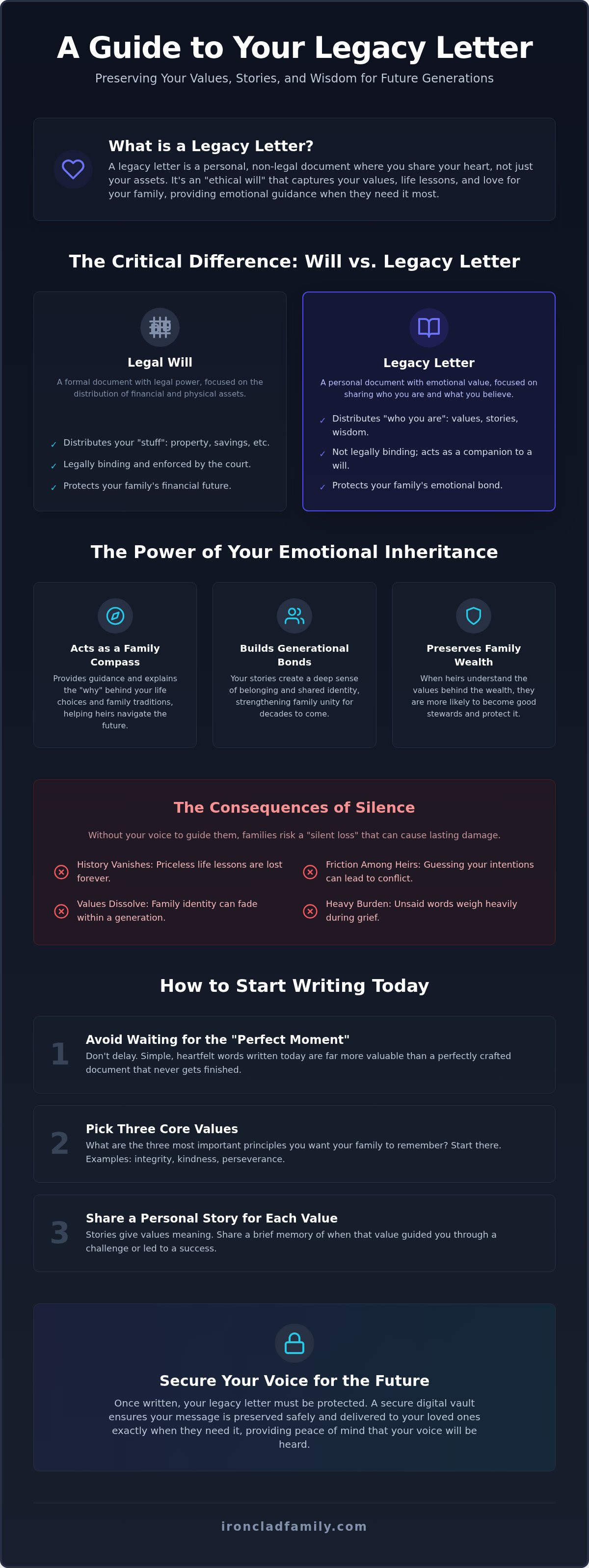
A legacy letter is a personal document designed to share your heart rather than your bank account. It's often called an ethical will, but it holds no legal power in a courtroom. Its true value is found in the living room. It's a non-legal record of your values, life lessons, and the love you hold for your family. Many families enter estate planning focused only on taxes and titles. They often end up feeling lost or grieving without a sense of direction. Writing a legacy letter fills this emotional gap. It provides the guidance that a standard legal document cannot offer. It turns a list of assets into a living narrative for your heirs.
The Difference Between a Will and a Legacy Letter
A legal will is built to distribute your "stuff." It identifies who receives the house, the car, or the savings. In contrast, a legacy letter distributes "who you are." It captures your character, your mistakes, and your greatest triumphs. You need both tools to ensure a successful generational wealth transfer. While the will protects the financial future, the letter protects the family's emotional bond. Keep in mind that this letter doesn't replace your legal documents. It acts as a companion. It adds color to the black-and-white lines of a trust or will, making the transition easier for everyone involved.
The Problem Families Face Without One
When a family leader passes away without sharing their stories, a "silent loss" occurs. Valuable history vanishes in an instant. This void often leads to friction among heirs. Family members may wonder why you made certain choices, which can lead to long-term hurt. Without your voice to act as a compass, your loved ones are left to guess your intentions. They might struggle to understand the values that built the family's foundation. The weight of unsaid words is a heavy burden during the grieving process. They don't just miss your presence; they miss the wisdom you didn't share. By writing a legacy letter today, you remove that uncertainty. You give them the gift of clarity and the peace of mind that comes from knowing exactly what you wanted them to hear. It ensures your voice remains a steady guide for generations to come.
Why Your Personal History and Values Matter
Your life experience is a treasure. It's more than just a collection of dates or old photos. It's an emotional inheritance. This is the core asset of your family. Financial assets can be spent, but your wisdom is a resource that grows the more it's shared. By writing a legacy letter, you provide your family with a compass. Values aren't just abstract ideas. They're the rules you lived by to build your life. When your children understand why you valued hard work or why you always gathered for Sunday dinner, those traditions gain a soul. They stop being chores and start being a shared identity. Your perspective provides the "why" behind everything you've built.
Building Multi-Generational Continuity
Stories create a deep sense of belonging for your grandchildren. They need to know they're part of something bigger than themselves. When they hear about your struggles and how your values pulled you through, they find strength for their own lives. This continuity maintains your family identity over many decades. It also helps preserve family wealth. Money without a mission usually disappears. When heirs understand the values behind the wealth, they're more likely to protect it. You're giving them a reason to be good stewards of what you've left behind. You're building a bridge between the past and the future.
The Consequence of Silence
Silence is a risk to your family's future. What happens when heirs receive an inheritance but don't understand the reason behind it? Without your guidance, family values can dissolve within just one or two generations. This is how family bonds break down. Many people wait for the "perfect time" to start writing a legacy letter. They wait for a special anniversary or a quiet weekend that never comes. This delay is dangerous. Life is unpredictable. Your voice is the most important tool your family has to stay connected. Protecting these stories today ensures your family remains a cohesive unit long after you're gone. Taking steps toward complete family preparedness starts with making sure your wisdom is never lost to silence. Don't let your life's greatest lessons become a mystery to those who love you most.
Common Mistakes When Writing a Legacy Letter
Even with the best intentions, the process of writing a legacy letter can go off track. One major error is treating it like a legal deposition. If you use stiff, formal language, your family won't hear your true voice. They don't need a lecture; they need your love and guidance. Another critical mistake is using this document to settle old scores or critique family members. A legacy letter should be a gift of peace, not a source of new conflict. If you include shaming or negative comments, it can poison the very memories you are trying to protect. Your goal is to strengthen bonds, not create a record of grievances that heirs will have to carry forever.
The 'Blank Page' Trap
Many people fail because they try to write their entire autobiography in one sitting. This leads to the "blank page" trap. You feel overwhelmed and decide to wait until you are older or have more time. Sincerity is always better than perfection. You don't have to be a professional writer to share your heart. If you wait for the perfect moment, you risk leaving your family with nothing but silence. Procrastination is the greatest enemy when you are writing a legacy letter. It's better to write three sentences today than to plan a book that you never actually start. Your family will value a few honest words far more than a long, polished script that lacks your personal touch.
Storage and Accessibility Failures
The most heartbreaking mistake is finishing your letter but not telling anyone where to find it. We call this the "hidden shoebox" failure. If your letter is tucked away in an attic or a basement, it might be lost in a fire, a flood, or a move. Physical papers are fragile and easily misplaced. Similarly, saving a document on a password-protected laptop doesn't help if no one else has the credentials. Your voice is only a legacy if it can be heard. Without a plan for access, your effort is wasted. You must ensure your family can find your message exactly when they need it most. A legacy that stays hidden is a story that eventually disappears. You need a solution that is both secure and accessible to those you trust.
Practical Steps for Writing a Legacy Letter Today
Starting the process of writing a legacy letter doesn't require you to be a poet. It only requires your honesty. You don't need a massive library of stories to make an impact. Follow these five steps to create a message that will stand the test of time and provide comfort to your heirs.
- Step 1: Identify your audience. Decide if this letter is for your spouse, your children, or your entire family. Knowing exactly who you're talking to makes the words flow more naturally.
- Step 2: Choose three core values. What are the non-negotiables of your life? Think of traits like integrity, resilience, or kindness that you want your family to carry forward.
- Step 3: Share one specific story. Pick a single moment when you learned a hard lesson. Describe the struggle and the outcome. This makes your values feel real and relatable for the reader.
- Step 4: Express your hopes. What do you wish for their future? Offer specific blessings or pieces of advice for the milestones they haven't reached yet, like a wedding or a first home.
- Step 5: Choose a secure storage method. A letter is only valuable if it's delivered. Ensure your words are safe from physical damage and easily accessible to your loved ones when the time comes.
Simple Prompts to Get You Started
If you're still feeling stuck, use these prompts to spark your memory. They're designed to move you past the initial anxiety of a blank page and focus your thoughts on what matters most.
- What was the hardest thing you ever did, and what did it teach you about your own strength?
- When you look at your family today, what makes you feel the most pride?
- In one sentence, how do you define a successful life?
Keeping it Simple and Sincere
You don't need complex language to make a big impact. Aim for a 6th to 8th grade reading level. This ensures your message remains clear and accessible for younger generations who may read it years from now. Use "I" statements to keep the tone personal and warm. Speak as if you're sitting in the room with them, sharing a quiet conversation. Try the "one-hour rule." Set a timer for 60 minutes and write your first draft without stopping to edit yourself. You can always polish the grammar later. The goal of writing a legacy letter is to get your heart onto the page, not to win a writing contest. Once your draft is ready, you should store family records safely in a place that guarantees they'll be found. Taking this small action today removes a great deal of uncertainty for your family's future.
Securing Your Voice: Using a Digital Vault for Legacy Messages
Writing a legacy letter is a deeply personal act of love. However, your words are only as strong as the system that protects them. If your message is lost in a computer crash or an unorganized drawer, your wisdom disappears with it. This is why a secure digital vault for families is essential. IronClad Family provides "The Vault" as a central fortress for your life's work. It stores both your legal documents and your emotional legacy in one protected space. By using zero-knowledge encryption, the system ensures that only you and your chosen heirs can ever read your private thoughts. Even the service provider cannot see the contents of your heart. This level of security transforms your digital files into a living legacy that survives for generations.
The "Legacy Messages" tool is designed to solve the problem of delivery. It acts as an automated courier for your most sensitive thoughts. You can rest easy knowing that your message will reach the right person at the right time. You don't have to worry about a physical letter being lost in a move or destroyed in a flood. Your voice is preserved in a digital sanctuary that remains unshakeable over time. It provides a definitive resolution to the anxiety of "what if they never find it?"
Why Security Matters for Your Legacy
Your private memories deserve professional-grade protection. Hackers and unauthorized eyes are a modern risk that you can't ignore. Professional encryption gives you the peace of mind that your stories won't be compromised. The "IronClad Receiver" system is a key part of this defense. It ensures that your messages are delivered only after a specific triggering event. This means your private letters remain private until they are truly needed. It's a robust, fortress-like solution that treats your digital assets with the same gravity as your physical property. You're not just storing data; you're protecting the very essence of your family's future security.
Integrating Letters into Your Estate Plan
A complete estate plan covers both assets and values. Storing your legacy letter alongside your Will and Power of Attorney creates a holistic roadmap for your heirs. Many financial advisors now use digital vault platforms to help families stay organized. This ensures that your digital inheritance includes your wisdom, not just your bank accounts. When your legal and emotional documents live in the same space, you remove the burden of search from your family. You provide them with a single source of truth during a difficult time. Writing a legacy letter and placing it in a secure vault means your family will never have to wonder about your final wishes or the stories you wanted to share. You're giving them the gift of absolute preparedness.
Secure Your Family’s Emotional Future Today
Your life's wisdom is the most valuable asset you can leave behind. By writing a legacy letter, you ensure that your values and stories continue to guide your family long after you're gone. This simple act of love fills the gap that traditional estate planning often leaves behind. It turns a collection of property into a meaningful narrative of who you are and what you stand for. You've worked hard to build a life of purpose; don't let those lessons fade into silence.
True peace of mind comes from knowing your voice is protected by a technical guardian. With zero-knowledge encryption and automated emergency delivery, your most personal messages are kept safe until the exact moment they're needed. When combined with state-specific legal tools, you create a fortress for your family's future security. You can move forward with the calm confidence that your legacy is unshakeable and your loved ones are fully prepared for whatever comes next.
Learn how to protect your family’s most important documents with a secure digital vault.
digital vault
Frequently Asked Questions
What is a legacy letter exactly?
A legacy letter is a non-legal document, also known as an ethical will, that shares your values, life lessons, and hopes with your family. Unlike a traditional will that focuses on who gets your money or property, this letter focuses on who you are. It acts as an emotional bridge between generations. By sharing your personal history, you provide your heirs with a moral compass and a deeper understanding of their family heritage.
How long should a legacy letter be?
There is no required length for a legacy letter. Some people write a single page, while others create a longer document. The goal is sincerity rather than volume. If you can express your core values and love in a few paragraphs, that is perfectly fine. Your family will value the honesty of your words more than the page count. Focus on being clear and heartfelt rather than trying to fill space with unnecessary details.
Is a legacy letter legally binding like a will?
No, a legacy letter is not a legally binding document. It cannot be used to distribute financial assets or name legal guardians. You should use a state-specific Last Will and Testament for those legal tasks. While the legacy letter carries great emotional weight, its purpose is to provide guidance and wisdom. It works best as a companion to your legal estate plan, filling the emotional gaps that legal paperwork often leaves behind.
When is the best time to start writing a legacy letter?
The best time to start writing a legacy letter is right now. Many people wait for a major life event or a quiet moment that never arrives. Life is unpredictable, and your wisdom is too valuable to risk losing to silence. You don't need to finish it in one day. Starting a draft today ensures that your voice is preserved, providing immediate peace of mind for you and a lasting gift for your children.
Where is the safest place to store a legacy letter?
The safest place to store your letter is in a secure digital vault. Physical papers can be lost in fires, floods, or simply misplaced over time. A digital solution like The Vault uses zero-knowledge encryption to keep your thoughts private. This ensures that your sensitive messages are protected from hackers and are only accessible to the people you choose. It provides a permanent, unshakeable home for your family's most important memories.
What should I do if I am not a good writer?
You don't need to be a professional author to create a meaningful message. Your family wants to hear your voice, not a polished script. Use simple language and speak as if you are having a conversation in your living room. You can use prompts to get started, such as sharing your proudest moment or a hard lesson you learned. Sincerity is far more important than perfect grammar or a sophisticated vocabulary.
Can I write multiple legacy letters for different people?
Yes, writing individual letters for different family members is a powerful way to personalize your legacy. You might have specific advice for a grandchild that is different from what you want to say to your spouse. Personalized messages allow you to address the unique bond you share with each person. This approach creates a stronger emotional connection and ensures that everyone in your family feels seen and valued by your words.
How does a digital vault help with legacy letters?
A digital vault provides two main benefits: high-level security and guaranteed delivery. Tools like Legacy Messages allow you to schedule your letters to be released to your heirs at the right time. This removes the risk of your letter being found too early or never found at all. By writing a legacy letter and storing it in a vault, you use technology to guard your family's emotional future with absolute certainty and care.
