


- 12 mins
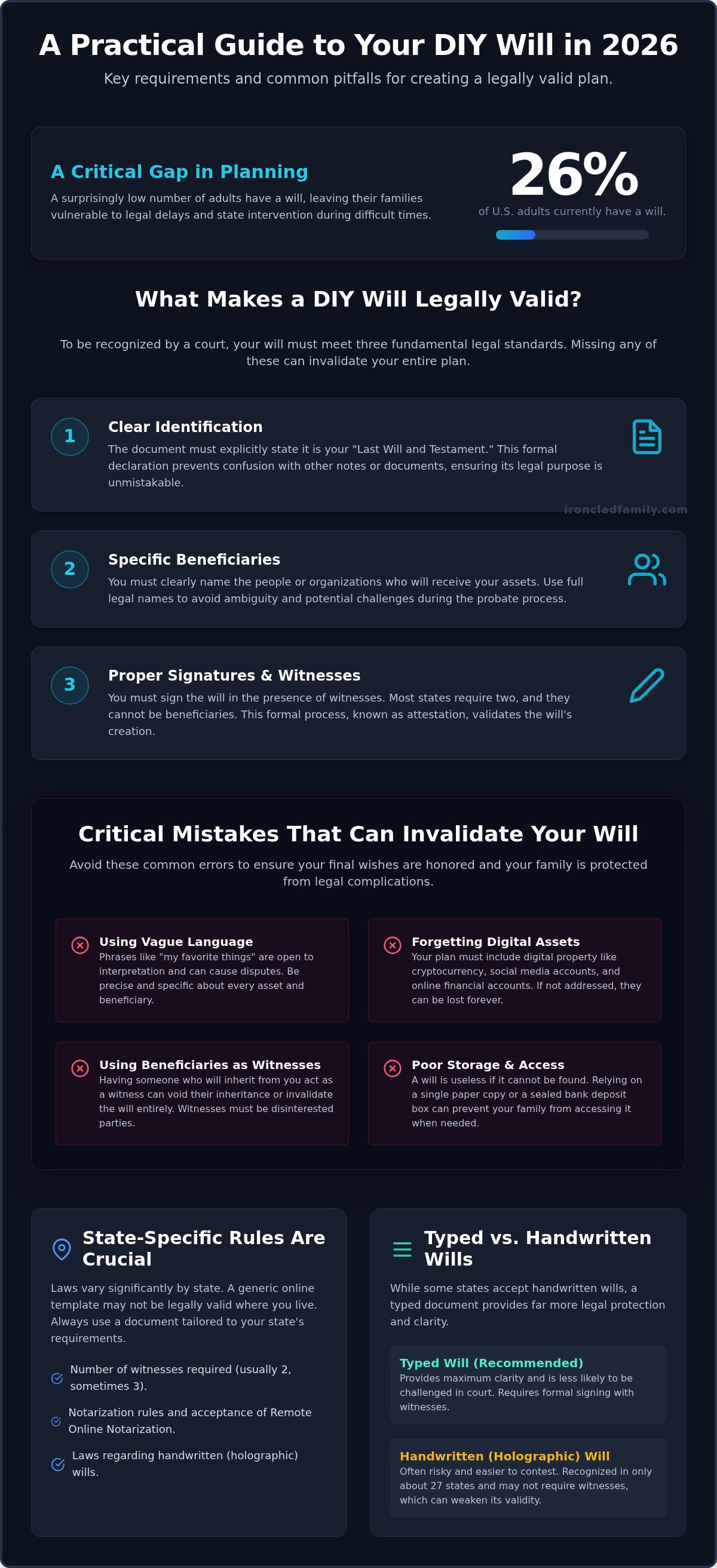
Only 26% of adults in the United States currently have a will, a number that has dropped significantly even as our lives become more complex. You likely feel the weight of this responsibility but hesitate because of high legal fees or the fear of making a technical error. Creating a do it yourself will is a practical way to reclaim control over your future without the stress of a traditional law office. It is about more than just paperwork; it is about ensuring your life's work reaches the people you love most.
It is natural to worry that a document you write yourself might not hold up in court or, worse, that your family won't be able to find it during a crisis. This guide shows you how to build a legally valid plan that protects your assets and provides your family with absolute clarity. We will walk through the specific legal requirements for 2026, common pitfalls to avoid, and the essential steps to secure your legacy so it is never lost or forgotten.
Key Takeaways
- Learn the exact signature and witnessing rules needed to make sure your do it yourself will is legally binding in 2026.
- Identify the common mistakes that can ruin a plan, such as using vague language or forgetting about digital assets like crypto and social media.
- Discover how to choose a trusted executor who has the tools and information they need to carry out your final wishes.
- Understand why a document is only useful if it's found, and learn the best ways to store and share your plan with your family.
Why a Do It Yourself Will Is More Than Just a Paper Document
Imagine spending hours documenting your final wishes only for that paper to be lost in a move or destroyed in a basement flood. In 2026, we are seeing a major shift toward digital-first estate planning because physical documents are simply too fragile. A do it yourself will is more than just words on a page; it is a promise of protection for the people you love. If your family cannot find your plan when they need it most, the state takes over. This often leads to long probate delays and deep family stress during an already painful time.
- DIY wills are legally recognized in every state as long as you follow specific signing and witnessing rules.
- Where you store your document is just as critical as what you write inside it.
- Simple, practical steps can prevent the technical mistakes that often lead to a will being challenged in court.
The Hidden Risks of Traditional Paper Wills
Relying on a single physical copy of your will is a gamble you don't need to take. Fires, floods, or even simple misplacement can erase your legacy in seconds. Many people think a safe deposit box is the best answer, but this often creates a "trap" for your heirs. Banks frequently seal these boxes immediately after a death. This means the very people who need your will can't get to it without a court order. This lack of access is a primary cause of legal battles. Understanding the history and legal basis of wills helps us see why modern, secure access is so vital for 2026.
Defining Your Legacy in Simple Terms
You don't need to be a millionaire to require a plan. If you have children, a home, or even sentimental digital photos, you have a legacy that deserves a shield. Moving from a state of uncertainty to a feeling of absolute preparedness is a powerful emotional shift. It replaces the "what if" with "I'm ready." A do it yourself will is a legal roadmap that tells the world exactly how to handle your assets and who should care for your family. It's a way to speak for yourself when you are no longer there to do so, ensuring your life's work is handled with the respect it deserves.
What Makes a DIY Will Legally Valid in 2026?
A do it yourself will is a legally binding document that outlines your final wishes, but it only works if it meets specific legal tests. To start, you must be at least 18 years old and of "sound mind." This means you understand what you own, who your family members are, and the effect of the document you are signing. In 2026, the definition of a legally valid will has expanded in many areas to include digital formats, but the core principles remain the same.
You might wonder if you can just write your wishes by hand. While about 27 states recognize holographic, or handwritten, wills, these are often risky. They are easier to challenge in court because they lack the formal structure of a typed document. Most people choose a typed do it yourself will because it provides more clarity. Modern technology has also made legalizing these documents easier. Remote Online Notarization (RON) now allows you to have your will notarized via a secure video session, which is just as valid as meeting a notary in person in many jurisdictions.
The Three Core Requirements for Every Will
Every will must satisfy three basic elements to be considered legitimate by a probate court:
- Clear Identification: The document must explicitly state that it is your Last Will and Testament. This prevents any confusion with other letters or notes you might leave behind.
- Specific Beneficiaries: You must clearly name the individuals or organizations that will receive your assets. Using full legal names helps avoid identity confusion during the probate process.
- Proper Signatures: You must sign the document in the presence of at least two witnesses. These witnesses generally cannot be people who are set to inherit anything from you.
State-Specific Rules You Must Follow
Laws vary significantly from one state to another. A generic template you find online might work in one place but fail in another because it doesn't follow local rules for witnessing or notarization. For example, some states require three witnesses, while others only require two. Some states have recently updated their laws to allow for electronic storage, such as the changes in North Carolina that took effect on January 1, 2026. If your document doesn't match your state's specific requirements, a judge could throw it out entirely.
To avoid these technical traps, IronClad Family provides state-specific documents that are designed to meet the exact legal standards of your home state. This ensures your plan is robust and ready for the probate process. Once your document is ready, you can use a secure digital vault to store a copy, making it accessible to your family the moment it is needed.
How to Create Your Own Will Without a Lawyer
- Step 1: Gather your assets. Make a list of everything you own. This includes bank accounts, real estate, and digital credentials like cryptocurrency; for those with alternative physical investments, check out Whiskey & Wealth Club to ensure they are properly documented.
- Step 2: Pick an executor. This person will be the project manager for your estate. They will handle the paperwork and ensure your assets go to the right people.
- Step 3: Name guardians. If you have minor children or pets, decide who will provide their daily care. This is often the most emotional part of the process.
- Step 4: Draft the document. Use a state-specific template that accounts for the latest 2026 legal requirements. This ensures your wishes are written in a way the court understands.
- Step 5: Make it official. Sign your document in front of witnesses and a notary. This final act of execution transforms your draft into a legally binding shield for your family.
Choosing the Right People for Key Roles
Your executor should be someone who is both organized and trustworthy. They don't need to be a financial expert, but they must be able to handle deadlines and communicate clearly with your heirs. It's vital to name "backups" for every role. Life is unpredictable, and your first choice might not be available when the time comes. A backup is your safety net. Once you've made your choices, discuss these roles with your family. Hearing your wishes directly from you prevents confusion and resentment later.
Adding Heart to Your Legal Plan
A standard legal form often misses the personal touch that truly comforts a family. While a do it yourself will handles the "what" of your estate, Legacy Messages handle the "why." These are personal notes, videos, or instructions that explain the stories behind your choices or offer final words of love. A legacy is the essence of a life, not just a bank balance. Including these personal elements ensures your family feels your presence and guidance even after you are gone. It turns a cold legal document into a living part of your family's history.
Common Mistakes That Can Ruin a DIY Will
Even the best intentions can fail if the execution is flawed. A do it yourself will is a sturdy tool, but it requires precision to stand up in court. One of the most heartbreaking errors is the "Secret Will" problem. You might spend hours creating a perfect plan, only to hide the document so well that no one can find it during a crisis. If the original signed document stays hidden, the court may treat your estate as if you never had a plan at all. This leads to the exact family stress and legal delays you were trying to avoid.
Another risk is failing to keep your document current. A will written ten years ago may list assets you no longer own or name people who are no longer part of your life. In 2026, the speed of change in our personal and financial lives is faster than ever. If you have experienced a birth, a death, a marriage, or a divorce, your do it yourself will needs an immediate review. An outdated plan is often worse than no plan at all because it creates confusion and opens the door for legal challenges.
The Danger of Vague Beneficiary Designations
Clarity is your family's best friend. Avoid using general phrases like "I want my kids to have everything." While this sounds simple, it can lead to expensive court battles. Does "kids" include step-children? Does it include children you might have in the future? Use full legal names for every person you mention. It is also helpful to understand "per stirpes." This is a legal term that simply means if one of your children passes away before you, their share of the inheritance will go to their own children. Using specific percentages instead of general piles of assets ensures that everyone knows exactly what you intended.
Ignoring Digital Inheritance
Your legacy is no longer just about physical property or bank accounts. In 2026, your digital life is a massive part of who you are. This includes your social media profiles, thousands of family photos stored in the cloud, and cryptocurrency. Many people forget to name a digital executor to handle these items. Without specific instructions, privacy laws like RUFADAA can lock your family out of your digital life forever. Proper planning for generational wealth transfer must include clear permissions for your loved ones to access these digital assets. You can ensure your family has the keys to your digital world by setting up Emergency Access Credentials today.
Beyond the Document: Securing and Delivering Your Legacy
Completing your do it yourself will is a significant milestone, but it is only the first half of the journey. A document that remains hidden or inaccessible during a crisis is effectively invisible. To truly protect your family, you need a system that bridges the gap between your intentions and their reality. This is where the concept of a "Digital Vault" becomes essential. It acts as a sacred repository for your life's work, ensuring that your legacy is not just written, but delivered.
How The Vault Protects Your Family
Organizing your critical documents in one place allows your loved ones to act with confidence when every second counts. Using secure digital vaults for estate planning prevents the common tragedy of lost or destroyed paperwork. IronClad Family provides a specialized "IronClad Receiver" system. This tool monitors for your well-being and automatically delivers your documents to your beneficiaries if you are no longer able to act. It removes the burden of "searching" from your family during their time of grief.
Security is the foundation of this protection. We use zero-knowledge encryption to ensure that your private information stays private. In simple terms, this means that even the people running the service cannot see your files; only you and the people you choose have the keys to unlock them. This level of cryptographic safety provides the peace of mind that your family's future is shielded from digital vulnerabilities.
Final Steps for Absolute Preparedness
Legacy planning isn't a one-time event; it's a living process. You should review your plan at least once a year or whenever you experience a major life event like a move or a new addition to the family. It's also vital to ensure your executor knows how to access the system. An emergency wallet card is a practical tool that gives them the credentials they need without compromising your daily privacy. Knowing how to store a will online securely is the final piece of the puzzle.
A do it yourself will is a powerful start, but a secure delivery system is the final seal on your legacy. By combining a legally valid document with a robust digital vault, you move from simple planning to total preparedness. You aren't just leaving behind assets; you are leaving behind a clear, accessible roadmap that guides your family with love and authority for generations to come.
Take the Final Step Toward Total Peace of Mind
Creating a do it yourself will is a powerful way to protect your family's future. You now know that a legal document needs more than just your signature; it requires state-specific compliance and a clear plan for your digital assets. Most importantly, you understand that a will only works if your loved ones can find it when they need it most. By following the steps in this guide, you have moved from a state of uncertainty to a position of strength.
Protecting your legacy requires a system that is as reliable as it is secure. By using state-specific legal tools and zero-knowledge encryption, you can ensure your private information remains a secure, living legacy. IronClad Family provides the final seal of protection with automated emergency delivery, making sure your wishes reach your beneficiaries exactly when they are needed. This ensures your life's work is never lost or forgotten.
Secure your legacy today with an IronClad Family Digital Vault.
You have the tools to move from uncertainty to absolute preparedness. Start building your family's fortress today and rest easy knowing your loved ones are protected.
Frequently Asked Questions
Is a do it yourself will actually legal in my state?
A do it yourself will is legally valid in every state as long as it follows that state's specific rules for signing and witnessing. While the core concept is universal, the details matter. For example, some states require two witnesses while others might have different rules for electronic documents. Using a state-specific template ensures your document meets the current 2026 legal standards of your home state.
Do I need a notary for a DIY will to be valid?
You don't technically need a notary to make a will legal, but having one is highly recommended. A notary's seal allows for a "self-proving affidavit," which speeds up the probate process by proving the signatures are authentic. In 2026, many states allow Remote Online Notarization. This lets you legalize your document through a secure video call from your home, making the process much easier.
Can I change my DIY will after it is signed?
You can change your will at any time as long as you are of sound mind. To make changes, you can either create a "codicil," which is a legal amendment, or draft an entirely new document that replaces the old one. It is often cleaner to write a new document to avoid any confusion between multiple versions. Always ensure the new version is properly signed and witnessed.
What happens if my family cannot find my will?
If your family cannot find your will, the state's "intestacy" laws take over. This means a judge decides who gets your assets based on a standard legal formula, regardless of what you might have wanted. This often leads to long delays, higher costs, and potential family arguments. Storing your document in a secure, accessible location is just as important as writing the document itself.
Do I need a lawyer if I have a small estate?
You generally don't need a lawyer if your estate is straightforward and you don't have complex tax issues. For many families, a well-drafted do it yourself will is enough to handle the distribution of a home, bank accounts, and personal belongings. If you have millions in assets or complicated business interests, a lawyer might provide extra protection, but for standard needs, DIY tools are effective.
How is a DIY will different from a living trust?
A will tells the court how to distribute your assets after you pass away, which usually involves a process called probate. A living trust, however, takes effect while you are alive and allows your assets to bypass probate entirely. While trusts can be more complex to set up, they offer more privacy and faster access for your heirs. Many people start with a will because it is simpler.
Can I include my digital assets and passwords in a DIY will?
You can include digital assets in your will, but you must name a "digital executor" to handle them. Since passwords change frequently, it is better to list the assets in the will and store the actual login credentials in a secure digital vault. This ensures your family can access your photos, social media, and cryptocurrency without the will becoming outdated every time you change a password.
Where is the safest place to store my will so my family can find it?
The safest place is a secure digital repository that your family can access in an emergency. Avoid hiding your will in a safe deposit box, as banks often seal these upon death. Instead, use a system that offers automated delivery to your beneficiaries. This ensures the right people get the document exactly when they need it, without having to search through old files.

