
- 14 mins
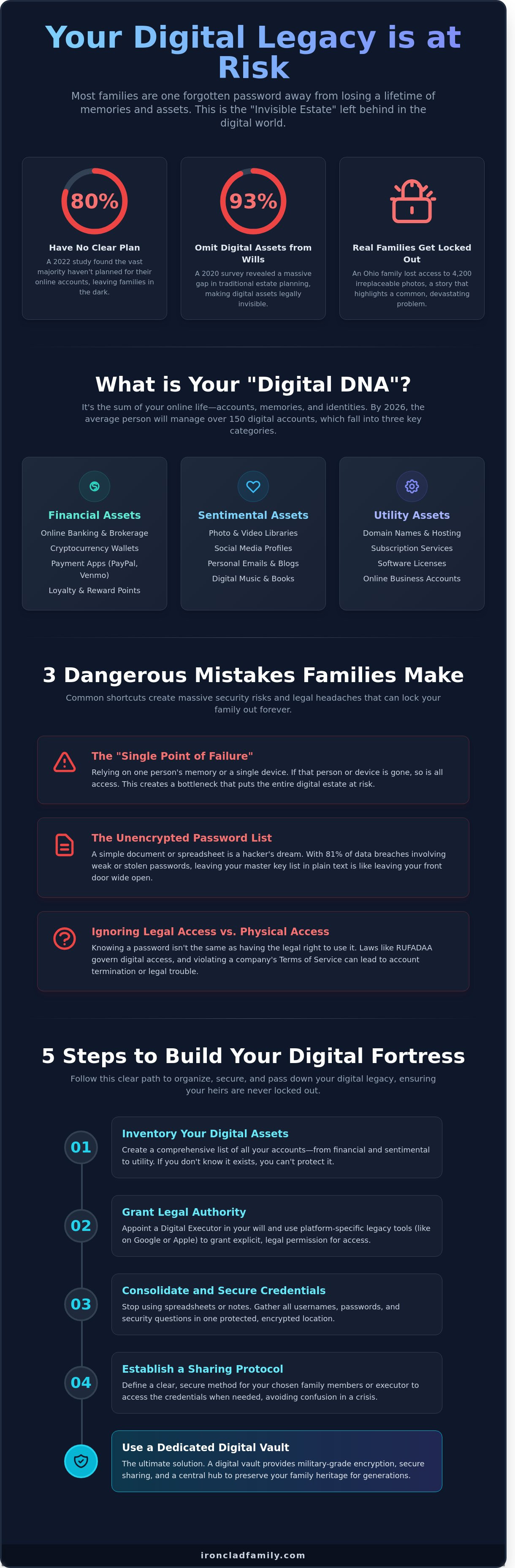
On October 12, 2023, a family in Ohio lost access to 4,200 irreplaceable digital photos because they didn't have one master password. This happens more than you think. A 2022 study by the Digital Legacy Association found that 80% of people haven't made a clear plan for their online accounts. Implementing digital asset management for families is the only way to ensure your digital DNA doesn't vanish into the void of a locked server.
You likely feel the anxiety of managing 50 or more different logins and subscriptions. It's a heavy burden to carry alone. You want to know your family is safe and that your life's work is accessible when it matters most. This article teaches you how to organize, secure, and pass down your legacy so your heirs are never locked out of your digital world. We'll look at the common traps families fall into and provide a clear path to building your own digital fortress.
Key Takeaways
- Understand why your "Digital DNA" is a valuable invisible estate that often gets left out of traditional wills and estate plans.
- Learn the legal difference between simply knowing a password and having the actual authority to access a loved one's accounts.
- Avoid dangerous mistakes like the "single point of failure" that can leave your family locked out of your life's work forever.
- Master the five essential steps for digital asset management for families to inventory and secure your most important credentials.
- Discover how a dedicated digital vault provides the military-grade protection needed to preserve your family heritage for future generations.
The Hidden Risk: What Is Your Family’s Digital DNA?
Your legacy is no longer just a collection of paper deeds and physical photo albums. It is your Digital DNA. This is the total sum of your online accounts, digital memories, and legal identities. Every time you open a bank account online or upload a photo to the cloud, you add a new strand to this DNA. Effective digital asset management for families begins with recognizing that these bits and bytes are just as valuable as the jewelry in a safe deposit box.
Most people leave behind what we call an "Invisible Estate." A 2020 survey by the Law Society found that 93% of people had not included any digital assets in their will. This creates a massive gap in traditional estate planning. If your family doesn't know an account exists, they can't protect it or inherit it. The concept of Digital inheritance is no longer a futuristic idea; it's a modern necessity for every household. Without a plan, your family faces a digital lockout that can last for years.
Big Tech companies don't make it easy to say goodbye. While Apple and Google have introduced legacy contact features, they are often buried in complex settings. If these aren't set up before a crisis, your loved ones may need a court order just to see your photos. This process is slow, expensive, and often ends in failure. Some people try to solve this by leaving a list of passwords on a piece of paper or in a basic document. This isn't a solution; it's a security risk. A 2023 report showed that 81% of data breaches involve weak or stolen passwords. Leaving your "keys to the kingdom" in an unencrypted format invites hackers to steal your family's future before they can even claim it.
What counts as a digital asset in 2026?
By 2026, the average person will manage over 150 digital accounts. These fall into three main categories. Financial assets include cryptocurrency wallets, online banking, and loyalty points that hold real cash value. Sentimental assets are your photo libraries, social media profiles, and personal blogs. Utility assets include domain names, web hosting, and active subscription services. Each one requires a specific key to unlock, and without digital asset management for families, these keys are often lost forever.
The cost of being unprepared
The price of silence is high. Families lose billions of dollars every year in unclaimed rewards, forgotten bank accounts, and lost investments. Beyond the money, the emotional toll of losing access to a decade of family history is devastating. Digital probate is the legal process of gaining access to a deceased person’s accounts. It is often a nightmare of red tape and legal fees. Taking action now ensures that your "Wise Protector" status remains intact, even when you aren't there to hold the keys yourself.
Why Family Digital Asset Management Is a Legal Necessity
Your traditional will is a powerful document, but it's often silent about your digital life. Most people assume that leaving a list of passwords on a piece of paper is enough to protect their heritage. It isn't. The legal landscape changed in 2015 when the Revised Uniform Fiduciary Access to Digital Assets Act (RUFADAA) was introduced. As of 2024, 48 U.S. states have adopted a version of this law. It dictates who can legally step into your digital shoes. Without proactive digital asset management for families, your loved ones might be locked out of your accounts forever, regardless of what your will says.
Digital assets aren't like physical property. When you die, your house stays where it is, but your data is governed by complex contracts. If your executor tries to access your accounts without specific legal authority, they could face significant hurdles. They might even be accused of violating federal privacy laws. Proper management ensures your executors have the legal "keys to the kingdom" without risking personal liability or legal pushback from tech giants.
Legal access vs. physical access
Knowing a PIN or a pattern lock doesn't make someone a legal digital heir. There's a massive gap between having the physical ability to open a phone and having the legal right to manage the data inside. Most tech companies operate under strict Terms of Service (TOS) agreements that treat unauthorized access as a security breach. If a family member logs into your account after you're gone, the provider might view it as a violation of the Computer Fraud and Abuse Act.
This legal friction often leads to heartbreaking results. Families frequently find themselves in court fighting for the fate of social media assets and sentimental photos because the user didn't grant explicit permission through the platform or a legal document. A dedicated management system bridges this gap. It provides the documented consent required by RUFADAA, turning a potential legal battle into a smooth transition of your digital inheritance.
The role of the Digital Executor
Choosing a digital executor is one of the most important decisions you'll make for your estate. This person isn't just a tech support contact; they're the guardian of your digital DNA. They need the authority to handle everything from closing subscription accounts to preserving family photos. You must leave specific, written instructions for every class of asset, from cryptocurrency to cloud storage. This prevents your legacy from becoming a scattered mess of "404 Not Found" pages.
This is why digital asset management for families must be integrated into your broader estate plan. You don't want your family guessing which accounts are important or where the private keys are hidden. Ensuring your family preparedness service includes clearly defined digital rights is the only way to guarantee your wishes are followed. It's about moving from a state of uncertainty to a feeling of absolute preparedness.
If you're ready to secure your heritage, you can start building your digital vault today to ensure your family is never left behind. Protecting these assets now prevents a legal nightmare for your children later, keeping your life's work safe and accessible for the next generation.
3 Dangerous Mistakes Families Make With Digital Assets
Protecting your family’s future requires more than just a traditional will. It involves securing the digital DNA of your life. Many households assume their information is safe because it's stored on a hard drive or written in a hidden notebook. This logic creates a fragile foundation for your legacy. Effective digital asset management for families demands a shift from casual storage to a fortified defense strategy. Avoiding these three common pitfalls will ensure your loved ones aren't left locked out of their own heritage.
The first mistake is the "Sticky Note" problem. Relying on physical lists or paper notebooks is a major security risk. These items are easily lost during a move, destroyed in a house fire, or stolen during a burglary. A 2022 report from the Identity Theft Resource Center highlighted that physical theft of records remains a primary driver for identity fraud. Paper has no backup and no encryption. If the notebook disappears, the keys to your life disappear with it.
The second mistake is the "Single Point of Failure" trap. In most homes, one person manages the logins, financial portals, and cloud subscriptions. This creates a bottleneck. If that individual becomes incapacitated, the rest of the family loses access to essential services. This leaves grieving relatives in a state of panic, forced to guess passwords while dealing with emotional loss. True security means sharing access without compromising the integrity of the data.
Relying on generic cloud storage
Many people mistakenly believe that Google Drive or Dropbox are permanent backups for an estate. These platforms are built for productivity, not for the transfer of a digital legacy. They lack automated trigger mechanisms for emergency access. If you don't log in, the provider might eventually wipe your data. In December 2023, Google updated its policy to state that accounts inactive for two years may have all content deleted. This makes generic storage a dangerous place for long term digital asset management for families. Without specialized tools, your photos and documents could vanish before your heirs can claim them.
The "Everything is in my head" mentality
Keeping passwords and account locations in your memory is a recipe for permanent data loss. This mentality places an immense burden on your survivors. They must contact dozens of companies, provide death certificates, and wait months for access that might never come. Statistics show that 90% of families have no formal plan for digital inheritance. This lack of organization often leads to the loss of sentimental photos and valuable financial accounts. When you don't document your digital footprint, you leave behind a chaotic puzzle instead of a clear path forward.
Finally, families often ignore the need for zero-knowledge encryption. They trust big tech companies to keep their data private, but those companies often hold the keys to that data. If a provider is hacked, your most sensitive documents are exposed. Zero-knowledge encryption ensures that only you and your chosen beneficiaries can see the content. It removes the service provider from the equation entirely. This military-grade protection is the only way to guarantee that your digital inheritance remains a private family matter.
5 Steps to Organize Your Family’s Digital Legacy
Building a digital legacy is more than just saving files. It is about ensuring your life’s work and your family's history remain accessible when they are needed most. Without a clear plan, your digital assets could be lost forever in a sea of encrypted accounts and forgotten passwords. A 2023 study by NordPass found that the average person manages roughly 100 passwords. Expecting your loved ones to guess these credentials during a time of grief is an avoidable burden. Effective digital asset management for families transforms this chaos into a structured, secure heritage.
- Step 1: Conduct a Digital Inventory. List every account you own. This includes financial accounts, social media, cloud storage, and subscription services. Don't forget physical hardware like external hard drives or old laptops that contain family photos.
- Step 2: Secure credentials in a digital vault. Once you have your list, move your logins and private keys into a secure environment. Using a zero-knowledge vault like IronClad Family ensures that only you and your designated receivers can view the data.
- Step 3: Update your legal documents. Ensure your will or living trust includes specific digital asset clauses. As of 2024, 46 states have passed some version of the Revised Uniform Fiduciary Access to Digital Assets Act (RUFADAA). This law gives your executor the legal right to manage your digital life, but only if you provide explicit consent in your legal papers.
- Step 4: Record legacy messages. Data provides facts, but messages provide context. Record short videos or write notes to explain the "why" behind certain files. This adds emotional value to the technical data you leave behind.
- Step 5: Test your emergency access plan. A plan is only as good as its execution. Run a "fire drill" with your chosen receivers to ensure they know how to access the vault when the time comes.
Inventorying your digital DNA
Your digital DNA consists of everything you have created or own online. Start by categorizing these assets by their value. Financial assets like bank accounts or stock portfolios require immediate access for probate. Sentimental assets, such as 20 years of family photos, require long-term preservation. You must also identify "hidden" assets. This includes digital wallets or private keys for cryptocurrency. If these keys are lost, the assets are gone forever. Use a simple spreadsheet or a dedicated mapping tool to track where these items live before moving them into a secure vault.
Designating your digital heirs
Choosing who receives your information is a deeply personal decision. Effective digital asset management for families allows you to assign specific folders to specific people. You might want your spouse to have the "Financial" folder while your children receive the "Family Memories" collection. Setting up IronClad Receivers allows for the automated delivery of these assets based on specific triggers you define. It's vital to talk to your family about this plan. They don't need to know every password today, but they must know that a protective system is in place and how they will eventually gain entry.
Securing Your Future With a Digital Vault
A digital vault is much more than a simple folder on your computer. While a password manager keeps track of your login credentials, a vault stores the actual substance of your life. Think of it as the difference between a key ring and a heavy-duty safe. One gets you through the door, while the other protects the treasures inside. For many people, digital asset management for families starts with this realization: your most sensitive files need a home that's built for long-term survival, not just daily convenience.
Your vault should act as a central repository for your "digital DNA," including:
- Legal documents like wills, trusts, and power of attorney forms.
- Financial records, insurance policies, and tax returns.
- Personal family history, private messages, and cherished photos.
Privacy is the foundation of this protection. Zero-knowledge encryption ensures that you're the only person who holds the keys to your data. Not even the service provider can see your documents. This level of security is vital because it removes the risk of a central data breach exposing your family's history. It's about maintaining absolute control. When you use a vault, you aren't just storing files; you're building a fortress around your family's future.
How the IronClad Vault protects you
IronClad Family acts as your Digital Guardian by using AES-256 bit encryption. This is the same standard used by military organizations to protect top-secret data. This system doesn't just sit idle. It uses automated delivery protocols to ensure your information reaches the right people when it's needed most. You can set specific triggers so that your spouse or children receive access to vital documents only at a predetermined time. It's a proactive way to protect your family’s most important documents without the stress of manual handovers.
The power of legacy messages
Effective digital asset management for families involves more than just numbers and legal titles. It requires a human touch. Legacy messages allow you to explain the "why" behind your instructions. Perhaps you want to tell your children why a specific piece of land has been in the family for 50 years, or explain the purpose of a specific trust fund. These messages bridge the gap between cold financial data and your actual intentions. They ensure your heritage isn't lost in translation, providing a clear voice for the next generation to follow.
Organization brings a unique kind of peace. When your digital life is scattered across old hard drives and various cloud accounts, there's a constant, low-level anxiety about what might happen if you aren't there to manage it. Centralizing everything into a secure vault replaces that worry with calm confidence. You know that your life's work is safe. You know your family won't have to struggle with locked accounts or missing paperwork. This preparation is the ultimate gift of security, allowing you to live your life fully today because you've already taken care of tomorrow.
Take Control of Your Digital Legacy
Your digital DNA represents the keys to your life. It's too precious to leave unprotected. By establishing a system for digital asset management for families, you bridge the gap between your physical estate and your online existence. You've learned that 3 simple mistakes can block heirs from 100% of your assets. You now have 5 steps to move from chaos to organization. This is about your family's future security.
IronClad Family acts as your digital guardian. Our platform uses zero-knowledge encryption; this means 0 people outside of you and your receivers can view your vault. We built an automated delivery system that triggers during emergencies, ensuring your loved ones aren't left guessing. With legal document integration for all 50 states, your plan stays robust. You've built a life. Now, protect it with a fortress that never sleeps.
You can rest easy knowing your legacy is safe and your family is prepared for whatever comes next.
Frequently Asked Questions
What is the difference between a password manager and a digital vault?
A password manager stores your login credentials while a digital vault secures the actual assets and documents themselves. Think of a password manager as the key ring and a digital vault as the armored safe. While 64 percent of people used some form of password saving in 2023, a vault goes further by protecting your deeds, birth certificates, and family photos. It provides a permanent, encrypted home for your digital DNA.
Is digital asset management for families legally binding?
Digital asset management for families acts as a vital roadmap for your estate, but it works best when paired with a formal will or trust. Since 2015, 46 U.S. states have adopted specific laws that recognize the transfer of digital property to heirs. Your vault ensures your loved ones have the keys to your life so they don't have to fight tech companies in court during the probate process.
How do I choose a digital executor for my family?
You should choose a digital executor who is both tech-savvy and consistently organized. This person will be responsible for managing your online presence and distributing your digital assets after you pass away. A 2022 survey found that 75 percent of executors feel overwhelmed by digital tasks. Pick someone who understands how to navigate two-factor authentication and who you trust to handle your most private memories with care.
What happens to my digital assets if I don’t have a plan?
Your digital assets often become permanently locked or deleted if you pass away without a clear plan. Major platforms have strict terms of service that usually prevent family members from gaining access to accounts. Statistics from 2021 show that billions of dollars in digital value are lost annually because heirs cannot bypass encryption or find account details. Without a vault, your family may face years of legal hurdles just to recover a single photo.
Can I store my crypto keys in a family digital vault?
You can and should store your private crypto keys and seed phrases in a secure family vault. Losing a private key means losing the entire investment; for example, an estimated 20 percent of all Bitcoin is currently lost in inaccessible wallets. By placing these keys in a zero-knowledge environment, you ensure your family can inherit your digital wealth without exposing the keys to hackers or the vault provider itself.
How does zero-knowledge encryption protect my family’s privacy?
Zero-knowledge encryption ensures that only you and your designated heirs hold the keys to your data. The service provider has zero visibility into your files; they store your data but can never read it. This military-grade protection means that even if a data breach occurs at the server level, your family's personal documents remain unreadable. It is the highest standard for protecting your digital legacy from prying eyes.
Is it hard to set up a digital asset management system for my family?
Setting up a digital asset management system for my family takes less than 30 minutes to begin. You start by identifying your most critical digital DNA, such as primary email accounts, financial logins, and precious photos. Most families find that once the foundation is built, they only need to spend 15 minutes every few months updating their records. It is a small investment of time that provides a lifetime of security and peace of mind.
What is RUFADAA and why should I care about it?
RUFADAA stands for the Revised Uniform Fiduciary Access to Digital Assets Act, which was updated in 2015. This law gives your executor the legal authority to manage your digital property if you have given explicit consent in your estate plans. Without mentioning your wishes in a digital vault or will, RUFADAA defaults to the strict privacy policies of tech companies. Understanding this law ensures your family has the legal right to access your digital heritage.