
- 14 mins
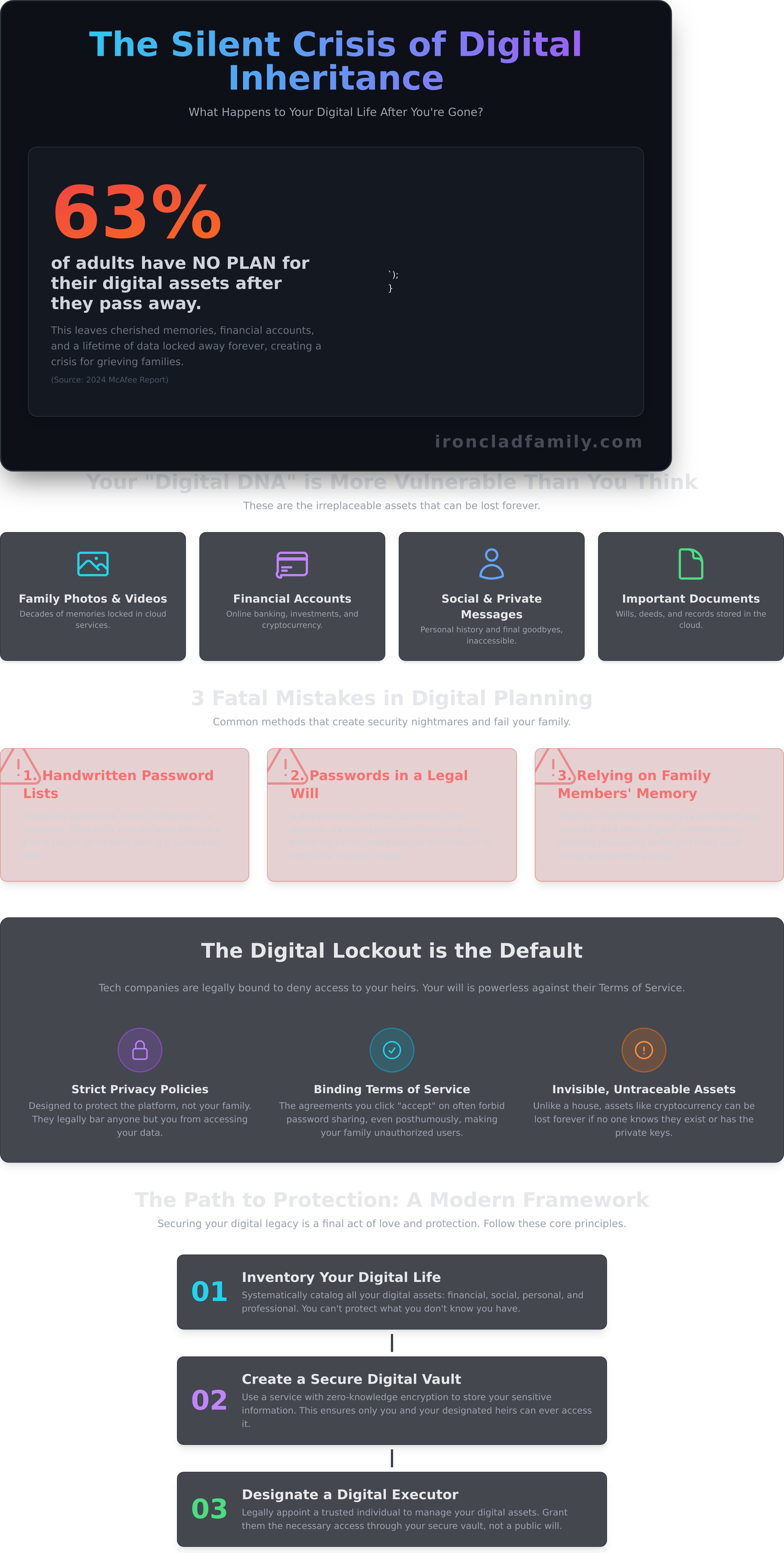
A 2024 McAfee report revealed a startling truth: 63% of adults have no plan for their digital assets after they pass away. It's a chilling thought. Your family's most cherished memories, from first steps to final goodbyes, could be locked forever behind a password you alone knew. The anxiety over your financial accounts and private messages falling into the wrong hands is a heavy burden, one that traditional estate planning simply wasn't built to carry.
This guide provides the fortress you need. We will give you a clear, actionable strategy for digital inheritance planning that secures your digital DNA, protects your loved ones from identity theft, and ensures your legacy is passed on, not locked away. You'll discover the legal framework for your assets, the tools to create a secure digital vault, and the exact steps to grant your family the keys to your life, safely and securely.
Key Takeaways
- Understand why your "Digital DNA"—from online banking to family photos—is often more vulnerable than physical assets and can be lost forever.
- Discover the fatal security flaws in common methods like handwritten password lists and including sensitive credentials in a legal will.
- Follow a clear framework for effective digital inheritance planning, starting with a complete inventory of your online life.
- Learn how zero-knowledge encryption creates a truly private digital vault, ensuring only your designated heirs can ever access your legacy.
The Silent Crisis: What Happens to Your Digital Life After You Are Gone?
Your life is online. Your memories, your assets, your professional identity—it all exists as a complex tapestry of data. But what happens to the keys to this life when you are no longer here to hold them? Without a clear strategy, your digital world is sealed shut, leaving your loved ones locked out from your most precious assets and memories. This is the silent crisis of the modern age.
The solution is a fortress built with foresight. This process, formally known as digital inheritance planning, is the essential practice of organizing, securing, and designating who can access and manage your digital assets after your death. It’s more than a list of passwords; it’s a definitive act of protection for your family. For a deeper dive into the legal and technical challenges, Wikipedia offers a comprehensive overview of What is Digital Inheritance?, explaining the obstacles families face.
Key Takeaways
- The Digital Lockout is the Default: Without a plan, tech companies' privacy policies will automatically bar your family from accessing your accounts, memories, and assets.
- Terms of Service Aren't on Your Side: The agreements you click "accept" on are designed to protect the platform, not your heirs. They often forbid password sharing, even posthumously.
- Digital Assets Are Invisible: Unlike a house or a car, digital property like cryptocurrency or a photo archive can be lost forever if no one knows it exists or how to access it.
- Planning is a Final Act of Protection: Organizing your digital life is one of the most significant acts of care you can perform for your loved ones, sparing them from administrative and emotional chaos.
The Reality of the Digital Lockout
Imagine your family, grieving, trying to find your final wishes in an email account they can't open. Or attempting to retrieve decades of family photos from a cloud service that denies them access. This isn't a hypothetical; it's a painful reality for thousands of families every year. By 2026, the average adult will manage over 300 distinct online accounts, from financial portals to social media profiles, creating a complex web of digital identity. Each account is protected by a "terms of service" agreement that legally terminates with the user, effectively turning your family into unauthorized outsiders.
Digital Assets vs. Physical Property
You wouldn't hide the deed to your house. Yet, your most valuable digital assets are often left in the equivalent of a locked safe without a key. A traditional estate executor can find a car title or bank statement. They can't find your Bitcoin wallet's private keys or the master password to your family's photo archive. Physical property is tangible and visible. Your digital DNA is not. This fundamental difference makes traditional estate tools obsolete for managing your online legacy, leaving your executor powerless and your heritage at risk of being permanently erased.
Becoming a Wise Protector of your family's future means acknowledging this new reality. Proper digital inheritance planning is your final act of love, ensuring the story you've written online doesn't end with a "Password Incorrect" error. It’s about leaving behind clarity, not chaos.
Why Digital Inheritance Planning is Essential for Modern Families
Your physical assets are protected by centuries of law. A house has a deed, a car has a title, and a safe can be opened by a professional. Your digital assets have none of these safeguards. They are protected only by passwords and encryption, making them invisible, fragile, and often inaccessible to the people who matter most after you’re gone. In 2026, where over 70% of a person's most valuable information exists only in digital form, this vulnerability is no longer a minor oversight. It’s a critical failure in family protection.
Without a clear strategy, your loved ones face a digital brick wall. They are locked out of financial accounts, cut off from irreplaceable memories, and left to untangle a complex web of online services with no map. This is why digital inheritance planning is not an option; it's an absolute necessity for the modern family.
Protecting Your Digital DNA
Think beyond files and folders. Your "Digital DNA" is the sum of your life's story, encoded in the cloud. It’s the thousands of photos of your children growing up, the decades of emails with your spouse, and the financial records that secure their future. Left unprotected, this legacy is dangerously exposed. An unmanaged digital footprint can be exploited for identity theft, while social media accounts can become "ghosts" that cause ongoing emotional pain for your family. A digital inheritance plan acts as a sentinel, standing guard over your identity and ensuring your story is preserved, protected, and passed on according to your exact wishes.
The Legal Gap: Why Your Will Isn’t Enough
A common mistake is to list passwords in a will. Don't do it. Your last will and testament becomes a public document once it enters probate, which is like taping your bank PIN to a public bulletin board. The law has evolved to address this, but it requires your proactive involvement. The Revised Uniform Fiduciary Access to Digital Assets Act (RUFADAA), now adopted in 47 states, creates a legal pathway for a designated "Digital Executor" to manage your online accounts.
However, this law only works if you grant that permission first. Legal experts stress that this framework is central to effectively protecting your digital assets, as it navigates the complex terms of service agreements from tech giants. It’s also crucial to understand that RUFADAA often grants access, not ownership. Your representative can manage an account, but ownership of the assets within it is still dictated by your will. This legal complexity is why a comprehensive family preparedness service is the new standard for securing a legacy. It bridges the gap between your intentions and your family's legal ability to act on them.
3 Fatal Mistakes in Digital Estate Planning
In the quiet work of protecting your family, good intentions can create catastrophic vulnerabilities. You believe you've secured your digital life for your loved ones, but common methods are often the most dangerous. They leave your family’s future exposed. True security requires avoiding the three fatal mistakes that undermine even the most thoughtful plans.
Failing at digital inheritance planning isn't an option. Let's dismantle these flawed approaches and replace them with ironclad strategies.
The Paper List Liability
That handwritten list of passwords tucked into a desk drawer feels responsible. It is not. A 2022 study by Keeper Security revealed that 44% of adults still rely on this method. A paper list is a fragile promise, easily broken by fire, flood, or theft. It's unencrypted data, plain for any eyes to see. More critically, it's a dead end in a world of modern security. It cannot help your executor bypass the two-factor authentication (2FA) prompts that protect your most vital accounts. A password is only half the key; the other half lives on a device your family may not be able to access.
The Privacy Risk of Public Wills
Placing your most sensitive credentials inside your Last Will and Testament is the digital equivalent of engraving your bank PIN on a park bench. Once your will enters probate, it becomes a public record. In many jurisdictions, these documents are digitized and can be accessed by anyone with a simple request. Listing a private key to a crypto wallet or the master password to your email account is an open invitation to thieves. Your legacy could be plundered before your executor even receives the court's permission to act. The Wise Protector approach is different: the will is the map, not the treasure. It should name a digital executor and point to the location of a secure, encrypted vault where the actual keys to your life are stored. The instructions are public; your digital DNA remains private.
Your digital world is not a static collection of files. It’s a living, breathing extension of your life that changes constantly. According to 2024 NordPass research, the average person has over 100 online accounts, a number that grows each year. A plan made today will be dangerously incomplete in two years. This "set it and forget it" mindset is a trap. It creates a confusing and incomplete puzzle for your family, leaving valuable assets locked away and final wishes unheard. Your digital inheritance planning must be a dynamic process. It demands a living solution, a central vault you can update in minutes, ensuring your legacy is always whole and your family is never left searching for keys that no longer fit the locks.
5 Practical Steps to Secure Your Digital Heritage
Thinking about your digital legacy can feel overwhelming. Your online life is a complex web of accounts, files, and memories. Without a clear map, it becomes a locked maze for your family, adding immense stress to an already difficult time. This structured approach to digital inheritance planning transforms chaos into clarity, ensuring your legacy is a gift, not a burden.
Follow these five steps to build a fortress around your digital life.
- Inventory Your Digital Assets. You cannot protect what you haven't identified. The average person has over 100 online accounts, a number projected to double by 2028. You must create a comprehensive inventory. This is the foundational step.
- Choose Your Digital Heirs. Select the trusted individuals who will carry out your wishes. These are your IronClad Receivers, the guardians of your digital keys.
- Decide What Happens to Each Account. Not all assets are equal. You must leave clear instructions for each one: preserve, transfer, or delete.
- Secure the Keys with Zero-Knowledge Encryption. A password in a notebook is a vulnerability. Your access credentials demand military-grade protection that only you can control.
- Automate the Delivery of Instructions. Your plan must function without you. A secure, automated system ensures your instructions reach your heirs at the precise moment they're needed, removing any guesswork.
Creating a Digital Asset Inventory
Your digital footprint is your legacy. Catalog it with precision. Group your assets into clear categories to understand the scope of your digital estate. This inventory is the blueprint for your entire digital inheritance planning strategy.
- Financial & Business: Bank accounts, investment portfolios, cryptocurrency wallets, and business domains. These are your highest-priority assets.
- Cloud Storage & Communication: Google Drive, Dropbox, iCloud, and primary email accounts. These often hold the keys to other accounts.
- Social Media: Facebook, Instagram, LinkedIn, and X (formerly Twitter). Decide if they should be memorialized or deleted.
- Sentimental Assets: This is your digital DNA. It includes irreplaceable data like family photo archives, personal journals, saved legacy messages, or even a treasured family recipe book stored in the cloud.
Naming Your Digital Sentinel
Your Digital Executor, or what we call a Digital Sentinel, is the most critical role you will assign. This person must be both trustworthy and tech-savvy enough to navigate platform-specific policies. Discuss your wishes with them beforehand; their agreement is vital. Provide them with emergency access credentials, not by sharing passwords directly, but by granting them access to a secure digital vault that unlocks only upon your passing.
You've built a life online. You've curated memories, managed finances, and connected with loved ones. Now, you must ensure that legacy is protected with the same diligence. The blueprint is clear, and the tools are available. Don't leave your family with a digital puzzle they can't solve. Build your secure digital inheritance plan today and grant them the ultimate peace of mind.
The IronClad Vault: A Fortress for Your Digital Legacy
Theory and intention are not enough. Protecting your family’s future requires action and the right tools. After exploring the complexities of digital assets, it's clear that a scattered collection of passwords in a notebook or a file on a shared drive won't work. Your legacy deserves a fortress. IronClad Family was built for this exact purpose, providing a definitive solution to the challenges of modern digital inheritance planning.
We believe your life’s digital story, your financial keys, and your final wishes are not just data. They are your digital DNA. This requires a new category of protection, one that combines military-grade security with a profound understanding of family trust. It’s a system designed not just to store information, but to ensure its safe passage to the next generation at the precise moment it's needed.
The Power of Zero-Knowledge Security
Imagine a physical vault where only you possess the key. Not the bank, not the security guard, just you. That is the principle behind our zero-knowledge architecture. Using AES-256 encryption, the same standard trusted by the NSA for top-secret information, your data is locked before it ever leaves your device. We can't see it. We can't access it. No one can. This is fundamentally different from standard cloud storage, where providers often hold the encryption keys, creating a single point of failure that hackers relentlessly target. With over 2,300 publicly reported data breaches in 2023 alone, trusting a lesser standard is a risk your family can't afford.
Automated Legacy Delivery
A vault is useless if your loved ones can't open it when the time comes. This is where IronClad moves beyond simple storage and becomes a complete legacy assurance system. You designate trusted individuals as “IronClad Receivers,” assigning them specific access to parts of your vault. In the event of an emergency, our secure, multi-step verification process confirms the situation and automates the delivery of your predetermined information. There is no frantic search for passwords, no legal battles for access, and no risk of your digital life being lost forever. It's a quiet, dignified transfer of control, transforming the chaos of uncertainty into the calm of absolute preparedness.
Ultimately, effective digital inheritance planning is about creating certainty. It’s about building a bridge from your life to your loved ones’ future, ensuring every piece of your legacy is accounted for and protected. By consolidating your digital DNA into a single secure digital vault, you're not just organizing files; you are giving your family the final, powerful gift of peace of mind.
Build Your Unbreakable Digital Fortress
Your digital life, from family photos to financial assets, represents your modern legacy. Without a plan, it's at risk of being lost forever, creating a silent crisis for those you leave behind. You now know the 3 fatal mistakes that can erase your digital heritage and the 5 practical steps to prevent them. Effective digital inheritance planning isn't just a technical task; it's an act of profound care for your family's future.
This is where preparation meets protection. Don't let your family's most important documents and digital keys become inaccessible. Learn how to protect your family’s most important documents with a secure digital vault. The Ironclad Vault is built on a foundation of zero-knowledge encryption for total privacy, features automated emergency credential delivery, and integrates with all 50 U.S. states' specific legal document requirements. Take the final step today. Give your loved ones the clarity and security they deserve.
Frequently Asked Questions About Digital Inheritance Planning
What is the difference between a traditional will and digital inheritance planning?
A traditional will governs your physical assets like property and investments, while a digital inheritance plan secures the keys to your online life. Your will can't grant access to encrypted data or social media accounts due to privacy laws like the Stored Communications Act. This plan provides a legal framework and technical access for your loved ones to manage your digital footprint, from financial accounts to the irreplaceable family photos stored in the cloud. It’s the essential modern layer of protection.
Is a digital inheritance plan legally binding in 2026?
Yes, a digital inheritance plan is legally binding in 2026 when properly integrated with your traditional will. As of early 2026, 47 U.S. states have enacted the Revised Uniform Fiduciary Access to Digital Assets Act (RUFADAA), which grants your chosen executor legal authority over your digital property. This legal framework ensures your wishes are respected by tech companies and that your digital executor can carry out their duties without legal roadblocks. Your plan is your voice, legally recognized.
What happens to my social media accounts like Facebook or Instagram after I die?
Without your direction, platforms like Facebook and Instagram will either memorialize your account or lock it down permanently, a process that can take up to 90 days. Memorialization prevents anyone from logging in, preserving your profile as a tribute but locking away private messages and data. A clear digital inheritance plan allows you to appoint a legacy contact with specific permissions, ensuring your digital memories are managed exactly as you wish, not by a corporation’s default policy.
Can I include cryptocurrency and NFTs in my digital estate plan?
Absolutely. Including cryptocurrency and NFTs in your plan is critical to prevent their permanent loss. Without the private keys to your digital wallets, these assets are irretrievable. An estimated 20% of all Bitcoin is considered lost forever, much of it due to owners passing away without a transfer plan. Your digital estate plan provides a secure, encrypted method to pass on these keys, protecting what could be a significant part of your family’s financial future.
How do I securely share passwords with my heirs without getting hacked?
You share passwords securely using a dedicated digital vault protected by military-grade AES-256 encryption. Storing credentials in a notebook or an unsecured file creates a massive vulnerability. A secure vault ensures this sensitive data is shielded from hackers but can be released to your designated heir only upon verification of your passing. It’s the only method that balances absolute security during your life with guaranteed access for your family after. Don't leave your legacy vulnerable.
What is a digital executor and how do I choose one?
A digital executor is the person you legally authorize to manage your entire digital life, from social media to online banking. Choose someone who is at least 18 years old, a U.S. resident, and demonstrates both absolute trustworthiness and a baseline level of digital literacy. This person doesn't need to be a tech genius, but they must be responsible enough to follow your instructions and protect your digital DNA. Your choice is a declaration of trust.
Does a digital vault replace the need for a lawyer?
No, a digital vault is a powerful tool, but it doesn't replace the need for an estate planning lawyer. A lawyer establishes the legal authority for your digital executor through your will, ensuring their actions are legally protected. The vault then provides the secure, technical means for that executor to access the assets you've entrusted to them. One provides the legal key; the other provides the digital keys. Both are essential for an ironclad plan.
How often should I update my digital inheritance plan?
You should review your digital inheritance plan at least once a year, or immediately following any major life event. These events include marriage, divorce, the birth of a child, or a significant change in your digital assets, like starting a new online business. An outdated plan can create as many problems as no plan at all. Keeping your digital legacy current ensures it remains a protected and accurate reflection of your life and wishes.

