


- 11 mins
Signing your estate plan on a screen feels simple and convenient, but picking the wrong process can leave your family with paperwork that probate courts completely reject. When comparing e-notary platforms vs remote online notary for estate planning, many families and advisors assume every digital stamp works the same way. That assumption is dangerous.
You want the convenience of handling paperwork without delays, but you also need absolute certainty that your wishes will hold up in court. Notarizing estate documents online is only half the battle; true preparedness requires permanent legal validity and secure digital custody. In this guide, you will learn the critical differences between in-person e-notarization and remote online notarization to execute and protect your estate documents properly.
We will examine how state laws treat electronic wills, identify common probate traps, and show you how to protect your signed records so your loved ones can access them when it matters most.
Key Takeaways
- Understanding e-notary platforms vs remote online notary for estate planning comes down to physical presence, because in-person electronic signing requires being in the same room while remote signing happens over secure video.
- Remote online notarization approval does not automatically apply to electronic wills, meaning your state may still require traditional ink signatures for certain documents.
- Printing out an electronically notarized document strips away the hidden cryptographic certificate that proves it is genuine and tamper-free.
- Standard commercial cloud folders lack the protective legal safeguards and automated delivery protocols required to hand off estate files to fiduciaries.
- Choosing the right signing method depends on balancing family location, personal mobility, and the specific probate rules in your county.
Understanding E-Notary Platforms vs Remote Online Notary for Estate Planning
Many people think signing a document on a screen automatically means it was notarized online. Others assume that any electronic notary allows them to stay on the couch. Both assumptions cause serious legal mistakes. When evaluating e-notary platforms vs remote online notary for estate planning, the single biggest difference is physical location.
A basic electronic signature simply captures your intent on a computer, but it carries no notarial authority. An official electronic notarial act requires verified identity checks, an electronic journal record, and a tamper-evident digital seal. How the notary observes your signature creates two completely different legal procedures.
What Is an E-Notary Platform?
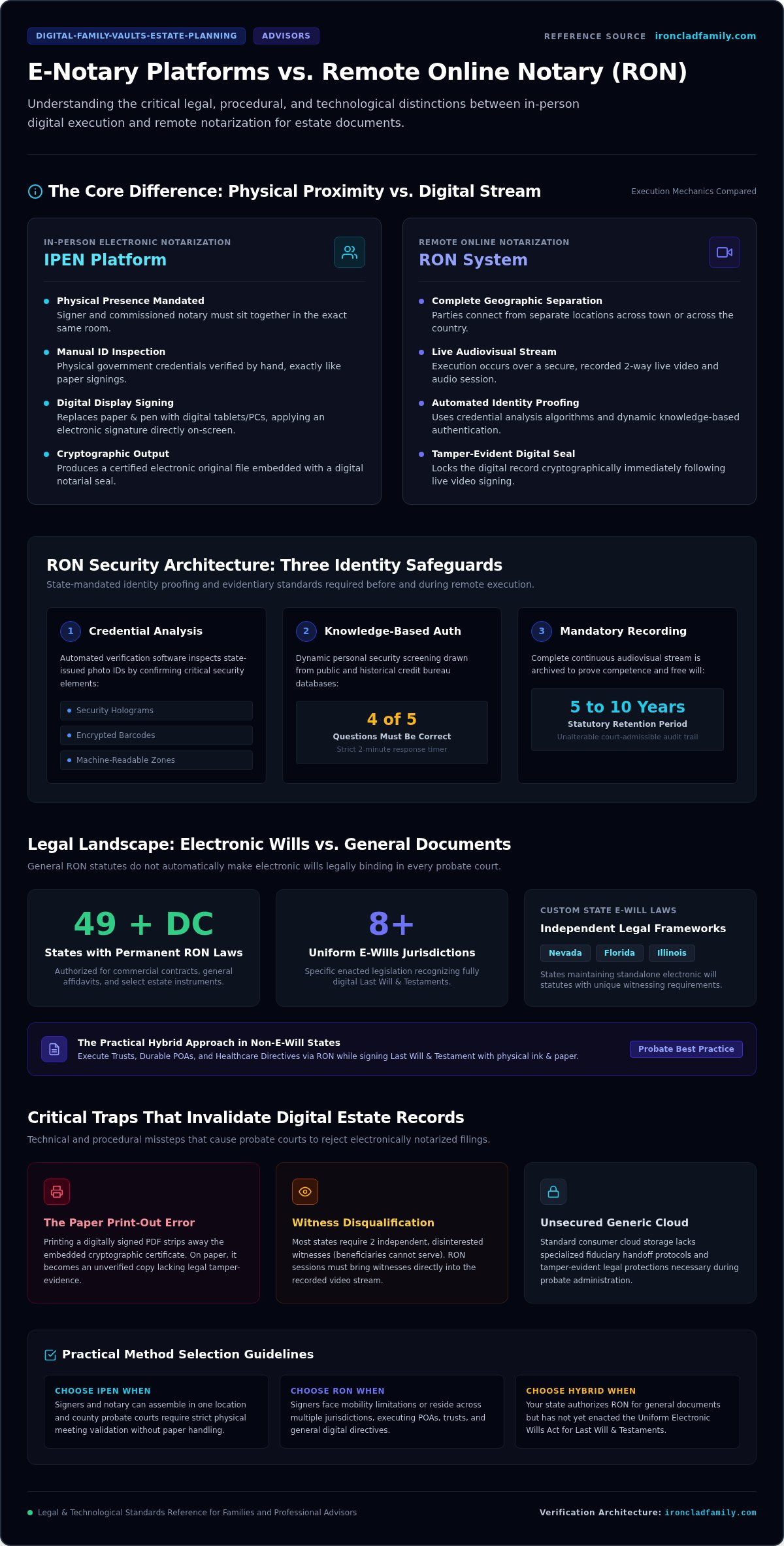
An electronic notary platform, often called In-Person Electronic Notarization (IPEN), still requires physical presence. You and the commissioned notary sit in the exact same room, but you replace paper documents and ballpoint pens with digital tablets and computers.
The notary inspects your physical government identification by hand, just like a traditional signing. Once you sign on the screen, the notary applies a digital seal backed by a cryptographic certificate. This process produces a certified electronic original file rather than a physical paper stack, while satisfying traditional legal requirements for in-person meetings.
What Is Remote Online Notarization (RON)?
Remote online notarization removes physical proximity entirely. You and the notary connect through a secure, live two-way audiovisual feed from different locations, whether across town or across the country.
Because the notary cannot inspect your physical credentials by hand, state regulations require multi-factor identity proofing before the session begins:
- Credential Analysis: Automated software examines your government ID to verify its security holograms, barcodes, and machine-readable data.
- Knowledge-Based Authentication: You must correctly answer at least four out of five identity questions drawn from past credit and public records within two minutes.
- Audiovisual Recording: The platform records and archives the entire signing interaction for 5 to 10 years, providing clear evidence that you were competent, aware, and acting freely.
Once you clear these checks, you sign the digital file during the live video stream. The notary then attaches their official digital seal, locking the document against future tampering.
Legal Validity and State Rules for Digital Estate Planning Documents
Everyday business contracts rely on standard commercial laws, allowing people to sign routine agreements on their phones in seconds. Estate planning documents face far stricter legal standards. Because a will takes effect only after you pass away, you cannot stand before a judge to verify your wishes. Probate courts apply intense scrutiny to prevent fraud and protect vulnerable individuals.
That is why choosing between e-notary platforms vs remote online notary for estate planning requires a careful look at state laws. A digital signature tool that works for a house lease might fail completely in probate court.
Wills, Trusts, and Powers of Attorney: Different Rules Apply
While 49 states and Washington, D.C. have enacted permanent remote online notarization laws, those statutes do not automatically cover electronic wills. Standard electronic commerce acts explicitly exclude wills and codicils.
At least eight jurisdictions have enacted the Uniform Electronic Wills Act, and states like Nevada, Florida, and Illinois have created their own electronic will laws. In states without electronic will legislation, families often use a hybrid approach. They execute trusts, durable powers of attorney, and healthcare directives through remote online platforms, but they sign their Last Will and Testament with physical ink and paper.
Addressing the Witness Dilemma in Remote Signing
Most states require two independent witnesses for a valid will. These individuals must be disinterested, meaning they inherit nothing from your estate. During an in-person electronic session, these witnesses sit in the room with you and the notary.
Remote online notarization handles this by bringing qualified witnesses directly into the live video session. Everyone sees, hears, and interacts with each other in real time. The platform creates an unalterable audio-video recording of the entire meeting. If an estranged relative later claims you were pressured or confused, that recording provides clear visual proof of your sound mind and voluntary choices.
Once you finish executing these files, it is vital to protect important documents in a secure repository that preserves their underlying digital certificates for your future fiduciaries.
Common Mistakes Families Make with Electronic Estate Documents
Electronic signing offers immense convenience, but simple procedural missteps can quietly unravel your legacy plan. When weighing e-notary platforms vs remote online notary for estate planning, families often assume the digital process matches the informal habits of daily screen use. In estate law, small technical blunders carry severe legal consequences.
The most common errors stem from treating official digital execution like basic email correspondence or standard paperwork.
The Paper Printout Trap
Many people complete an online signing, download the final document, and immediately print a paper copy for their home filing cabinet. They assume the printed page serves as the legal original. It does not.
A digitally notarized document relies on an embedded cryptographic certificate. This code actively checks whether the file has been altered since the notary applied their digital seal. Printing the file flattens the image into plain paper, stripping away the underlying digital certificate and audit log. Probate courts and financial custodians require the original, uncorrupted electronic file to verify that the seal remains unbroken.
Authentication and Identification Failures
Remote notarization rules demand strict proof of who is sitting behind the screen. Overlooking basic preparation often causes sessions to fail before they even start:
- Failing the identity quiz: State statutes require signers to score at least 80% on automated background questions within two minutes. Missing two attempts triggers a mandatory 24-hour lockout.
- Expired photo identification: Automated credential analysis rejects expired driver's licenses or passports instantly, halting the signing.
- Unprepared witnesses: If your state demands independent witnesses for specific estate forms, failing to have those individuals logged on and verified will invalidate the entire appointment.
Finally, many families leave their finished digital estate files scattered across downloads folders or buried inside personal email threads. If an unexpected illness strikes, fiduciaries cannot act if they do not know where to find the authenticated records or their accompanying access credentials.
Practical Steps: How to Choose the Right Notarization Method
Choosing between e-notary platforms vs remote online notary for estate planning comes down to your family's personal setup, comfort with technology, and local probate practices. Neither option is universally better. The right choice depends on your specific circumstances.
Before booking any appointment, review your draft estate documents with your estate attorney or financial advisor. Confirm whether your county probate court accepts remote execution for wills, or if an in-person electronic session is safer.
When Remote Online Notary Is Your Best Option
Remote online notarization offers exceptional flexibility when life makes travel difficult. Consider RON if you face these situations:
- Geographic distance: Your named trustees, executors, or independent witnesses live across different states.
- Mobility or health limitations: A loved one is homebound, in assisted care, or facing health challenges that make office visits difficult.
- Urgent scheduling needs: You need to finalize a power of attorney or living trust quickly before extended travel or medical treatment.
When In-Person Electronic Notarization (IPEN) Makes More Sense
In-person electronic notarization provides a middle ground, combining digital paperless records with face-to-face reassurance. IPEN works best in these scenarios:
- Thin credit histories: Young adults, elderly relatives, or individuals who might struggle to pass dynamic online background questions avoid automated lockouts during face-to-face review.
- Conservative probate courts: If local judges maintain rigid preferences for physical presence when proving a last will, meeting an e-notary in person prevents unnecessary court disputes.
- Complex family dynamics: Complicated distributions or sensitive family situations often benefit from having legal counsel physically present in the room.
Once you choose your path, prepare your hardware. Test your webcam, confirm your internet connection is stable, and inspect your driver's license to ensure it is valid. After your session concludes, store family records safely alongside your other long-term legacy plans.
Securing Your Notarized Documents in a Dedicated Digital Vault
Completing your signing session resolves only half of your legacy planning. Whether you compare e-notary platforms vs remote online notary for estate planning to pick the right signing method, the documents you produce need permanent preservation. Storing these vital records on a home computer or standard consumer cloud drive leaves them vulnerable to accidental deletion, account lockouts, and privacy leaks.
Consumer cloud platforms are built for basic file sharing, not legal succession. They lack the specialized architecture required to hold cryptographic legal evidence intact across generations.
Why Digital Estate Documents Need Specialized Custody
A properly executed estate document is a living record of your intentions. When family members cannot locate your electronic records, estates stall in court for months. Medical staff cannot honor a healthcare directive if the digital file is trapped behind a forgotten password.
Generic cloud drives do not verify fiduciary authority, nor do they track digital notary audit trails. If you store your records in regular folders, your heirs face major obstacles:
- Missing audit logs: Separating the notary certificate from the PDF file invalidates the legal integrity of your documents.
- Account lockouts: Service providers frequently freeze accounts when an owner passes away, blocking relatives from accessing critical instructions.
- Zero visibility: Family members often do not even realize a digital will or trust exists, causing assets to be distributed under state intestacy rules.
How IronClad Family Protects Your Completed Estate Plan
A specialized repository bridges the gap between digital signing and real-world execution. Placing your records in a secure digital vault for families protects both the original file and its tamper-evident digital seal.
Platforms like IronClad Family utilize zero-knowledge encryption, meaning only you and your designated fiduciaries hold the keys to unlock your documents. The service links your authenticated estate files, video notary session logs, and emergency instructions in one centralized environment.
More importantly, automated emergency delivery protocols release specific credentials to verified fiduciaries only when predetermined conditions are met. This safeguards your family's future, ensuring the hard work you put into choosing between e-notary platforms vs remote online notary for estate planning translates into seamless protection when your loved ones need it most.
Taking the Next Step to Protect Your Estate
Deciding between e-notary platforms vs remote online notary for estate planning ensures your wishes stand firm when your family needs them most. Whether you sit face-to-face with an e-notary or complete your signing through a live video session, your documents only succeed if your state honors the method and your digital files remain untampered.
Executing your documents is simply the first milestone. True family preparedness requires keeping your records organized, cryptographically intact, and readily accessible to the people you trust. IronClad Family brings these pieces together with zero-knowledge encryption architecture, integrated remote online notary connectivity, and automated emergency delivery protocols that release instructions to verified fiduciaries when necessary.
Learn how to protect your family’s most important documents with a secure digital vault.
digital vault
Frequently Asked Questions
Is a remote online notarization legally recognized for wills in every state?
No, remote online notarization is not universally accepted for wills in every state. While 49 states allow remote signing for standard contracts, trusts, and powers of attorney, electronic wills follow separate statutes. States like Florida, Nevada, and Illinois have specific e-will laws, but others still require physical ink signatures on paper. Always verify your local probate court requirements before attempting remote will execution.
What is the main difference between an electronic signature and an e-notarization?
An electronic signature merely records an individual's digital mark or consent on a file. In contrast, an e-notarization is a formal legal act performed by a commissioned official. When researching e-notary platforms vs remote online notary for estate planning, remember that genuine notarial acts require verified identity checks, live witnessing, an official journal record, and an embedded digital certificate that protects the PDF against unauthorized tampering.
Can I print out a remotely notarized document for my family records?
You can print out a copy for reference, but that paper version is not the legal original. Remote online notarization relies on cryptographic metadata embedded directly within the electronic PDF file. Printing the document flattens the image and destroys the underlying security certificates. Probate courts and financial institutions require the pristine, certified digital file to verify the unbroken seal and authentic audit trail.
What happens if a signer fails the knowledge-based authentication quiz during an online notary session?
State regulations require signers to score at least 80% on identity verification questions within two minutes. If you fail two consecutive attempts, the automated security system locks you out for a mandatory 24-hour waiting period. Signers with limited credit history, such as young adults or elderly individuals, often choose in-person electronic notarization to avoid these automated lockouts.
Do remote online notarizations require separate witnesses for estate planning documents?
Yes, most states require two independent witnesses for valid wills and certain healthcare directives. During an online session, these individuals must join the live audiovisual stream alongside you and the notary. Each witness completes identity verification before signing the digital document on screen. The platform records the entire multi-party session to verify everyone saw and heard the execution simultaneously.
How does an electronic notary verify that a signer is acting of their own free will?
The notary uses the live, two-way video feed to observe the signer's body language, speech, and physical surroundings. Notaries are trained to ask open-ended questions to assess mental competence and confirm understanding. If unauthorized individuals appear in the room, coach the signer off-camera, or cause visible distress, the notary must immediately refuse the transaction to protect against undue influence.
Where should I store digitally notarized estate documents so my executor can find them?
You should store authenticated legal files inside an encrypted, dedicated digital vault rather than a standard consumer cloud folder. Evaluating e-notary platforms vs remote online notary for estate planning must include long-term document custody. A specialized vault protects cryptographic certificates from data corruption and uses automated emergency delivery protocols so your executor can access necessary records without legal delays.
