


- 14 mins
Imagine a Tuesday morning where you aren't there to explain your child's sensory triggers or favorite meal to a new caregiver. For many, this thought brings a sharp chill, yet it's the reality we must prepare for with calm confidence. Effective estate planning for parents of a special needs child is about more than just money; it's about ensuring your child's voice and needs are never lost in a gap of care. You've likely spent years protecting their $2,000 SSI resource limit and worrying about complex legal jargon that feels like a foreign language.
We're here to turn that anxiety into absolute preparedness. This 2026 guide will show you how to create a secure, accessible plan that ensures your child is cared for exactly as you wish, even when you cannot be there. We'll walk through the updated 2026 ABLE account rules, explain how to use Special Needs Trusts without losing benefits, and show you how to organize a digital legacy that acts as a permanent guardian for your family's future.
Key Takeaways
- Understand why a standard will can accidentally disqualify your child from essential benefits like SSI and Medicaid.
- Learn to draft a Letter of Intent, the essential "instruction manual" that guides future caregivers through your child’s daily routines and personal needs.
- Discover how tools like Special Needs Trusts work within estate planning for parents of a special needs child to provide financial security without losing government support.
- Identify the four critical documents, including guardianship papers and powers of attorney, that must be organized for immediate emergency access.
- Find out how to securely store and share your child’s care plan so it reaches the right people the moment it is needed.
The Foundation of Estate Planning for Parents of a Special Needs Child
Estate planning for parents of a special needs child isn't just about dividing assets after you're gone. It's a protective shield that surrounds your child's future and ensures their quality of life remains stable. A standard will often fails these families because it treats every heir the same. If you leave money directly to a child with a disability, you might accidentally "disinherit" them from the very programs they rely on for daily survival. This is why a specialized approach is required to build a fortress around their well-being.
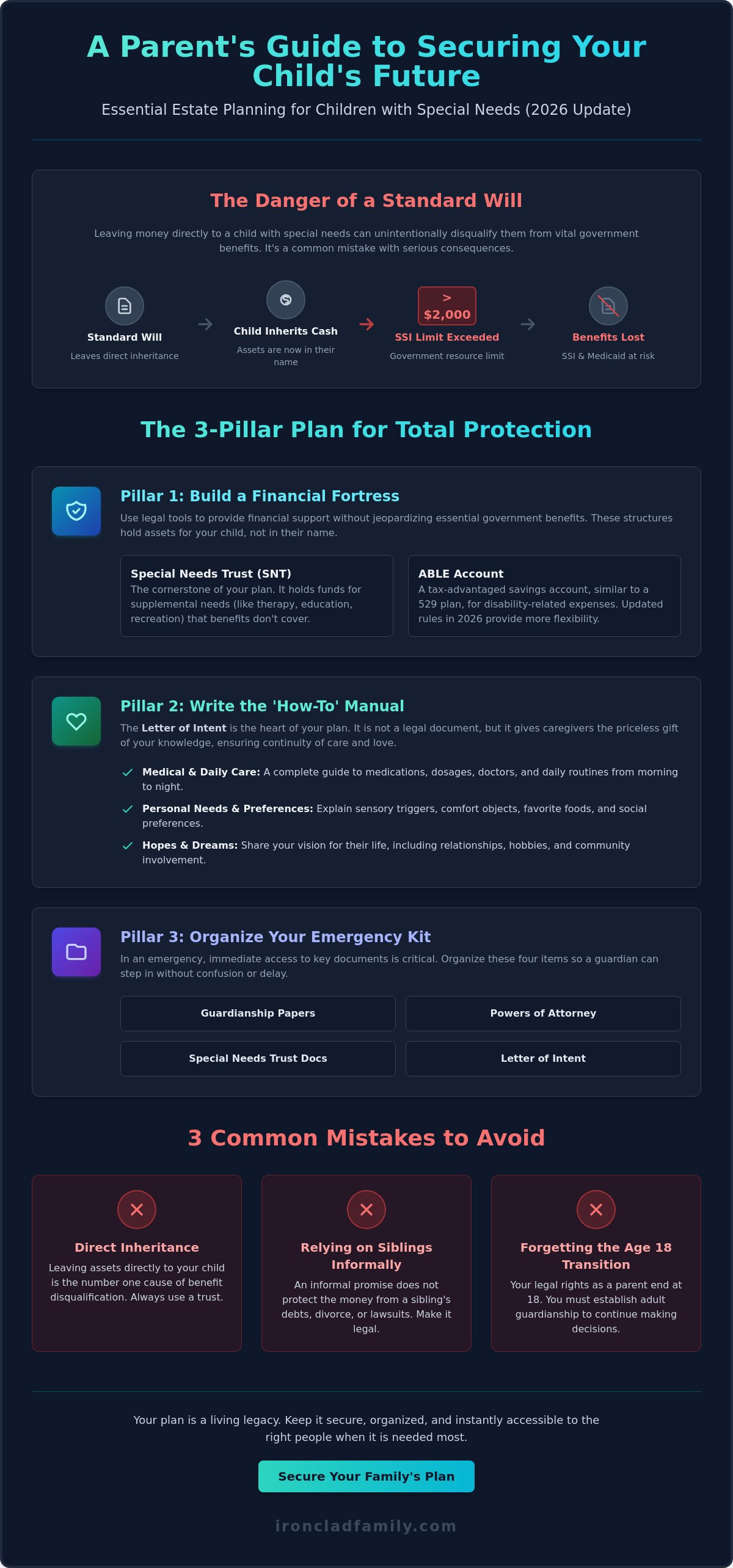
Government programs like Supplemental Security Income (SSI) have strict asset limits that haven't been adjusted for inflation in decades. In 2026, the SSI resource limit for an individual remains $2,000. If your child inherits even a small amount of cash through a traditional will, they could lose their monthly payment and Medicaid coverage. To prevent this, families use a Special Needs Trust (SNT). This legal tool holds assets for the child's benefit without those assets counting as their personal property. It allows them to keep their benefits while using trust funds for things the government doesn't cover.
To better understand how these legal tools work together, watch this helpful video:
The Real Problem: The Planning Gap
Most parents focus on what happens years down the road. However, the most dangerous time is the "planning gap." This is the window between a parent’s sudden emergency and a guardian taking over. If you're in an accident, who knows your child’s medication schedule? Who knows how to calm them during a sensory meltdown? Without clear instructions, a child might face severe medical or emotional distress. Your plan needs to be a living legacy that provides instant guidance when you can't speak for yourself.
Common Mistakes to Avoid in 2026
Many well-meaning families fall into traps that put their child's security at risk. Avoiding these errors is the first step in successful estate planning for parents of a special needs child. Here are the most frequent mistakes we see:
- Direct Inheritance: Leaving money directly to the child. This is the fastest way to disqualify them from federal benefits and state aid.
- Relying on Siblings: Assuming a sibling will "just take care of it." Without a legal structure, that money belongs to the sibling, making it vulnerable to their creditors, lawsuits, or divorce.
- Forgetting the Age 18 Transition: Once a child reaches adulthood, your legal right to make decisions ends. You must have guardianship or power of attorney in place before they turn 18 to maintain continuity of care.
Step 1: Writing a Comprehensive Letter of Intent
While trusts and wills provide the financial skeleton of your legacy, the Letter of Intent is the heart. It acts as the "instruction manual" for your child’s life. If you aren't there to explain things, a guardian will know exactly how to step in without causing a disruption in care. It isn't a legal document, but it's the most important tool you'll leave behind. Estate planning for parents of a special needs child often focuses on the "how much" of money; however, the "how to" of daily care is just as critical for long-term peace of mind.
This document bridges the gap between a legal structure and a human life. It ensures that the person stepping into your shoes doesn't have to guess about your child's preferences or medical requirements. Without it, even the best-funded trust can't ensure your child's favorite routines or emotional needs are met. You're building a narrative that guides your child's future protectors through every hour of their day.
Medical and Daily Care Details
Start with the essentials. List every medication, the exact dosage, and the contact information for their pharmacy. Don't stop at the clinical facts. Document sensory triggers. Does a specific sound cause distress? Does a weighted blanket help them feel safe? Include a "typical day" schedule that covers everything from wake-up times to bedtime rituals. For many, stability is safety. Knowing that breakfast is always at 8:00 AM can prevent a crisis during an already difficult transition. Estate planning for parents of a special needs child must include these granular, daily details to be truly effective.
Social and Emotional Well-being
Your child is more than a medical file; they are a person with a rich social life. Identify the "circle of support," including friends, cousins, teachers, and neighbors. Describe your child’s favorite recreational activities and their long-term hopes. If they love the local library or a specific park, write it down. Explain religious or cultural traditions that ground them in their identity. This ensures your family's values continue even in your absence.
Your child grows, and their needs change. Set a reminder to update this document every year, perhaps during tax season or on a birthday. An outdated manual can be as confusing as no manual at all. Once you've written this vital guide, you need to ensure it's accessible during a crisis. Storing your manual in a secure digital vault ensures your chosen guardians can find it the moment they need it.
Step 2: Choosing the Right Legal and Financial Tools
Choosing the right legal tools is the next phase of estate planning for parents of a special needs child. While the Letter of Intent provides the heart of the plan, these financial tools provide the fortress. You need a way to provide for your child's future without hitting the $2,000 asset limit that triggers a loss of essential benefits. This requires a sophisticated approach to asset ownership that keeps your child's name off the title while keeping their needs at the center of every decision.
In 2026, your child's legacy also includes digital assets. A modern plan should include instructions for managing online accounts, social connections, and digital memories. This ensures their digital life is protected just as much as their physical assets. These tools act as a technical guardian, standing watch over the resources your child will need for decades to come.
The Power of a Special Needs Trust
A Special Needs Trust (SNT) is the most powerful tool in your kit. It keeps assets separate from your child's personal property. Because the trust owns the money, the Social Security Administration doesn't count it as a resource. This is vital for maintaining Medicaid and SSI eligibility. You must choose between a First-Party trust, which uses the child’s own money, and a Third-Party trust, which is funded by your assets. Third-Party trusts are usually the preferred choice because they don't require a Medicaid payback when the child passes away. Learning how to make a will is a great first step, but it must be coordinated with these trusts to work correctly.
Trust funds are meant for "quality of life" expenses that government benefits don't cover. This includes things like travel, computers, or hobbies. As of late 2024, the rules became even more flexible; food expenses paid by a trust no longer reduce a beneficiary's SSI payment. This change allows the trust to better support your child's daily health and happiness.
ABLE Accounts vs. Trusts
The ABLE account has become even more useful for estate planning for parents of a special needs child. As of January 1, 2026, the eligibility age has expanded. Now, anyone who became disabled before age 46 can open one. These accounts allow for tax-advantaged savings and easy access for daily needs. For 2026, the annual contribution limit is $20,000. Up to $100,000 in an ABLE account is ignored by the SSI program, providing a massive buffer for your child's savings.
- Trusts are best for large assets like a home or a significant inheritance.
- ABLE Accounts are perfect for daily spending and modest savings.
- Coordination is key. You can use trust funds to deposit money into an ABLE account, giving your child more independence while keeping the long-term funds safe.
Finally, pick a successor trustee who truly understands your child’s specific needs. They will manage the money and make distributions. This person needs to be both financially responsible and empathetic. They are the bridge between the legal paperwork and your child's daily reality.
Step 3: Organizing Your Documents for Emergency Access
A perfectly drafted trust is just a stack of paper if your chosen guardian can't find it when the sirens are wailing. Estate planning for parents of a special needs child must include a strategy for immediate access. In a crisis, every minute counts. If your documents are locked in a safe deposit box or a dusty binder at home, they are effectively invisible to the people who need them most. You need a system that acts as a beacon, guiding caregivers to the information they need the moment they need it.
Physical "death binders" are a relic of the past. They are bulky, hard to update, and easily destroyed by fire or flood. More importantly, they aren't mobile. If an emergency happens while you are traveling or away from home, that binder is useless. A digital approach ensures your Special Needs Trust paperwork, Letter of Intent, and Guardianship papers are available anywhere in the world at the touch of a button.
Securing Your Digital Legacy
Your child’s life is likely managed through dozens of online portals. This includes medical records, therapy schedules, and benefit accounts for SSI or Medicaid. A comprehensive digital estate planning checklist is essential for special needs families. You must document these login credentials and ensure they are legally accessible. This is where RUFADAA comes in. It is a set of laws that gives your fiduciaries the legal right to manage your digital assets, but only if you've given them permission in advance.
Emergency Credential Delivery
How does your guardian get into your digital files if you aren't there to give them the password? This is the gap that most plans ignore. Automated delivery systems can solve this by releasing sensitive information only when specific conditions are met. Think of it as a digital hand-off that happens exactly when it's supposed to. You can even use personalized emergency wallet cards to alert first responders and provide immediate instructions on how to access your child’s care plan.
This level of organization provides the peace of mind that comes from knowing your plan is truly protected. It moves you from a state of worry to a state of calm confidence. To start building your child's digital fortress, you can secure your documents in a digital vault with IronClad Family today.
How IronClad Family Protects Your Special Needs Legacy
Estate planning for parents of a special needs child requires a level of security that standard cloud storage simply cannot provide. You are storing your child’s medical history, financial records, and deeply personal care instructions. IronClad Family serves as the Technical Guardian for this sensitive data. We use zero-knowledge encryption to ensure your child’s care plan is a private fortress. This means your information is scrambled so that even we cannot see it; only you and those you choose have the keys to unlock it.
The "Receiver" system ensures that your chosen guardians get access exactly when they need it. It prevents the risk of information being lost or accessed prematurely. This system bridges the gap between your legal paperwork and the daily care your child requires. It ensures that your life’s work and your child’s future are never left to chance during a crisis. By automating the hand-off of credentials, you remove the burden of searching for passwords from your child's future caregivers.
The Vault: More Than Just Storage
Within The Vault, organization becomes effortless. You can store your will, trust documents, and Letter of Intent in one central location that is accessible from anywhere. Beyond legal files, you can leave Legacy Messages for your child. These are videos or letters that provide emotional support and guidance when you cannot be there in person. They allow your voice to be heard during your child's most important milestones. As your child grows and their needs change, you can update these digital assets instantly to reflect their current reality.
A Partner in Your Family’s Future
IronClad Family is committed to multi-generational continuity. We understand that your plan is not a static document; it is a living legacy. Our system works alongside your financial advisor or attorney to ensure your digital assets are RUFADAA compliant and fully integrated into your broader strategy. This ensures that your fiduciaries have the legal right to manage your digital world without hitting roadblocks. This partnership ensures that your family’s narrative continues without interruption, providing a steady hand for the next generation.
Taking the first step toward absolute preparedness is the greatest gift you can give your child. Estate planning for parents of a special needs child is an act of love that requires a robust, secure solution. By securing your plan now, you move from uncertainty to a place of calm confidence. You can rest easy knowing that your child’s voice and your instructions are protected by an unshakeable digital guardian.
Build a Fortress for Your Child's Future
You now have the tools to close the planning gap and replace anxiety with calm confidence. By combining legal instruments like Special Needs Trusts with a detailed Letter of Intent, you ensure your child’s daily routines and long-term benefits remain intact. Effective estate planning for parents of a special needs child isn't just about the paperwork you sign today; it's about making sure those instructions reach the right people during a crisis. You've learned how to protect benefits, document daily care, and organize your digital world.
IronClad Family is here to act as your technical guardian. Our system uses zero-knowledge encryption for total privacy and offers automated emergency delivery of your instructions. We also provide state-specific legal document support to keep your plan robust and compliant. This ensures that your child is cared for exactly as you wish, even when you cannot be there to speak for them.
Secure your child’s future today with a digital vault from IronClad Family.
You've taken the first step toward true peace of mind. Your child's legacy is safe, and their future is bright.
Frequently Asked Questions
What is the most important document in estate planning for a special needs child?
The Special Needs Trust is the most critical legal document because it protects your child's eligibility for government benefits. It holds assets so they don't count toward the $2,000 resource limit. However, the Letter of Intent is equally vital for daily care. Together, they form the backbone of estate planning for parents of a special needs child, ensuring both financial security and personal well-being are protected for the long term.
Can my child have a bank account and still receive SSI?
Your child can have a bank account, but the balance must stay below $2,000 to keep receiving SSI. If the balance goes over this limit, benefits may be suspended. For 2026, an ABLE account is a better option for savings. It allows up to $100,000 to be ignored by the Social Security Administration, giving your child more financial freedom without the risk of losing their monthly payments.
Who should I choose as a trustee for a Special Needs Trust?
You should choose a trustee who is both financially responsible and deeply understands your child’s unique needs. This person manages the trust's money and decides how to spend it for your child's benefit. Many families pick a sibling or a close family friend. It's also smart to name a professional trustee or a bank as a backup to ensure the trust is managed correctly for decades without interruption.
How is an ABLE account different from a Special Needs Trust?
An ABLE account is a tax-advantaged savings account for daily expenses with an annual contribution limit of $20,000 in 2026. A Special Needs Trust is a legal arrangement that can hold unlimited assets, such as a home or a large inheritance. While ABLE accounts are easier to use for small purchases, trusts provide a more robust shield for significant family wealth and long-term security. Most families use both tools together.
What happens if I die without a special needs estate plan?
If you die without a plan, state laws decide who gets your assets, which often means money goes directly to your child. This inheritance will likely disqualify them from SSI and Medicaid instantly. A judge will also choose a guardian who might not know your child’s specific needs or routines. This creates a dangerous gap in care that can lead to emotional and physical distress for your child during a crisis.
How do I ensure my child’s new guardian knows their medical routine instantly?
You can ensure a new guardian knows everything instantly by using a digital vault to store your Letter of Intent and medical records. This system can be set to release information to your chosen guardians the moment a crisis occurs. By organizing these details now, you provide a clear roadmap for medications, dosages, and sensory triggers. It removes the guesswork and ensures your child’s routine remains stable during a difficult transition.
Can I use an online service to create a Special Needs Trust?
You can use online services to draft many estate documents, but you must ensure they are state-specific and legally sound. Special needs planning is complex, so many families use a hybrid approach. They use a digital service for the initial documents and then have an expert review them. IronClad Family provides state-specific legal document support and secure storage to help you build a strong foundation for your child’s future security.
What is a Letter of Intent and is it legally binding?
A Letter of Intent is not a legally binding document, but it is the most important instruction manual you will ever write. Judges and guardians use it to understand your child’s history and your wishes for their future. While a trust handles the money, this letter handles the heart of the matter. It provides the daily details that keep your child safe, happy, and understood when you can't be there to guide them.

