

- 11 mins
What if the greatest risk to a family's wealth isn't market volatility, but a missing password during an unexpected crisis? A solid portfolio cannot protect an heir who can't locate an estate directive or access vital accounts when minutes count. This vulnerability is why more professionals now practice holistic advising, focusing on the family records and human connections behind the balance sheet.
You already know how painful it is when essential legal paperwork and financial details remain trapped in disconnected silos. When sudden health events or life transitions strike, that fragmentation causes deep stress for grieving relatives. It's also why heirs so often part ways with their parents' trusted professionals; they simply were never given a clear, organized seat at the table.
Discover how holistic advising bridges the gap between financial portfolios, estate records, and family continuity. We'll examine how to build a unified framework for sensitive personal records, keep the next generation connected, and ensure every client family achieves complete peace of mind.
Key Takeaways
- Discover how holistic advising expands beyond balance sheets to unite financial portfolios, estate documents, and family records.
- Learn how scattered records and missing passwords put family stability at risk during sudden emergencies.
- Identify the major planning errors that cause next-generation heirs to leave their parents' longtime advisors.
- Get a practical blueprint to conduct full family asset audits that include vital personal and legal directives.
- Understand how a centralized, encrypted system keeps critical family documents organized and accessible when heirs need them most.
What Is Holistic Advising and Why Does It Matter?
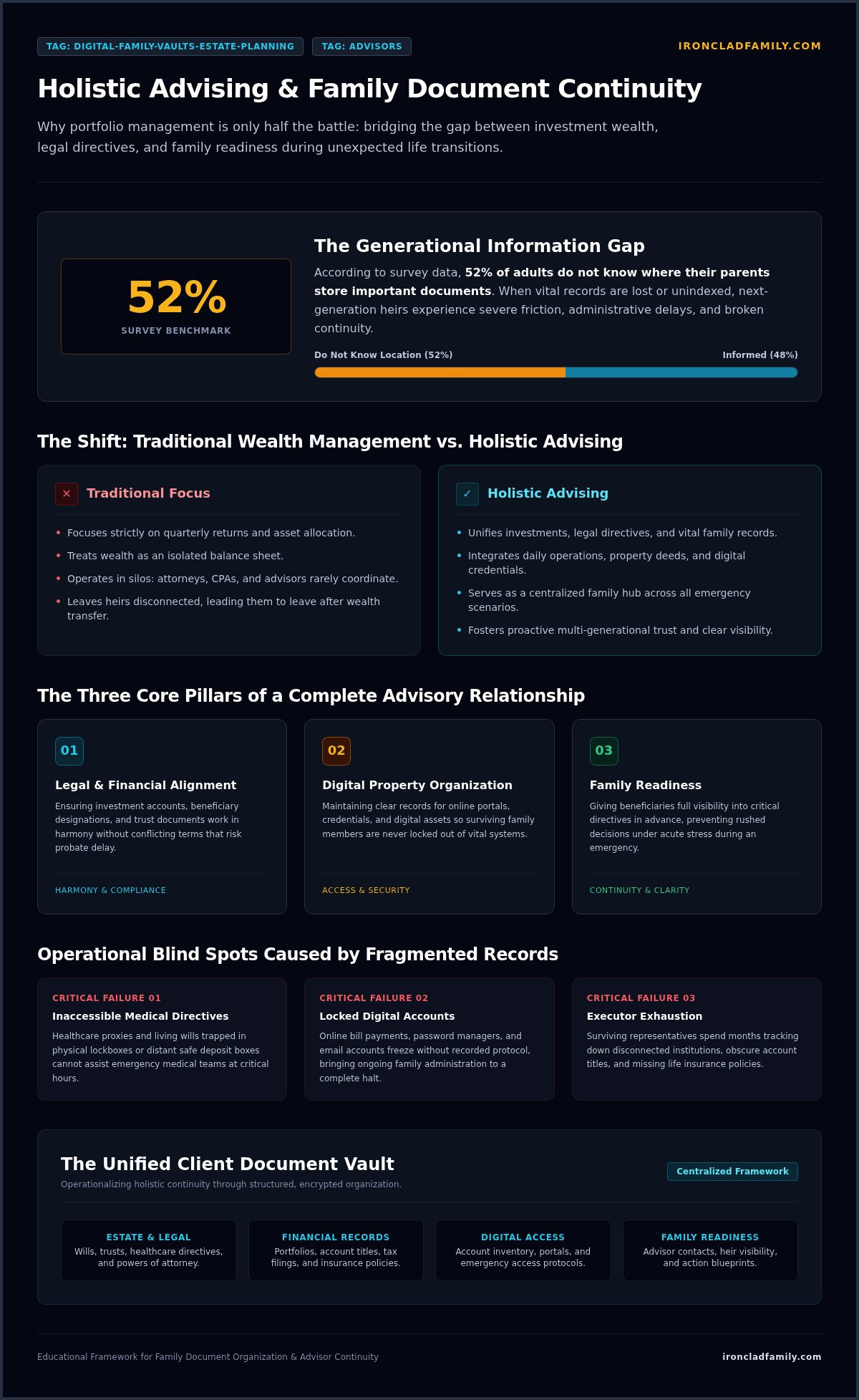
Managing investments is only half the battle when securing a family's future. For decades, traditional wealth management focused solely on quarterly returns and asset allocation. Yet when sudden illnesses or unexpected deaths occur, a well-managed portfolio cannot resolve a lost deed, an unlocated healthcare directive, or locked accounts. Real protection requires a complete view of a family's life.
True holistic advising unifies investments, legal directives, and vital family records into a single clear picture. Instead of treating wealth as an isolated spreadsheet, this method looks at how money connects to legal documents, family wishes, and daily operations. Without direct access to comprehensive estate planning documents and emergency instructions, even the largest balance sheets can get tangled in probate court or delayed by administrative paralysis.
The Shift from Transactional to Comprehensive Guidance
Clients no longer want advisors who only pick funds or rebalance accounts once a year. Modern families face complex lives with digital accounts, distributed family members, and multiple properties. They need a trusted coordinator who can bridge the gap between their financial assets and their personal wishes.
Advisors who adopt holistic advising serve as the central hub for a family's future. They help coordinate tax records, insurance policies, and healthcare proxies alongside the core investment strategy; insurance professionals aiming to master this level of comprehensive risk protection can discover IICS to develop elite producer skills. When a crisis strikes, the family knows exactly who to call and where every vital record lives.
Core Pillars of a Complete Advisory Relationship
Building a fully integrated advisory practice relies on three essential pillars:
- Legal and Financial Alignment: Investment accounts, beneficiary designations, and trust documents must work together without conflicting terms.
- Digital Property Organization: Online portals, passwords, and digital assets require clear records so heirs aren't locked out of vital systems.
- Family Readiness: Beneficiaries need clear visibility into essential directives before an emergency forces them to make rushed decisions under stress.
The Hidden Risks of Fragmented Client Data and Siloed Planning
Most family records are scattered across physical lockboxes, old email threads, and forgotten filing cabinets. An advisor might hold the portfolio, while an estate attorney holds the will, and an insurance agent holds the life policy. These separate silos create dangerous blind spots. When records don't talk to each other, small errors turn into costly disasters.
Siloed planning puts the family at risk during emotional moments. If an account title contradicts a trust document, assets can easily get trapped in lengthy probate court proceedings. Surviving relatives face unnecessary legal fees and painful delays simply because no one verified that the legal plan matched the financial reality.
The Threat to Generational Wealth Transfer
A major risk of data silos is the breakdown between generations. According to a 2024 survey, 52% of adults do not know where their parents store important documents. When heirs don't know where to look, they feel lost, frustrated, and disconnected from the process.
This disconnection is why so many heirs replace their parents' advisor soon after inheriting wealth. If an advisor has only managed an investment portfolio without involving the next generation, there is zero relationship to fall back on. Establishing a proactive, client document vault bridges this divide, giving the rising generation practical access while fostering trust before a major transition occurs.
Operational Blind Spots During Family Emergencies
Paperwork failures become immediately dangerous during sudden health crises. Consider what happens when unexpected events take place:
- Inaccessible Medical Directives: A living will stored in a safe deposit box is useless when doctors need treatment decisions at midnight.
- Locked Digital Assets: Online bill pay, password managers, and email accounts freeze without clear digital access protocols, halting essential family operations.
- Executor Exhaustion: Appointed family representatives waste months hunting down obscure account numbers, tax filings, and insurance policies across separate institutions.
Practicing true holistic advising means solving these operational blind spots before they happen. When all critical directives and assets connect in one secure place, advisors protect families from preventable chaos.
Common Mistakes Advisors and Families Make in Estate Continuity
Estate planning often fails long before an emergency occurs. The breakdown rarely stems from bad investment picks. Instead, it happens because families treat legacy planning as a single event rather than an ongoing discipline. Signing a will ten years ago does not mean a family is prepared for a crisis tomorrow.
Advisors sometimes make the mistake of leaving document storage and family communication entirely to their clients. At the same time, families assume their trusted professionals already have everything under control. This mutual assumption leaves huge gaps in preparedness, especially when digital accounts, insurance policies, and family circumstances change over time.
The Paper Binder and Unsecured Storage Trap
Many households rely on three-ring binders tucked away on a shelf or basic cloud folders shared over email. Both approaches create significant hazards. Physical binders become outdated the moment an account changes, and they cannot help a relative who lives across the country during a sudden medical event.
Standard cloud drives and unencrypted email threads pose serious security threats. Storing Social Security cards, bank passwords, and deeds in ordinary folders exposes sensitive personal data to identity theft. An unorganized mix of digital files creates panic instead of calm when an executor needs clear directions immediately.
Excluding the Rising Generation from the Planning Process
Family continuity breaks down when conversations focus strictly on asset balances while leaving adult heirs in the dark. Research highlights this disconnect clearly: while 79% of ultra-high-net-worth individuals involve their advisors in legacy discussions, only 36% feel confident their heirs are truly prepared. Leaving children out of the organizational process breeds anxiety and mutual distrust.
When professionals practice true holistic advising, they help families avoid several typical errors:
- Ignoring Digital Property: Overlooking password managers, cloud subscriptions, and two-factor recovery codes that heirs need to manage the estate.
- Assuming Documents Are Up to Date: Failing to verify whether named executors, guardians, or power of attorney agents are still willing and able to serve.
- Hiding Practical Details: Keeping account locations secret until grief and stress make finding them overwhelming.
Legacy planning is about people, not just paperwork. Bringing next-generation heirs into the organizational process turns abstract wealth management into clear, collaborative protection that lasts across lifetimes.
Practical Steps to Implement a Holistic Advising Strategy
Adopting a comprehensive advisory model does not happen overnight. It requires shifting from sporadic account check-ins to a structured, repeatable process. By systematically gathering legal, personal, and digital records, professionals transform loose planning into a protected family legacy.
Here is a clear three-step blueprint to put holistic advising into daily practice.
Step 1: Completing the Family Readiness Audit
Start by inventorying every vital document beyond the investment portfolio. Most families have paperwork tucked away across different providers, making a structured checklist necessary.
- Core Legal Directives: Review wills, revocable trusts, healthcare proxies, and durable powers of attorney. Confirm these reflect current family wishes.
- Asset Ownership and Deeds: Match property titles, business agreements, and vehicle registrations against existing trust instructions.
- Digital Footprint: Document where primary email accounts, cloud files, financial logins, and device passwords reside.
- Insurance Policies: Gather life, disability, long-term care, and umbrella liability policies in one place.
Step 2: Engaging the Entire Family Unit
Once you catalogue the assets, invite adult children into the conversation. Host a family preparedness meeting focused on education rather than exact dollar figures. Walk heirs through where documents live, explain executor expectations, and introduce the professional team.
Advisors looking to streamline this collaboration can integrate a digital vault platform for advisors. This tool gives clients and their heirs a structured space to view critical instructions without exposing private financial details before the right time.
Step 3: Creating a Living Record Maintenance Plan
Family records must grow and change alongside real life. Outdated instructions often cause as much conflict as missing documents. Schedule a dedicated annual review to keep the family roadmap accurate.
During each review, verify that primary and contingent beneficiary designations on retirement accounts match the overall estate plan. Update emergency contacts whenever family members relocate or change phone numbers. Finally, confirm that new property acquisitions, business ventures, or digital credentials are added to the client organization system immediately.
How Secure Digital Vaults Operationalize Holistic Advising
Adopting a broader planning philosophy is valuable, but advisors need practical systems to make it work. Collecting files without a secure home creates risk rather than relief. A protected digital vault serves as the central command center for a family's entire life, uniting legal records, account locations, and personal wishes under one roof.
Security must come first. High-grade systems use zero-knowledge encryption, meaning only the client and their chosen contacts hold the keys. Not even the software provider can view the private records inside. This architecture gives families complete privacy while giving advisors the structure they need to practice effective holistic advising.
Bridging the Gap Between Daily Finances and Family Legacy
Wills, powers of attorney, trust schedules, and asset maps belong together in a single protected space. Rather than forcing clients to manage clunky spreadsheets, professionals can provide a branded client document vault. This dedicated portal deepens client trust and simplifies document collection.
IronClad Family provides a purpose-built platform designed specifically for family preparedness. It allows advisors to guide clients through document collection, verify completeness, and maintain clear records alongside long-term investment strategies.
Protecting Privacy While Empowering Next-Generation Continuity
True continuity requires balancing immediate security with future access. Clients maintain total ownership of their private keys and personal documents at all times. They choose exactly who can view individual files, whether that includes an estate attorney, an accountant, or adult children.
Here is how a dedicated platform protects families across transitions:
- Granular Permissions: Share access to property records today while keeping personal legacy messages and passwords private until needed.
- Automated Emergency Access: Ensure designated heirs receive critical directives and credentials quickly during a medical crisis without exposing accounts prematurely.
- Unified Organization: Replace confusing filing cabinets with an intuitive layout that anyone in the family can navigate under stress.
By connecting high-tech protection with practical legacy tools, IronClad Family transforms disconnected documents into organized family peace of mind.
Securing Family Continuity Beyond the Balance Sheet
A client's true legacy is more than numbers on an investment statement. When records sit scattered across desks and inboxes, sudden life events turn into administrative crises. Embracing holistic advising solves this challenge by connecting financial portfolios directly with legal directives and essential personal records.
Advisors can now provide families with complete certainty. A dedicated Advisor Portal gives you the tools to guide clients and retain next-generation heirs before transitions occur. Protected by zero-knowledge encryption, sensitive documents remain entirely private. Automated emergency access protocols ensure that vital healthcare proxies and credentials arrive in the right hands the instant they're needed.
Guiding a family toward complete preparedness builds generational trust that outlasts market cycles. You don't just protect their wealth; you protect their peace of mind.
See how advisors use digital vaults to strengthen client relationships.
Frequently Asked Questions
What is holistic advising in wealth and estate planning?
Holistic advising is a comprehensive advisory approach that unites a client's investment portfolios, estate legalities, and essential family records into one coordinated system. Instead of focusing only on account returns, it organizes practical details such as living wills, property deeds, and digital credentials. This method ensures that legal directives match financial holdings and protects families from administrative confusion during unexpected medical events or estate settlements.
How does holistic advising differ from traditional wealth management?
Traditional wealth management concentrates almost exclusively on portfolio design, risk tolerance, and asset growth. In contrast, comprehensive guidance expands the relationship to encompass estate continuity, digital asset protection, and next-generation family readiness. It tackles operational vulnerabilities, such as locked online accounts or uncoordinated beneficiary designations, that typical portfolio reviews overlook. This gives families a unified plan rather than fragmented advice from isolated professionals.
Why do financial advisors need to manage client documents alongside investments?
Portfolios do not exist in a vacuum. If an advisor optimizes an account but the client's estate directives contradict account titling, assets can be delayed in probate court. Helping clients organize critical documents gives advisors complete visibility into total family assets. It also equips advisors to guide surviving relatives immediately during emergencies, preventing panicked decisions and costly administrative delays when families are grieving.
How does a digital vault support holistic advising practices?
A digital vault serves as the operational engine for holistic advising by providing a secure, central hub for all sensitive family records. It allows advisors and clients to store, categorize, and update estate plans, insurance policies, and digital access credentials in real time. Features like permission-based sharing ensure legal professionals, advisors, and heirs can coordinate smoothly without compromising privacy or security.
What documents should be included in a holistic family advisory review?
A thorough review covers foundational estate planning files like wills, trusts, durable powers of attorney, and healthcare proxies. It also catalogues property deeds, vehicle titles, business agreements, and insurance policies across life, health, and property. Crucially, modern reviews should also include digital estate records, such as password manager access, primary email accounts, and two-factor authentication instructions for critical services.
How does holistic advising improve generational wealth transfer retention?
Heirs frequently fire their parents' advisor simply because no prior relationship exists. By introducing comprehensive family planning early, professionals involve adult children in practical preparedness and estate organization before any transfer takes place. This builds multi-generational trust and positions the advisor as a supportive guide rather than just an asset manager, drastically improving client retention across major life milestones.
Is standard cloud storage safe enough for holistic estate planning records?
Standard consumer cloud storage lacks the specialized safeguards needed for sensitive estate files. Ordinary cloud folders often rely on shared links and lack zero-knowledge encryption, leaving Social Security numbers and financial credentials vulnerable to account takeovers. A dedicated digital vault uses client-side encryption and automated emergency protocols, ensuring files remain completely unreadable to unauthorized parties while guaranteeing access to designated heirs when needed.