

- 14 mins
Imagine your family needs to find your medical directive or a specific bank account password during a midnight emergency. If they only find a heavy filing cabinet and a stack of unsorted mail, a stressful situation quickly becomes a crisis. Most people feel a sense of dread when they look at their mountain of paperwork. You want to protect your life's work, but learning how to organize important family documents often feels like an impossible task. Organization without accessibility is a failed legacy; true protection requires a system that lives where your family does.
It's natural to worry about losing records to a fire or fearing that your heirs won't find your account passwords. You deserve the calm confidence that comes with a secure, manageable system. This guide provides a simple, step-by-step method to sort, secure, and share your most critical records. We will show you how to move from paper clutter to a fortified digital repository, ensuring your loved ones have the access they need when it matters most. By the end of this article, you will have a clear plan to protect your family's future and ensure your legacy remains intact.
Key Takeaways
- Understand why a central system prevents the stress and confusion families face when searching for records during a crisis.
- Learn how to organize important family documents by sorting them into five core categories: Vital, Financial, Legal, Medical, and Digital.
- Compare the security of traditional binders against zero-knowledge digital vaults to see which best protects your family's privacy.
- Follow a simple step-by-step plan to gather and categorize your records so they're ready for the next generation.
- Discover how a secure digital repository ensures your loved ones have the right access credentials when they matter most.
Why Your Family Needs a Document Organization System
A well-built system for your family records is more than just a tidy desk; it's a protective shield for your legacy. Think of yourself as a technical guardian. You're not just filing papers, you're securing the future of the people you love most. Most families don't have a plan until a crisis hits. When an emergency happens, they find themselves on a stressful treasure hunt for birth certificates, insurance policies, and passwords. This search often happens during the worst moments of their lives. Learning how to organize important family documents is the best way to prevent this unnecessary pain.
Effective personal information management ensures that your life's work isn't lost in a sea of clutter. Without a system, your family might miss out on life insurance payouts or face long delays in probate court. These aren't just small inconveniences. They are expensive mistakes that can lead to family conflict and lost wealth. To better understand this concept, watch this helpful video:
Key Takeaways for Quick Success
You don't need to finish everything in one day. Start with these simple steps to build your momentum:
- Start small by gathering all your legal papers in one pile.
- Prioritize documents that prove identity, like passports and social security cards.
- Use a hybrid approach by keeping physical copies in a fireproof box and digital copies in a secure vault.
The most important rule of document management is to do it now. Waiting for the "perfect time" usually means waiting until it's too late. Your goal is to move from a state of uncertainty to a feeling of absolute preparedness.
The Real Cost of Paper Chaos
Disorganization has a high price tag. When documents go missing, probate becomes a legal nightmare. Lawyers have to spend more time tracking down assets, which means more money coming out of the estate. Research shows that lost or misplaced paper documents can cost between $120 and $220 per file in labor alone. This doesn't even account for the emotional toll on your loved ones.
There's also the risk of forgotten bank accounts or uncollected life insurance. If your heirs don't know an account exists, they can't claim it. Organizing your records is a final act of love. It shows your survivors that you cared enough to make their hardest days a little easier. When you learn how to organize important family documents, you're building a fortress around your family's future.
The Essential Categories for Your Important Family Documents
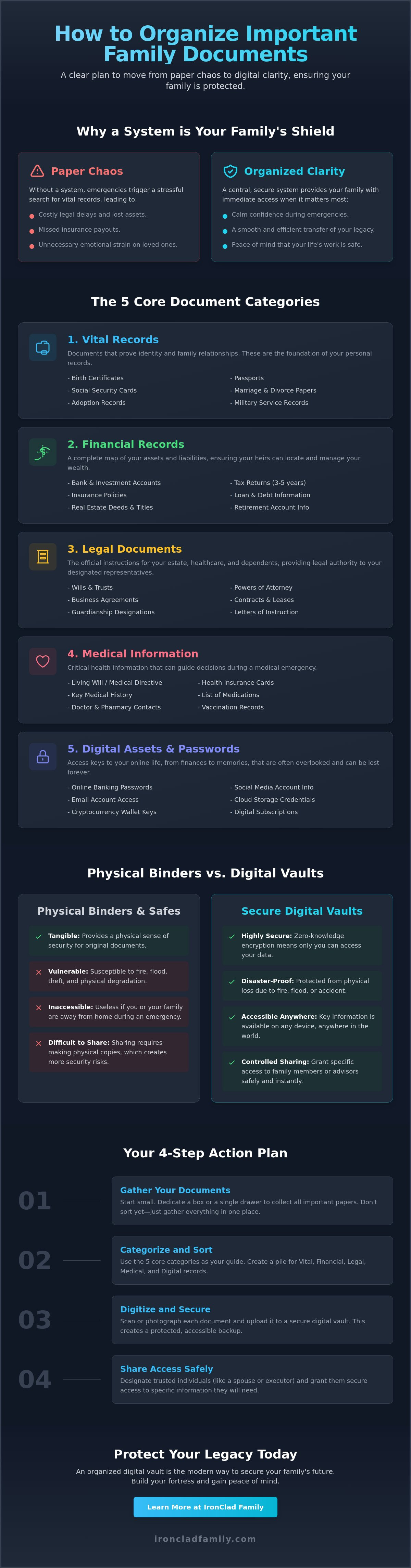
To master how to organize important family documents, you need a logical framework. Instead of a single pile, we use five core buckets: Vital, Financial, Legal, Medical, and Digital. This structure ensures that no part of your life is left unprotected. It turns a chaotic stack of papers into a clear roadmap for your heirs. Before we dive into the details, use the table of contents below to navigate this guide.
Guide Contents
- Why Your Family Needs a Document Organization System
- The Essential Categories for Your Important Family Documents
- Physical Binders vs. Digital Vaults: Which Is Safer?
- A Step-by-Step Plan to Organize Your Family Records
- Beyond Storage: How IronClad Family Secures Your Digital Legacy
Each category serves a specific purpose during a transition of wealth. For example, your legal documents prove who is in charge, while your financial records show what assets need protection. A complete checklist of important documents helps you verify that nothing has slipped through the cracks. It's also helpful to include a family emergency plan checklist within these buckets to guide your loved ones through a crisis.
Vital Records and Identity Documents
Vital records are the foundation of your legal identity. This bucket includes birth certificates, social security cards, passports, and marriage licenses. These items are difficult and time-consuming to replace. If a passport is lost or destroyed, getting a new one can take weeks of bureaucratic hurdles. We suggest keeping physical originals in a high-quality fireproof safe while scanning digital copies for immediate access. This hybrid approach ensures you have the "wet ink" signature when required, but also a backup if the physical copy is unreachable.
Financial and Estate Planning Paperwork
This category is the most critical for a smooth transfer of assets. You must include your will, trusts, powers of attorney, and life insurance policies. Don't just store the documents; include a clear list of all bank accounts and physical assets like real estate or jewelry. In states like California, the small estate limit to avoid probate is $208,850 for non-real estate assets as of 2026. If your records are messy, your family might end up in court even if your estate is simple. Using a secure digital vault for estate planning ensures these high-stakes files are organized and ready for your executor.
The New Frontier: Digital Assets and Credentials
Your "important documents" now include things you can't touch. Passwords, crypto keys, and cloud storage access are the keys to your modern kingdom. Without a plan, these assets can stay locked forever, leaving your family unable to close accounts or retrieve precious photos. This is where you should also include "Legacy Messages." These are personal notes or videos that serve as an emotional inheritance. They provide comfort that a bank statement never could. To start securing these invisible assets, consider setting up a secure digital repository today.
Physical Binders vs. Digital Vaults: Which Is Safer?
When you decide how to organize important family documents, you face a critical choice: the physical binder or the digital fortress. The traditional binder is a familiar tool, but it lacks the strength of a modern digital vault. Many families rely on a home safe, thinking it provides total security. In reality, paper is fragile. It burns, it rots, and it gets lost. A true technical guardian understands that physical storage is only one piece of the puzzle. Relying solely on a closet shelf or a generic cloud drive leaves your legacy vulnerable to both natural disasters and digital thieves.
The Limits of the Fireproof Box
Many people buy a fireproof box and assume their work is done. However, most consumer safes are only rated to protect paper for 30 to 60 minutes. If a house fire burns longer or hotter, the documents inside can still char or turn to ash. There is also the risk of theft. A small safe is easy for a burglar to carry away. Sharing these files during an emergency is also difficult. If your family is in another state when a crisis happens, they can't reach the papers they need. We recommend using a physical binder only as a temporary "grab-and-go" tool for quick evacuations, not as your primary security system.
- Fireproof ratings are limited by time and temperature.
- Physical keys are easily lost, and drilling a locked box can be expensive.
- Water damage from floods or fire hoses can destroy paper even inside a safe.
Why a Secure Digital Vault is the Gold Standard
A secure digital vault provides a level of protection that no physical box can match. It offers 24/7 access from anywhere in the world. This means your family can retrieve your medical directive or insurance info instantly, even if they aren't at your home. The key to this security is "Zero-Knowledge" encryption. This standard ensures that only you and your designated recipients can see your data. Even the company storing the files cannot peek inside. It is the most secure method for protecting sensitive data, according to a 2025 study by the Open Web Application Security Project.
By moving your records into a vault, you rebrand your information as a living legacy. It's no longer just a collection of static files; it's a protected asset that grows with your family. This approach removes the fear of human forgetfulness. You don't have to remember where you hid a key or a folder. Your legacy is held in a cryptographic fortress, ready when your loved ones need it most. When you learn how to organize important family documents using this high-tech method, you achieve true peace of mind.
How to Organize Important Family Documents: A Step-by-Step Plan
Turning a mountain of paper into a protected legacy takes a clear process. It's easy to feel stuck when you look at years of accumulated files, but you can break the work into manageable steps. This plan shows you how to organize important family documents without losing your mind. By following a steady rhythm, you move from chaos to a state of absolute preparedness.
Gathering and Sorting Your Papers
The first step is the Great Gathering. You need to hunt down records from every corner of your life. Look in old filing cabinets, attic boxes, and even your email inbox. Don't forget your bank's safe deposit box. While these boxes can cost between $15 and $350 a year, they often hide the most vital items like original deeds or stock certificates. If you lose the key, a bank might charge $40 for a replacement or $200 to drill the box open. Finding these keys now prevents your heirs from facing those fees and delays during a crisis.
Once you have your pile, use the "Do it NOW" rule. When a new piece of mail or a legal notice arrives, decide its category immediately. Use clear labels for your physical folders and avoid the trap of over-complicating your system. Stick to the five buckets we discussed earlier: Vital, Financial, Legal, Medical, and Digital. This simple sorting ceremony ensures that every document has a home and a purpose.
- Check the freezer or a fireproof safe for "hidden" emergency cash or keys.
- Look through old tax returns to find forgotten bank account numbers.
- Gather all life insurance policies to verify the current beneficiaries.
Creating a Clean Digital Filing System
Once your papers are sorted, it's time for the digital transition. A scan is only useful if you can find it quickly. Use a clear naming convention for every file you create. Instead of a generic name like "Scan001.pdf," name the file "2026_Last_Will_Jane_Doe.pdf." This small habit makes searching your records much faster for both you and your family. Ensure your scans are high-quality so the text is readable for legal or financial purposes.
After you secure a document in your vault, you can shred the unnecessary paper clutter. This reduces the risk of identity theft and keeps your home organized. For the most sensitive files, you need a level of protection that a standard hard drive or a generic cloud service cannot provide. You can start building your secure digital repository today to ensure your legacy is protected by the highest security standards available.
The final step is the Security Lockdown. Once your files are named and scanned, move them into a zero-knowledge environment. This ensures your data is not just stored; it is fortified. You're acting as the wise protector, making sure that the essence of your life's work is available only to the people you trust.
Beyond Storage: How IronClad Family Secures Your Digital Legacy
Knowing how to organize important family documents is only half the battle. The greatest system in the world fails if your loved ones can't access it when a crisis occurs. Most storage solutions are passive; they sit and wait for someone to find them. IronClad Family acts as a partner in your family's long-term narrative, ensuring that your life's work is not just stored, but actively protected and delivered when it matters most.
At the heart of this service is a digital fortress built with zero-knowledge encryption. This high-trust security means that your sensitive data is scrambled so that only you and your chosen recipients can ever read it. Even the service provider cannot peek inside your files. This level of cryptographic safety transforms your documents from vulnerable files into a secure living legacy. It provides the calm confidence you need to know your private information stays private and unreachable by outsiders.
Automated Emergency Delivery
The most difficult part of estate planning is the "treasure hunt" your family faces after you are gone. Grieving loved ones shouldn't have to search through drawers for account numbers or insurance policies. The "Receiver" system solves this by automatically delivering your credentials and instructions to the right people at the right time. You set the triggers, and the system handles the rest. This removes a massive emotional and logistical burden from your survivors during their hardest days. They won't have to wonder where you kept your will or how to access your accounts.
To make this system even more robust, a physical emergency wallet card serves as a vital link to your digital safety. It tells first responders or family members exactly how to access your emergency credentials in a split second. By combining physical preparedness with digital strength, you ensure that your family is never left in the dark during a medical or legal emergency. It is a simple tool that bridges the gap between your digital vault and the physical world.
A Fortress for Your Living Legacy
True peace of mind comes from knowing that your preparation is complete. When you follow a clear system for how to organize important family documents, you move from a state of anxiety to a feeling of absolute preparedness. You are no longer worried about fire, theft, or forgotten passwords. Instead, you can focus on living your life, knowing your technical guardian is standing watch over your most precious records.
Your family's future security is the greatest gift you can leave behind. It is an act of love that speaks across generations. By securing your assets and messages today, you ensure your legacy remains a source of strength rather than a source of confusion. Start your journey toward total preparedness today and give your family the protection they deserve for the years to come.
Securing Your Family's Future Today
You now have a clear roadmap for your family's most precious records. By sorting your files into the five core buckets and moving them into a zero-knowledge environment, you transform a messy pile of paper into a fortified legacy. You've learned how to organize important family documents using a system that prioritizes both security and accessibility. This process isn't just about tidying up; it's about becoming a technical guardian for the next generation.
IronClad Family is here to ensure your hard work is never lost. Our platform was built by security and technology experts to provide total privacy through zero-knowledge encryption. With our automated emergency delivery system, your heirs will receive exactly what they need without the stress of a treasure hunt. Don't leave your family's future to chance. Start protecting your family's living legacy with IronClad Family today. Your preparedness is the greatest gift you can offer your loved ones. Take this final step and enjoy the peace of mind that comes with knowing your legacy is safe.
Frequently Asked Questions
What are the most important documents to keep in a fireproof safe?
Original birth certificates, social security cards, and property deeds are the most critical items for a fireproof safe. These "wet ink" records prove your identity and ownership. While a safe offers physical protection, remember that consumer safes have time limits for heat resistance. Always keep digital backups in a secure vault to ensure you have access if the physical box is unreachable or stolen.
How long should I keep physical copies of tax returns and legal papers?
Keep your tax returns for at least seven years to cover most audit requirements. Permanent legal records like marriage licenses, military discharge papers, and estate plans should be kept for your entire life. After you scan these documents into a secure system, you can shred the physical copies of old bank statements or utility bills to keep your home filing system manageable.
Is it safe to store my will and power of attorney in a digital vault?
It is very safe if you use a vault with zero-knowledge encryption. This technology ensures that nobody, not even the service provider, can see your files. Storing these records digitally is a key part of how to organize important family documents. It allows your family to view your wishes instantly from any location, which is vital if an emergency happens far from home.
What happens to my digital assets if I don't leave instructions?
Digital assets like crypto wallets or cloud photos often disappear if you don't leave clear instructions. Most platforms have strict privacy rules that prevent heirs from logging in after a death. This can result in the loss of significant financial assets or precious family memories. Creating a plan for your digital inheritance ensures these assets are passed down just like physical property.
Should I use a bank's safe deposit box for my original will?
Many experts advise against keeping your only original will in a safe deposit box. Banks may lock the box when they learn of a death, requiring a court order for your family to open it. This creates unnecessary delays. It's better to keep the original in a secure home safe and provide your family with digital access through a protected vault.
How can I ensure my family has access to my documents in an emergency?
The best way is to use a system that automatically delivers access credentials to your heirs during a crisis. You should also give them a physical emergency wallet card that lists contact info and basic instructions. This removes the burden of searching through your house for keys or passwords, allowing your family to focus on their well-being instead of paperwork.
What is the best way to categorize family documents for easy searching?
Group your records into five clear categories: Vital, Financial, Legal, Medical, and Digital. This is a proven strategy for how to organize important family documents. Within these buckets, use consistent naming rules for your digital files. Include the year and the document type in the file name so you can find exactly what you need with a simple keyword search.
Do I need a lawyer to help me organize my family's estate documents?
You don't need a lawyer to sort and store your papers, but you do need one to draft legal documents. A lawyer ensures your estate plan follows state laws and will stand up in court. Once your documents are signed and notarized, you can take over the organization process. You are the best person to manage the day-to-day security of your family's records.

