


- 14 mins
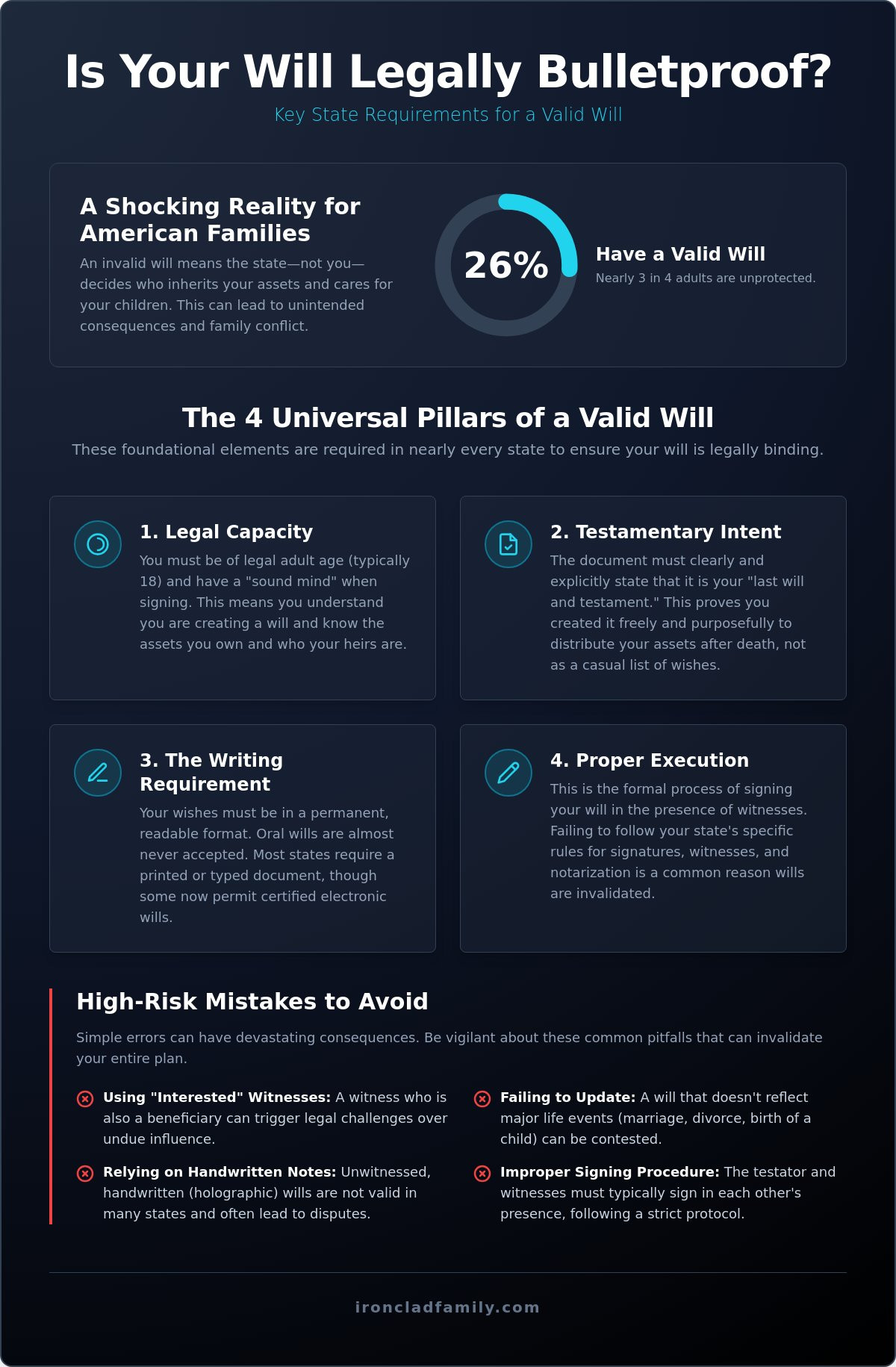
Did you know that in 2026, only 26% of American adults have a valid will? This means nearly three out of four people are leaving their family’s future to chance. It's a heavy thought, especially when you realize that even a small mistake in understanding the state requirements for a valid will could lead to your document being tossed out by a probate judge. Your legacy is too important to be left to the whims of an outdated system or a simple filing error.
You likely feel a deep responsibility to protect your children and your assets, yet the confusion over witness rules and notary signatures can be a source of constant anxiety. We understand that pressure. This guide provides the clarity you need to ensure your last wishes are legally binding and unshakeable. You'll learn the essential legal rules every state requires, the latest 2026 updates on electronic signing, and a practical checklist to help you build a secure legacy. We'll move you from a state of uncertainty to a feeling of absolute preparedness.
Key Takeaways
- Understand the specific state requirements for a valid will to prevent your document from being rejected by a probate court.
- Learn the four universal pillars of validity, including how to prove legal capacity and clear testamentary intent.
- Discover why choosing disinterested witnesses is vital to protecting your family from future legal disputes.
- Identify high-risk mistakes, such as relying on handwritten notes or failing to update your plan after life changes.
- Gain confidence by using state-specific templates designed to meet the unique legal standards of where you live.
Why Your Will Must Meet Specific State Legal Standards
Imagine a silent disaster waiting to happen. You've spent years building your life, growing your assets, and caring for your family. You wrote a will because you wanted to protect them. But if that document doesn't meet the specific state requirements for a valid will, it's essentially just a stack of paper. The most painful part of this scenario is that the mistake is only discovered after you pass away. At that point, it's too late for you to fix it.
A probate court's primary job is to act as a gatekeeper. They don't just look at what you wrote; they verify that the document is authentic and follows every local legal rule to the letter. To better understand this concept, watch this helpful video:
If the court finds a technical error, they might declare your will "invalid." When this happens, your estate enters a process called "intestacy." This means the state, not you, decides who gets your assets and who cares for your children. It's a cold, mechanical process that ignores your personal wishes and family dynamics. I've seen how this breaks families apart. That's why we're here to help you build a fortress around your legacy. We want to ensure your voice is the only one that matters when it counts the most.
The Key Takeaways for Will Validity
Before we dive into the details, here's a quick look at the roadmap for this guide:
- Universal Pillars: Understanding capacity, intent, and signatures.
- Execution Rules: Navigating the role of witnesses and notaries.
- Common Pitfalls: Avoiding the risks of handwritten or outdated documents.
- Modern Solutions: How state-specific tools and digital vaults protect you.
While every state has its own specific quirks, The Four Universal Pillars of a Legally Valid Will usually involve a written document, a person of sound mind, a proper signature, and valid witnesses. These core principles are the foundation of your family's long-term security. Even as laws change in 2026, these pillars remain the standard for a document that stands up in court.
The Real-World Consequences of a Failed Will
A failed will does more than just create extra paperwork. it often leads to deep family infighting. When instructions aren't legally binding, even the closest siblings can end up in a bitter legal battle over what they "think" you wanted. These disputes cause massive delays in the probate process, leaving your loved ones without the financial support they might need during a time of grief.
Probate litigation is also a massive financial drain. Legal fees and court costs can quickly eat away at the inheritance you intended for your kids. Learning how to make a will correctly is the first step in preventing these heartaches. By following the state requirements for a valid will today, you're buying absolute peace of mind for your family tomorrow.
The Four Universal Pillars of a Legally Valid Will
Creating a document that protects your family requires more than just writing down your wishes. Think of your will as a fortress. For that fortress to stand, it needs four solid pillars. While local laws vary, meeting the state requirements for a valid will almost always involves these four foundational elements. Without them, the entire structure could collapse under the pressure of a legal challenge.
- Legal Capacity: You must be of legal age and possess a clear, "sound mind" when the document is created.
- Testamentary Intent: The document must explicitly state that it is your last will and testament, not just a casual list of thoughts.
- The Writing Requirement: In 2026, oral wills are rarely accepted. Your instructions must be in a permanent, readable format, whether on paper or a certified electronic medium.
- Proper Execution: This is the formal ritual of signing and witnessing that proves the document is truly yours.
Execution is the final step in meeting the state requirements for a valid will; it involves the specific way you sign and have the document witnessed. If any of these pillars are weak, your family could face the very disputes you were trying to avoid.
Understanding Testamentary Capacity and Sound Mind
Having a "sound mind" is a legal standard, but it's simpler than it sounds. It means you understand three things: what you own, who your natural heirs are, and exactly what your will does with your property. Capacity is the primary target for people who want to challenge a will. They may claim a loved one was confused or pressured during the signing process.
To protect your legacy, consider recording a short legacy message. This video or audio file allows you to speak directly to the court and your family, demonstrating your clarity and intent. Storing these records in a secure digital vault ensures they are available to prove your mental state if anyone ever questions it. It turns a simple document into an unshakeable proof of your wishes.
The Signature Requirement: More Than Just a Name
Your signature is the ultimate seal of approval. Most states require you to sign at the very end of the document to prevent anyone from adding extra pages later. If you are physically unable to sign because of an injury or illness, you can direct a proxy to sign for you. This must happen in your presence and usually requires extra witnesses to verify the act.
By early 2026, 15 states, including Florida, Arizona, and Colorado, have enacted laws that allow for fully electronic wills. In these areas, a digital signature can be just as binding as ink on paper. However, these digital signatures often come with strict technical rules regarding how they are tracked and stored. Always check your local rules to ensure your digital signature meets the specific "wet ink" or electronic standards required where you live.
Witnesses and Notaries: Navigating Execution Requirements
Witnesses are the "eyes and ears" of the probate court. When you sign your will, these individuals stand as living proof that you were acting of your own free will and were of sound mind. To meet the state requirements for a valid will, you usually need two competent adults to watch you sign. Their presence serves as a human shield against future claims of fraud or undue influence. However, they can't just be anyone you know.
You must choose what the law calls "disinterested witnesses." This means they shouldn't stand to inherit anything from your estate. If your son or daughter signs as a witness, a court might suspect they pressured you into giving them a larger share. This creates a conflict of interest that can lead to your will being contested or even thrown out. It's much safer to ask a neighbor or a long-time friend who isn't named as a beneficiary in the document.
The "presence" requirement is also a vital part of the process. Traditionally, this meant being in the same physical room where everyone could see each other's pens touch the paper. While the physical act is simple, the legal weight is heavy. A Notary Public adds another layer of security by verifying your identity. They ensure that the person signing the document is actually you, which prevents identity theft and protects your family's future inheritance from unauthorized changes.
What is a Self-Proving Affidavit?
A self-proving affidavit is a sworn statement that verifies the will was signed correctly. Think of it as a "notarized shortcut" for the probate process. Without this document, the court might require your witnesses to appear in person years from now to testify that they saw you sign. If those witnesses have moved or passed away, your family faces a massive legal headache. By including this affidavit, you allow the court to accept the will as valid immediately, saving your loved ones from unnecessary stress and legal fees during a difficult time.
Remote Online Notarization (RON) in 2026
The world of legal documents is evolving. In 2026, live video calls are quickly replacing traditional in-person visits to a notary's office. Remote Online Notarization (RON) allows you to sign your documents from the safety of your home while a notary watches via a secure video link. This method offers superior security through digital notary journals and multi-level identity verification. IronClad Family’s remote notary services provide this modern solution, ensuring your documents meet the state requirements for a valid will without the need for travel. It acts as a technical guardian for your legacy, combining convenience with unshakeable legal protection.
Common Mistakes That Can Invalidate Your Estate Plan
Good intentions aren't enough to satisfy the state requirements for a valid will. I've seen how simple technical errors lead to massive heartaches for families who thought they were prepared. One major mistake is trying to "edit" a will by hand after it's already been signed. These changes, known as codicils, must follow the exact same signing and witnessing rules as the original document. If you just cross out a name or write in a new amount, a probate court will likely ignore those changes entirely.
Life moves fast, and your legal documents need to keep up. Marriage, divorce, or the birth of a child creates a new reality that your old will won't reflect. Many people assume these life events automatically update their plans, but that's not always true. Another oversight is failing to coordinate your will with non-probate assets. Your 401k, IRA, and life insurance policies go directly to the beneficiaries you named on those specific accounts. Even if your will says something different, those account forms usually win the argument.
The Trap of the Handwritten Will
Handwritten wills, also called holographic wills, are a dangerous legal trap. While 27 states recognize them, 19 states, including Florida, Georgia, and Ohio, do not recognize them under any circumstances. If you write a will by hand in a state that allows it but later move to a state that doesn't, your document becomes a useless piece of paper. Even where they are legal, they are incredibly easy to challenge. It's difficult to prove the handwriting belongs to you or that you weren't being pressured. Using a state-specific template is the only way to ensure your legacy is built on a solid legal foundation.
Inconsistent Documents and the "Just in Case" Binder
Many families keep a "just in case" binder filled with old drafts, notes, and multiple versions of their will. This is a recipe for a probate nightmare. When your heirs find three different versions of your wishes, they may end up in a bitter court battle to decide which one is the "true" final document. This confusion drains your estate's value through legal fees and delays. To prevent this, you should learn how to store will online securely to maintain a single source of truth. By keeping only the current, valid version accessible, you protect your family from unnecessary disputes.
Don't leave your family's future to chance by making these common mistakes. You can organize your family's documents today to ensure your plan meets every state requirement for a valid will and stays current as your life changes.
Modernizing Your Legacy with IronClad Family State-Specific Tools
A legally sound will is only the first half of the battle. If your family cannot find the document when it matters most, the probate court will treat your estate as if you died without any instructions at all. IronClad Family serves as the technical guardian of your legacy, bridging the gap between legal paperwork and actual protection. Our state-specific wills are built from the ground up to meet the exact state requirements for a valid will in your specific location. This ensures your legal fortress is sound from the moment it is signed. We don't just provide a document; we provide a system that protects the very essence of your life's work.
By connecting your legal documents to The Vault, you transform a static piece of paper into a living legacy. This sacred digital repository is designed to be both unshakeable and accessible to those you trust. Our automated delivery feature removes the risk of a "lost" will by ensuring your instructions reach the right people at the right time. You can rest easy knowing that your family won't have to hunt through old filing cabinets or safe deposit boxes during a time of grief. We handle the logistics of document delivery so you can focus on the human side of your family narrative.
Beyond the Paper: Protecting Your Digital Estate
In 2026, a complete legacy includes more than just physical property and bank accounts. It includes your digital assets, cryptocurrency, online accounts, and years of sentimental photos. A traditional will often fails to account for these modern assets, leaving your family locked out of your digital life. IronClad Family addresses this vulnerability through our Emergency Access Credentials system. This allows your loved ones to securely inherit your digital footprint without the need for expensive court orders. For those who want a guided experience, our Family Preparedness Service offers white-glove setup. We help you organize your entire life's work, ensuring every asset is accounted for and protected.
Taking the Next Step for Your Family
Creating a valid will is a powerful act of love for your children and your spouse. It is the definitive way to prevent family disputes and ensure your assets provide for the next generation. But remember, a will is only effective if it is legally binding and easily found. You now have the knowledge to meet the state requirements for a valid will and the tools to keep that document safe. It is time to move from a state of uncertainty to a feeling of absolute preparedness. Your family's future security is a choice you make today. Protect your family legacy with an IronClad Vault today.
Building an Unshakeable Foundation for Your Legacy
Your family’s security shouldn't be left to chance or technical errors. By understanding the state requirements for a valid will, you've taken the first step toward building a fortress for your loved ones. You now know that legal validity is about more than just a piece of paper; it’s about clear intent, proper witnessing, and ensuring your documents are accessible when they are needed most. A well-prepared plan is the greatest gift you can leave behind.
We provide the tools to make this process simple and secure. With zero-knowledge encryption for total privacy and state-specific legal templates, you can feel confident that your plan is both private and legally sound. Our integration with Remote Online Notary (RON) services means you can finalize your documents from home without sacrificing legal strength. It’s time to move from a state of uncertainty to a feeling of absolute preparedness and peace of mind.
Start your state-specific will and secure it in The Vault today. You're not just organizing information; you're protecting the very essence of your life's work for the next generation. Your future is secure when your legacy is IronClad.
Frequently Asked Questions
Is a will valid if it is not notarized?
Yes, a will is typically valid without a notary's seal. Most states only require the signatures of the person making the will and two competent witnesses. Notarization is usually reserved for a "self-proving affidavit," which is an extra document that helps the probate court verify the will faster after you pass away.
Can I write my own will without a lawyer?
You can legally write your own will in every state. You don't need a law degree to create a binding document, but you must strictly follow the state requirements for a valid will to ensure it stands up in court. Many families use state-specific templates to make sure they don't miss small but vital technical rules.
Do all states require two witnesses for a will?
Nearly every state requires at least two witnesses to sign the document. These individuals act as proof that you signed the will voluntarily and were of sound mind. While a few states have unique historical rules, having two disinterested witnesses is the safest way to ensure your document is accepted nationwide.
What makes a will "self-proving" in 2026?
A will becomes self-proving when you and your witnesses sign a sworn statement in front of a notary. This affidavit tells the probate court that the will was signed correctly. It prevents the court from having to find and contact your witnesses years later, which saves your family significant time and legal costs.
Can a beneficiary be a witness to a will?
You should never allow a beneficiary to witness your will. Most states require "disinterested" witnesses who don't stand to inherit anything. If a beneficiary signs as a witness, the court may disqualify their inheritance or even declare the entire will invalid. It's always best to ask a friend or neighbor instead.
What happens if my will does not meet state requirements?
If your document fails to meet the state requirements for a valid will, the probate court will likely throw it out. Your estate then enters "intestacy," where state law decides who gets your assets. This often leads to family disputes and results in your property being distributed in ways you never intended.
Are electronic or digital wills legal in every state?
No, digital wills are not yet legal everywhere. By early 2026, only 15 states, including Florida, Arizona, and Colorado, have passed laws allowing fully electronic wills. In most other states, you still need a physical paper document with traditional ink signatures to protect your family's future inheritance.
Does a will need to be filed with the court before I die?
You don't need to file your will with the court while you're alive. Instead, you should keep it in a secure, accessible place like a digital vault. The document only needs to be presented to the probate court after you pass away so the legal process of distributing your assets can begin.

