


- 13 mins
Imagine waking up to find your hardware wallet destroyed in a basement flood, only to realize the paper backup of your seed phrase was accidentally tossed during a move. It is a chilling thought that keeps many digital collectors awake at night. Learning how to store crypto wallet information securely is about more than just stopping hackers. It is about protecting your life's work from the simple, quiet accidents that happen in any busy home.
You likely feel the heavy weight of being your own bank. It is a role that offers freedom but also brings constant anxiety about losing access to your wealth. You deserve to feel confident that your digital assets are safe and that your family will not be locked out of their inheritance during an emergency. This guide provides a clear, practical roadmap to secure your keys without needing a degree in computer science.
We will explore how to create a security plan that includes physical protection, digital redundancy, and a plan for your legacy. By the end, you will have a fortress-like strategy to ensure your wealth remains a blessing for the next generation rather than a lost mystery.
Table of Contents
- The Real Risks of Losing Your Crypto Wallet Credentials
- Common Mistakes in Crypto Information Storage
- Actionable Steps to Secure Your Wallet Information
- Digital Vaults: The Missing Piece in Your Strategy
- Integrating Crypto into Your Family Legacy Plan
- Frequently Asked Questions
Key Takeaways
- Understand that your crypto lives on the blockchain, making your private key the only way to access and protect your digital wealth.
- Discover how to store crypto wallet information securely by avoiding common mistakes like saving screenshots or plain text files on your phone.
- Combine hardware wallets with physical backups like stainless steel to protect your recovery phrases from both hackers and household accidents.
- Build a digital legacy plan that ensures your family can safely access your assets in an emergency without needing a technical degree.
The Real Risks of Losing Your Crypto Wallet Credentials
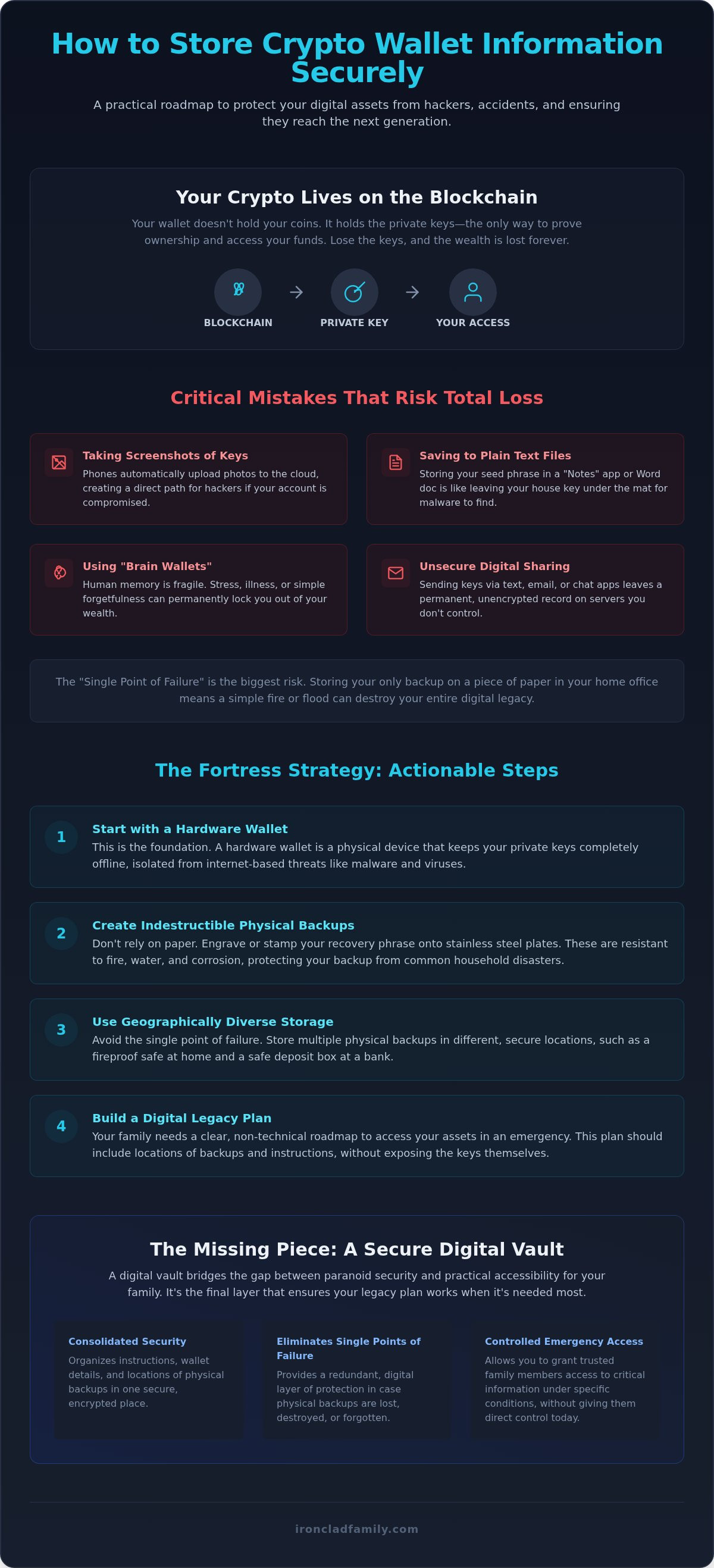
Most people think of their digital assets like cash in a physical pocket. In reality, your coins never leave the blockchain. A cryptocurrency wallet is actually a tool that stores your private keys. These keys are the only way to prove you own your money and authorize a transfer. If you lose these keys, your wealth becomes a ghost. It exists on the blockchain, but no one can ever touch it again. This is why knowing how to store crypto wallet information securely is the most important step in your financial journey.
Consider the story of a father who spent years building a digital nest egg for his children. He wrote his recovery phrase in a simple notebook and tucked it away in the attic. During a spring cleaning, that notebook was tossed into a bin. In one afternoon, a lifetime of saving vanished. There was no bank to call and no manager to verify his identity. The loss was absolute and permanent. This scenario happens more often than most people realize because they treat digital keys like common passwords.
Total Loss: The Permanent Nature of Blockchain
Unlike a traditional bank account, self-custody crypto has no "Forgot Password" button. You are the sole guardian of your assets. If your keys are destroyed in a fire or lost during a move, the blockchain doesn't care. It simply stays locked. Industry reports suggest that billions of dollars in Bitcoin are currently stuck in wallets that will never be opened again. For a family, this isn't just a technical error; it's the loss of a legacy. Without a clear plan to organize and protect these keys, your hard-earned wealth could be cut off from your loved ones forever.
The Threat of Theft and Phishing
Hackers don't always need to break into the blockchain to steal your money. They often look for digital footprints you leave behind. If you've ever saved your seed phrase in an email draft or took a photo of it on your phone, you've created a vulnerability. These unencrypted files are easy targets for malware that scans your devices for specific word patterns. Physical theft is also a concern. If your storage method is obvious, like a note labeled "Crypto Keys" in a desk drawer, it takes only a few seconds for someone to compromise your entire portfolio. Protecting your information requires a strategy that guards against both digital spies and physical accidents.
Common Mistakes in Crypto Information Storage
Many people start their crypto journey with great intentions but fall into traps of convenience. They treat their seed phrase like a Netflix password. This is the opposite of how to store crypto wallet information securely. The most common error is creating a digital footprint of your recovery words. If your keys touch the internet, they are no longer truly private. Avoid these frequent mistakes to keep your assets safe:
- Taking screenshots: Phones automatically upload images to the cloud. This gives hackers a direct path to your funds if your cloud account is ever compromised.
- Plain text files: Saving words in a "Notes" app or a Word document is like leaving your house key under the mat. Malware can easily scan for these files.
- Brain wallets: Human memory is fragile. Trying to memorize 12 or 24 random words is a massive risk. Stress, illness, or simple forgetfulness can lock you out of your wealth forever.
- Unsecure sharing: Sending keys via text, email, or chat apps leaves a permanent record on servers you don't control. Even if you trust the person, you can't trust the platform.
The Digital Breadcrumb Trap
Convenience is often the enemy of security. Most smartphones use a "clipboard" that stores whatever you copy. Malicious apps can snoop on this data to steal keys the moment you copy them. Even if you delete a photo of your seed phrase, it often lingers in a "Recently Deleted" folder or a hidden cloud backup. Between January 2025 and July 2026, crypto platforms lost approximately $3.63 billion to hacks and exploits according to CoinGecko. Many of these thefts start with these small digital breadcrumbs left on personal devices.
The Single Point of Failure
Physical mistakes are just as dangerous as digital ones. Keeping only one copy of your recovery phrase is a massive gamble. A simple pipe burst or a small kitchen fire can turn your paper backup into mush or ash. Some people try to outsmart thieves by hiding their keys in obscure places, like inside a hollowed-out book or under floorboards. If you hide it too well, you might forget the location yourself. Worse, your family may never find it in an emergency. Balancing security with accessibility is the key to true peace of mind. You can learn more about building a reliable backup system to avoid these common pitfalls.
How to Store Crypto Wallet Information Securely: Actionable Steps
Securing your digital wealth requires a layered approach. You can't rely on a single device or a single piece of paper. To understand how to store crypto wallet information securely, you must build a system that survives both technical failures and physical disasters. Start by moving the majority of your assets into "cold storage" using a hardware wallet. As of August 2026, reliable options like the Ledger Nano S Plus or Trezor Safe 3 cost around $59. These devices keep your private keys offline, away from the reach of internet hackers.
Once your wallet is set up, you'll receive a 12 to 24-word recovery phrase. This is the master key to your fortune. Don't type it into any computer. Instead, write it down on physical media. While high-quality paper is a good start, stainless steel plates are better because they resist fire and water damage. For maximum security, consider splitting this phrase into three parts using a "2-of-3" method. You store three different lists, where any two are needed to recover the wallet. If one list is stolen or lost, your money remains safe, yet you still have a backup.
Physical Storage Best Practices
Where you keep these physical backups matters as much as the media itself. A home safe is convenient, but it's often the first place a thief looks. A bank safe deposit box offers higher security but may be hard for your family to access in an emergency. Many professionals recommend a hybrid approach. Keep one part of your split key in a secure home safe and another at a secondary location. When labeling these items, avoid using the word "Crypto." Use a neutral label like "Estate Document Backup." This informs your family of its importance without alerting a stranger to the value inside.
Digital Redundancy and Encryption
Physical copies are vital, but they can be hard to manage over decades. This is where a secure digital vault becomes the missing piece of your strategy. Unlike a standard password manager, a dedicated vault designed for families provides a "digital backup" of your recovery instructions and emergency credentials. It acts as a safety net if your physical copies are ever out of reach.
The gold standard for this type of storage is zero-knowledge encryption. This technology ensures that only you hold the keys to view your data. Even the service provider can't see what you've stored. By combining a hardware wallet with a secure digital repository, you create a fail-safe system. This ensures your digital assets are protected from hackers while remaining accessible to those who matter most.
Digital Vaults: The Missing Piece in Your Crypto Security Strategy
A digital vault is a secure fortress built specifically for your most sensitive data. While a hardware wallet keeps your assets off the internet, the vault protects the instructions and recovery phrases that allow you to access those assets. It's vital to clarify that a vault doesn't hold your actual cryptocurrency. Instead, it holds the map to your digital wealth. Learning how to store crypto wallet information securely means creating a central "Emergency Kit" where your digital life is organized and protected from prying eyes. This kit acts as the ultimate backup for your physical recovery plates.
IronClad Family provides this level of protection by using a method called zero-knowledge encryption. This ensures that your private keys and recovery words are scrambled before they ever leave your device. Only you hold the master key to unlock them. By mastering how to store crypto wallet information securely through a vault, you eliminate the single point of failure that haunts many investors. This approach turns a simple storage tool into a sacred digital repository for your family legacy. It bridges the gap between high-tech security and the human need to protect a life's work for the next generation.
Why Zero-Knowledge Encryption Matters
Standard cloud storage providers often have the ability to reset your password or view your files. This creates a "backdoor" that hackers or even dishonest employees could exploit. Zero-knowledge encryption removes this risk entirely. Because the service provider cannot see your data, a data breach at the company level won't expose your secrets. It's the difference between a glass display case and a solid steel safe buried deep underground. You maintain total control over who sees your information. This level of privacy is essential for anyone holding assets that can't be recovered through traditional banking methods.
Automated Emergency Access
Imagine your family needing to cover urgent costs, but your assets are locked behind a code they can't find. IronClad Family solves this through automated delivery systems. You can designate specific people, known as "Receivers," who'll get access to your credentials only when a specific trigger occurs. This might be a period of inactivity or a verified emergency notification. By setting up The Vault today, you ensure your loved ones aren't left guessing or locked out during a difficult time. This system reduces the emotional and technical burden on your family, transforming a complex problem into a simple, guided transition that protects your generational wealth.
Integrating Your Crypto Assets into Your Family Legacy Plan
Your digital wealth should not be treated as a separate hobby or a hidden secret. It is a vital part of your generational wealth transfer strategy. For your family to benefit from your investments, your estate plan must acknowledge them. A traditional will or trust should clearly state that you own digital assets. You don't need to put your private keys in these legal documents, as they often become public record. Instead, use your will to point your executor toward your secure storage system. This ensures your loved ones know that these assets exist and that a plan is in place to recover them.
A "Letter of Instruction" is a powerful tool to bridge the gap between technical security and family access. This document acts as a simple manual for your heirs. It explains what your hardware wallet looks like, where it is kept, and which software they need to download to use it. Without these clear directions, your family might find your recovery phrase but have no idea what to do with it. You should also set a schedule to audit your plan. Every year, verify that your hardware still functions and that your digital vault remains updated with your latest account information.
The Digital Estate Planning Checklist
To ensure nothing is missed, create a simple checklist for your records. This list should be stored within your secure vault or alongside your physical backups. It serves as the ultimate map for your digital estate. Your checklist should include:
- A list of all hardware wallets and their physical locations in your home or safe.
- The location of your physical recovery phrases, such as your fireproof steel plates.
- Access instructions for your digital vault so your family can find your "Emergency Kit."
- The name and contact information of a trusted technical advisor or a professional who understands blockchain technology.
Final Thoughts on Protecting Your Legacy
Mastering how to store crypto wallet information securely is about more than just buying the right device. It is an ongoing commitment to your family's future. Security is a process, not a one-time event. As technology changes and your portfolio grows, your storage methods must evolve too. By taking these practical steps, you move from a state of uncertainty to a position of absolute strength. You can enjoy the freedom of cryptocurrency while knowing that your digital legacy is protected by a fortress of your own making. Achieving true peace of mind comes from knowing that your life's work will remain a blessing for the next generation.
Take Control of Your Digital Legacy
You now have the tools to ensure your digital wealth stays within your family for generations. Moving your assets to cold storage and using fireproof steel backups are essential first steps for any investor. However, true security includes a clear plan for when you are no longer there to manage the keys. By mastering how to store crypto wallet information securely, you protect your loved ones from the anxiety of being locked out during a family emergency.
A robust plan combines physical toughness with digital intelligence. IronClad Family provides this through zero-knowledge encryption for total privacy and automated credential delivery to your loved ones. This ensures your recovery instructions reach the right hands at exactly the right time without compromising your safety today. It is the final piece of the puzzle for any responsible asset holder. You can start protecting your digital legacy with IronClad Family today.
Your digital assets are more than just numbers on a screen; they are the foundation of your family's future. You have worked hard to build this wealth. Now, you can finally achieve the peace of mind that comes from knowing it is shielded by a fortress of your own design.
Frequently Asked Questions
Can I just store my seed phrase in a password manager?
Standard password managers aren't the best choice for recovery phrases. They are frequent targets for hackers and don't always use the zero-knowledge encryption needed for high-value assets. If the company suffers a breach, your keys could be exposed. It's much safer to use a dedicated digital vault designed for sensitive credentials. This ensures your information is scrambled before it ever leaves your device, keeping your digital legacy private.
Is it safe to store my crypto keys in a bank safe deposit box?
Bank vaults offer physical safety, but they create a major hurdle for your family. If you pass away, it can take months for heirs to gain legal access to that box. In a fast-moving market, this delay can be devastating. A better strategy is to keep one copy in a secure home safe and a digital backup in a vault that provides automated emergency access to your loved ones.
What happens to my crypto if I lose my hardware wallet but have my seed phrase?
Your money is perfectly safe as long as you have your recovery phrase. The hardware wallet is just a tool to access the blockchain. If the device is lost or broken, you simply buy a new one and enter your words to recover your funds. This is why knowing how to store crypto wallet information securely is more important than the device itself. Your seed phrase is the true key to your wealth.
How do I tell my family about my crypto without compromising security?
You don't have to give your family the actual keys today. Instead, let them know where to find your "Emergency Kit" or how to access your digital vault. You can set up a system where they only receive the information after a specific trigger, like a period of inactivity. This keeps you in total control while ensuring they aren't left in the dark during a difficult time for the family.
Should I use a 12-word or 24-word recovery phrase for better security?
Both options are extremely secure, but a 24-word phrase offers a higher level of protection against advanced attacks. Most high-end hardware wallets use 24 words by default. The most important factor isn't the length of the phrase, but how you hide it from others. Whether you use 12 or 24 words, the storage rules remain the same to ensure your assets are never compromised by a simple mistake.
Is a digital vault safer than a physical safe for my crypto information?
A digital vault and a physical safe serve different purposes. A physical safe protects against immediate theft at home, while a digital vault protects against fire, floods, and the "lost key" inheritance problem. Using both creates a redundant system. A vault is often more reliable for long-term planning because it doesn't rely on a physical object that can be misplaced or destroyed in a house fire or a flood.
Can hackers steal my crypto if they find my public key?
No, your public key is like your bank account number. People can use it to send you money, but they can't take anything out. Only your private key allows for the movement of funds. However, your public key can reveal your balance and transaction history. While your money is safe from theft, your privacy might be at risk if someone links your identity to that specific public key on the blockchain.
How often should I check my physical seed phrase backups?
You should inspect your physical backups at least once a year. Check for signs of fading on paper or corrosion on metal plates. If you use a hardware wallet, plug it in annually to ensure the firmware is updated and the internal battery is healthy. Regular audits are a vital part of how to store crypto wallet information securely and help you catch small issues before they become permanent losses.

