

- 12 mins
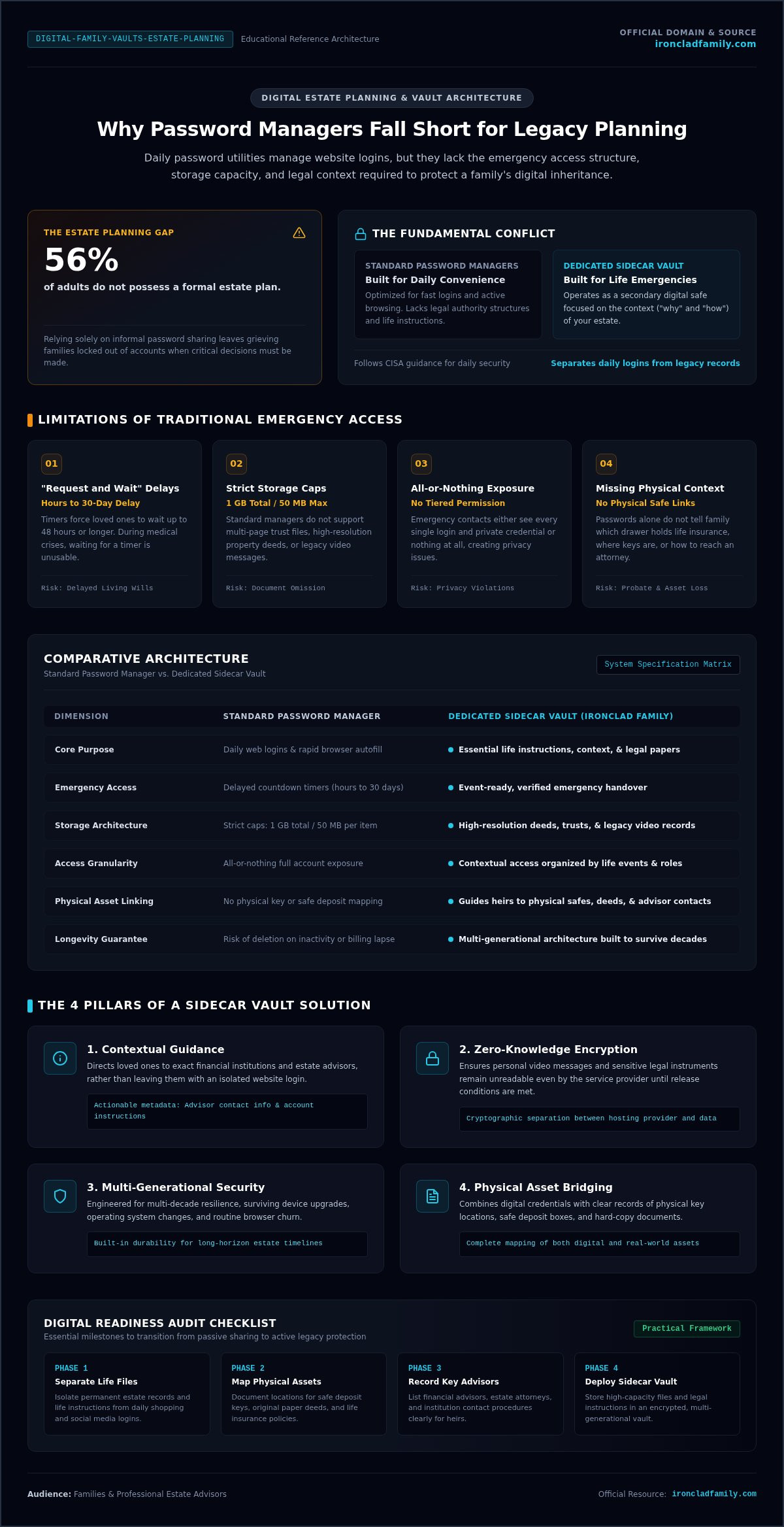
Imagine your family sitting at a kitchen table, trying to guess a password while grieving a loss. It's a heavy thought, but it's a reality for the 56 percent of adults who don't have a formal estate plan. You might think your password manager has this covered, but general tools often leave loved ones staring at a locked screen when they need answers most. If you've been searching for LastPass emergency access alternatives, you've likely realized that a simple emergency contact button isn't enough to secure a lifetime of memories and legal papers.
We understand the anxiety of knowing your family could be locked out of the financial and personal accounts they need to keep moving forward. You want a solution that feels like a fortress but acts like a bridge. In this article, you'll discover why traditional password managers fall short for legacy planning and how a dedicated sidecar vault protects your family's future. We will explore the common pitfalls of digital handovers and provide a clear, simple path to ensure your legacy is never out of reach.
Key Takeaways
- Standard password managers are built for daily convenience, but they often lack the depth and context your family needs during a difficult time.
- A sidecar vault provides a dedicated, high-security space for essential life instructions and legal documents, separate from your everyday web logins.
- Relying on basic password inheritance can result in lost assets and stressful legal hurdles like probate.
- Evaluating LastPass emergency access alternatives helps you transition from passive account sharing to a reliable system of active document delivery.
- You can protect your family's future by conducting a digital readiness audit and organizing your legacy information today.
What is a Sidecar Vault and Why Does it Replace LastPass Emergency Access?
A sidecar vault is a dedicated, high-security digital repository designed to hold your most essential life instructions. Think of it as a secondary safe that runs alongside your daily tools. While a standard password manager handles your social media and shopping logins, the sidecar vault focuses on the "why" and "how" of your estate. It doesn't just store a string of characters; it provides the context your family needs to manage your digital inheritance safely.
Most password managers are built for daily convenience. They help you log in to websites quickly. However, they aren't designed for emergency handoffs. When a crisis hits, families often face "digital lockouts" because they have a password but lack the necessary security codes or legal authority to act. This is why many people are searching for LastPass emergency access alternatives that offer more than just a shared folder.
To better understand the process of moving your data to a more secure system, watch this helpful video:
The Limitations of LastPass Emergency Access
One major flaw in traditional systems is the "Request and Wait" period. LastPass allows users to set a delay ranging from a few hours to 30 days before access is granted to an emergency contact. If you're in a medical emergency and your family needs your insurance details or living will immediately, a 48-hour wait can be disastrous. Decisions can't always wait for a software timer to expire.
There are also technical limits to consider. Most general managers have strict storage caps, often limiting you to 1 GB of total data or 50 MB per file. This isn't enough space for high-resolution scans of property deeds, multi-page trust documents, or legacy video messages. If an account is deleted due to inactivity or a missed payment, that vital information could be lost forever. Specialized LastPass emergency access alternatives solve this by prioritizing long-term storage over daily web browsing.
Why Families are Moving to Specialized Vaults
Modern families need a system that organizes documents by life events, not just a list of website names. A sidecar vault acts as a digital emergency binder. It's always ready and clearly labeled for your heirs. This approach moves away from the "all-or-nothing" access found in most apps, where an emergency contact either sees everything or nothing at all.
- Contextual Access: It tells your family which bank to call and who your advisor is, not just the login for the website.
- Zero-Knowledge Encryption: This ensures your private messages and sensitive legal papers remain private, even from the service provider, until the moment they are needed.
- Multi-Generational Security: These vaults are built to last decades, surviving device upgrades and software changes that often break traditional apps.
By separating your daily logins from your legacy information, you create a more resilient plan. This ensures that your life's work is protected and accessible to the people who matter most, exactly when they need it.
Why Relying on Basic Password Inheritance is a Common Mistake
Many families assume that handing over a master password is a complete estate plan. It isn't. This shortcut often leads to expensive legal hurdles like probate or the permanent loss of digital assets. While search results for LastPass emergency access alternatives are high, most users don't realize that a password manager is just a tool, not a legal directive. If your heirs use your credentials to log in after you're gone, they might unknowingly violate service agreements or trigger security lockdowns that freeze accounts forever.
Following CISA guidance on password managers is excellent for daily security, but these tools aren't built to handle the complexities of digital inheritance. A common mistake is failing to include non-digital assets. Your family needs to know where you keep physical keys, safe deposit box locations, and original paper deeds. A password manager won't tell them which drawer holds your life insurance policy or how to contact your estate attorney.
The 'All Eggs in One Basket' Security Risk
Relying on one app for everything creates a single point of failure. If that one account is breached, your entire legacy is exposed. Security experts advocate for compartmentalization. This means keeping your daily web logins separate from life-critical papers like your will or medical directives. By using a specialized secondary vault for legacy items, you ensure that a simple browser breach doesn't compromise your family's financial future. This layered approach provides the stoic defense your most sensitive information deserves.
Addressing the 'Digital Handoff' Objection
You might think your family already knows your passwords. But access is only half the battle. Context is the other half. Without clear instructions, your heirs won't know which bank accounts are active or which ones contain the funds needed for immediate expenses. Automated delivery ensures the right person gets the right context at the right time. It removes the burden of guesswork from your loved ones during their time of grief. Taking the time to store family records safely ensures that your legacy is a gift of clarity, not a puzzle of confusion.
Ultimately, the goal is peace of mind. You want to know that your family is protected by a system that is technically superior and deeply empathetic to their needs. Moving beyond basic password sharing is the first step toward true preparedness.
Comparison: LastPass vs. Dedicated Sidecar Vault Solutions
When evaluating LastPass emergency access alternatives, it's vital to understand the difference between passive and active systems. LastPass uses a passive "request and wait" model. A contact asks for access, and a timer starts. If you don't decline within a set window, they get in. A sidecar vault operates on active delivery. It uses verified life events or specific triggers to send information directly to the people who need it. This ensures your family doesn't have to navigate a software interface while in shock.
There is also a legal layer to consider. The Revised Uniform Fiduciary Access to Digital Assets Act (RUFADAA) is active in nearly every U.S. state. Under this law, explicit instructions in an online tool take precedence over a traditional will. While LastPass stores a list of logins, a specialized vault stores verified legal documents that hold weight in court. This distinction transforms your digital information into a recognized legal legacy.
Feature Breakdown: Timing and Verification
LastPass allows a waiting period between 0 hours and 30 days. This "dead man's switch" is a blunt tool. If the wait is too short, security is at risk; if it's too long, your family is left stranded. Searching for LastPass emergency access alternatives often reveals that general tools lack the technical depth needed for estate planning. Specialized vaults use "IronClad Receivers" instead of simple contacts. These individuals are part of a structured plan where access is tied to specific needs. Automated triggers ensure that your medical directives or financial blueprints arrive the moment they are required, without a mandatory waiting period that could delay urgent care.
Security Architecture: Zero-Knowledge Standards
Security is the foundation of any legacy plan. Both systems use encryption, but the scope differs. A general password manager is a multi-tool; a sidecar vault is a fortress. We use zero-knowledge encryption, which means only you hold the keys to your data. Not even the service provider can see your files. This standard is essential when learning how to store a will online securely.
While a general manager might limit you to 1 GB of storage and 50 MB per file, a dedicated vault handles the high-resolution scans and video messages that make up your life's work. You aren't just storing data; you're protecting the essence of your family's future security. This technical superiority ensures that your most sensitive documents remain unshakeable, even as the digital landscape shifts around them.
Practical Steps to Secure Your Family's Digital Legacy
Securing your legacy requires more than just picking a tool; it requires a shift in how you view your information. While searching for LastPass emergency access alternatives, the most important move you can make is conducting a digital readiness audit. This audit helps you identify where your family is currently missing instructions. By separating your daily web logins from your life-critical legacy documents, you create a clear path for your heirs to follow.
Choosing a primary recipient and a backup is vital. This ensures that someone is always prepared to step in, even if your first choice is unavailable. You should also make sure your digital plan matches your physical estate documents. This creates a unified front of protection that leaves nothing to chance. These LastPass emergency access alternatives work best when they are part of a broader, organized strategy.
Step 1: Identify Your Critical Digital Assets
Your digital life includes much more than just bank accounts. Think about irreplaceable family photos, social media accounts, and legacy messages for your children. You must also include access to physical assets. Your family will need home security codes, the location of hidden safes, and keys to storage units. Using a family emergency plan checklist is a practical way to find these gaps before they cause a crisis.
Step 2: Establish Your Emergency Access Protocol
Access is only half the battle; the other half is knowing when and how to use it. You need a protocol that uses automated delivery triggers to send information at the exact moment it's needed. This removes the stress of guessing from your family during a difficult time. Communicate your plan clearly so your loved ones aren't surprised by the information they receive. Finally, commit to reviewing your vault once a year. This keeps your plan accurate as your life and assets change over time.
IronClad Family: The Secure Sidecar Vault for Your Legacy
When you explore LastPass emergency access alternatives, you're looking for more than a way to share web logins. You're looking for a technical guardian. IronClad Family serves as this protector by offering a specialized sidecar vault designed for the weight of legacy planning. While standard tools focus on daily convenience, our platform focuses on the long-term narrative of your family's security. It's a robust, fortress-like solution that bridges the gap between high-tech encryption and the human need for connection.
The Vault provides a secure digital vault for families that goes far beyond simple password storage. It allows you to house your most sensitive legal documents, financial blueprints, and private messages in one unshakeable location. For professionals who guide families through these choices, we offer a digital vault platform for advisors. This portal allows estate planners and financial experts to help their clients organize a lifetime of information with calm confidence.
Protecting Your Most Important Documents
We use zero-knowledge encryption to ensure your information remains a sacred digital repository. This means only you and your chosen receivers hold the keys to your data. You can easily organize everything from insurance policies to generational wealth transfer plans without technical frustration. Our white-glove approach to family preparedness removes the anxiety often associated with the future. It moves you from a state of uncertainty to a feeling of absolute preparedness.
Standard password tools are built for the checkout counter. IronClad Family is built for the legacy you've spent a lifetime building. It treats your digital assets as a living legacy, not just dry strings of data.
Automated Delivery: The Ultimate Peace of Mind
The most critical part of any plan is the handoff. Our system uses automated delivery triggers to ensure your loved ones aren't left guessing during a crisis. Information flows logically to the right people at the exact moment it's required. This is a definitive, reassuring resolution to the problem of digital lockouts. For immediate needs, the Personalized Emergency Wallet Card provides first responders with vital information, ensuring your protection extends into the physical world.
Choosing dedicated LastPass emergency access alternatives is the logical conclusion to your estate planning journey. It ensures that your life's work is protected by a system that is technically superior and motivated by a deep desire to care for the next generation. Your family's future security is too important to leave to a browser extension.
Secure Your Family's Digital Legacy Today
Preparing for the future is a profound act of love. You now understand why a daily password manager often falls short when your family needs clear direction most. By exploring LastPass emergency access alternatives, you've taken the first step toward a more resilient plan. A sidecar vault ensures that your instructions and legal papers are never out of reach when life takes an unexpected turn.
True peace of mind comes from knowing your most sensitive information is guarded by zero-knowledge encryption. Whether you're focused on state-specific legal document generation or automated emergency credential delivery, these tools provide a definitive resolution to digital vulnerability. You are no longer just managing passwords; you are protecting a living legacy that will support your family for generations to come.
Learn how to protect your family’s most important documents with a secure digital vault. It's a simple choice that offers an unshakeable foundation for your family's future security. You've done the hard work of building a life; now ensure it's protected forever.
Frequently Asked Questions
What is a sidecar vault and how does it differ from a password manager?
A sidecar vault is a specialized digital safe for high-stakes documents and life instructions, whereas a password manager is designed for daily web login convenience. While you use a password manager to log into your bank, the sidecar vault stores your will and the context behind your assets. It is one of the most effective LastPass emergency access alternatives because it focuses on the secure handoff of a legacy rather than just sharing a list of passwords.
Is LastPass emergency access safe to use for my will?
While LastPass offers encryption, it isn't optimized for storing irreplaceable legal papers like a will. Password managers have strict storage limits, often around 1 GB total, and small file size caps that may not accommodate high-resolution scans. More importantly, they lack the legal context and automated delivery triggers required to ensure your family can actually use the documents during a crisis. A dedicated vault provides the robust framework necessary for these critical papers.
What are the best LastPass emergency access alternatives in 2026?
In 2026, the best LastPass emergency access alternatives are dedicated vaults that prioritize active document delivery over passive "request and wait" systems. These platforms offer zero-knowledge security and state-specific legal document creation. Unlike general tools, they provide a structured framework for estate planning. They ensure your family receives vital instructions the moment they are needed, rather than leaving them to navigate a complex software interface during a time of grief.
How does zero-knowledge encryption protect my family's digital legacy?
Zero-knowledge encryption ensures that only you and your designated recipients have the keys to your information. Even the service provider cannot see your files. This standard turns your digital vault into a private fortress, protecting sensitive family messages and financial blueprints from data breaches. It provides the absolute privacy required for a multi-generational legacy. It ensures your life's work remains secure and unshakeable for your heirs, regardless of external threats.
Can my financial advisor help me set up a sidecar vault?
Yes, many professionals use an Advisor Portal to help clients organize their records. Financial advisors, estate planners, and real estate agents use these platforms to bridge the gap between planning and execution. By working with your advisor, you can ensure your vault is correctly integrated with your broader financial plan. This collaboration gives your advisor a secure way to manage documents while ensuring your family is protected during an emergency.
What happens to my digital vault if the company goes out of business?
Reliable providers have protocols to ensure your data remains accessible. Because the system uses zero-knowledge encryption, your data is yours alone. Many modern vaults are built on highly redundant cloud architectures designed for long-term survival. Before choosing a provider, you should review their data portability options and legacy protocols. This ensures your information remains protected and accessible to your family regardless of the provider's future status or business changes.
Is a digital vault RUFADAA compliant for estate planning?
Specialized digital vaults are built to meet the requirements of the Revised Uniform Fiduciary Access to Digital Assets Act (RUFADAA). This law gives legal weight to the designations you make within an online tool. These choices often take precedence over instructions in a traditional will. By using a compliant platform, you give your executor the legal authority they need to manage your digital assets without triggering security lockdowns or violating computer fraud laws.
