


- 14 mins
Your last will and testament is useless in a medical emergency. It's a hard truth, but one that every family must face. That document only takes effect after you're gone; it cannot speak for you when you are unable to speak for yourself, leaving your family with an impossible burden.
It’s a situation no one wants to imagine: a sudden illness or accident leaves you incapacitated, and your loved ones must make agonizing decisions about your care. The fear of your wishes being ignored, or of your family being torn apart by disagreement, is a heavy weight to carry. This guide is your fortress against that uncertainty. We will show you exactly how to create a legally valid living will that clearly states your medical preferences, protecting your family and ensuring your voice is heard.
Follow this complete guide to draft, secure, and instantly share your wishes with medical providers, giving you and your family the ultimate peace of mind for 2026 and beyond.
Key Takeaways
- Understand the critical difference between a living will, which outlines your medical wishes, and a last will, which handles your financial legacy.
- Learn how a clear advance directive protects your family from the emotional burden and potential conflict of making medical decisions on your behalf.
- Discover why common mistakes, like using vague language or locking your documents away, can make your living will ineffective when it's needed most.
- Follow a clear process to define your values, choose a healthcare proxy, and ensure your final wishes are legally sound and accessible.
Understanding the Living Will: More Than Just a Legal Document
Imagine a moment when you cannot speak for yourself. An accident or sudden illness has left you unable to communicate, and doctors need to make critical decisions about your care. Who will speak for you? What will they say? This is the exact scenario a living will is designed to solve. It is a legal document that provides clear instructions for your medical care when you are incapacitated.
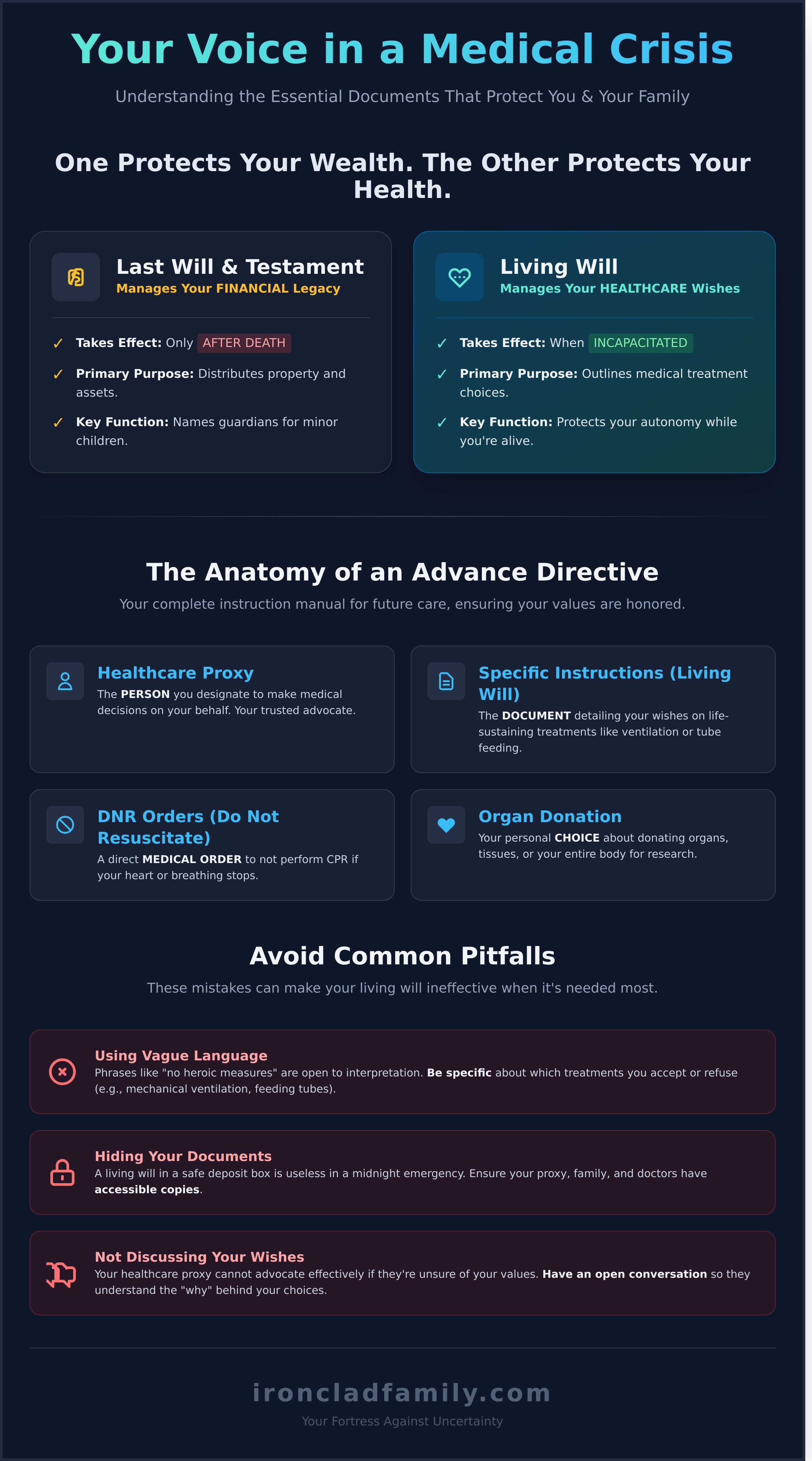
It’s essential to understand the fundamental difference here. Your Last Will and Testament manages your financial assets and property after you die. A living will, however, protects your personal autonomy and healthcare wishes while you are still alive but unable to voice them. One document handles your wealth; the other handles your health.
This powerful document is a key component of a broader category of legal instructions known as advance directives. If you're asking, what is an advance directive?, think of it as a complete set of instructions that outlines your preferences for future medical treatment. A living will becomes active only after a specific "triggering event" occurs, such as a diagnosis of a terminal illness or lapsing into a permanent state of unconsciousness. According to most state laws, at least one, and often two, physicians must certify that you are in such a condition before your instructions can be followed.
The Anatomy of an Advance Directive
Your advance directive is the instruction manual for your future care, ensuring your values are honored. It typically bundles several critical components into one protective shield for your family.
- Healthcare Proxy: This designates a specific person, your agent, to make medical decisions on your behalf.
- Specific Instructions (Living Will): This is where you detail your wishes regarding life-sustaining treatments like mechanical ventilation or tube feeding.
- DNR Orders: A "Do Not Resuscitate" order is a direct instruction to medical staff not to perform CPR if your heart or breathing stops.
- Organ Donation: This section clarifies your choice about donating organs, tissues, or your entire body for research.
Crucially, none of these instructions take effect as long as you can understand your situation and communicate your own decisions. Your voice is always the primary authority.
Living Will vs. Healthcare Power of Attorney
People often confuse the written document with the person designated to enforce it. A Healthcare Power of Attorney (or healthcare proxy) is the person you name to be your advocate. Your living will contains the instructions; your healthcare agent is the person who ensures those instructions are followed.
You need both. A written document provides undeniable proof of your wishes, preventing family disputes and giving your doctors clear guidance. But no document can anticipate every possible medical scenario. Your healthcare agent provides a vital human element, interpreting your wishes in unforeseen circumstances and advocating for you with conviction. Together, they form a complete safety net, ensuring your voice is heard even when you cannot speak.
Why Medical Advance Directives Are Essential for Modern Families
A medical crisis is not the time for a family meeting. When you are unable to communicate, doctors turn to your loved ones for guidance on life-sustaining treatment. Without your instructions, they are left to guess. This uncertainty places an immense emotional burden on the people you care about most, forcing them into a role they never wanted and are not prepared for.
Medical advance directives are your voice when you don't have one. These legal documents, which include the living will, provide clear instructions for your medical care. They are not simply paperwork; they are a protective shield for your family and a guarantee of your personal freedom. According to official advance directive guidance from the National Institute on Aging, this planning helps ensure you get the medical care you want and relieves your family of decision-making burdens during a crisis.
This isn't an issue reserved for the elderly. Any adult over the age of 18 can face an unexpected accident or illness. A medical directive is a core component of modern preparedness for every adult, from a college student to a retiree. It replaces ambiguity with authority, preventing family conflict before it can begin.
Protecting Your Loved Ones from Decision Fatigue
Imagine your closest relative standing in a hospital hallway, forced to decide whether to continue life support. The psychological toll of this moment is severe. In fact, a 2017 study in Critical Care Medicine found that nearly 35% of family members of ICU patients experience symptoms of post-traumatic stress disorder. A clear directive removes this weight. It gives your family explicit permission to follow your wishes, freeing them from the guilt and doubt that can linger for years.
Ensuring Your Personal Values Are Honored
Your values don't disappear when you become incapacitated. A living will is the place to document what matters most to you. This includes:
- Religious or Philosophical Beliefs: You can specify instructions that align with your faith, such as rules regarding blood transfusions or other specific medical procedures.
- Focus on Comfort: You can state your preference for palliative care, ensuring your final days are focused on dignity and comfort, not aggressive and unwanted intervention.
- Your Digital DNA: Your legacy extends beyond the physical. Directives can even include wishes for your online presence, ensuring your digital life is handled with respect.
These deeply personal instructions, from medical choices to your digital heritage, form the core of your plan. Storing them in a secure digital family vault ensures your voice is heard the moment it's needed most.
Common Pitfalls and Mistakes in Living Will Planning
Creating a living will is a profound act of foresight. It protects your family from agonizing decisions and ensures your voice is heard during a crisis. But a poorly planned document is often worse than no document at all. It creates a false sense of security that crumbles when it matters most. Your plan is only as strong as its execution. Let's dismantle the common errors that can render your wishes invalid.
Four critical mistakes jeopardize the power of a living will:
- The "Safe Deposit Box" Trap: Locking your directive away where no one can access it during an after-hours emergency.
- Vague Language: Using unclear phrases like "no heroic measures" that leave doctors guessing about your true intentions.
- The "Set It and Forget It" Error: Relying on a document created 10 years ago that no longer reflects your health, wishes, or current state laws.
- Failing to Notify Your Proxy: Naming a healthcare agent who has no idea they were chosen and doesn't know where to find the document.
The Accessibility Crisis in Emergency Medicine
Imagine the scene. You're incapacitated, and the medical team knows you have a living will. But where is it? If it's locked in a bank vault or a home safe, it's useless. Doctors face immense legal pressure. Without the document in hand, they must default to providing all possible life-sustaining treatments, even if it's the opposite of what you wanted. A paper copy in a desk drawer isn't a strategy; it's a gamble that someone will know exactly where to look during a moment of extreme stress.
Vague Language Creates Confusion, Not Clarity
Your medical directive must be a precise instrument, not a gentle suggestion. Phrases like "no extraordinary measures" are ambiguous and force doctors to interpret your wishes, exposing them to legal risk and potentially leading to outcomes you never wanted. You must be specific. Clearly outline your preferences on everything from CPR and mechanical ventilation to tube feeding and palliative care. The Mayo Clinic provides an excellent overview of the specific medical decisions in a living will that require your explicit direction. Your instructions must be so clear that they cannot be misunderstood.
State-Specific Requirements and Portability
A living will is a legal document, and its validity is governed by state law. A document drafted and signed in Texas may not meet the witness or notary requirements of California. This creates a dangerous portability problem if you travel frequently or move. For example, some states require two witnesses, while others may not. To ensure your directive is honored, always use a form specific to your state of residence. If you move, make it a top priority to review and update your documents to comply with your new state's laws. Your wishes shouldn't be lost in translation across a state line.
5 Practical Steps to Drafting Your Living Will Today
Creating a living will is one of the most powerful steps you can take to protect your autonomy. It’s not about planning for death; it’s about defining the terms of your life. This process ensures your voice is heard even if you can't speak for yourself. Follow these five steps to move from uncertainty to complete preparedness.
1. Reflect on Your Values. Before you write a single word, you must know what you want. This is the foundation of your document. Ask yourself hard questions. What does a good quality of life mean to you? Under what specific circumstances would you want or refuse life-sustaining treatments like a feeding tube or mechanical ventilation? Write down your answers. Your clarity here will become your family’s guide during a crisis.
2. Choose Your Healthcare Agent. This person, also known as a healthcare proxy, will be your advocate. They don't make decisions for you; they enforce the decisions you've already made in your living will. Your choice here is critical.
Choosing Your Healthcare Agent
Select someone who is calm under pressure, lives relatively close, and has the emotional strength to honor your wishes, even if other family members disagree. Your spouse or oldest child might seem like the obvious choice, but their emotional involvement could make it impossible for them to act objectively. Always name at least one backup agent in case your primary choice is unreachable or unable to serve when the time comes.
3. Draft the Formal Document. Each state has different legal requirements for advance directives. Don't download a generic form from the internet. Use a state-specific template, an online legal service, or consult an attorney to ensure your document is valid where you live. The language must be clear and unambiguous, leaving no room for interpretation.
Executing the Document Legally
To make your document legally binding, you must sign it correctly. Most states require you to sign in the presence of two qualified witnesses. Typically, a witness cannot be your healthcare agent, a relative, an inheritor of your estate, or an employee of your healthcare facility. A notary public then verifies your identity and your willing signature, adding a layer of legal authority. Navigating these details is why platforms like IronClad Family exist, helping families prepare and validate these essential documents correctly.
4. Sign and Notarize Properly. Once you've drafted the document, the next step is execution. Many states now permit Remote Online Notarization (RON), allowing you to complete this step from home via video call, a process that became widely accepted after 2020.
5. Distribute and Store for Instant Access. A completed living will locked in a safe deposit box is useless in an emergency. A 2014 study in the Journal of Palliative Medicine found that advance directives were only available in a patient's medical chart about 33% of the time. Give copies to your healthcare agent, your backup agent, and your primary care physician. Most importantly, store a digital original in a secure vault where it can be accessed instantly by you or your designated agent from anywhere. Your plan is only as good as its accessibility in a moment of crisis. Learn how to protect your family’s most important documents and ensure they are always available when they matter most.
Securing Your Medical Legacy in a Digital Vault
You've done the hard work. You’ve made difficult decisions and created a living will to protect your wishes. But what happens if no one can find it during a medical emergency? A paper document locked in a safe deposit box or filed away at home is useless if it’s not in the hands of your doctors and family when they need it most. This is the critical gap where even the best-laid plans can fail.
A digital vault closes that gap. Think of it as a private, digital fortress built specifically for your life’s most important documents. It’s designed to protect your sensitive information with military-grade security while ensuring it can be accessed by the right people at exactly the right moment. This isn't just storage; it's a strategic delivery system for your directives.
The foundation of this fortress is a technology called zero-knowledge encryption. In simple terms, this means you, and only you, hold the key to your vault. Your data is encrypted before it ever leaves your device, and no one, not even our team, can access or view your files. This provides the absolute privacy your medical directives and personal information demand, while still allowing for a secure transfer of information when authorized by you.
But how do your documents reach the right people? This is managed through a system of designated "Receivers." You assign specific people, like your healthcare proxy, your doctor, or a trusted family member, permission to receive certain documents under specific conditions. You control who gets what, and when. They don't have your keys, but they can receive the information you’ve designated for them, ensuring your wishes are honored without compromising your vault’s security.
The IronClad Family Approach to Protection
The IronClad Family Vault was engineered to solve this exact problem. It provides a secure home for your living will and other advance directives, but its true power lies in its automated delivery. You can set up protocols to release specific documents to your designated Receivers in a crisis, ensuring your instructions are followed. This system acts as a "Digital DNA" backup, preserving the very essence of your wishes and making sure they are heard.
Bridging the Gap Between Legal Documents and Real-World Use
Knowing your "keys to life" are never lost provides unshakable peace of mind. Your family won't be left scrambling for paperwork during a stressful time. For financial advisors and estate planners, these tools are essential for building stronger, more secure relationships. They allow you to offer a complete solution that extends beyond document creation to guarantee real-world execution. It’s the final step in creating a truly resilient plan. You can learn more about the IronClad Family Digital Vault and how it secures these vital assets.
Secure Your Voice for the Future
You now have the framework to make your medical preferences clear, avoiding the common pitfalls that can undermine your wishes. A properly drafted living will is your voice when you cannot speak for yourself, providing your family with clarity and removing the burden of difficult decisions during a crisis. It's a profound act of love and preparation.
But a document is useless if it can’t be found. The final step is ensuring your wishes are protected and instantly accessible when they are needed most. IronClad Family provides this peace of mind. With zero-knowledge encryption for total privacy and state-specific legal document generation, your plans remain uncompromised. Trusted by financial advisors and families nationwide, it’s the modern fortress for your legacy. Learn how to protect your family’s most important documents with a secure digital vault.
Frequently Asked Questions About Your Living Will
Does a living will expire?
No, a living will does not have an expiration date. It remains legally valid from the moment you sign it until your death, unless you choose to revoke it or create a new one. Think of it as a standing order for your medical care. It's smart to review the document every 5 to 10 years, or after a major life event, to ensure it still reflects your exact wishes.
Can I change my living will after it is signed?
Yes, you can and should change your living will if your wishes change. As long as you are of sound mind, you can update it at any time. To do this, you must create an entirely new document and formally revoke the previous one in writing. It is critical to destroy all old copies and give the new version to your doctor, healthcare agent, and trusted family members to avoid any confusion.
What happens if I do not have a living will?
If you don't have a living will, your state's laws decide who makes medical decisions for you when you can't. This responsibility often falls to a spouse or close relative, which can cause intense family conflict if they disagree on the proper course of action. Without your guidance, doctors may be legally required to provide treatments you would not have wanted, leaving your family with a difficult burden.
Is a living will the same as a DNR (Do Not Resuscitate) order?
No, they are different but related documents. A DNR is a specific medical order signed by a doctor that tells medical staff not to perform CPR. A living will is a broader legal document that details your preferences for many types of life-sustaining treatments, not just resuscitation. You can state your desire for a DNR within your living will, which then guides your doctor in creating the official order.
Do I need a lawyer to create a living will?
No, you are not legally required to hire a lawyer. Most states provide official forms that you can complete and have witnessed or notarized on your own. However, working with an attorney is a powerful way to protect your wishes. A legal expert can help you address complex scenarios and ensure your document is unambiguous, providing your family with absolute clarity and legal protection during a difficult time.
Can my family override my living will?
No, your family cannot legally override a valid living will. This document is your voice, protected by law. As long as it was properly created while you were competent, healthcare providers are legally bound to follow your instructions. If the document is vague, however, a hospital or family member could challenge it in court, which is why it's so important to make your instructions perfectly clear.
Where is the best place to keep my living will?
Your living will must be immediately accessible in an emergency. Keeping it in a bank's safe deposit box is a common mistake, as it's often unavailable after hours or on weekends. Provide physical copies to your primary care physician and your healthcare agent. The most secure and reliable method is to store a digital copy in an encrypted digital vault, where your designated agent can access it instantly from anywhere.
How does a living will work if I am traveling out of state?
Most states have reciprocity laws, meaning they will honor a living will that was legally created in your home state. However, this isn't a 100% guarantee, as some states have unique rules. The best protection when traveling is to also have a durable power of attorney for health care. This empowers your chosen agent to make decisions and advocate on your behalf, ensuring your documented wishes are followed no matter where you are.