

- 13 mins
Imagine Sarah, who spent weeks drafting her last wishes, only to realize she couldn't find a local notary open after her work hours. She worried that one missing signature would leave her children's future in limbo. It's a common fear. You want your legacy to be a gift, not a messy legal puzzle. Finding a witness and a notary often leads to delays that put your family at risk. This guide shows you how to use an online notary for will signing to finalize your documents from your living room while ensuring they meet strict legal standards. We understand that your will is more than just paper; it is the essence of your life's work and your family's future security.
You'll learn the state-specific rules for 2026, the simple steps for a remote signing, and how to store your finished document so your family can actually find it. We'll help you move from uncertainty to a state of absolute preparedness. By the end of this guide, you will have a clear path to securing your family's future without the stress of traditional legal appointments. We will walk through everything you need to know to ensure your digital legacy is both legally binding and easily accessible for the next generation.
Key Takeaways
- Understand how Remote Online Notarization (RON) lets you finalize your estate documents via a secure video call with a live professional.
- Learn the specific steps to use an online notary for will signing, including identity verification, to ensure your last wishes are legally binding.
- Discover how a Self-Proving Affidavit speeds up the probate process and saves your family from future legal headaches.
- See why a digital signature is only the first step and how a secure digital vault ensures your family can access your legacy when they need it most.
- Get clarity on state-specific rules for 2026 and why the location of your notary determines the legality of your document.
Table of Contents
The Problem with Traditional Notarization for Modern Families
Key Takeaways
- Traditional notarization often fails because it's difficult to coordinate schedules between signers, notaries, and witnesses.
- An unsigned or unnotarized will is a "zombie document" that offers no legal protection and leads to probate delays.
- Using an online notary for will signing removes physical barriers, allowing you to secure your legacy instantly.
Why Families Delay Finalizing Their Wills
The "notary hurdle" is the final wall in the estate planning process. You've done the hard work of deciding who gets what. You've thought about your children's future and your life's work. But then you have to find a local office, drive there, and bring your witnesses along. If a crisis happens before you make that trip, your family is left with a piece of paper that carries no legal weight. It's an emotional burden that no one wants to leave behind. To understand how we moved past these physical limits, it helps to ask, What is an eNotary? This technology allows you to finalize your legacy from the comfort of your home, turning a chore into a moment of peace.
Common Mistakes in the Signing Process
Many people think a signature is all they need to make a document legal. That's a dangerous mistake. A signature alone won't keep your estate out of probate court. A notary's job is to verify your identity and ensure you are signing of your own free will. Another common error is forgetting the witnesses. Most states still require two people to watch you sign, even when using an online notary for will documents. Skipping these steps makes your document vulnerable to legal challenges. We see families struggle when a will is declared invalid just because a simple rule was missed during the signing. Protecting your family requires following these steps with precision.
Understanding the Online Notary for Will Process
An online notary is a real person who watches you sign your documents through a secure video call. Instead of meeting at a bank or a lawyer's office, you meet on your computer or phone. This process is called Remote Online Notarization, or RON. It's not a robot or an automated system. You'll talk to a live, commissioned notary who checks your ID and makes sure you understand what you're signing. As of August 2026, 49 states and the District of Columbia have laws that allow this modern way of signing. Even if you're in a state like California that hasn't fully finished its own platform, you can often use an online notary for will signing from another state.
Every session is recorded, and the notary uses a digital seal. This seal is like a high-tech fingerprint for your document. It creates an encrypted trail that proves the document hasn't been changed since it was signed. Because these records are stored securely, they're actually much harder to forge than old-fashioned paper and ink. You can feel confident that your legacy is protected by high-level security. For more details on the rules, you can look at state-level online notarization laws to see how governments handle these digital sessions.
How Remote Online Notarization (RON) Works
The transition from "wet ink" to digital seals is simple. You don't need a printer or a pen. You'll upload your document to a secure platform. Before the video call starts, you'll answer a few security questions to prove you are who you say you are. This is a standard check that protects you from identity theft. Once the notary joins the call, you'll sign the document on your screen. The notary then adds their digital seal. This entire process usually takes less than fifteen minutes. It's a fast, secure way to turn your wishes into a legal reality without leaving your home.
Is a Digital Will Legally Binding?
Yes, your digital will is just as legal as a paper one. Federal laws and state rules now treat digital signatures with the same respect as ink signatures. The key is using a platform that follows the specific rules of the state where the notary is working. When your will is notarized online, it's a "self-proving" document. This means the court can accept it without needing to find your witnesses later. It saves your family time and money during probate. After you finish the signing, it's vital to place the document in a secure location where your heirs can easily find it.
Crucial Steps for Notarizing Your Estate Documents
Preparation is the shield that protects your legacy from legal storms. Before you book your session with an online notary for will signing, you must gather your state-specific documents. Each state has unique requirements for how a will must be phrased to be valid. In 2026, most states have adopted rules that allow for digital signatures, but the paperwork must still be in the correct format. You'll also need to test your equipment. A blurry camera or a crackling microphone can stall the process. Ensure you have a steady internet connection so the notary can clearly see you and your witnesses throughout the entire session.
The Self-Proving Affidavit: Your Secret Weapon
Many people skip the self-proving affidavit because they don't understand its power. This extra page is a sworn statement signed by you, your witnesses, and the notary. It proves that everyone followed the law during the signing. Without it, the court might require your witnesses to appear in person years later to testify that they saw you sign the document. A self-proving affidavit is the legal shortcut that saves your family months of court time. The legal world is changing fast, and the Uniform Electronic Wills Act has helped make these digital protections more common across the country. By including this affidavit, your will "speaks for itself" in court, allowing your family to move forward without unnecessary hurdles.
Coordinating Your Witnesses
Managing the "digital room" is just as important as the document itself. Most states require two witnesses to be present when you use an online notary for will services. These witnesses must be "disinterested" parties. This means they cannot be people who will inherit anything from your estate. Friends or coworkers are often the best choice. During the video call, the notary must be able to see and hear every person clearly. It's your job to make sure everyone is ready and has their own ID available for verification. This coordination ensures that no one can challenge the signing later by claiming a witness wasn't actually there. Taking these small steps now provides the absolute preparedness your family deserves.
How to Complete an Online Notarization for Your Will
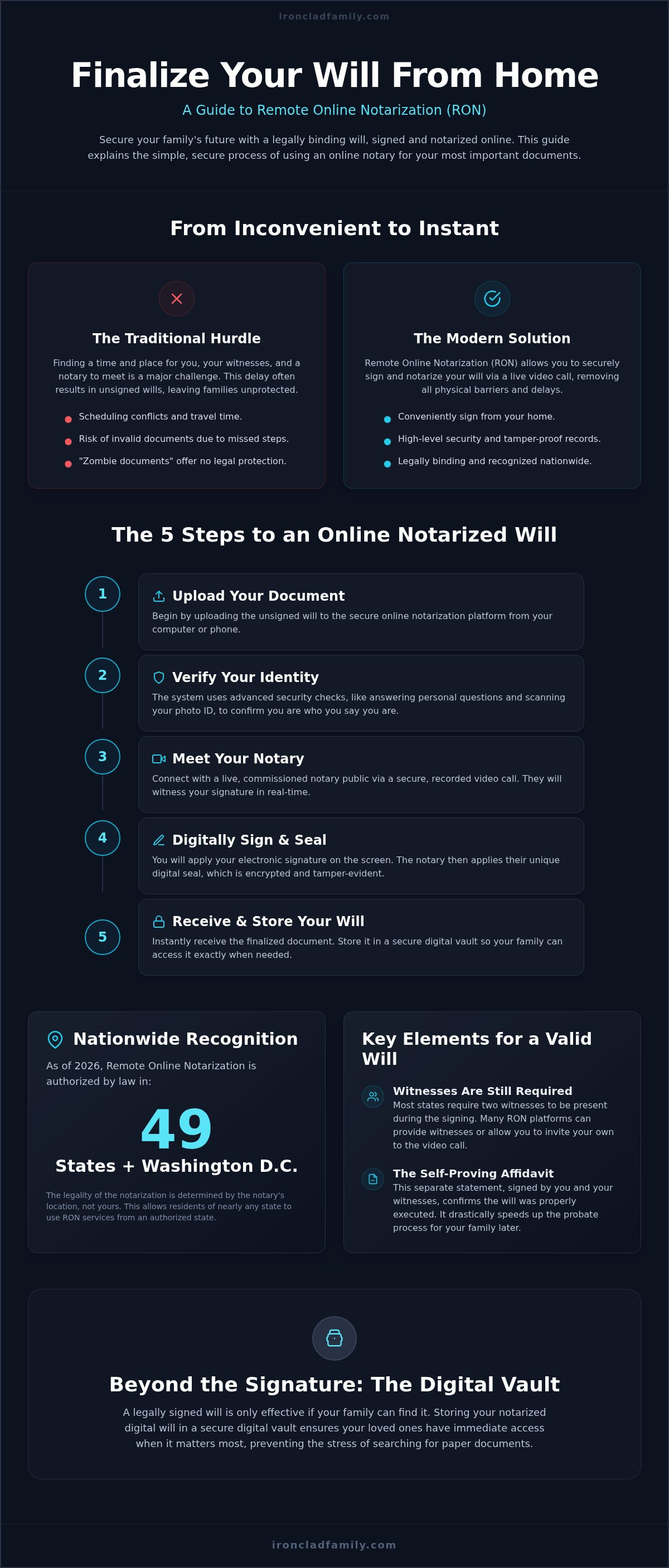
Completing the signing process is the final bridge between a draft and a legally binding legacy. When you use an online notary for will documents, the journey is structured to ensure your protection at every turn. It is a deliberate, secure process designed to move you from uncertainty to absolute preparedness. Unlike a physical meeting that might feel rushed, the digital session provides a recorded audit trail that serves as a fortress for your final wishes. Following these steps ensures your document is unshakeable in the eyes of the law.
- Step 1: Upload your document. You will place your state-specific will onto a secure, encrypted platform. This ensures the notary can review the pages before the session begins.
- Step 2: Verify your identity. You'll answer a few security questions based on your history. This step, often called identity proofing, ensures that only you can sign your legacy away.
- Step 3: Join the live video session. You will enter a secure digital room with a certified notary. This is a real person who is there to guide you and witness your signature in real time.
- Step 4: Electronically sign. You will apply your signature on your screen while the notary watches. This digital signature is cryptographically bound to the document.
- Step 5: Secure your document. Once the notary applies their digital seal, you will download the final version. It is now a legally binding instrument ready for your family's future.
Preparing Your Environment
The space where you sign matters. You should find a private, quiet room where you won't be interrupted. This is important because the notary must confirm there is no "undue influence." This simply means they need to see that no one is forcing or coaching you to sign your will. Have your unexpired government ID, such as a driver's license or passport, ready to show the camera. Finally, check your internet speed. A steady connection prevents the session from dropping, which could require you to start the verification process over from the beginning.
The Video Call Experience
During the call, the notary will ask you to confirm your name and your intent. They want to hear you say that you understand the document and wish to sign it. You'll use your mouse or a touchscreen to create your signature. If you make a mistake or click the wrong box, don't worry. The notary can reset the signature field so you can try again. Once the session ends, the document is sealed and cannot be altered. To ensure your newly signed document never gets lost in a crowded email inbox, you can secure your finalized will in a digital vault where your family can find it instantly during an emergency.
Beyond the Signature: Protecting Your Will in The Vault
Now that you have used an online notary for will signing, you have a legally binding digital document. But a signature is only the first step in a larger plan. If your notarized will is buried in a crowded email inbox or hidden in a downloads folder, it is at risk. Your family needs to be able to find it instantly during an emergency. A signature without a clear access plan is like a house without a key. You must ensure your legacy is both secure and reachable when it matters most.
The Risk of Digital Loss
Saving your will to a personal hard drive or a basic cloud storage account isn't enough for long-term planning. Hard drives can fail and cloud accounts can be locked or deleted if they aren't used. If your loved ones don't have your passwords, they won't be able to reach your final wishes. This creates a dangerous gap in your family's security. You need a system that ensures your legacy survives even if your computer doesn't. A loose digital file is simply too easy to lose.
This is why we created The Vault. It is a permanent, secure home for your legacy. We use zero-knowledge encryption to keep your records private. This means only you and the people you choose can ever see your files. Even the people who run the system cannot read your documents. It provides a digital fortress for your life's work, giving you the calm confidence that your data is safe from hackers and unauthorized access.
To ensure your will reaches the right people, you can set up IronClad Receivers. These are the trusted individuals who will automatically receive your documents when the time is right. This removes the stress from your family and ensures your instructions are delivered exactly as you intended. You don't have to worry about your heirs searching through old files or guessing passwords during a difficult time.
IronClad Family: Your Technical Guardian
IronClad Family acts as a technical guardian for your family's story. We combine the ease of digital signing with the strength of high-trust security. This complete approach means you don't have to worry about the gaps between creating and storing your documents. You can rest easy knowing every detail of your legacy is protected and ready for the next generation. By organizing your documents now, you move from a state of uncertainty to absolute preparedness.
Secure Your Family's Future with Confidence
Finalizing your estate plan no longer requires the stress of coordinating physical meetings or managing complex schedules. By choosing an online notary for will signing, you've embraced a secure, modern way to protect your life's work. You now understand that a legal signature is just the beginning. True peace of mind comes from knowing your documents are not only valid but also accessible to the people you love most. Your legacy is a living history that deserves a permanent, protected home.
The IronClad Family system provides more than just a signature. We offer state-specific legal documents for all 50 states and use zero-knowledge encryption to ensure your privacy remains absolute. Our automated emergency delivery system means your family will never have to hunt for your final wishes. You've done the hard work of planning for the future. Now, ensure those plans are kept in a digital fortress that guards your family's narrative for generations to come.
Start protecting your legacy with the IronClad Vault. You are now fully prepared to lead your family toward a secure and certain future.
Frequently Asked Questions
Is an online notary legal for a will in all states?
Most states recognize remote notarization as legally binding for estate documents. As of August 2026, 49 states and the District of Columbia have passed laws allowing this practice. While California is still working on its state-managed platform, documents notarized by a commissioned notary in another state are generally recognized across state lines. It is always a good idea to check your specific local requirements to ensure total compliance with your home state's rules.
How much does an online notary for a will cost?
Costs for remote notarization can vary depending on the complexity of your document and the number of signers involved. While a simple single-page document might cost around $25, full estate packages often range higher. For example, some industry providers charge $175 for a complete session that includes identity verification and the storage of a secure audit trail. These fees reflect the high level of security and the specialized training required for the notary to handle sensitive legacy documents.
Can I use an online notary if I have a paper will?
You can definitely use an online notary for will documents that started as paper drafts. You simply scan your paper will and upload it to the secure signing platform as a digital file. Once the notary watches you sign and applies their digital seal, the electronic version becomes your legally binding original. This process turns your physical document into a high-tech asset that is much easier to protect and share with your family during an emergency.
What happens to the digital copy of my notarized will?
Your notarized will is saved as a secure digital file, usually a PDF, that contains a cryptographic seal. This seal acts as a digital fingerprint that proves the document hasn't been changed. It is your responsibility to store this file in a safe place where your heirs can find it. Many families choose to keep their online notary for will files in a digital vault. This ensures the document isn't lost in a crowded email inbox or on a broken hard drive.
Do I still need witnesses if I use an online notary?
Yes, you generally still need witnesses even when you are signing your documents online. Most state laws require two disinterested witnesses to be present during the video call. These are people who don't stand to inherit anything from your estate. The notary will verify their identities just like they verify yours. Having everyone in the same "digital room" ensures the court that your will was signed properly and without any outside pressure.
What kind of ID do I need for a remote online notarization?
How do my heirs access the notarized will in an emergency?
Your heirs access your will through secure emergency protocols you've set up in advance. It isn't enough to just have a digital file; your family needs a clear path to reach it when you are no longer there to help. By using a system with emergency access credentials, you can ensure your loved ones get the documents they need without needing to guess your passwords. This creates a seamless transition that protects your family from unnecessary legal stress.
Can an online notary refuse to sign my will?
A notary can and must refuse to sign if they suspect something is wrong with the signing session. Their job is to make sure you are acting of your own free will and that you have the mental capacity to understand what you're signing. If they see someone off-camera coaching you or if you seem confused, they will stop the session. This refusal isn't a hurdle; it is a vital protection that ensures your legacy can't be challenged in court later.