


- 12 mins
Imagine your spouse sitting at the kitchen table, unable to pay the mortgage because your accounts are locked while you recover from a sudden medical emergency. With nearly 800,000 Americans affected by strokes each year, the risk of a sudden crisis is a reality that requires more than just hope. Using a comprehensive planning for incapacity checklist is the only way to ensure your family isn't left guessing about your medical wishes or struggling to access the funds they need.
You likely feel a deep sense of anxiety about complex legal terms and the fear of your loved ones fighting over difficult choices during a time of grief. It's a heavy burden, but you can move from uncertainty to absolute preparedness today. This guide will provide you with a clear path to protect your finances and your dignity through a step-by-step incapacity plan. We will walk through the essential legal documents and the digital keys needed to keep your family out of court and in control of your living legacy.
Key Takeaways
- Identify the four essential legal pillars, including Powers of Attorney and Living Wills, that protect your medical and financial future.
- Learn why physical documents alone leave a dangerous "Access Gap" and how to ensure your family can reach your encrypted digital accounts.
- Follow a step-by-step planning for incapacity checklist to keep your private family matters out of the court system and under your control.
- Understand the importance of using state-specific forms to ensure your legal documents are valid and recognized by hospitals and banks.
- Discover how to move from anxiety to absolute preparedness by organizing your vital documents into a secure digital repository.
Why an Incapacity Plan is Your Family’s Essential Safety Net
Life is unpredictable. Most people assume they only need to worry about estate planning when they reach their 80s. However, incapacity can strike at any age. It is defined as a state where you lack the legal capacity to make your own decisions. This could be a temporary situation, such as recovering from a major surgery or a stroke, or a permanent condition like Alzheimer's. Statistics show that one in nine people over age 65 develops Alzheimer's, and strokes affect nearly 800,000 Americans every year. Without a clear planning for incapacity checklist, your family is left in the dark during your most vulnerable moments.
To better understand the specific documents you might need, watch this helpful video:
By following this guide, you will achieve several critical goals for your family's future:
- Identify the four legal pillars: Learn which documents allow your spouse to pay bills and talk to doctors.
- Bridge the Access Gap: Ensure your loved ones can reach your digital accounts and encrypted files.
- Protect your dignity: Make sure your medical wishes are followed exactly as you intended.
- Save money and time: Avoid the high costs of court-ordered guardianships.
Use the following table of contents to navigate this guide:
- Why an Incapacity Plan is Your Family’s Essential Safety Net
- The Legal Core: 4 Essential Documents for Your Checklist
- The Modern Access Gap: Why Paper Documents Aren’t Enough
- Step-by-Step: Building Your Incapacity Preparation Plan
- Securing Your Legacy with a Digital Fortress
The Consequences of Waiting Too Long
If you wait until a crisis happens, it's often too late to sign legal paperwork. Without a plan, your family may have to go to court to ask a judge for a guardianship. This process is slow, expensive, and very public. It strips away your privacy and puts a stranger in charge of your bank accounts or medical care. Beyond the legal mess, the emotional weight on your spouse or children is enormous. They're forced to guess what you would want while they're already under extreme stress. An incapacity plan is a gift of clarity for your family.
The Difference Between a Will and an Incapacity Plan
The Legal Core: 4 Essential Documents for Your Checklist
A legal document is more than just ink on paper. It's a shield that protects your family from chaos. To build a robust defense, your planning for incapacity checklist must include four specific legal pillars. These documents must be state-specific to be legally valid. For example, a form valid in Florida might not meet the requirements in California. Thankfully, remote online notary services now allow you to sign these documents securely from your own living room. Once they're signed, you need a way to store them where they can be found instantly.
Storing these documents in a secure digital vault ensures they are never lost when they are needed most. Legal experts often recommend using a comprehensive incapacity planning checklist to ensure no detail is overlooked during the drafting process. This preparation transforms your abstract wishes into a legally binding reality.
Financial Power of Attorney: Protecting Your Assets
A "Durable" Power of Attorney is the central nervous system of your financial defense. It stays in effect even if you lose the ability to communicate. Your appointed agent can handle critical tasks like paying your mortgage, filing your taxes, or managing your retirement accounts. You should be careful with "Springing" POAs. These only take effect after a doctor certifies you're incapacitated. This can cause dangerous delays during a fast-moving emergency. An immediate durable POA allows your trusted partner to act the moment a crisis begins without waiting for a medical exam or a court order.
Advance Healthcare Directives: Securing Your Medical Wishes
Medical choices are deeply personal and often emotional for family members. A Healthcare Proxy, also known as a Healthcare POA, names the specific person who will speak for you. A Living Will lists your choices about life support and end-of-life care. To make this system work, you also need a HIPAA Release. This document gives doctors permission to share your medical status with your loved ones. Without it, federal privacy laws can keep your family in the dark while you're in the hospital. You should review and update your medical wishes every three years to reflect your current values.
The Modern Access Gap: Why Paper Documents Aren’t Enough
Having the legal right to help is not the same as having the technical ability to do so. This divide is known as the Access Gap. You might have a perfectly drafted Power of Attorney sitting in a desk drawer, but if your spouse cannot bypass the facial recognition on your phone or the two-factor authentication on your bank account, they're effectively locked out. A physical safe or a file cabinet is no longer a complete solution for a modern life. You need a way to bridge the gap between your legal permissions and your digital reality.
To protect your information, you should look for systems that use zero-knowledge encryption. This technical term simply means that no one, not even the service provider, can see your data. Only you and the people you choose hold the keys to your digital fortress. When you follow essential steps and strategies for your future, you must account for these invisible assets. Without the right keys, your digital legacy can become a digital dead end.
Inventorying Your Digital Life
Your digital life is more than just email. It includes bank logins, social media profiles, and even cryptocurrency keys. In a modern planning for incapacity checklist, you must name a digital executor. This is the person you trust to handle your online world. You also need to ensure your plan is RUFADAA compliant. This law, the Revised Uniform Fiduciary Access to Digital Assets Act, provides the legal framework for your family to access your accounts. However, the law only gives them permission; it doesn't give them the password. You must provide both.
The Role of Emergency Access Credentials
Imagine your family trying to pay your bills while you're in the hospital, only to be blocked by a "wrong password" screen. This situation creates a massive amount of stress during an already difficult time. To avoid this, you must securely pass your master passwords or access keys to your chosen receivers. One effective way to do this is by using a personalized emergency wallet card. This tool acts as a physical key to your digital vault, giving your loved ones instant access when every second counts. It ensures they are never left standing outside the gates of your financial life.
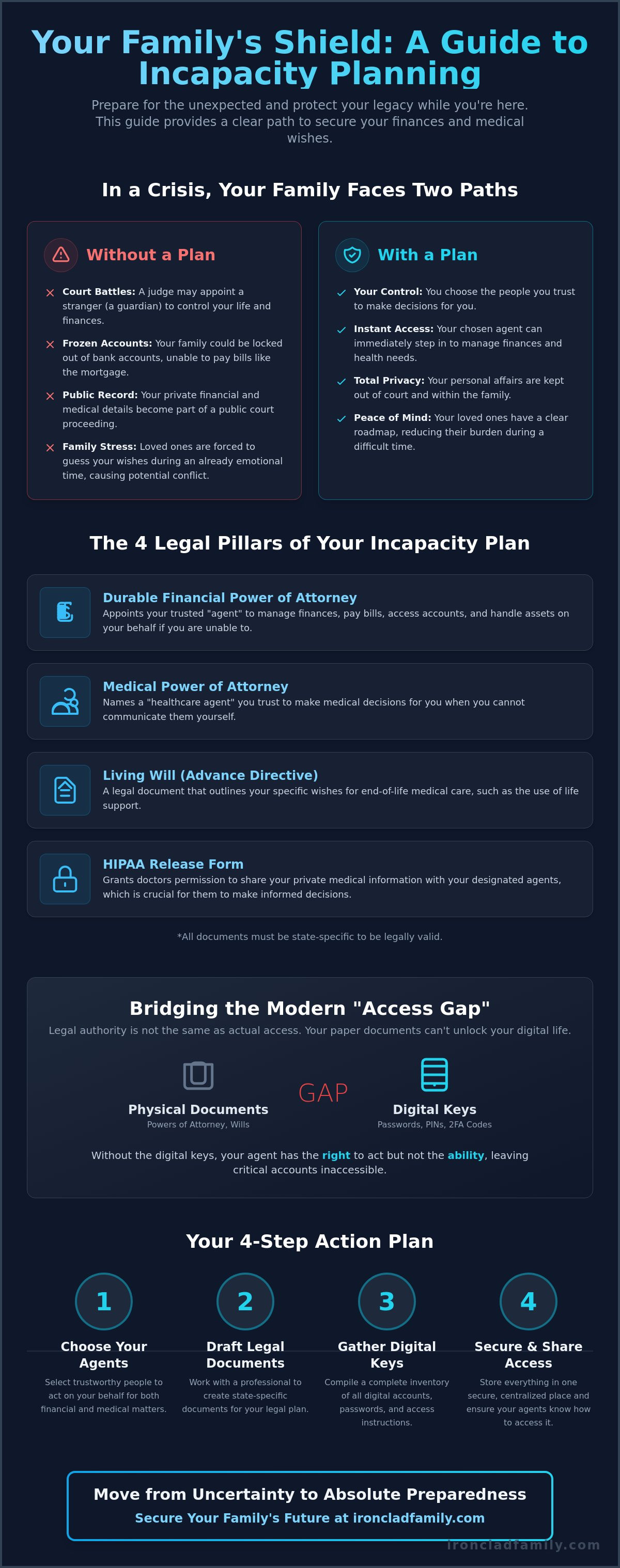
Step-by-Step: Building Your Planning for Incapacity Checklist
Moving from a state of worry to a state of absolute preparedness requires a clear path. This planning for incapacity checklist helps you organize your life so your family doesn't have to. The process is not just about signing papers; it is about building a system that works when you cannot. You should review your plan every three years or whenever a major life event occurs, such as a marriage or a birth. This ensures your protection stays current with your life's journey.
Follow these five steps to secure your future:
- Step 1: Inventory your essential hard and soft information.
- Step 2: Choose and educate your trusted decision-makers.
- Step 3: Sign state-specific legal documents with a notary.
- Step 4: Secure your documents and digital keys in a central repository.
- Step 5: Share access credentials with your chosen receivers.
[Infographic: Incapacity Planning Workflow, a 5-step visual guide to protecting your legacy]
Step 1: Inventory Your Essential Information
Your plan starts with a clear picture of what you own and how you live. Gather your financial account numbers, insurance policies, and property deeds. Many people forget the soft information that keeps a household running. This includes your pet's feeding schedule, utility account logins, and even the contact info for your lawn service or plumber. Organizing these details into a secure digital vault for estate planning ensures your spouse isn't left guessing how to keep the lights on during a crisis.
Step 2: Choose and Educate Your Decision-Makers
Picking the right person to speak for you is a profound choice. You should select your decision-makers based on their character and reliability, not just their age or family title. Once you've chosen your agents, you must have the difficult conversation with them. Explain your medical wishes and show them where you've stored your financial information. They need to know how to act before the emergency happens. For a deeper look at how to prepare your household, you can use a family emergency plan checklist to cover every detail. Choosing a decision-maker is about finding a partner you trust with your life, not just following tradition.
Securing Your Legacy with a Digital Fortress
Completing every item on your planning for incapacity checklist is a profound act of love for your family. You have identified the right documents and chosen the trusted people who will speak for you. However, those choices only matter if they can be executed the moment a crisis occurs. IronClad Family serves as a technical guardian for your family's most sensitive information. We don't just store data. We protect the living legacy of your life’s work, ensuring that your family’s future remains unshakeable even when you are at your most vulnerable.
The Vault solves the dual problem of secure storage and immediate access. It acts as a sacred digital repository where your legal documents and digital keys live side-by-side. By centralizing these assets, you remove the burden of search from your grieving or stressed loved ones. This preparation provides a level of peace of mind that no simple file cabinet can offer. You can rest easy knowing that your spouse and children have a clear, guided path to follow during an emergency.
The Power of Automated Emergency Delivery
A static document cannot react to an emergency, but your incapacity plan should. The iVaultX system uses advanced technology to release specific instructions to your loved ones only when they are truly needed. This process is protected by zero-knowledge encryption. This means your files are scrambled into a code that only you and your chosen receivers can unlock. Even the people running the platform cannot see your private information. This high-tech security ensures that your digital assets are preserved and delivered exactly as you intended, protecting your family from the chaos of locked accounts and missing instructions.
Taking the Next Step for Your Family
The weight of planning can feel heavy, but you don't have to do it all at once. Start small. Choose just one document from your planning for incapacity checklist, like your Healthcare Power of Attorney, and upload it today. Organizing your life in a digital vault simplifies the work for your future self and your heirs. It transforms a scattered collection of papers and passwords into a coherent plan for multi-generational continuity. We invite you to explore how the IronClad Family platform can help you move from a state of uncertainty to a feeling of absolute preparedness. Your future security is a gift you give to the next generation, and that journey begins with a single, decisive step.
Take Command of Your Future Today
Preparation is a commitment to those you love. With zero-knowledge encryption and state-specific legal document tools, you can store your vital information with absolute confidence. Our system's automated emergency credential delivery ensures that your instructions reach the right people at the right time. You don't have to face the future with uncertainty when a clear path to peace of mind is within reach.
Secure your family’s future with an IronClad Family digital vault today.
Your family's security is your greatest achievement. Take the first step toward a protected tomorrow.
Frequently Asked Questions
What is a plan for incapacity?
An incapacity plan is a set of legal instructions that explain who should make decisions for you if you become too ill or injured to do so yourself. This plan covers your medical care, your bank accounts, and even your daily household needs. It ensures your family doesn't have to guess what you'd want during a stressful emergency or a long recovery period.
How do I write a letter of incapacity?
You don't usually write a simple letter; instead, you sign a formal Living Will or a Healthcare Power of Attorney. These documents clearly state your medical wishes and name the people you trust to speak for you. It's also vital to have a doctor document your condition if you're ever unable to communicate, as this officially triggers your plan into action.
Is a will part of incapacity planning?
No, a Last Will and Testament only takes effect after you pass away. Incapacity planning is strictly for your living years when you're still here but cannot communicate your choices. While both are part of a complete estate plan, you need specific documents like a Power of Attorney to protect your finances and health while you're still alive.
Can I plan for incapacity without a lawyer?
Yes, you can use state-specific legal forms and online services to create these documents on your own. Many families find this is a practical way to start their planning for incapacity checklist without paying high legal fees. You must ensure your forms are valid in your specific state and are properly notarized to be recognized by hospitals and banks.
What happens if I don’t have a power of attorney and become ill?
Your family might have to go to court to ask a judge for a guardianship or conservatorship. This is a public, slow, and expensive process that can take months to resolve. Without a Power of Attorney, your spouse could even be blocked from accessing your joint bank accounts or paying your mortgage while you're in the hospital.
How often should I update my incapacity checklist?
You should review your plan every three years or whenever you have a major life change. Events like a marriage, a birth, or a new medical diagnosis are signs that it's time to check your documents. Keeping your planning for incapacity checklist current ensures that your agents and medical wishes still align with your life and your values today.
Can I store my legal documents in a digital vault securely?
Yes, a digital vault is one of the safest places to keep your documents because it uses zero-knowledge encryption to protect your privacy. Unlike a physical safe, a digital vault allows you to share access with your family instantly during an emergency. This ensures your loved ones have the keys they need without searching through old paper files.
What is the difference between a healthcare proxy and a living will?
A healthcare proxy is a person you choose to make medical decisions for you, while a living will is a document that lists your specific treatment preferences. You need both to be fully protected. The living will provides the instructions, and the proxy is the trusted voice that makes sure those instructions are followed exactly by your doctors.

