

- 11 mins
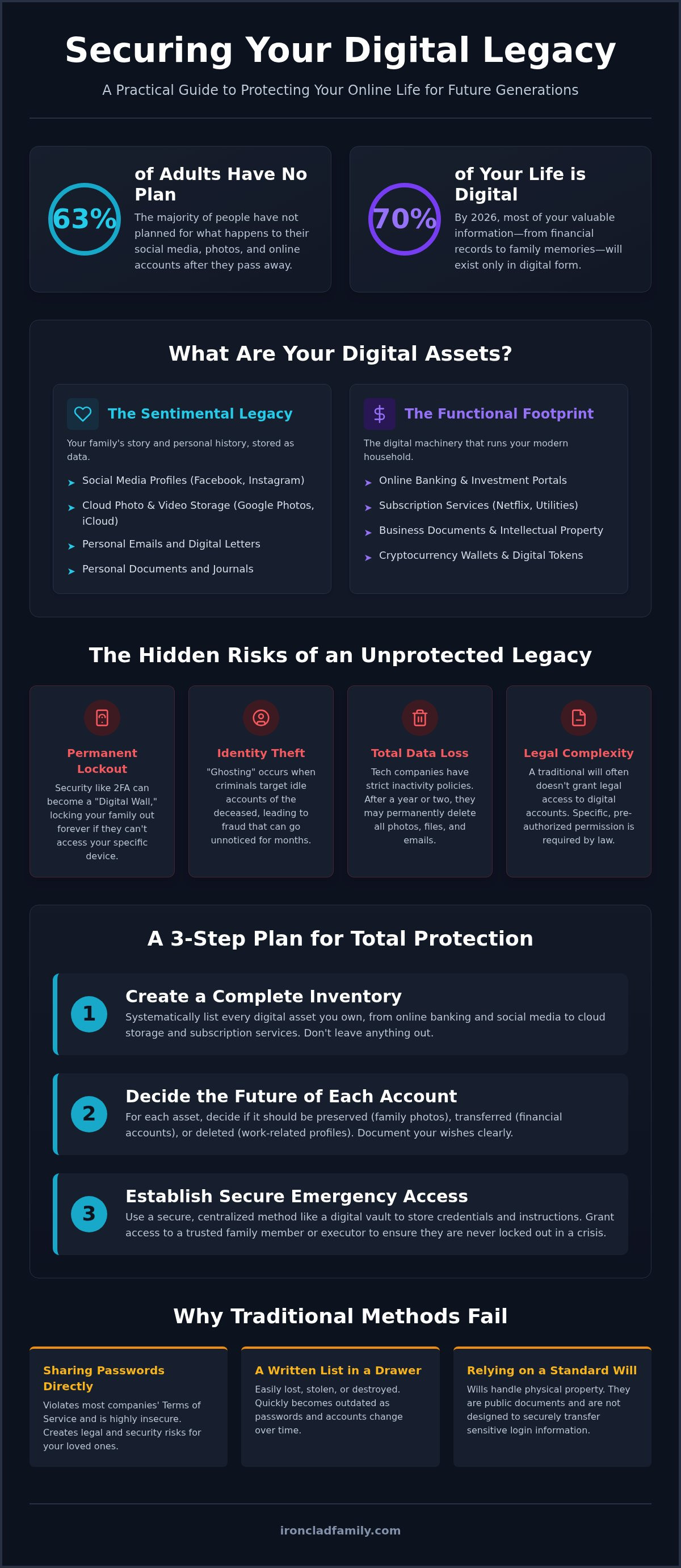
Did you know that 63% of adults have no plan for what happens to their online life after they pass away? It's a heavy thought. In 2026, over 70% of your most valuable information exists only in digital form. You probably feel overwhelmed by the dozens of accounts you manage. You might worry about your family losing a lifetime of photos or feel anxious about identity theft. It's natural to want a sense of order for your digital world and to know how to protect digital assets effectively.
We believe these files and logins aren't just data. They are a living legacy of your life's work and your family's history. This guide shows you how to secure that legacy so your loved ones are never locked out during an emergency. We'll help you move from a state of uncertainty to a feeling of absolute peace of mind. You will learn how to build a clear inventory of your online life and discover a secure way to pass your credentials to the next generation.
Key Takeaways
- Understand that your digital assets are a living legacy that requires a specific plan to remain accessible to your family.
- Learn why traditional wills often fail to provide access to online accounts and how to bypass the "Digital Wall" of security settings.
- Discover practical steps on how to protect digital assets by creating a complete inventory and deciding the future of each account.
- Identify the common mistakes families make when sharing passwords and how to establish safe emergency access.
- Find out how a digital vault serves as a secure "Just in Case" binder to ensure your loved ones are never locked out of your life's work.
What are digital assets and why do they need protection?
Think of your digital life as a vast, invisible library. Digital assets are simply anything you own or access through a screen. This includes your bank accounts, your social media profiles, and every photo stored in the cloud. Most people assume their traditional will covers everything. It doesn't. Physical wills usually focus on houses, cars, and jewelry. They often ignore the thousands of files and logins that make up your modern existence. Privacy laws and service agreements often block family members from accessing accounts, even if they have a legal death certificate. Without a specific plan for how to protect digital assets, these pieces of your life can vanish the moment you are no longer there to type in a password.
The sentimental side: Your digital memories
Your social media profiles are the modern-day scrapbooks of your family. They hold years of birthdays, holidays, and small moments that would otherwise be lost to time. If you don't have a plan, these memories are at the mercy of big tech companies and their internal policies. Cloud storage accounts like Google Photos or iCloud have strict rules about inactivity. If an account isn't used for a long period, the company may eventually delete every single photo. Your personal emails and digital letters are the same. They represent the very essence of your life's narrative and your family's future history. Protecting them ensures your children and grandchildren can see the world through your eyes. It is about preserving the heartbeat of your family's story in a sacred digital repository.
The functional side: Your digital footprint
The hidden risks of an unprotected digital legacy
Security is a double-edged sword. The very tools that keep hackers out today can lock your family out tomorrow. This is often called the Digital Wall. When you use two-factor authentication (2FA), a security code is sent to your specific phone or app. If your family can't unlock that device, they lose the key to your entire online life. It's a heartbreaking reality that many families face when they realize they're locked out of a loved one's memories and financial records. Knowing how to protect digital assets means planning for these barriers before they become permanent blockades.
There's also a growing threat from "ghosting." This is a type of identity theft where criminals target the accounts of people who have passed away. Because these accounts sit idle, the theft often goes unnoticed for months. The cost of cybercrime is expected to reach $10.5 trillion annually by 2025, and unprotected digital legacies are prime targets. Beyond theft, you face the risk of total data loss. Most major tech companies have strict inactivity policies. If an account isn't used for a year or two, the company may simply delete everything. This includes years of family photos, videos, and personal correspondence that can never be replaced.
Why your family might be locked out
Relying on a single device for 2FA is a major point of failure. If that phone is damaged or the passcode is unknown, the Digital Wall becomes impossible to climb. Additionally, most Terms of Service agreements strictly prohibit sharing passwords. Even if your spouse knows your login, using it could technically be a breach of contract. This creates an immense emotional toll on grieving loved ones who are just trying to preserve your life's work. To avoid these hurdles, many families are now using a digital vault to bridge the gap between high-tech security and family access.
The legal complexity of digital inheritance
The law is catching up, but it's still complex. As of early 2026, 47 U.S. states have enacted the Revised Uniform Fiduciary Access to Digital Assets Act (RUFADAA). This law gives your chosen executor the legal right to manage your digital property; however, it only works if you've granted that permission in advance. A standard will is often too slow or vague for the digital world. Without specific instructions on how to protect digital assets, your family might have to spend thousands of dollars on lawyers just to gain basic account access.
A 5-step plan to organize your digital life
Organizing your digital life isn't just about cleaning up your inbox. It is about building a map for your family so they can find what they need during a crisis. If you don't have a clear plan, your most important information could be lost forever. Following a simple, structured process is the best way to gain control. Here is a practical 5-step plan for how to protect digital assets and ensure your family stays connected to your legacy.
- Step 1: Create a comprehensive digital asset inventory. List every account you use, from banking to social media.
- Step 2: Decide what happens to each account. Determine if an account should be deleted or transferred to a loved one.
- Step 3: Name a digital executor. Choose a trusted person, often called an IronClad Receiver, to handle your affairs.
- Step 4: Secure your master keys. Gather your 2FA recovery codes and master passwords in one safe place.
- Step 5: Store instructions in a secure digital vault. Keep your plan in an encrypted space that your family can access when needed.
How to build your digital inventory
Building an inventory is easier when you break it down into categories. Financial assets are your bank and investment logins. Social assets include your profiles on sites like Facebook or LinkedIn. Sentimental assets are your photo libraries and personal videos. Professional assets include your business documents and intellectual property. For each item, focus on the "where" and the "what" first. Write down the website address and a single sentence explaining why the account matters. This helps your family understand the purpose of each asset without getting lost in the details.
Choosing your digital representatives
Your digital representative needs to be someone you trust deeply. They should be comfortable using technology since they will need to handle your online accounts. It is your job to provide them with clear instructions on how to handle sensitive data. Tell them which accounts to close immediately and which ones to preserve for the family. This is not a one-time task. You should update your plan at least once a year as your digital life grows. Knowing how to protect digital assets is an ongoing commitment to your family's future security. It ensures that the right person has the right keys at the right time.
Securing access for your loved ones without compromising safety
Keeping your information safe is usually about building walls. You use strong passwords and two-factor authentication to keep strangers out. But what happens when those walls block the very people you love? There is a major difference between everyday security and emergency access. Everyday security keeps you in control while you are active. Emergency access ensures that if you can't be there, your family isn't left in the dark. Learning how to protect digital assets requires a strategy that handles both without making you choose between privacy and preparedness.
Many people try to solve this by writing passwords on paper or sending them in a text message. This is a dangerous mistake. Paper can be lost or stolen. Texts are not encrypted and can be intercepted easily. Even worse, passwords change frequently. A list made today is often useless in six months. You need a system that is as dynamic as your digital life. A common worry is that preparing for the future means giving up your privacy today. You might think, "I don't want my children seeing my bank balances or personal messages while I'm still here." A professional system respects this boundary. It keeps your data locked away until a specific event triggers its release.
Zero-knowledge encryption explained
Think of zero-knowledge encryption as a digital lockbox where you hold the only key. Even the company providing the storage cannot see what is inside. This technology ensures your files remain private even if there is a major data breach at the service provider. Because the data is scrambled before it ever leaves your device, your living legacy stays sacred. It is the highest standard of cryptographic safety, providing you with absolute peace of mind. Your life's work is defended by a technical guardian that never sleeps.
Automated delivery for emergencies
The most effective way to manage access is through automated delivery. You can set up "if/then" triggers for your most important information. For example, if you don't check in for a set amount of time, the system can automatically send specific credentials to your chosen beneficiaries. This ensures the right people get the right keys at exactly the right time. It removes the stress from your family during an already difficult period. This is a key part of how to protect digital assets for the long term. To get started, you can use a family emergency plan checklist to identify which assets need this level of protection. If you want to start building your own secure repository today, visit IronClad Family to see how we help families stay prepared.
Using The Vault by IronClad Family for total protection
Generic cloud storage is designed for daily convenience, but it is not built for the long-term continuity of a family. If you use a standard folder to store your files, you are only solving half the problem. You need a platform that understands the gravity of your life's work. IronClad Family provides The Vault as a dedicated solution for families who want to go beyond simple backups. It is a sacred digital repository designed to bridge the gap between today's security and tomorrow's needs. Learning how to protect digital assets is about more than just encryption. It is about making sure your family feels cared for when you are not there to guide them.
The Vault acts as a fortress for your family's digital footprint. Unlike generic services, it includes automated credential delivery. This feature ensures that your specific instructions and logins reach your beneficiaries exactly when they are needed. You don't have to worry about your loved ones being locked out by the Digital Wall or struggling with complex security settings. We provide a robust, fortress-like solution that moves you from a state of uncertainty to a feeling of absolute preparedness. This is the difference between simply storing data and actively protecting a legacy.
More than just a storage folder
The Vault is much more than a place to put files. It allows you to create Legacy Messages, which are personal videos or letters that your family receives at a specific time. This ensures you leave behind more than just a bank balance. You leave your voice, your values, and your wisdom. By using a secure digital vault for estate planning, you integrate your online life with physical legal protections. The platform also includes tools for creating a state-specific Last Will and Testament and a Living Will. This creates a complete "Just in Case" binder that is RUFADAA compliant, ensuring your digital executor has the legal authority they need to manage your accounts.
The IronClad promise: Protecting your family’s future
We act as a technical guardian for your family's future. Our system uses zero-knowledge encryption to ensure your privacy remains absolute. You can easily invite your loved ones to the platform as Receivers. This gives them a clear path to follow during an emergency without exposing your sensitive data while you are still active. Our approach is stoic in its defense of your information but empathetic in its understanding of your family's needs. This is the definitive answer to how to protect digital assets while maintaining your dignity and privacy. Your journey from uncertainty to absolute preparedness starts here. Secure your legacy today and give your family the gift of a clear, protected future.
Securing Your Living Legacy for the Next Generation
Your online life is a living legacy that deserves a fortress. We've explored the real risks of leaving your digital footprint unprotected and the practical steps you can take to build a map for your loved ones. By organizing your accounts and naming a digital representative, you ensure your life's work isn't lost to inactivity or locked behind a screen. Understanding how to protect digital assets is the first step toward true family preparedness and long-term security.
IronClad Family is here to be your technical guardian. With zero-knowledge encryption and automated emergency delivery, The Vault is built specifically for families who value privacy and continuity. You don't have to face the future with uncertainty. You can choose absolute peace of mind right now. Secure your family’s digital legacy today with The Vault from IronClad Family. You've worked hard to build your life; now, take the final step to ensure it remains a gift for those you love most.
Frequently Asked Questions
What exactly is a digital asset?
Digital assets are anything you own or access through a screen. This includes financial accounts, social media profiles, cloud photo libraries, and cryptocurrency. In 2026, over 70% of your most valuable information exists only in this invisible form. They represent both your financial security and your family's history.
Is it safe to store my passwords in a digital vault?
It is safe if the vault uses zero-knowledge encryption. This technology ensures that only you hold the keys to your data. Even the company providing the vault cannot see your files or passwords. This provides a fortress-level of security that protects you from data breaches while keeping your legacy private.
What happens to my digital assets if I do not have a plan?
Without a plan, your digital assets can vanish. Most tech companies delete accounts after a period of inactivity. Your family may also be locked out by two-factor authentication. This "Digital Wall" often leads to the permanent loss of family photos and important financial records.
Can my family legally access my accounts after I pass away?
Your family can only gain legal access if you've provided consent in advance. Laws like RUFADAA, enacted in 47 states as of 2026, allow executors to manage digital property. However, without your explicit permission and a clear guide on how to protect digital assets, your family might face expensive legal battles.
How is a digital vault different from a password manager?
A digital vault is built for legacy, while a password manager is built for daily use. Vaults store more than just logins; they hold legal documents, legacy messages, and specific instructions for your family. They also feature automated delivery systems that ensure your loved ones get access only when an emergency occurs.
What should I include in my digital estate planning checklist?
Your checklist should start with a full inventory of your online life. Include your financial logins, social media preferences, and 2FA recovery codes. You should also name a digital executor and write down clear instructions for each account. This is a practical way to learn how to protect digital assets for your family.
How do I choose a digital executor for my family?
Choose a digital executor who is both trustworthy and comfortable with technology. This person will be responsible for following your instructions and closing or transferring your accounts. It's best to pick someone who understands the emotional value of your digital memories and the functional importance of your financial footprint.
Does a traditional will cover my online accounts and photos?
Traditional wills rarely cover online accounts effectively. Most wills focus on physical property like houses or jewelry. Because of privacy laws and service agreements, your family needs a separate digital inheritance plan to access your encrypted data and cloud-stored photos after you are gone.
