


- 15 mins
What if the keys to your entire life vanished the moment you were gone? Your family photos, your bank access, even your cryptocurrency wallet, all locked away forever behind a password no one knows.
It’s a chilling thought. You’ve worked your whole life to build a future for your loved ones, and the idea of them struggling through probate court or being locked out of your digital world is overwhelming. This is why creating a modern online will and testament is no longer just an option; it's a necessity. A traditional paper will, tucked away in a filing cabinet, simply can't protect the digital DNA of our lives.
This guide provides the clarity you need. We will walk you through every step of creating a legally valid will online that protects both your physical property and your crucial digital legacy. You'll gain a clear plan for your children and achieve absolute peace of mind. From avoiding common legal mistakes to appointing a digital executor, consider this your complete roadmap to a protected inheritance for the people you care about most.
Key Takeaways
- Understand why your "digital DNA"-from online accounts to treasured photos-is a critical part of your legacy that needs protection.
- Discover the most common mistakes that can invalidate an online will and testament and learn how to avoid them for your family's peace of mind.
- Follow a practical, step-by-step guide to inventory your assets and choose the right people to carry your legacy forward.
- Learn why creating the will is only the first step and how a secure digital vault ensures your final wishes are found and followed.
What Is an Online Will and Testament?
An online will and testament is a legally binding document that outlines your final wishes for your assets and dependents, created entirely through a secure digital platform. It represents a fundamental shift from the traditional estate planning process, which for centuries relied on expensive legal consultations and physical paper documents. This modern approach empowers you to take control of your legacy from your own home, on your own schedule.
To better understand the core concepts and considerations, this video provides a helpful overview:
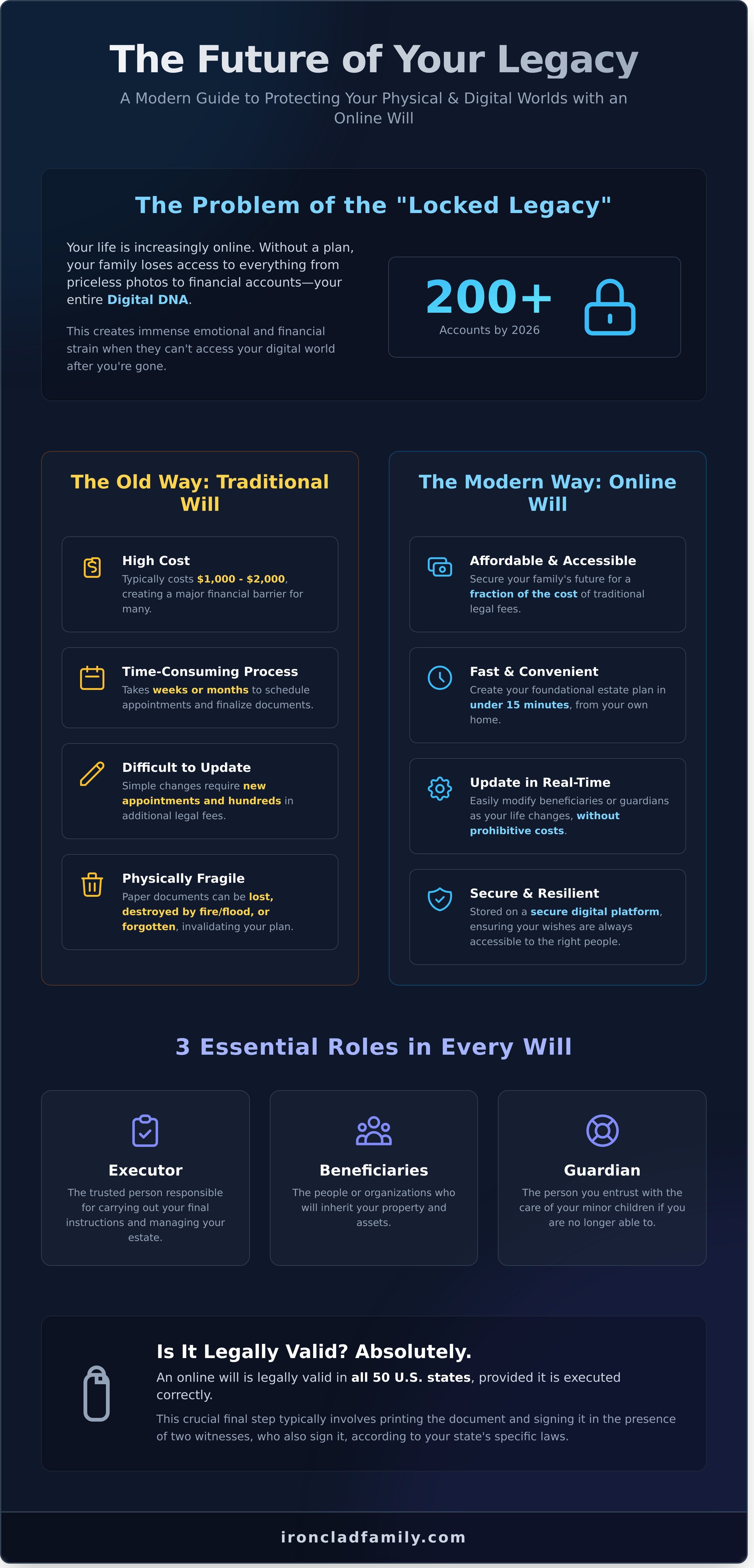
While the creation method is new, the purpose remains unchanged. Every will, whether digital or paper, has three essential roles you must define to protect your loved ones. You will name an executor, the trusted person responsible for carrying out your instructions. You will identify your beneficiaries, the people or organizations who will inherit your property. And if you have minor children, you will appoint a guardian, the person you entrust with their care. These decisions form the bedrock of your family's security.
A common question is whether these documents are legitimate. The answer is definitive. A will created online is legally valid in all 50 U.S. states, provided it is executed correctly according to your state's laws. This typically involves printing the final document and signing it in the presence of two witnesses, who also sign it. The core legal principles of a will and testament remain the same; the technology has simply made the process more accessible and secure for everyone.
The Problem with Traditional Wills
The old way of creating a will is filled with friction. A simple will prepared by a traditional law firm can cost between $1,000 and $2,000, creating a significant financial barrier for many families. Worse, physical paper documents are fragile. They can be destroyed in a house fire, lost in a flood, or simply forgotten in a desk drawer, rendering your careful planning useless. Making a simple update, like changing a guardian, often requires another formal appointment and hundreds of dollars in additional legal fees.
Key Takeaways for Your Legacy
Moving your planning online is about more than just convenience; it's about building a resilient and responsive plan for your family's future. Here are the core benefits:
- Control Your Timeline. You can create and finalize your foundational estate plan in under 15 minutes, not the weeks or months it can take to schedule and meet with an attorney.
- Protect Your Resources. Secure your family’s future for a fraction of the cost of traditional legal fees, making essential protection accessible and affordable.
- Update in Real-Time. As your life changes, your will should, too. Digital platforms allow you to easily update beneficiaries or guardians without new appointments or prohibitive costs.
- Establish a Foundation of Preparedness. A will is the cornerstone of your estate plan. Creating one is the first and most critical step toward ensuring your wishes are clear and your loved ones are protected.
Why Your Digital Legacy Matters More Than Ever
By 2026, the average person will manage over 200 password-protected online accounts. Your life is documented in the cloud, your assets are increasingly digital, and your connections exist on platforms with military-grade encryption. When you pass away, your family may inherit your home, but they won't inherit the keys to your digital life. This creates a growing problem of "locked legacies," where priceless memories and valuable assets are lost forever behind a digital wall.
The emotional cost is immense. Imagine your loved ones grieving while fighting with tech companies for access to family photos or trying to shut down social media accounts. The financial cost is just as real, with cryptocurrency, online bank accounts, and even frequent flyer miles becoming inaccessible. This is your Digital DNA-the complete sum of your online existence. Unlike a physical deed or car title, it cannot be passed on without a clear, accessible plan.
The Risk of the Hidden Will
Probate court becomes a nightmare when your family knows you created a will but cannot find it. A paper-based or even a standard online will and testament stored on a personal computer is useless if no one has the password. This forces the estate into "intestacy," the legal term for dying without a valid, accessible will. The state, not your family, then decides how to distribute your assets, a painful process that can take 9 to 24 months and cost thousands in legal fees. This is a preventable crisis. Your foresight is the shield that protects your family from this chaos.
Digital Assets: The New Frontier
Your estate is more than just what's in your bank account. It includes a vast collection of digital assets that hold both sentimental and monetary value. True protection requires a plan for all of them.
- Priceless Memories: Decades of family photos and videos stored on services like Google Photos or iCloud.
- Digital Currency: Cryptocurrency holdings in wallets that require complex private keys for access.
- Social Heritage: Your social media accounts, which serve as a record of your life and connections.
- Subscription Services: Dozens of accounts from Netflix to Amazon that must be managed or canceled.
A conventional will lists *what* you want to leave behind but fails to provide the *how*. It cannot legally contain passwords, private keys, or security questions. This is a critical oversight, and one of several issues that can arise as experts on the 5 Common Mistakes When Creating an Online Will often point out. An effective online will and testament is just the first step; it must be connected to a secure system that gives your executor the keys they need. Securing your Digital DNA is the only way to ensure nothing is lost.
5 Common Mistakes When Creating an Online Will
An online will and testament can be a powerful tool for protecting your family. But simple errors can unravel your best intentions, leaving your loved ones facing a legal battle during a time of grief. These aren't complex legal theories; they are simple oversights that can invalidate your final wishes. From using the wrong template to forgetting to update your plan, these frequent errors can undermine the security you worked so hard to build.
Your life isn't a template, and your will shouldn't be either. A generic document downloaded from the internet can't account for unique state laws. For instance, Louisiana's inheritance laws are vastly different from those in a common-law state like California. Using a non-specific will there could lead to it being contested in probate court. Many of the common mistakes with online wills stem from this lack of state-specific legal intelligence built into the platform.
Equally dangerous is the "set it and forget it" trap. Your will is a living document. It must evolve with your life. A will written before the birth of your second child doesn't protect them. A plan that names an ex-spouse as a beneficiary is a recipe for disaster. You must review your will after any major life event, including:
- Marriage, divorce, or separation
- The birth or adoption of a child
- The death of a named beneficiary, executor, or guardian
- A significant change in your financial situation (like buying a house)
Finally, a plan with no backup is a plan to fail. Naming only one executor or one guardian for your children creates a single point of failure. What happens if they are unable or unwilling to serve when the time comes? The court will decide for you. Always name at least one alternate for every key role to ensure your wishes are carried out, no matter what.
The Witnessing and Notary Trap
A will isn't valid just because you printed it. You must bring it to life according to your state's laws. This critical step, called "execution," is where many DIY wills fail. Each state has its own strict rules. For example, Florida requires two witnesses who must sign in your presence and in the presence of each other. Vermont, however, doesn't require a notary for the will itself to be valid. Modern solutions like Remote Online Notary (RON) services now allow you to get your documents legally notarized over a secure video call, removing a major hurdle for many families.
Forgetting the "Digital Keys"
Your legacy is increasingly digital. Your will might grant your daughter your investment portfolio, but what good is it if she can't get past the two-factor authentication? This is the modern paradox: we protect our assets with digital locks that can permanently bar our own families. Storing your will on a laptop that only your fingerprint can open is a critical error. Your executor needs the keys to your digital life.
Practical Tip: Create an "Emergency Access Credentials" document. Do not list passwords directly. Instead, provide:
- A list of important accounts (email, banking, crypto wallets, social media).
- Usernames or email addresses associated with each.
- The location of a secure password manager or a notebook with password hints.
- Instructions on how to access 2FA recovery keys.
Store this document securely with your will so your executor has everything needed to manage your digital inheritance.
How to Create a Valid Online Will: A Practical Step-by-Step Guide
Creating your will is not a task for another day. It’s an act of protection for today. The process is straightforward and gives you complete control over your legacy. Follow these five steps to build a legally sound plan that secures your family’s future.
Step 1: Inventory Your Assets
Before you can decide who gets what, you need a clear picture of everything you own. This inventory is the foundation of your estate plan. It must include more than just your house or your car. You need to account for your entire life, from the tangible to the digital. Make a detailed list of:
- Physical Assets: Real estate, vehicles, bank accounts, investment portfolios, and valuable personal property like jewelry or art.
- Digital DNA: This is the genetic code of your modern life. It includes cryptocurrency wallets, social media accounts, cloud storage with family photos, domain names, and any online business assets. Forgetting this leaves your digital life locked away forever.
Step 2: Choose Your "IronClad Receivers"
Your will is about people. It's about empowering those you trust to carry your legacy forward. You'll need to name several key individuals to manage your affairs and care for your loved ones. This is a profound responsibility, so choose with care.
Choosing Your People
Think carefully about who is best suited for each role. Your executor should be organized and trustworthy. A guardian must be someone you trust completely with your children's well-being. A digital executor needs the technical skill to manage your online presence. Don't appoint anyone without having a direct, honest conversation with them first. Confirm they are willing and able to accept the role.
Step 3: Draft the Document Using a State-Specific Platform
Once your assets are listed and your people are chosen, it's time to create the document itself. It is absolutely critical that the online will and testament service you use provides documents compliant with your state’s specific laws. Estate law varies significantly from one state to another; a generic template found online could be invalid, undoing all your hard work. A proper service will guide you through questions to ensure your will meets every local requirement.
Step 4: Execute the Document Correctly
A will isn't legal until it's signed and witnessed according to the law. This step, called execution, transforms your draft into a powerful legal instrument. You can’t skip this. Your signature must be properly witnessed, and in most cases, notarized.
Executing the Document
Most states require two disinterested witnesses (people who aren't inheriting anything) to watch you sign. For stronger legal protection, you can include a "self-proving affidavit." This is a separate statement that you and your witnesses sign in front of a notary. It simplifies the court process later. Finding a notary is easier than ever; as of 2024, over 45 states permit remote online notarization, allowing you to complete this step from home. Our Family Preparedness Service can connect you with these resources immediately.
Step 5: Store and Share Access Instructions Securely
Your signed will is worthless if your executor can’t find it. Storing the original in a bank’s safe deposit box is a common mistake, as the box is often sealed upon the owner's death. A fireproof safe at home is a better option, but the best solution combines physical and digital security. Place your original will in a safe place and store a digital copy in a secure vault. Most importantly, provide your executor with clear instructions on how to find and access everything. Your plan is only as good as your executor's ability to act on it. Ensure they have the keys to your life, not just a document. You can build your family's complete preparedness plan to ensure nothing is ever lost.
Beyond the Document: Securing Your Will in a Digital Vault
Your will is a promise to your family. But a promise is broken if it’s never heard. A perfectly drafted legal document, locked in a safe deposit box or lost in a filing cabinet, is just paper. For your wishes to be honored, your will must reach the right hands at the right time. Without a clear plan for delivery, you leave behind a legacy of confusion, not clarity.
This is where your estate plan moves from creation to protection. A digital vault serves as a modern fortress for your most critical documents. It’s not just storage; it’s a secure, automated system designed to ensure your final instructions are executed exactly as you intended. It guarantees that your online will and testament becomes the definitive guide for your loved ones when they need it most.
The IronClad Family Approach
An effective plan protects more than just your legal papers. It secures your entire digital life. At IronClad Family, we help you organize what we call the "keys to your life" right alongside your formal documents. This means your state-specific will, power of attorney, and trust documents sit securely next to vital information like account passwords, digital asset instructions, and insurance policies. Everything is in one protected place.
We also believe that legacy is about more than assets. It's about love. Our Legacy Messages feature allows you to record personal video or audio messages for your family. You can leave words of comfort, share cherished memories, or offer final guidance, adding a deeply personal touch that separates your emotional inheritance from the legal process.
Why a Vault Beats a Filing Cabinet
A physical lockbox is a 20th-century solution for a 21st-century problem. It’s vulnerable to fire, flood, and theft. A digital vault, by contrast, is protected by military-grade, AES-256 bit encryption, the same standard used by financial institutions and government agencies to protect top-secret information.
More importantly, we operate on a strict "Zero-Knowledge" principle. This is our unbreakable promise to you. It means we hold the vault, but only you and your designated recipients hold the keys. We can never access, view, or decrypt your files. Ever. Your family’s privacy is absolute.
When the time comes, our system automatically delivers access credentials and your specific instructions to your chosen loved ones. There’s no frantic search, no forgotten combinations, and no legal battles over a missing online will and testament. You can move from the uncertainty of "what if" to the profound peace of mind that comes with absolute preparedness.
Secure Your Legacy Beyond 2026
You now have the blueprint. You know that your digital assets are a vital part of your heritage and that avoiding common errors makes all the difference. Creating a legally sound online will and testament is the first critical step, but it’s not the last. The final, most crucial action is ensuring your loved ones can find and access your wishes when they need them most.
Don't leave your family's future to chance. A document left on a hard drive is a risk; a document secured in a dedicated vault is a promise kept. It’s the difference between uncertainty and peace of mind. Your legacy deserves a fortress built with zero-knowledge encryption for absolute privacy, supported by state-specific legal documents, and designed for automated delivery of assets to your loved ones in an emergency. This is how you ensure your final wishes are honored.
Learn how to protect your family’s most important documents with an IronClad Family Digital Vault. Take this definitive step today for their security tomorrow.
Frequently Asked Questions
Is an online will and testament legally binding in 2026?
Yes, an online will and testament is legally binding in a growing number of states. As of late 2023, over a dozen states have adopted laws based on the Uniform Electronic Wills Act, and this trend is expected to continue through 2026. For an electronic will to be valid, it must meet your state's specific requirements for digital signatures, electronic witnesses, and sometimes remote online notarization. Always confirm your local jurisdiction's laws.
How much does it cost to make a will online compared to a lawyer?
Making a will online is significantly more affordable than hiring an attorney. Online services typically cost between $100 and $300 for a complete will. In contrast, a traditional estate planning lawyer often charges between $1,000 and $2,000 for the same service, with fees increasing for more complex estates. Online platforms provide a cost-effective solution for individuals with straightforward financial situations who need to protect their families.
What happens if I make a mistake on my online will?
A mistake on your online will can have serious consequences, potentially invalidating a specific gift or even the entire document. Common errors include misspelling a beneficiary's name, failing to name an alternate executor, or not following the correct signing and witnessing procedures for your state. Reputable online platforms use guided prompts to help prevent these mistakes, but you must carefully review every detail before finalizing the document.
Do I need a notary for my online will to be valid?
Notarization requirements for an online will are determined by state law. Some states, like Nevada, require a remote online notarization (RON) session to make an electronic will legally valid. Other states may only require electronic witnesses without a notary. It is critical to follow the specific execution ceremony required by your state law, as failing to do so could render your will invalid in probate court.
Can I update my online will after it is signed?
Yes, you can easily update your online will, and you should do so after any major life event. Milestones like a marriage, the birth of a child, a divorce, or a significant change in your assets all call for a review of your will. Most online platforms allow you to log into your account, make the necessary changes, and then re-execute the document with new signatures and witnesses, which legally revokes all previous versions.
What is the difference between a last will and a living will?
A last will and testament directs how your property and assets are distributed after you pass away. It also names an executor to manage your estate and can appoint guardians for minor children. A living will is completely different; it's a healthcare directive that states your wishes for medical treatment if you become unable to communicate them yourself. Both are essential parts of a complete estate plan but serve entirely different functions.
How do I ensure my family can find my online will after I pass?
You must tell your executor where your executed online will and testament is stored and provide clear instructions on how to access it. The most secure method is to store the final document in a digital vault and grant access permissions to your executor. This protects your will from being lost, damaged, or misplaced like a physical paper document, ensuring your loved ones can find and follow your final wishes without any delay or confusion.
Are online wills safe from hackers and data breaches?
The security of your online will depends on the platform you choose. A secure provider uses military-grade, end-to-end encryption, which ensures that only you and the people you authorize can ever view your documents. At IronClad, your data is secured in a private digital vault that even our team cannot access. This level of protection is designed to shield your family's most sensitive information from all digital threats and potential data breaches.

