


Your last will and testament says nothing about how you want to live. It's a common misconception, one that leaves families guessing during a crisis. That document only activates after you are gone, offering no guidance on your medical care if you become unable to speak for yourself.
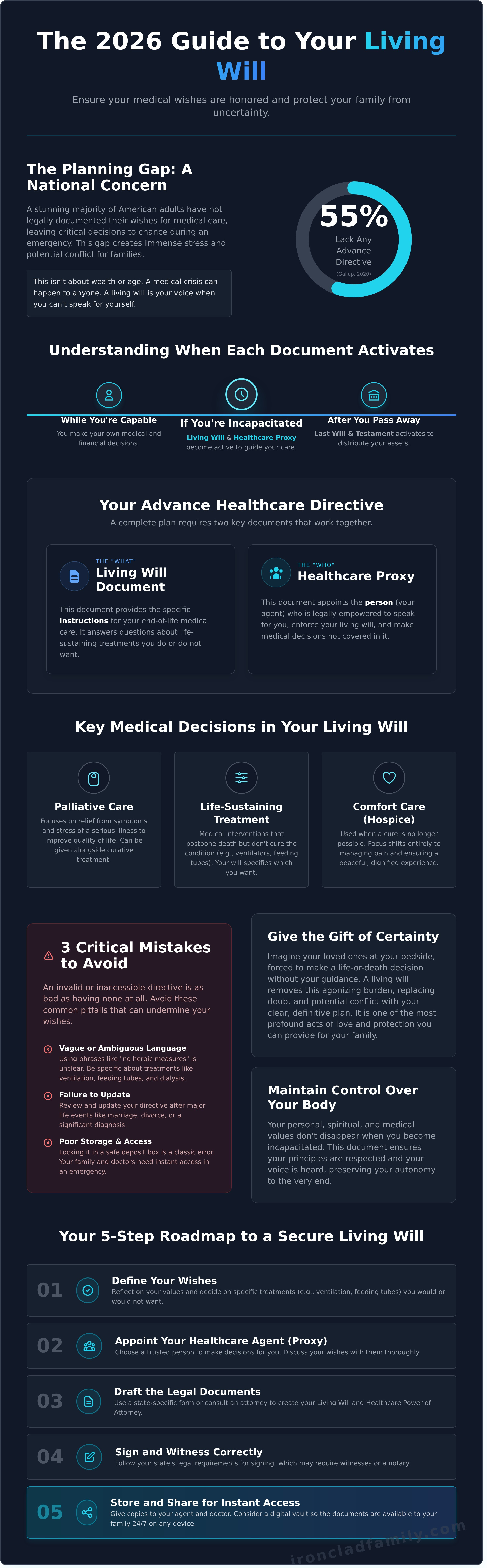
It’s deeply unsettling to think about that kind of emergency, especially when a 2020 Gallup poll showed that 55% of Americans lack any advance directive. You worry your wishes won't be honored, or that your loved ones will be forced to make an agonizing decision without your guidance, causing lasting conflict.
This guide will give you the clarity and control you deserve. We will walk you through every step of creating a legally sound living will document for 2026, ensuring your medical autonomy is protected and your family is shielded from uncertainty. You'll gain the profound peace of mind that comes from having a definitive plan.
We’ll cover the critical differences between types of wills, detail the common mistakes that can invalidate your wishes, and provide a clear roadmap to secure your medical directive.
Key Takeaways
- Define your medical wishes clearly to maintain control over your end-of-life care, ensuring your voice is heard even when you cannot speak for yourself.
- Remove the immense pressure and potential for conflict from your family by providing a clear roadmap for your medical preferences during a crisis.
- Avoid critical errors by ensuring your living will document uses specific, unambiguous language and is updated after major life events.
- Discover the most effective way to store and share your directive so it is instantly available to your loved ones and doctors in an emergency.
Understanding the Living Will Document and Its Purpose
Think of a living will as a clear roadmap for your medical care. It is a legal document that outlines your specific wishes for end-of-life treatment if you are ever unable to communicate them yourself. This isn't about your assets or inheritance; it's about your body, your values, and your voice in critical healthcare decisions.
A living will document only "wakes up" and takes effect when a doctor certifies that you are incapacitated and cannot make or share your own choices. It directly answers difficult questions about life-sustaining measures, ensuring your family isn't left guessing or arguing about what you would have wanted. This vital document is fundamentally different from a Last Will and Testament, which only deals with the distribution of your property after you have passed away.
To better understand this concept, watch this helpful video:
Living Will vs. Healthcare Power of Attorney
It's easy to confuse these two, but they serve different roles. A living will provides the instructions (the "what"), while a Healthcare Power of Attorney (or healthcare proxy) appoints the person (the "who") to enforce those instructions. You need both. Together, these documents create a complete advance healthcare directive. For example, if your living will states you don't want a feeding tube, your appointed healthcare agent is the person legally empowered to speak with doctors and ensure that specific wish is honored.
Common Medical Terms You Should Know
Your living will uses specific medical language. Understanding these terms is the first step toward making informed decisions. Here are three of the most common concepts you'll encounter:
- Palliative Care: This is specialized medical care focused on providing relief from the symptoms and stress of a serious illness. The goal is to improve quality of life for both the patient and the family. It's not the same as hospice and can be provided at any age and at any stage of an illness, often alongside curative treatment.
- Life-Sustaining Treatment: This refers to any medical intervention that postpones death but does not cure the underlying condition. Common examples include mechanical ventilation (breathing machines), dialysis, and artificially administered nutrition and hydration (feeding tubes). Your living will allows you to specify which, if any, of these treatments you would want.
- Comfort Care: Also known as hospice care, this approach is used when a cure is no longer possible. The focus shifts entirely away from life-sustaining treatments and toward maximizing comfort. The primary goal becomes managing pain and ensuring a peaceful, dignified experience.
Why Every Adult Needs a Clear Medical Directive
A medical crisis can strike at any age. It doesn't wait for retirement. Yet, a 2017 study from the University of Pennsylvania found that only 37% of U.S. adults have prepared any kind of legal directive for their medical care. When you are unable to communicate, the burden of choice falls on the people you love most. They are left to guess, to argue, and to hope they are making the right decision.
A clear medical directive, often called a living will document, removes that uncertainty. It is not a sign of giving up. It is an act of profound responsibility and control that protects both you and your family from a worst-case scenario. It provides a clear, legally-binding roadmap for your care, ensuring your voice is heard even when you cannot speak.
The Gift of Certainty for Your Loved Ones
Imagine your spouse or child at your hospital bedside, forced to make a life-or-death decision on your behalf. Without your written instructions, they face an impossible choice, one that can lead to years of guilt, doubt, and family conflict. This is the heavy burden you can lift from their shoulders today.
Creating a living will is an act of protection. You are giving your family the gift of certainty. You are replacing their potential agony with your definitive clarity. This simple document transforms a moment of crisis into a moment of following a plan, your plan. It is one of the most powerful ways to shield your family from emotional trauma.
Maintaining Control Over Your Body
Your values do not disappear when you become incapacitated. A living will ensures your personal, spiritual, and religious beliefs are respected by your medical team. It is your voice, codified into a legal instrument that speaks for you. These legal instruments, often called advance directives for medical decisions, give you the power to specify exactly what you want.
This includes your right to:
- Refuse medical treatment you do not want.
- Request treatments that align with your wishes, such as specific pain management protocols.
- Outline your preferences for life-sustaining procedures, like mechanical ventilation or tube feeding.
Without these instructions, decisions are left to others who may not fully understand your deepest convictions. This document guarantees your autonomy, ensuring the care you receive is the care you choose. Once completed, storing a verified copy in a secure digital vault ensures it is immediately accessible to your healthcare agent and medical team when it matters most.
5 Critical Mistakes People Make with Advance Directives
Creating a living will document is a profound act of foresight. You've taken the essential step to protect your autonomy and spare your loved ones from agonizing decisions. Yet, even the most well-intentioned plans can fail if they fall into common, avoidable traps. Your wishes are too important to be lost to a simple oversight.
Understanding these five critical mistakes is the key to ensuring your directive works exactly as you intend when it matters most. These aren't just clerical errors; they can fundamentally alter your end-of-life care.
Vague Language and Its Consequences
The single greatest point of failure in an advance directive is ambiguity. Phrases like "no heroic measures" or "don't keep me on machines" feel clear to you, but they are wide open to interpretation in a hospital's critical care unit. A doctor’s definition of "heroic" might be very different from your own, especially during a crisis.
Clarity is your shield. Your instructions must be direct and specific to be effective. The National Institute on Aging advises that specific guidance on treatments like CPR, ventilator use, and feeding tubes is crucial for your healthcare team.
- Unclear: "No extraordinary measures."
- Clear: "I consent to a trial period of mechanical ventilation for up to 14 days. If my condition has not improved and my physicians determine I have a terminal illness, I direct them to withdraw the ventilator."
The "Hidden Document" Trap
You've locked your original living will in a fireproof safe or a bank's safe deposit box. It’s secure. It’s also completely useless in an emergency. Medical decisions happen fast, often in the middle of the night. If your healthcare agent and hospital staff cannot access the document instantly, they must proceed without it. A 2017 study found advance directives were unavailable for nearly 50% of patients who had one.
Your directive is more than a legal form; it’s a critical piece of your Digital DNA. It carries the instructions for your care based on your deepest values. The content is vital, but immediate, secure access is what gives it power.
Failing to update your document is another silent threat. A living will document should be reviewed every few years or after any major life event, such as a marriage, divorce, or a significant new medical diagnosis. An outdated agent or an unaddressed medical condition can render your wishes invalid.
Perhaps the most common mistake is not discussing your wishes with your chosen healthcare agent. Handing them a document is not enough. You must have a frank, heartfelt conversation, explaining your values and the reasoning behind your choices. This conversation empowers them to advocate for you with confidence and clarity, transforming them from a proxy into a true guardian of your wishes.
Finally, many people mistakenly believe their Last Will and Testament covers medical decisions. It does not. A Last Will dictates what happens to your property after you die. A living will protects your medical wishes while you are still alive. Confusing the two leaves you unprotected when you are most vulnerable.
Steps to Complete Your Living Will Document Today
Creating a living will is one of the most profound acts of care you can perform for yourself and your loved ones. It transforms abstract wishes into a clear, actionable plan, removing uncertainty during a crisis. This isn't a task for "someday." You can secure your legacy today by following these essential steps.
First, reflect on your personal values. Before you write a single word, you must look inward. A living will is more than a checklist; it’s a statement of your personal values. What does a good quality of life mean to you? Consider specific medical situations. How do you feel about interventions like CPR, mechanical ventilation, or tube feeding if you have a terminal condition? Answering these questions for yourself is the foundation of a powerful and effective living will document.
Choosing Your Healthcare Agent
Your healthcare agent, or proxy, is the person you authorize to make medical decisions on your behalf if you cannot. This role requires more than just love; it demands a level-headed advocate who can honor your wishes under intense pressure. Don't automatically choose your spouse or eldest child. While they love you most, a 2017 study in the Journal of Pain and Symptom Management found that family members correctly guess a patient's wishes only 68% of the time. The best agent is someone you trust completely, who can remain calm, and who lives close enough to be present when needed. Once you've chosen someone, have "The Talk." Be direct, share your document, explain your reasoning, and get their explicit consent to act as your champion.
Next, you must draft the document using state-specific legal requirements. Each state has its own laws governing advance directives. A form that is valid in Florida may not be recognized in Oregon. You can find state-specific templates through your state's bar association, department of health, or an estate planning attorney. Using the correct form is a critical step to ensure your wishes are legally protected.
Legally Validating Your Wishes
A signed piece of paper isn't enough. To make your living will legally binding, you must execute it according to your state's laws. This typically involves signing it in the presence of witnesses or a notary public. Witnesses verify that you are signing of your own free will and are mentally competent. A notary officially verifies your identity. For modern convenience and security, services like IronClad Family offer remote online notary options, allowing you to finalize your documents from anywhere.
- State Compliance Checklist:
- Confirm how many witnesses your state requires (usually two).
- Check if witnesses can be relatives, heirs, or healthcare providers.
- Verify if your state mandates notarization in addition to or instead of witnesses.
- Ensure everyone signs and dates the document correctly.
Finally, store the document where it can be accessed 24/7. A perfectly executed living will document is useless if your family and doctors can't find it when it's needed most. A safe deposit box is locked after hours and on weekends. A file at home might be forgotten or lost. Medical teams need immediate access. Your family's peace of mind depends on instant retrieval. You must ensure your final wishes are not just recorded, but readily available. Store your living will in a secure digital vault where it can be retrieved by your trusted contacts anytime, anywhere.
How a Digital Vault Ensures Your Wishes Are Followed
You’ve done the hard work. You created a living will document that clearly states your healthcare preferences. But where is it right now? If it’s in a desk drawer, a home safe, or a file cabinet, it might as well not exist during a medical emergency. A locked drawer is a barrier. A misplaced file is a crisis. A study in Health Affairs found that while 37% of U.S. adults have an advance directive, a primary challenge is ensuring the document is available to clinicians at the moment of crisis.
This is the critical gap between intention and action. Your legal document is only powerful if it can be accessed by the right people at the right time. A physical paper cannot bridge that gap. A modern approach is required.
The "Digital Guardian" approach to estate planning treats your critical documents not as static files, but as active instructions ready for delivery. A digital vault serves as this guardian. It's a secure, centralized location for your most important information, providing immediate access to authorized family members and medical teams. Instead of a frantic search, your designated people receive the information they need, when they need it. This access is protected by zero-knowledge encryption, a security protocol that ensures only you and your chosen representatives can view your data. Not even the company hosting the vault has the key; your privacy is absolute.
The IronClad Approach to Medical Directives
IronClad Family was built to be more than just storage; it’s a secure repository for your "Digital DNA." This includes your living will document, healthcare power of attorney, and other vital directives. Our automated delivery feature is the core of this protection. You can set specific conditions for the release of documents, ensuring your medical directives are automatically sent to your designated healthcare agent or physician precisely when they are needed most. This removes the burden of memory from your loved ones during a stressful time. It’s a complete system designed for total readiness. You can learn more about this integrated strategy in our Family Preparedness Service.
The Peace of Mind of a Secure Legacy
A digital vault transforms your planning from a legal exercise into a practical, actionable strategy. It closes the dangerous gap between your written wishes and the reality of a medical emergency. You are no longer hoping your family finds the right folder. You are guaranteeing they have the right information. This simple step provides profound reassurance. You have done everything possible to protect your family from confusion and uncertainty, ensuring your voice is heard even when you cannot speak for yourself. You have protected them from the unknown. You can secure your legacy today by setting up your own Digital Vault.
Secure Your Final Wishes Today
Creating your living will is a profound act of care for your loved ones. It removes uncertainty during a crisis and ensures your medical preferences are honored without question. But a paper copy of your living will document stored in a filing cabinet can fail you when it's needed most. Your directives must be instantly accessible to be effective.
That's why securing your wishes in a digital vault is the final, critical step. With tools that offer state-specific legal document generation and automated delivery for emergencies, you ensure your voice is heard. Your family’s privacy is guarded by zero-knowledge encryption, meaning only you and your trusted contacts ever have access.
Take control of your legacy. Give your family the gift of absolute certainty.
Frequently Asked Questions About Living Will Documents
Is a living will document the same as a DNR (Do Not Resuscitate)?
No, a living will document is not the same as a DNR. A DNR, or Do Not Resuscitate order, is a specific medical instruction from your doctor to withhold CPR if your heart or breathing stops. In contrast, your living will provides broader instructions about all types of end-of-life medical care, such as the use of feeding tubes or mechanical ventilation. While your living will can state your wishes about CPR, a DNR is a separate, legally recognized medical order.
Can I change or cancel my living will after it is signed?
Yes, you can change or cancel your living will at any time, as long as you are considered mentally competent. To make a change, you should create a new document that clearly states it revokes all previous versions. It's critical to destroy all old copies and distribute the newly signed and witnessed version to your healthcare agent, your doctor, and any family members who had the previous one. This prevents confusion and ensures your current wishes are honored.
Do I need a lawyer to create a living will document?
No, you don't legally need a lawyer to create a living will in most states. Many states, including California and Florida, provide approved statutory forms that you can complete, sign, and have witnessed or notarized yourself. However, consulting an attorney is a wise investment if your healthcare wishes are complex or if you want to ensure your document fully complies with your state's specific laws. An attorney provides peace of mind that your instructions are ironclad.
What happens if I move to a different state?
Your living will may not be fully valid if you move, as each state has unique laws. While over 40 states have reciprocity provisions to honor out-of-state documents, it's the safest course of action to create a new living will using a form that complies with your new state's laws. This simple step eliminates any ambiguity or legal challenges, ensuring your healthcare providers can confidently follow your instructions without delay. It's a critical update to your personal legacy documents.
Does a living will document cover my financial assets?
No, a living will document exclusively covers your healthcare decisions and has no authority over your financial assets. To manage your finances, you need a completely separate legal document, typically called a durable power of attorney for finances. This appoints a trusted agent to handle your accounts, pay bills, and manage investments if you cannot. Keeping these two roles separate is a cornerstone of a well-protected estate plan, securing both your health and your heritage.
Who should I give copies of my living will to?
You should give copies to your appointed healthcare agent, any alternate agents, and your primary care physician to place in your medical file. It's also wise to inform your closest family members that the document exists and where it can be found. For absolute accessibility, storing a digital copy in a secure vault allows your designated agent to access it immediately in an emergency, ensuring your wishes are known and respected without fail, anytime and anywhere.
What is the difference between an advance directive and a living will?
A living will is one type of advance directive. The term "advance directive" is a general category for legal documents concerning future medical care. This category includes both the living will, which states your specific wishes for treatment, and the healthcare power of attorney, which names a person to make decisions for you. Together, these two documents form a comprehensive advance directive, giving you a powerful voice in your future care when you can no longer speak for yourself.
Will my living will document be followed in an emergency room?
Not always, as an emergency room's primary goal is immediate stabilization. ER teams are trained to preserve life first and may not have time to locate your documents. However, once your condition is stabilized, they will seek out your living will document and contact your healthcare agent. Your instructions are then used to guide all subsequent decisions about your care, ensuring your long-term treatment aligns perfectly with the wishes you've taken the time to secure.

