


- 13 mins
What if the fate of your family home was decided by a cold set of state rules rather than your own voice? It is a heavy thought, yet 56% of American adults currently don't have a will or any estate planning documents in place. You likely worry about the government seizing your property or your children facing a bitter dispute in court. You want to ensure your home remains a source of security for your family, not a source of stress. We agree that your home is more than just an asset; it is the foundation of your family's future.
This guide will show you exactly what happens to your house when you die without a will under 2026 laws. You will learn how state intestacy rules function and discover practical ways to transfer property without the headache of probate. We will explore how to navigate updated thresholds, like California’s $184,500 limit, so you can move from uncertainty to absolute peace of mind. We are going to provide a clear roadmap to keep your home secure and ensure your legacy remains in the right hands.
Key Takeaways
- Understand how state laws determine what happens to your house when you die without a will, often moving control from your family to a court administrator.
- Learn why the probate process is necessary to clear your home's title before it can be sold or moved into a loved one's name.
- Recognize the financial and emotional risks of silence, such as high court costs and the potential for forced property sales among heirs.
- Explore non-probate tools that allow your home to transfer automatically, saving your family months of legal delays and uncertainty.
- Discover how centralizing your property records and access codes creates a logistical roadmap that protects your legacy and your family's peace of mind.
Intestacy and Your Home: Who Really Inherits?
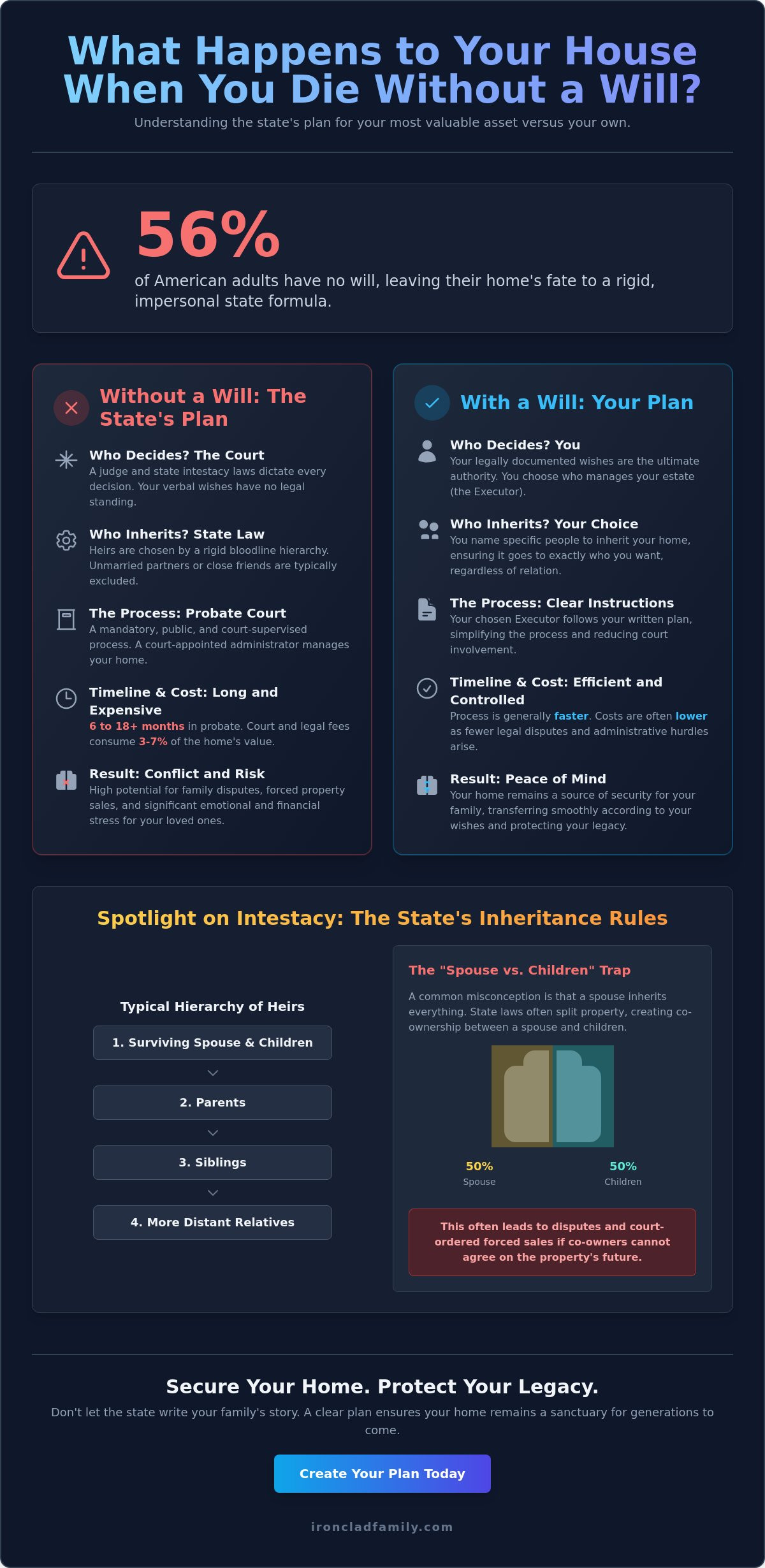
When you pass away without leaving a valid will, you leave the future of your family home in the hands of the state. This legal state is known as Intestacy. It simply means you died without a formal set of instructions for your assets. Without these instructions, your personal wishes or verbal promises carry no weight in a courtroom. Instead, the law uses a rigid formula to determine who receives the deed to your property.
To better understand how this process works and how it affects your family, watch this helpful video:
The court does not consider who "deserves" the house or who lived there the longest. It follows a strict hierarchy of heirs. This usually starts with a surviving spouse and children, then moves to parents, siblings, and more distant relatives. If you told your son he could have the house because he helped with the mortgage, but you didn't record that in a legal document, the court cannot honor that informal agreement. The law only recognizes what is written and signed. Knowing what happens to your house when you die without a will is essential because it reveals how quickly control can slip away from your loved ones.
The Role of State Intestacy Laws
Intestacy laws are state-specific. While most follow a general bloodline pattern, the details vary significantly from one border to the next. If you own property in multiple states, each house will be subject to the specific laws of the state where it is located. This can lead to a confusing legal web for your heirs to untangle. Intestate succession is the legal method used to distribute a person's property when they die without a valid will.
Spouses vs. Children: The Common Conflict
Many people assume a surviving spouse automatically inherits the entire home. This is a dangerous misconception. In many jurisdictions, the law requires the home to be shared between a spouse and children. For example, a state might grant 50% to the spouse and 50% to the children. This often leads to a "tenancy in common" trap. This is a situation where multiple people own the same property but don't always agree on what to do with it.
When heirs are stuck in this trap, one person might want to sell while another wants to stay. Since no one has total control, these disputes often lead to "forced sales" ordered by the court. Learning what happens to your house when you die without a will helps you see the risks of leaving these decisions to the state. It's about ensuring your home remains a sanctuary for your loved ones rather than a source of legal combat. You don't want your family's history to be reduced to a court case number.
The Probate Process: Why the Court Takes Control
Probate is the court-supervised legal process of proving that an estate is being handled correctly. When there is no will, the court steps in to oversee every detail of your estate. This is where the answer to what happens to your house when you die without a will becomes a matter of public record and legal procedure. The court's primary job is to clear the title. This means they must verify who actually owns the property before it can be sold or legally moved into a relative's name. This process isn't free; on average, probate costs can consume 3% to 7% of the home's total value in fees and legal expenses. For a deeper look at this process, you can read our guide on Understanding Probate.
The Court-Appointed Administrator
Since you didn't name an executor, the court will appoint an administrator to manage your home. This person is often a surviving spouse, but if family members fight, the court might choose a professional third party. This can be risky. A stranger or a relative you don't trust may gain full control over your most valuable asset. This administrator has the legal power to sell the house to pay off your debts or taxes, even if your heirs wanted to keep it. They must follow state intestacy laws to the letter, regardless of any verbal promises you made during your lifetime.
The Timeline of a House in Probate
This legal journey is rarely quick. In most U.S. cases, a house will be stuck in probate for 6 to 18 months. During this long waiting period, the mortgage, property taxes, and utility bills still need to be paid. If the estate doesn't have enough cash, the house can fall into foreclosure. There is also the physical risk to the property. An empty house is prone to theft, vandalism, or damage from burst pipes. While the court decides what happens to your house when you die without a will, the home itself can lose value due to simple neglect.
Ensuring your family has immediate access to your property records and mortgage details can prevent these delays. Using a digital vault is a practical way to keep your home’s logistical roadmap safe and accessible for your heirs.
The Hidden Dangers of Leaving No Real Estate Plan
A common myth is the belief that "my kids will just figure it out" when the time comes. While this feels like an act of trust, it's actually a heavy burden to place on grieving loved ones. Without a clear legal roadmap, the house moves from being a cherished family legacy to a source of confusion and debt. This is the core of what happens to your house when you die without a will. One of the most severe risks is the "Heirs Property" crisis. This happens when the title becomes so tangled among multiple relatives that no one has the clear authority to sell, repair, or even buy insurance for the home. Over time, the property can become legally untouchable, losing its value and its place in your family's future.
Family Disputes and the Forced Sale
When multiple heirs inherit a house together, they become co-owners with equal rights. If three siblings inherit a home but only one wants to sell it to pay off personal debts, that one sibling can file a partition lawsuit. This legal move forces the sale of the home, regardless of what the other two siblings want. These lawsuits are expensive and often lead to the house being sold at a public auction for a fraction of its worth. The emotional damage of these battles often lasts much longer than the legal case. The process of intestate succession is designed to divide assets, but it is not designed to keep families together. A written plan is the only way to prevent these forced sales and preserve family harmony.
The Digital House: A Modern Vulnerability
In 2026, a house is more than just a physical structure; it's a collection of digital accounts. Your home likely relies on smart thermostats, solar panel monitoring, security cameras, and Wi-Fi-enabled appliances. If your heirs don't have the login credentials for these systems, they face a total "digital lockout." They might be unable to adjust the heat, view security footage, or even change the codes on the front door. A standard will rarely includes these vital passwords. Truly understanding what happens to your house when you die without a will means acknowledging that your home's digital essence is just as important as the deed itself. Without a secure way to pass on these credentials, your family's sanctuary can quickly become a high-tech fortress they cannot control or maintain.
How to Leave a House to a Child Without Probate
You don't have to leave your home's future to chance. While state law dictates what happens to your house when you die without a will, you can take active steps now to keep your property out of the courtroom. The goal is to classify your home as a non-probate asset. These assets transfer automatically to your chosen heirs the moment you pass away, bypassing the judge and the associated legal fees entirely. Beyond knowing how to make a will, you should consider these four specific legal tools to protect your home:
- Transfer on Death (TOD) Deeds
- Revocable Living Trusts
- Joint Tenancy with Right of Survivorship
- Life Estate Deeds
By using these methods, you ensure the transition of your home is a private family matter rather than a public legal battle. It's about creating a seamless bridge for your children so they can focus on their grief rather than paperwork. If you want to begin organizing these vital records today, you can start by securing your current deed in a digital vault to ensure your family has the roadmap they need.
Transfer on Death (TOD) Deeds
A Transfer on Death deed is one of the simplest ways to avoid probate. It works much like a beneficiary designation on a bank account. You sign a deed that names your child as the person who will receive the house when you pass away. You still own the house completely while you're alive. You can sell it, mortgage it, or change the beneficiary at any time. When you die, the house goes to your child immediately without any court involvement. While not every state allows TOD deeds, many do, and they are a highly effective tool for straightforward inheritance.
Living Trusts and Joint Tenancy
A Living Trust acts like a protective bucket that holds your house for your child. Since the trust owns the house, not you personally, it doesn't have to go through probate when you die. This provides the highest level of control and protection for your family's future. Another option is Joint Tenancy with Right of Survivorship. This means you and your child own the house together. When one owner dies, the other automatically becomes the sole owner. However, you must be careful. Adding a child to your deed while you are still alive can create a tax trap. They may lose the "step-up in basis," which could lead to much higher capital gains taxes when they eventually sell the home. It's often better to use a trust or a TOD deed to preserve those tax benefits for your heirs.
Understanding what happens to your house when you die without a will is the first step toward preventing a family crisis. By choosing the right legal tool, you transform a potential legal battle into a simple, quiet transfer of ownership.
Protecting Your Home and Legacy with IronClad Family
Understanding what happens to your house when you die without a will is only half the battle. Even if the legal title eventually moves to your heirs, they can still face a logistical nightmare. Without a clear guide, your children might struggle to find mortgage statements, insurance policies, or even the codes to the security system. IronClad Family acts as the technical guardian for your home's legacy. We provide the tools you need to organize the physical and digital details that keep a household running. Our system ensures that your family isn't just left with a deed, but with a complete roadmap for the future.
The Vault is a secure space where you can store your deed, property tax records, and smart home credentials. While state laws dictate what happens to your house when you die without a will, they don't provide a manual for your children to manage the property. To solve this, we developed the IronClad Receiver system. This feature allows for the automated delivery of your most sensitive documents to your chosen heirs at exactly the right time. It bridges the gap between legal ownership and practical management. Think of it as a digital companion to your legal plans, ensuring no detail is lost in the transition.
Beyond the Will: The Logistical Roadmap
Your children need the keys to the digital kingdom just as much as they need the physical keys to the front door. A house in 2026 is tied to dozens of digital accounts, from utility portals to solar panel monitoring. If these passwords die with you, your family faces a "digital lockout" that can take months to resolve. Within the IronClad Family Digital Vault, you can centralize these logins alongside personal legacy messages. These messages allow you to leave guidance, stories, or simple words of love for your children. It turns a cold legal transfer into a warm, guided handoff of the family home.
A Fortress for Your Family’s Future
Security is the foundation of everything we do. Our platform uses zero-knowledge encryption, which means only you and your designated receivers can ever see your information. We don't just store data; we protect the essence of your life's work. By organizing your home records now, you ensure your child isn't left searching through dusty shoeboxes or old filing cabinets during a time of grief. This preparation provides a level of calm confidence that no court order can match. You gain the peace of mind that comes from knowing your home is secure and your family is truly prepared for whatever comes next.
Take Control of Your Family’s Legacy
Leaving your home to chance means letting state laws and court administrators dictate your family's future. You have seen how the probate process can drain a home's value by up to 7% and how sibling disputes can lead to forced sales. Truly understanding what happens to your house when you die without a will reveals that a legal document is only part of the solution. Your family also needs a logistical roadmap to access the digital accounts and smart systems that keep your home running daily.
You can move from uncertainty to absolute preparedness right now. By combining state-specific legal tools with a secure digital repository, you ensure your heirs aren't left searching for answers during a crisis. Our platform uses zero-knowledge encryption to keep your records private and features automated document delivery to your loved ones in an emergency. Secure your family’s home and legacy today with The Vault. You have worked hard to build your life's work; we are here to help you protect the essence of that legacy for the next generation.
Frequently Asked Questions
Can my children stay in the house if I die without a will?
Your children can often remain in the home, but their legal right to own it isn't immediate. They will likely need to go through the probate process to put the deed in their names. If they cannot agree on whether to keep or sell the house, a court might eventually order a sale to divide the proceeds fairly among all heirs.
Does the state take your house if you have no heirs?
The state only takes ownership of your home as a last resort, a process called escheat. This only happens if the court cannot find any living relatives, including distant cousins or aunts and uncles. Most state laws require an extensive search for blood relatives before the government can claim your property.
How long does probate take for a family home?
Probate for a real estate asset typically lasts between 6 and 18 months in the United States. The exact time depends on the complexity of your debts and how quickly the court-appointed administrator completes the required paperwork. During this period, the house remains in a legal waiting zone where it cannot be sold or refinanced.
What happens to the mortgage when the homeowner dies?
The mortgage debt stays with the property and must continue to be paid to avoid foreclosure. Federal law generally allows a relative who inherits the home to take over the existing mortgage payments instead of paying the full balance immediately. If the estate has other cash assets, the administrator may use them to keep the mortgage current during probate.
Is a TOD deed better than a will for a house?
A Transfer on Death (TOD) deed is often faster and less expensive for the specific task of moving a house to an heir. While a will must go through the court, a TOD deed transfers the property automatically and privately. However, a will is still necessary to handle your other belongings and final wishes that a deed cannot cover.
Who is responsible for property taxes during probate?
Your estate is responsible for paying property taxes, insurance, and maintenance costs while the court settled your affairs. The administrator uses money from your bank accounts or other assets to cover these bills. If there is no cash available, the administrator might be forced to sell the house to pay the tax authorities.
Can I leave my house to my child if I still owe money on it?
Yes, you can leave a house with a mortgage to your child. They will inherit the equity you have built up, but they also take on the responsibility of the remaining debt. Your child will need to work with the lender to assume the loan or refinance it to keep the home in the family.
What is the most affordable way to avoid probate for my house?
A Transfer on Death (TOD) deed is usually the most affordable way to control what happens to your house when you die without a will. In many states, you only need to pay a small filing fee at your local county office to record the deed. This simple step ensures your home passes directly to your child without the high cost of a court battle.

