
- 13 mins
What if your family's entire inheritance was locked behind a screen they could never open? Most people believe their cloud drives and filing cabinets are enough to protect their loved ones. However, research from May 2026 shows that tech platforms can legally deny access to your digital life unless you have specific legal authorization under laws like RUFADAA. This leaves families in a state of high anxiety when a crisis hits. You deserve better than a "best guess" strategy for your most important documents. Using a digital vault for families is no longer a luxury; it's a necessity for anyone looking to secure their digital DNA.
You likely already feel the weight of managing passwords, bank details, and property deeds across dozens of platforms. We agree that the current system is often broken and confusing. This article will show you how to move from digital chaos to absolute preparedness by debunking common myths about document security. We'll preview the steps to build a single source of truth that automates your instructions and guarantees your legacy is protected for the next generation.
Table of Contents
- The Hidden Risks of a Scattered Digital Life
- 5 Myths About Using a Digital Vault for Families
- Cloud Storage vs. a Dedicated Digital Vault for Families
- 4 Steps to Organize Your Family’s Critical Information
- Securing Your Digital DNA with IronClad Family
- Frequently Asked Questions
Key Takeaways
- Understand the hidden risks of a "digital scavenger hunt" and how lost account access can lead to significant financial loss for your heirs.
- Learn why a dedicated digital vault for families provides the legal framework required by RUFADAA that standard cloud storage often lacks.
- Debunk common myths about digital security and discover why big-tech platforms are not designed for long-term legacy protection.
- Follow a practical four-step guide to inventory your digital DNA, including financial assets, legal papers, and sentimental files.
- Discover how to use automated emergency instructions to ensure your loved ones receive the keys to your life exactly when they need them.
The Hidden Risks of a Scattered Digital Life
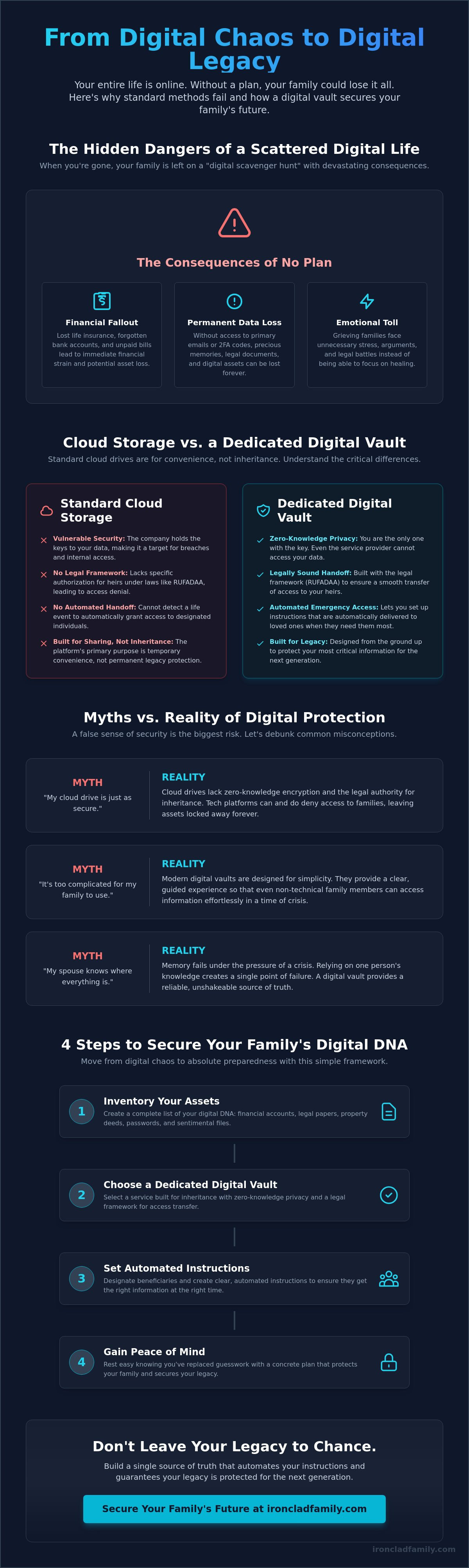
Imagine the person you love most has passed away. Amidst the heavy grief, you find yourself staring at their smartphone, unable to unlock the screen. You need to pay the mortgage and access bank accounts, but every password is hidden behind a wall you can't climb. This is the start of a "digital scavenger hunt." It's a chaotic and often unsuccessful search for every digital asset owned by your loved one. While a physical folder in a desk drawer was enough for past generations, it's no longer enough for modern families. Most of our life's work is now locked behind layers of security that don't automatically open for heirs.
To better understand why a modern organization system is vital for your home, watch this helpful video:
One of the greatest dangers is the risk of permanent data loss. If you lose access to two-factor authentication (2FA) codes or a primary email account, your digital DNA could be gone forever. Standard cloud storage isn't built to handle these handoffs. A digital vault for families solves this by creating a secure bridge between your information and the people who need it most. Without this bridge, your heritage is at the mercy of tech companies and their rigid rules. This leaves your family vulnerable to losing years of memories and financial security.
The Consequences of No Plan
The financial fallout of a scattered digital life is real and immediate. Lost life insurance policies or forgotten bank logins mean your money stays out of your family's hands. Bills can go unpaid because no one can log in to utility accounts, leading to service cancellations during a crisis. Grieving loved ones shouldn't have to fight legal battles just to see family photos or close a social media account. When instructions are missing, families often face unnecessary stress and arguments over what you would have wanted. This emotional toll is often heavier than the financial loss.
Common Mistakes in Document Organization
Many people try to organize their security by storing everything on a single, unencrypted USB drive. These drives can fail, get lost, or become outdated. Others share passwords via insecure text messages or emails, leaving the keys to your life open to hackers. Perhaps the most dangerous mistake is assuming a spouse "just knows" where everything is. In a moment of crisis, memory often fails under pressure. A digital vault for families replaces these risky habits with a single, unshakeable source of truth that protects your family's future security.
5 Myths About Using a Digital Vault for Families
Most people believe they're already protected because they use a standard cloud drive or a physical safe. These old ideas often lead to a false sense of security. When we talk about protecting your digital DNA, it's vital to separate fact from fiction. Many families wait until a crisis to realize their current system is full of holes. By then, it's often too late to recover lost information or access vital accounts. Let's clear up the most common misunderstandings about securing your family's future.
Debunking the Cloud Storage Misconception
The biggest myth is that a standard cloud drive is the same as a digital vault for families. Standard cloud accounts are built for convenience, not inheritance. If you lose your password, the company can often reset it for you because they hold the keys to your data. This makes your account vulnerable to hackers. A specialized vault uses zero-knowledge privacy. This means you are the only one with the key. Even the company providing the service cannot see what you've stored. Standard cloud drives also lack a way to pass information to heirs. They don't know when you've passed away, and they won't automatically hand over your "keys to the life" to your beneficiaries.
Privacy and Ease of Use
Another common worry is that these systems are too complex for non-techy family members. In reality, modern vaults are designed with simple interfaces that anyone can use. If you can send an email or use a smartphone, you can manage a vault. You also don't need to be wealthy to benefit from this level of organization. While the "Great Wealth Transfer" involves an estimated $84 trillion passing down by 2045, every household has something worth protecting. Whether it's a small life insurance policy, funeral wishes, or years of family photos, this information is priceless to your loved ones.
Privacy is the foundation of a secure legacy. Some fear that putting all their data in one place makes it a target. However, zero-knowledge encryption ensures that your private data stays private. It's like having a physical safe where only you have the combination. This setup prevents the "digital scavenger hunt" mentioned earlier by creating one secure spot for everything. You can begin organizing your family's most important details by exploring a secure digital vault designed for long-term protection.
Finally, many believe a vault is only for financial papers. Your legacy is more than just money. It includes your stories, your values, and your specific instructions for the future. A vault stores your "digital DNA," ensuring your family doesn't just inherit your assets, but also your wisdom and guidance. This comprehensive approach is what moves a family from a state of uncertainty to absolute peace of mind.
Cloud Storage vs. a Dedicated Digital Vault for Families
Standard cloud tools like Google Drive or Dropbox are designed for the living. They make it easy to share a photo or edit a document with a coworker. However, they aren't built to handle the end of a life. A digital vault for families provides a specialized layer of protection that general tools simply don't offer. While you might use multi-factor authentication (MFA) to log into your email, that doesn't help your heirs if they don't have your phone. A dedicated vault uses private keys and zero-knowledge encryption. This ensures you are the only one who controls the "keys to your life," rather than a tech company holding a master key to your data.
The legal landscape has also changed significantly. By early 2026, most U.S. states have adopted RUFADAA. This law says that tech companies can legally deny access to your digital property unless you've given explicit, written permission in your estate plans. Standard cloud storage doesn't provide the legal framework to grant this access within the app itself. Without a vault that integrates these permissions, your family might face a long and expensive court battle just to see your emails or cloud photos. This is the difference between simple storage and true legacy protection.
Why General Tools Fall Short
General tools lack a "trigger" for access. They don't know if you've become disabled or have passed away. This creates a massive hurdle for your loved ones. Heirs often struggle to prove they have a legal right to access a generic account. Even with a death certificate, many big-tech platforms will refuse to hand over data because their terms of service take priority over your will. Using a digital vault for families ensures these legal hurdles are cleared before a crisis occurs. It turns your data from a locked box into a reachable resource for those who need it most.
The Features of a True Family Fortress
A true fortress for your data includes the ability to designate "Receivers." These are trusted people who only get access to specific information when a certain event happens. This automated delivery is the missing link in modern estate planning. It ensures your instructions and assets reach the right hands at the exact moment they are needed. You can store more than just PDFs; you can protect your "Digital DNA," including cryptocurrency keys and legacy messages for your children. You can learn more about secure family document sharing to see how this protection works in practice. This system moves you from hope to absolute certainty that your heritage is protected.
4 Steps to Organize Your Family’s Critical Information
Moving from digital chaos to absolute preparedness doesn't happen by accident. It requires a steady, deliberate process to ensure your "keys to life" are ready when they are needed most. A digital vault for families is the foundation of this process, but you must first lay the groundwork. Organizing your legacy is an act of love that removes the burden of uncertainty from your spouse and children. By following a structured path, you turn a mountain of scattered data into a fortress of family security.
Step 1 & 2: Inventory and Legal Prep
The first step is a complete inventory of your digital DNA. This includes everything from bank logins and cryptocurrency keys to sentimental family photos stored in the cloud. You should also list the locations of physical items, such as the key to a safe deposit box or the deed to your home. Using a family emergency plan checklist is the best way to find hidden gaps in your organization. If you can't find a document in five minutes, your family won't be able to find it in a crisis.
Once your inventory is ready, gather your essential legal papers. This must include state-specific wills, trusts, and powers of attorney. In 2026, tech platforms are legally required to see explicit permission before granting access to an account. Storing these documents alongside your digital assets ensures your executor has the immediate legal authority to step in. This step prevents the "digital scavenger hunt" and keeps your family out of court.
Step 3 & 4: Sharing and Maintenance
Next, you must choose your trusted circle. Not everyone needs access to every file today. A sophisticated system allows you to assign specific documents to specific people. For example, your spouse might need immediate access to bank accounts, while your children might only receive your legacy messages later. These messages are a vital part of your heritage. They provide a way to pass on your values and final words of comfort, ensuring your emotional presence is felt even when you aren't there.
The final step is establishing a regular update schedule. Your life isn't static, and your protection shouldn't be either. Set a "digital audit" date once or twice a year to review your vault. Update any changed passwords, add new assets, and ensure your list of "Receivers" is still accurate. This small habit guarantees that your preparedness remains absolute. You can start building your family's fortress today by creating a secure digital vault that grows with you.
Securing Your Digital DNA with IronClad Family
Protecting your heritage requires more than just a password. It requires a system built on the principle of absolute privacy. IronClad Family uses zero-knowledge encryption to ensure that your private data stays private. This means we don't have a "master key" to your information. You are the only person who can unlock your digital fortress. While other companies might look at your files to sell you ads, we treat your information as a living legacy. We provide the military-grade protection your life's work deserves.
We solve the "delivery problem" that leaves many families locked out of accounts. Our unique IronClad Receiver system acts as a digital guardian. It automates the transfer of your emergency credentials to the people you trust. You don't have to worry about your spouse or children struggling with a "digital scavenger hunt" during a crisis. Instead, they receive the keys to your life exactly when they need them. This automated handoff is the final piece of a complete estate plan.
The iVaultX Advantage
The iVaultX platform was designed by security experts who understand family dynamics. We know that legacy planning is about more than just data; it's about people. Our system allows you to integrate state-specific wills and even use remote notary services to finalize your legal papers. For professionals, our advisor portal makes it simple for financial planners to help their clients stay organized. You can explore our digital vault for families features to see how we bridge the gap between high-tech security and emotional resonance.
Moving Forward with Confidence
You can move from a state of uncertainty to absolute preparedness in less than 15 minutes. Starting your vault is a practical step that provides immediate peace of mind. For a subscription of $15.75 per month, billed annually at $189, you get unlimited vaults and access to our funeral planning wizards. This small investment ensures that your digital DNA is never lost or deleted by a tech company's terms of service. Your family's future security is too important to leave to chance.
The "Great Wealth Transfer" is already happening, and $84 trillion will change hands by 2045. Don't let your piece of that legacy get caught in a legal or digital trap. By choosing a digital vault for families, you are taking a stoic stand to defend your data and care for the next generation. You've worked hard to build your life. Now, take the final step to ensure your legacy remains ironclad.
Build Your Family Fortress for the Future
Leaving your digital DNA scattered across the internet is a risk your family can't afford. You've learned that a digital vault for families is the only way to ensure your loved ones aren't locked out during a crisis. By moving beyond basic cloud storage and embracing zero-knowledge encryption, you guarantee that your private keys and heritage stay in the right hands. This system does more than store files; it integrates state-specific legal documents and automates emergency credential delivery.
It's time to stop the "digital scavenger hunt" before it starts. You have the power to protect your life's work and provide absolute peace of mind for the next generation. You don't have to navigate this alone. By choosing a secure path today, you ensure that your wisdom, assets, and memories are never lost to time or technology. Protect your family legacy—Start your IronClad Vault today. Your family's security is a living story, and you have the power to make sure the next chapter is fully protected.
Frequently Asked Questions
What is a digital vault for families?
A digital vault for families is a secure online space designed to store your most important information, such as passwords, wills, and financial details. It acts as a central hub for your "digital DNA." Unlike a simple folder on your computer, it's built to ensure your loved ones can access these keys to your life only when you want them to.
How is a digital vault different from Google Drive or iCloud?
A digital vault for families differs from standard cloud storage because it uses zero-knowledge encryption and automated delivery triggers. Standard services are meant for daily file sharing and don't have systems to help heirs after a death. A specialized vault ensures your beneficiaries have the legal and technical keys to your assets without needing a court order.
Is my information safe if the company goes out of business?
Your data is protected by zero-knowledge encryption, meaning only you hold the keys to unlock it. If a provider closes, your encrypted data remains unreadable to anyone else. Reputable vaults provide ways to export your information or use recovery keys to ensure your legacy remains reachable even if the platform changes.
Can my family access my vault while I am still alive?
You have total control over who sees your information while you're alive. You can choose to share certain folders with a spouse today, while keeping other items locked until a specific event occurs. Your family only sees what you've explicitly shared, giving you both privacy and a way to collaborate on your family organization.
Do I need a digital vault if I already have a physical safe?
Yes, because a physical safe can't store your digital life or provide immediate access from a distance. While a safe is good for a birth certificate, it won't help your family manage your online bank accounts or two-factor authentication codes. A vault provides a bridge between your physical assets and your digital presence.
How do I choose which family members get access to my vault?
You choose your "Receivers" based on the roles they'll play in your estate plan. You might give your spouse access to financial logins, while your children receive legacy messages or family photos. This allows you to tailor the information to each person's needs, ensuring the right people get the right data at the right time.
What happens to my digital vault if I forget my master password?
If you forget your master password, you'll need to use your physical recovery key. Because of zero-knowledge security, the company doesn't know your password and can't reset it for you. This is why it's vital to keep your recovery phrase in a safe place, as it's the only way to regain access if you're locked out.
Is a digital vault legally recognized for estate planning?
A digital vault for families is a powerful tool to help you follow laws like RUFADAA, which 46 states have adopted as of 2026. While the vault itself isn't a legal will, it stores the state-specific documents your family needs. It provides the written consent required by tech platforms to release your digital assets to your executors.

