

- 14 mins
What if 67% of your family's heritage, including your photo archives and financial accounts, became inaccessible to your children because of a simple paperwork oversight? Most parents assume their property will pass smoothly to their heirs, but without the right legal structure, your estate could spend 18 months trapped in a public probate court. Deciding between a trust and will is the most vital step you can take to shield your family's future.
It's normal to feel uneasy about legal jargon or the thought of your digital life being lost forever. You deserve the peace of mind that comes with knowing your spouse and children are fully provided for. This guide will show you the clear differences between these two options so you can protect your legacy with absolute confidence. We'll walk through the best ways to transfer assets, avoid court interference, and ensure your digital DNA remains a permanent part of your family story.
Key Takeaways
- Learn the clear differences between a Last Will and Testament and a Living Trust to build a foundation of security for your heirs.
- Discover how choosing the right plan acts as a protective roadmap, saving your family from the stress of probate and high legal fees.
- Avoid critical mistakes when setting up your trust and will, including the common error of failing to properly fund your assets.
- Follow a practical, step-by-step process to inventory your physical and digital assets, ensuring your entire heritage is accounted for.
- Understand why a secure digital vault is the essential "missing piece" to keep your most private documents accessible to those who need them most.
What Is the Difference Between a Trust and Will?
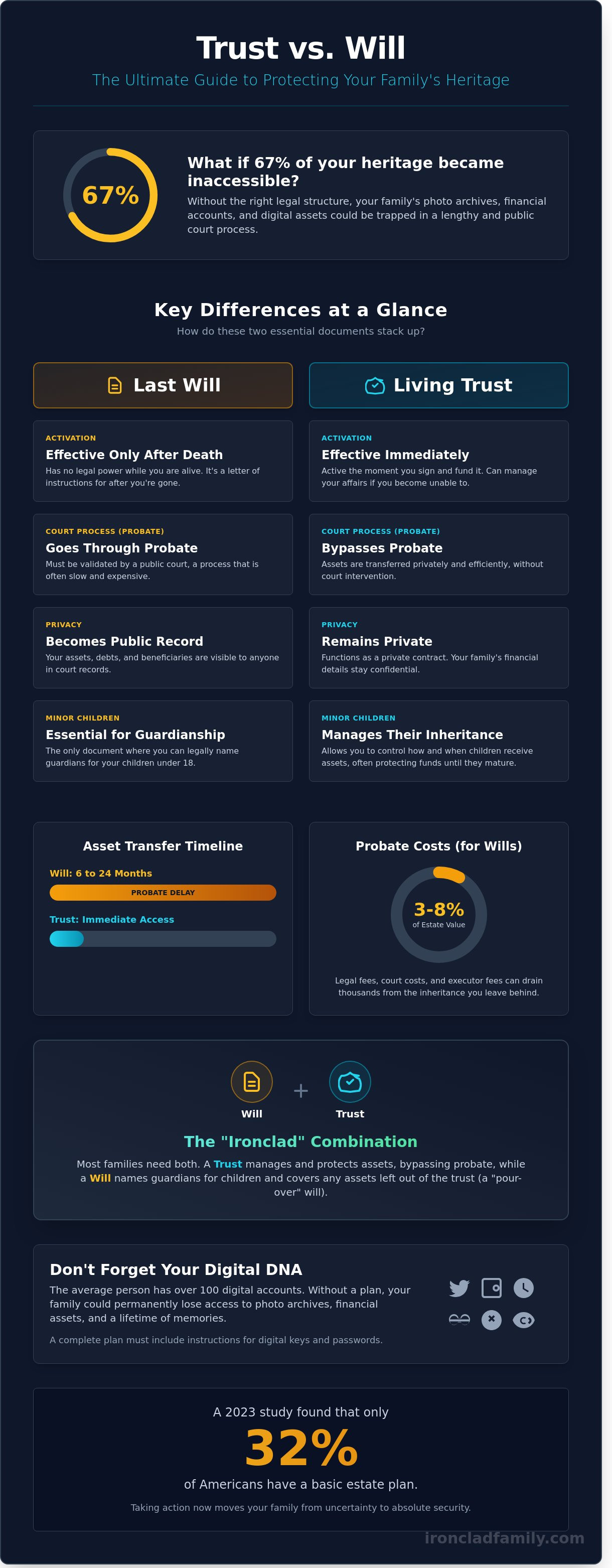
Understanding the distinction between a trust and will is the first step toward securing your family's future. These tools are the pillars of a strong estate plan, but they serve very different roles. A will is essentially a letter of intent. It tells the world where you want your physical and digital assets to go after you are gone. A living trust is more like a private vault. It is a legal entity that holds your assets and protects them while you are still alive.
The biggest difference between these two involves the clock. A will stays silent until you pass away. It has no power while you are breathing. A living trust is active the moment you sign the paperwork and fund it. This means a trust can manage your affairs if you become ill or injured, providing a level of protection a simple will cannot match. Most families find that a trust and will work best when used together. This combination ensures that no part of your legacy is left to chance or court intervention.
According to data from the American Bar Association, the probate process required for a will can take anywhere from 6 to 24 months to complete. This is a long time for a family to wait for the resources they need. A trust bypasses this delay entirely. It provides your loved ones with immediate access to the keys of your life. By choosing the right tools now, you move from a state of uncertainty to a feeling of absolute preparedness.
The Basics of a Last Will
A will is a classic legal document that outlines your final wishes. Its most vital job for modern families is naming guardians for minor children. If you have children under the age of 18, a will is non-negotiable. Without it, a judge who does not know your family will decide who raises your kids. You also name an executor in your will. This person is the project manager for your estate. They are responsible for paying final bills and distributing your physical property like furniture, jewelry, or vehicles.
The main drawback of a will is that it must go through the public probate process. In 2023, estate experts noted that probate costs can eat up 3% to 8% of an estate's total value. Because probate happens in a courtroom, your private business becomes a matter of public record. Anyone can see what you owned and who you left it to. For families who value privacy and speed, relying only on a will can create unnecessary vulnerabilities.
The Basics of a Living Trust
A living trust is different because it actually "owns" your assets while you are still here. You typically serve as the trustee, meaning you keep full control over your home, bank accounts, and investments. If you pass away or can no longer make decisions, a successor trustee steps in immediately. They follow your pre-written instructions without needing a court order. This transition is seamless and keeps your family out of the courtroom.
Privacy is a hallmark of the living trust. Because it is a private contract, it does not become part of the public record. Your financial details and the "digital DNA" of your estate remain confidential. This is a critical layer of security for the modern family. A trust allows you to distribute your heritage on your own timeline. You can choose to give an inheritance all at once or in stages, such as when a child reaches age 25 or 30. This level of control ensures your life's work is handled with the care it deserves.
Why Choosing the Right Plan Matters for Your Heritage
Leaving a legacy is more than just passing down money or property. It is about providing a clear roadmap for the people you love most. When you don't have a defined trust and will, your family is left to guess your intentions during their darkest hours. This confusion often leads to deep-seated resentment and avoidable arguments. A 2023 study by Caring.com found that only 32% of Americans have a basic estate plan. This gap creates a vacuum where conflict thrives. When you take the time to document your wishes, you aren't just filling out forms; you're shielding your spouse and children from the burden of heavy decision-making while they're grieving.
Financial protection is another critical pillar of your heritage. Choosing the right strategy can save your estate a fortune in unnecessary expenses. Legal fees for an unsettled estate can easily top $10,000 for even modest homes, draining the wealth you spent a lifetime building. Beyond physical assets, your digital inheritance requires a modern defense. We live in a world where the average person has over 100 digital accounts. Without a plan to pass on private keys and passwords, your family could lose access to precious memories and financial assets forever. Understanding how to manage a trust and will alongside your digital DNA is the first step in building a secure digital legacy that lasts for generations.
Specific details matter when you're protecting your life's work. You want to ensure your specific wishes are honored without family conflict. This means being precise about who receives sentimental items, from a grandfather’s watch to a family photo archive stored in the cloud. Clear instructions prevent the "he-said, she-said" scenarios that tear families apart in the wake of a loss. By being the "Wise Protector" today, you ensure your family remains a cohesive unit tomorrow.
Avoiding the Stress of Probate Court
Probate is a public, court-supervised process that often drags on for 9 to 24 months. During this time, your assets are typically frozen and unavailable to your heirs. A well-structured trust allows your family to bypass this hurdle entirely. It provides immediate access to funds for funeral costs, which averaged $7,848 in 2021 according to the National Funeral Directors Association. By removing the court from the equation, you reduce the emotional and financial burden on your grieving family members.
Protecting Minor Children and Heirs
Dying without a plan means you're "intestate," and the state decides who raises your children. A will is the only place where you can legally name a guardian. You can also use a trust to stagger inheritance for younger children. Instead of an 18-year-old receiving a large lump sum, you can schedule distributions at ages 25 and 30. This protects them from youthful mistakes and ensures the money serves its intended purpose: their long-term security and education.
5 Common Mistakes When Setting Up a Trust and Will
Creating a trust and will provides a sense of relief, but a single oversight can leave your family in a legal maze. Many people assume the hard work ends once the lawyer hands over a binder of papers. This is a dangerous misconception. To keep your legacy secure, you must avoid these five frequent errors.
- The "Set It and Forget It" Trap: Estate planning isn't a static event. Tax laws change, such as the major shifts seen in the 2017 Tax Cuts and Jobs Act. If your plan hasn't been reviewed since 2019, it likely misses new tax advantages or family changes like births or marriages.
- The Unfunded Trust: A trust is like a high-security vault. If you don't move your assets into it, the vault stays empty. You must retitle your home, bank accounts, and investments into the name of the trust. Without this step, your family still faces probate court, which can take 12 to 18 months to resolve.
- Ignoring the Digital Footprint: Most people forget that their life's work is now stored on servers. From family photos to crypto wallets, these assets vanish if no one has the keys.
- Selecting the Wrong Leader: Choosing an executor based on emotion rather than ability is a common pitfall. The person leading your estate needs to be organized, tech-savvy, and emotionally stable during a crisis.
- The Hidden Treasure Map: Storing documents in a bank safety deposit box can be a mistake. If you're the only one with access, your family might need a court order just to get the keys to your plan.
The Danger of "Dark" Digital Assets
Your digital legacy is more than just data; it's your family's history. If you don't provide a way for loved ones to access your smartphone or cloud storage, those memories are effectively deleted. A standard paper will often fails to unlock a locked device or a social media account. You need to ensure your documents are RUFADAA compliant. This law, officially known as the Revised Uniform Fiduciary Access to Digital Assets Act, gives your executor the legal right to manage your digital life. As of 2024, 46 states have adopted this act, making it a vital part of any modern trust and will. Without these specific legal permissions, tech companies will prioritize privacy over your family's grief, locking them out of your digital life forever.
Choosing the Right Executor or Trustee
It's vital to distinguish between who will care for your children and who will manage your money. A "guardian" provides a home and love. A "trustee" manages the inheritance, pays taxes, and follows legal instructions. These roles require different temperaments. Your best friend might be a wonderful support system but struggle with financial statements. Sit down with your chosen agents now. Explain their roles and confirm they are willing to serve. Research shows that 25% of estate delays happen because the named executor was surprised by the responsibility and felt overwhelmed by the task. Clear communication today prevents a family crisis tomorrow.
Practical Steps to Build Your Family Protection Plan
Creating a legacy plan doesn't have to be an overwhelming task. It requires a methodical approach to ensure every asset, whether physical or digital, is accounted for and protected. Most people delay this process because it feels final, but building a plan is actually an act of life. It provides the clarity your family will need during their most difficult moments. You can follow these four essential steps to move from uncertainty to total preparedness.
- Step 1: Inventory your physical and digital assets. You can't protect what you haven't identified. Start by listing real estate, bank accounts, and physical heirlooms. Then, move to your digital life, which often holds more sentimental and practical value than we realize.
- Step 2: Decide between a trust and will. This is a foundational choice. A will is a public document that goes through probate court; a trust is a private contract that can help your family avoid the delays and costs of the legal system.
- Step 3: Draft your state-specific legal documents. Laws vary significantly by location. A document that's valid in Texas might not meet the requirements in New York. You must ensure your documents comply with your local statutes to remain enforceable.
- Step 4: Securely store your documents and share access. A perfect plan is useless if your family can't find it. You need a centralized, secure location where your loved ones can access the keys to your life when the time comes.
Inventorying Your Digital DNA
Your "Digital DNA" consists of everything from your primary banking logins to the cloud storage holding 15 years of family photos. Start by listing every account you touch in a typical month. Include utility portals, social media profiles, and even loyalty programs. Don't just list the accounts; document the specific "how-to" for your family to access these files. Without clear instructions, 90% of digital assets can become permanently locked after a death. If this feels like too much to handle alone, our family preparedness service provides expert guidance to help you organize this vital information.
Executing Your Documents Legally
Once you decide on a trust and will, you must make them official. This usually requires witnesses and a notary public to verify your identity and intent. In many states, you need two witnesses who aren't beneficiaries of the estate. If you skip these formalities, the court may rule your documents invalid. You also need to keep your plan current. Life moves fast. A 2023 survey showed that 35% of people with estate plans haven't updated them in over five years. You should review your plan after major life events like a marriage, the birth of a child, or a move to a new state to ensure your protections remain airtight.
Security is the final piece of the puzzle. Storing your original documents in a physical safe is a start, but it doesn't solve the problem of immediate access for your family. By using a secure digital vault, you bridge the gap between high-tech security and family accessibility. This ensures that your "Wise Protector" status remains intact, even when you aren't there to provide the password yourself.
Beyond Paper: Why a Digital Vault Is the Missing Piece
Storing a physical trust and will in a bank safe deposit box often creates more problems than it solves. These heavy steel boxes were designed for 19th-century security, not 21st-century speed. When an individual passes away, banks usually seal the safe deposit box immediately. This creates a legal catch-22 for the family. They need the original documents to get court permission to open the box, but the documents are locked inside the box itself. As of 2023, state treasuries in the United States hold over $70 billion in unclaimed property. Much of this wealth remains lost simply because families couldn't find the paperwork or access the accounts their loved ones left behind.
A digital vault solves this by using zero-knowledge encryption. This technology ensures that your data is scrambled before it even leaves your device. Only you and your designated beneficiaries hold the private keys to unlock the information. The service provider cannot see your files, which keeps your legacy private but accessible to the right people at the right time. It's a proactive way to manage your digital DNA. Instead of leaving your family to guess your passwords or search through filing cabinets, you can automate the delivery of your credentials. You set the rules for when and how your information is released. This ensures your heirs aren't locked out of your life's work during their most difficult moments.
The IronClad Vault Advantage
There is a vital difference between a standard password manager and a legacy vault. A password manager is built for your daily convenience, helping you log into your email or bank account. IronClad Family is built for your family's future. It acts as a bridge between generations. While a password manager might lose its utility if you aren't there to provide a master code, a secure digital vault uses a "dead man's switch" or a verified beneficiary protocol. This means the vault ensures your family has the keys the moment they need them, without compromising your security while you're still active.
Securing Your Legacy Messages
Estate planning is traditionally about the transfer of money and property. However, your legacy is more than a list of assets. It's the "why" behind your life. Digital vaults allow you to store more than just a trust and will or financial spreadsheets. You can save video messages, personal letters, and family stories for future generations. This ensures that your values and memories are passed down alongside your wealth. You can record a message for a grandchild's future wedding or explain the history of a family heirloom. By using a digital vault, you protect the emotional essence of your family. It's about giving your loved ones peace of mind and a clear path forward. Learn how to protect your family’s most important documents and ensure your voice is never lost.
Secure Your Family Heritage Today
Deciding on a trust and will is the first step toward securing your family’s 2026 legacy. You’ve learned that while a will covers the basics, a trust can save your heirs from an 18-month wait in probate court. It’s vital to remember that a legal plan only works if people can find it when they need it most. IronClad Family acts as your digital guardian by bridging the gap between paper and protection.
We offer state-specific legal document generation and zero-knowledge encryption for total privacy. Our system also includes automated emergency credential delivery. This ensures your loved ones aren’t locked out of the 300 digital accounts the average person now owns. You’ve done the hard work of building a life. Now it’s time to lock the door and keep your heritage safe for the next generation. Your family deserves the peace of mind that comes from knowing every detail is covered.
Learn how to protect your family’s most important documents with a secure digital vault.
Frequently Asked Questions
Do I need a trust if I already have a will?
You often need both because a will alone doesn't prevent your estate from entering probate court. While a will names guardians for children under 18, a trust manages your assets and keeps them private. According to a 2023 Caring.com study, only 32% of Americans have any estate plan. Combining a trust and will creates a complete safety net that protects your family's heritage from legal delays.
Is a trust more expensive to set up than a will?
A trust costs more upfront, but it saves your family thousands of dollars in probate fees later. A simple will might cost $300 to $1,000; however, a living trust often ranges from $2,000 to $5,000. Since probate costs can consume 3% to 7% of an estate's total value, the initial investment in a trust prevents a much heavier financial burden on your heirs during their time of grief.
Can I make a trust and will online without a lawyer?
You can use online platforms to create these documents, but complex family situations often require professional guidance. Many DIY services provide templates for a basic trust and will starting around $150. While this works for simple estates, 60% of legal professionals suggest that custom drafting prevents future disputes. Always ensure your digital DNA is stored in a secure vault to keep these documents accessible to your survivors.
How do I protect my digital assets in my will?
You protect digital assets by naming a digital executor and including specific language regarding your online accounts. Research from 2022 shows the average person has over 90 online accounts. You must list your hardware, social media, and crypto keys in a separate memorandum. Don't put passwords in the will itself because it becomes a public record; instead, use a secure digital repository to pass on these keys to your life.
What happens if my family can’t find my trust or will?
If your family can't find your documents, the state determines who gets your assets through intestacy laws. This process can delay inheritance by 12 to 18 months. Without the original signed papers, your specific wishes for your legacy are ignored by the court. Storing your documents in a military-grade vault like IronClad Family ensures your loved ones have instant, secure access to your instructions when they need them most.
Is a living trust better for avoiding probate?
A living trust is the most effective tool for avoiding the public and costly probate process. Unlike a will, which a judge must verify, a trust allows for the immediate transfer of assets to your beneficiaries. This saves your family from the 6-month minimum wait time typical in most probate courts. It acts as a private fortress for your heritage, keeping your family's financial details out of public records and eyes.
How often should I update my estate planning documents?
You should review your plan every 3 to 5 years or after major life events. Events like a birth, a death, or a 20% change in your net worth require immediate updates. Laws regarding taxes and digital inheritance also change frequently; for instance, 46 states have now adopted the Revised Uniform Fiduciary Access to Digital Assets Act. Keeping your plan current ensures your protective shield remains strong as your family grows.