

- 13 mins
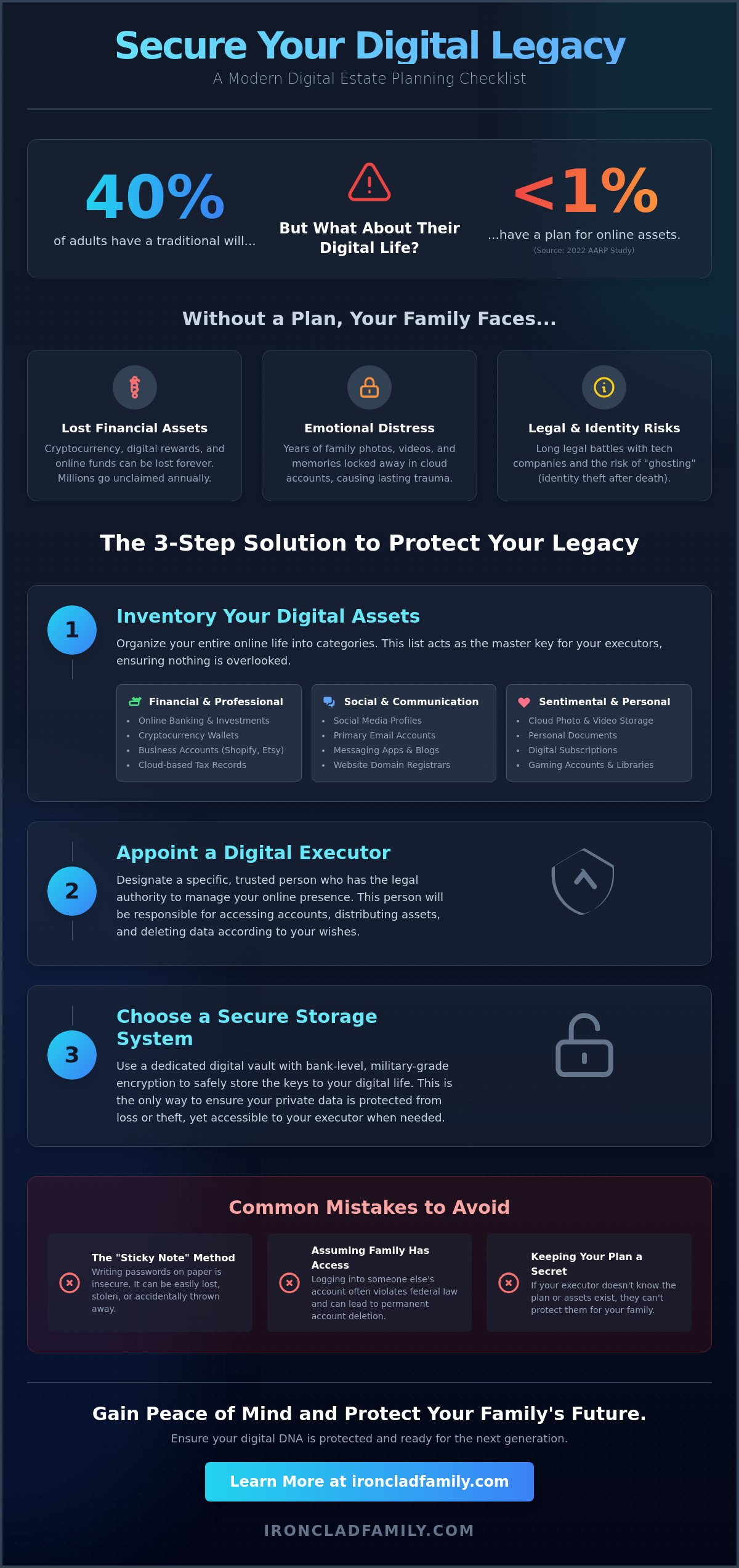
What if your family's most precious memories are currently locked behind a password that only you know? A 2022 AARP study found that while 40% of adults have a traditional will, almost none have a plan for their online assets. You've worked hard to build a life, yet much of your digital DNA exists in a space your loved ones can't reach. You likely feel that protecting your photos, financial accounts, and private keys is just as vital as a physical will. This digital estate planning checklist is designed to help you bridge that gap and secure your legacy.
You deserve the peace of mind that comes from knowing your digital inheritance is safe. It's frustrating to think about your family struggling with legal hurdles just to see a photo album or pay a final bill. We'll show you exactly how to organize your online life so nothing gets lost. You'll learn how to secure your accounts, name your digital executors, and ensure your legacy remains ironclad for the next generation. This guide provides the clear, simple steps needed to turn your scattered data into a sacred family heritage.
Key Takeaways
- Organize your online life and protect your family’s inheritance with a simple, step-by-step digital estate planning checklist.
- Learn how to categorize your assets into financial, social, and sentimental groups to ensure no piece of your legacy is lost.
- Discover why naming a dedicated digital executor is essential for managing your accounts and closing your online footprint.
- Understand how modern digital vaults use bank-level encryption to provide a secure home for your family's most sensitive documents.
- Gain the peace of mind that comes from knowing your digital DNA is protected and ready for the next generation.
Why Your Family Needs a Digital Estate Planning Checklist
Losing a loved one is a heavy burden for any family. It becomes even heavier when survivors realize they are locked out of the deceased person's life. Imagine your family trying to find bank details or precious photos, only to be met by a "password incorrect" screen. This is why a digital estate planning checklist is the most important tool you can leave behind in 2026. It ensures your family doesn't lose your life's work to a locked screen. Without a clear plan for your digital inheritance, your legacy could disappear forever.
Key Takeaways:
- Inventory all assets: List every account, from financial institutions to social media and cloud storage.
- Name a digital executor: Designate a specific person who has the legal authority to manage your online presence.
- Choose secure storage: Use a military-grade encrypted vault to store the keys to your life safely.
To better understand this concept, watch this helpful video:
The consequences of ignoring this plan are severe. Families often face long legal battles with tech companies to gain access to accounts. Financial assets like cryptocurrency or digital rewards can be lost for good. Beyond the money, the emotional distress of losing years of family memories stored in the cloud is a trauma that stays with survivors for a long time.
What Happens to Your Data When You Are Gone?
Your digital DNA stays active long after you pass away. Accounts that sit idle are high-risk targets for identity theft. This practice, often called ghosting, allows criminals to steal your identity to open credit lines or scam others. A standard will often lacks the specific language needed to handle online assets. By 2026, most states require very specific permissions to grant access to digital accounts; a general "give everything to my spouse" clause is usually not enough.
Common Mistakes in Digital Planning
The biggest mistake is the "sticky note" method. Paper is easily lost, stolen, or thrown away during a house cleaning. Another error is assuming a spouse can legally just log in. This often violates federal laws and platform terms of service, which can lead to accounts being permanently disabled. Finally, if you don't tell your executor these assets exist, they will never be found. Research suggests that millions of dollars in digital assets go unclaimed every year because families didn't know they existed.
Step 1: Making a Complete List of Your Digital Assets
The first step in your digital estate planning checklist is to identify every piece of your online life. Most people focus only on their physical home and bank accounts. Your digital footprint is often just as valuable. It includes everything from your primary email account to the loyalty points you have saved for years. Without a clear list, your family may spend months trying to track down these assets. You shouldn't use a public spreadsheet or a piece of paper for this task. These methods are vulnerable to hackers or physical loss. Instead, use a secure system that protects your privacy while ensuring your loved ones have a clear map to follow. This list acts as the master key for your executors.
Think of your digital assets in three main groups: financial, social, and sentimental. Each category requires a different level of access and specific instructions for your heirs. By organizing them now, you prevent your legacy from becoming a series of locked accounts and forgotten passwords. It is about moving from a state of uncertainty to a feeling of absolute preparedness.
Financial and Professional Digital Assets
You need to document every account that holds monetary value. This list starts with online banking and investment accounts. If you hold cryptocurrency, your private keys and wallet locations are critical. For entrepreneurs, this section includes digital storefronts like Shopify or Etsy, along with business-related cloud storage. A 2023 survey found that 52 percent of small business owners have no plan for their digital business assets. Don't let your hard work vanish. Include links to tax records and insurance documents stored in the cloud. These are the tools your family will need to settle your estate without unnecessary stress.
- Banking and Investments: List all institutions and the email addresses associated with them.
- Cryptocurrency: Document the location of hardware wallets and recovery phrases.
- Business Assets: Include login details for domain names, hosting services, and client databases.
Sentimental Assets and Digital DNA
Your "digital DNA" consists of the memories and messages that define your life. This includes photo libraries on iCloud or Google Photos and your social media profiles. These items often hold more emotional weight than a bank balance. Legacy messages and personal videos meant for your children or grandchildren are the keys to your life story. When these assets are lost, a part of your family’s heritage disappears forever. Organizing these files ensures your history remains intact for future generations. Storing these records in a secure digital vault provides the protection your family deserves.
Remember that social media accounts often have "legacy contact" features. You should name these contacts within the apps now. This allows your family to memorialize your page or download your photos according to your wishes. Treat these assets with the same gravity as your physical heirlooms. They are the modern version of a family photo album, and they deserve a permanent home.
Step 2: Naming Your Digital Executor and Handling Access
A digital executor is the guardian of your online world. This person takes over the keys to your life when you can't manage them yourself. They handle specific tasks like closing your social media accounts, managing your photo storage, or transferring digital files to your heirs. Without a designated person, your family might face months of legal battles just to see your last photos.
You might already have a traditional executor for your physical belongings. However, your digital executor needs a different skill set. They don't just need to understand your will; they need to know how to navigate a cloud storage system or manage a password manager. This choice is a vital part of your digital estate planning checklist because it bridges the gap between your physical assets and your digital DNA.
The Legal Side: RUFADAA and Power of Attorney
The law is finally catching up with our digital lives. The Revised Uniform Fiduciary Access to Digital Assets Act, or RUFADAA, is a legal framework that gives your executor the right to access your accounts. Since its creation in 2015, 46 states have adopted this law to prevent your data from being locked away forever by service providers.
To make this work, your Power of Attorney documents must include specific language. You can't assume a general statement covers your digital assets. You need to explicitly grant your executor the power to manage your "digital property." Because laws vary by state, you should ensure your legal documents are specific to your location. This prevents tech companies from blocking your family when they try to settle your affairs.
Choosing the Right Person for the Job
Picking your digital executor requires careful thought. You need someone who is tech-savvy enough to handle complex security settings. They should be comfortable with encryption and two-factor authentication. More importantly, they must be someone you trust with your most private information and your family heritage.
- Technical literacy: Can they navigate a cloud storage system or a crypto wallet?
- Reliability: Will they follow your instructions exactly and respect your privacy?
- Patience: Dealing with tech support and legal departments often takes time.
It's also smart to name a backup executor. If your primary choice is unavailable, your digital legacy won't be left in limbo. Once you choose, you must share your "Just in Case" instructions safely. Don't write passwords on a sticky note. Instead, use a secure digital vault to store these keys. This keeps your information safe while ensuring your guardian has the access they need when the time comes. Adding these steps to your digital estate planning checklist gives you peace of mind that your family is protected.
Step 3: Choosing a Secure Storage System for Your Digital Inheritance
For decades, families kept their most precious documents in fireproof safes or heavy bank deposit boxes. These physical tools worked well for paper deeds, jewelry, and old photographs. However, your digital DNA requires a different kind of fortress. If your digital estate planning checklist only includes a physical safe, your heirs will likely struggle to access your online life when it matters most.
Modern digital inheritance requires a "zero-knowledge" vault. Think of this like a bank vault where only you hold the unique key to the door. Even the bank manager cannot see what is inside or open the box for you. In 2026, this technology ensures that your private keys and heritage remain private. If a service provider can reset your password, they can see your data. A true secure storage system prevents this, keeping your digital identity safe from hackers and prying eyes.
You also need a system that handles automated delivery for emergency credentials. If something happens to you, your loved ones shouldn't have to guess how to find your information or hunt for hidden keys. A secure vault can be set to release specific access to your beneficiaries after a period of inactivity or upon legal verification. This step is a critical part of your family emergency plan checklist.
Why Password Managers Are Only Half the Battle
Most people use password managers for daily convenience. These tools are excellent for logging into streaming services or checking bank balances. However, they often fail during an estate transfer because they are built for the living, not for legacy. A password manager stores links and logins; it doesn't usually store the actual "keys to your life." You need a dedicated vault that holds house deeds, scanned birth certificates, and personal video messages. A holistic view ensures your family sees the full picture of your legacy, not just a list of random websites. Using a digital estate planning checklist helps you move beyond simple logins to true asset protection.
Security Standards to Look For
In 2026, security standards must be unshakeable to protect your family's future. Look for military-grade protection that uses 256-bit encryption. This level of security is so strong that it would take a supercomputer trillions of years to crack it. You should also look for services that offer remote online notary options. This allows you to legalize your digital plans from your own living room, ensuring your documents hold up in court. Using private keys means you are the sole guardian of your digital DNA, providing peace of mind for the next generation.
How IronClad Family Secures Your Digital Inheritance
IronClad Family acts as the Wise Protector for your digital legacy. We understand that your digital life is more than just a collection of files; it is your digital DNA. To keep this legacy safe, The Vault provides a secure, central fortress for your most important assets. It organizes your financial records, social media credentials, and private keys in one place. Instead of leaving your family to hunt through old drawers or locked laptops, you provide them with a clear, organized path forward. For those who prefer professional assistance, the Family Preparedness Service offers a white-glove setup. This service ensures your documents are uploaded correctly and your legacy is fully protected from the start.
Automated Delivery for Peace of Mind
A major risk in estate planning is that heirs often lack the keys they need to unlock a digital inheritance. IronClad Family removes this hurdle through automated delivery systems. These protocols ensure that your loved ones receive access to specific assets exactly when they need them. You decide the timing and the conditions. This system also allows for the delivery of legacy messages. These are personal notes, videos, or instructions that provide emotional comfort and practical guidance to your family after you are gone. As we move into 2026, the choice is clear. You can remain in a state of uncertainty, or you can move toward absolute preparedness. Securing your legacy now prevents the 100 percent preventable loss of your family's history.
A Solution for Families and Advisors
IronClad Family serves both individual households and professional planners. We provide a bridge between traditional estate law and modern technology. While many families use the platform to organize their personal lives, professional advisors use it to offer a higher level of service to their clients. The platform allows you to store state-specific wills alongside digital credentials in one unified space. This ensures that your legal documents and your digital assets are never separated. Having everything in one place simplifies the job for your executor and reduces the stress on your grieving family. It is a complete solution that protects your life's work and your family's future security.
Completing a digital estate planning checklist is one of the most selfless acts you can perform for your heirs. It replaces confusion with clarity and fear with confidence. By using the tools provided by IronClad Family, you ensure that your digital inheritance is passed down safely and securely. Don't wait for an emergency to realize your documents are scattered or inaccessible. Take the final step in your digital estate planning checklist today and secure your legacy for 2026 and beyond.
Protect Your Family with a Clear Digital Path
Protecting your digital DNA is a vital part of caring for your family. By completing your digital estate planning checklist, you ensure that your loved ones aren't locked out of important accounts or precious memories. You've learned how to catalog your assets, appoint a trusted executor, and choose a storage system that works when it matters most. These steps are the foundation of a modern legacy.
IronClad Family provides the tools you need to turn these steps into a permanent shield. Our vault uses zero-knowledge encryption for total privacy. We also provide state-specific legal document generation and automated emergency credential delivery. These features move you from a state of worry to a place of absolute peace of mind. It's the best way to keep your heritage safe for 2026 and the years to follow.
Your life's work deserves a guardian that is both technically superior and deeply human. Don't leave your digital inheritance to chance. Secure your digital inheritance with the IronClad Vault today. You're doing more than just organizing files; you're building a bridge for the next generation.
Frequently Asked Questions
What is a digital estate planning checklist?
A digital estate planning checklist is a strategic roadmap used to organize, manage, and protect your digital assets for your heirs. It serves as a comprehensive inventory of your online presence, ranging from financial accounts to sentimental photo collections. By following this guide, you ensure your family doesn't lose access to 100% of your digital legacy when you're no longer here to provide the keys.
Who should have a digital estate plan?
Every adult with a smartphone or an online account needs a digital estate plan to prevent identity theft and asset loss. According to 2023 industry data, the average person manages over 100 passwords. Without a plan, your family could spend months in probate court or lose access to your digital DNA forever. Whether you're a parent protecting family photos or a professional managing business data, this plan is your family's safety net.
Is a digital executor the same as a regular executor?
A digital executor is a specific role focused solely on managing your online accounts and electronic files. While a regular executor handles your physical home and bank accounts, the digital executor manages your keys to life in the virtual world. You can name the same person for both roles, but the digital executor needs the technical knowledge to navigate security protocols and encryption.
How do I legally give someone access to my passwords after death?
You can legally grant access by using a secure digital vault like IronClad Family and updating your will to reference the Revised Uniform Fiduciary Access to Digital Assets Act (RUFADAA). This law, adopted by 46 U.S. states as of 2024, allows you to name a person to manage your accounts. Simply writing passwords on paper isn't enough; you need a legally recognized method that protects your privacy while ensuring your loved ones aren't locked out.
What are the most important digital assets to include in my checklist?
Your digital estate planning checklist should prioritize financial accounts, cloud storage for family photos, and cryptocurrency wallets. You should also include social media profiles, email accounts, and subscription services that may continue to bill your estate. Including these items ensures your family can settle your final affairs and preserve your digital inheritance without unnecessary stress or legal hurdles.
Can I use a regular safe deposit box for my digital assets?
A physical safe deposit box is often a poor choice for digital assets because hardware like USB drives can fail within 10 years. Banks also require a court order for access after a death, which creates a 30 to 60 day delay for your family. A digital vault provides the military grade protection you need with the immediate accessibility your family deserves during a crisis.
How does zero knowledge encryption protect my family documents?
Zero knowledge encryption ensures that only you and your designated heirs hold the private keys to your digital DNA. Under this security model, the service provider has 0% visibility into your files. If a hacker breaches the server, your information remains unreadable because the actual data never leaves your device in an unencrypted state. This creates a fortress around your family's most sensitive heritage.