
- 15 mins
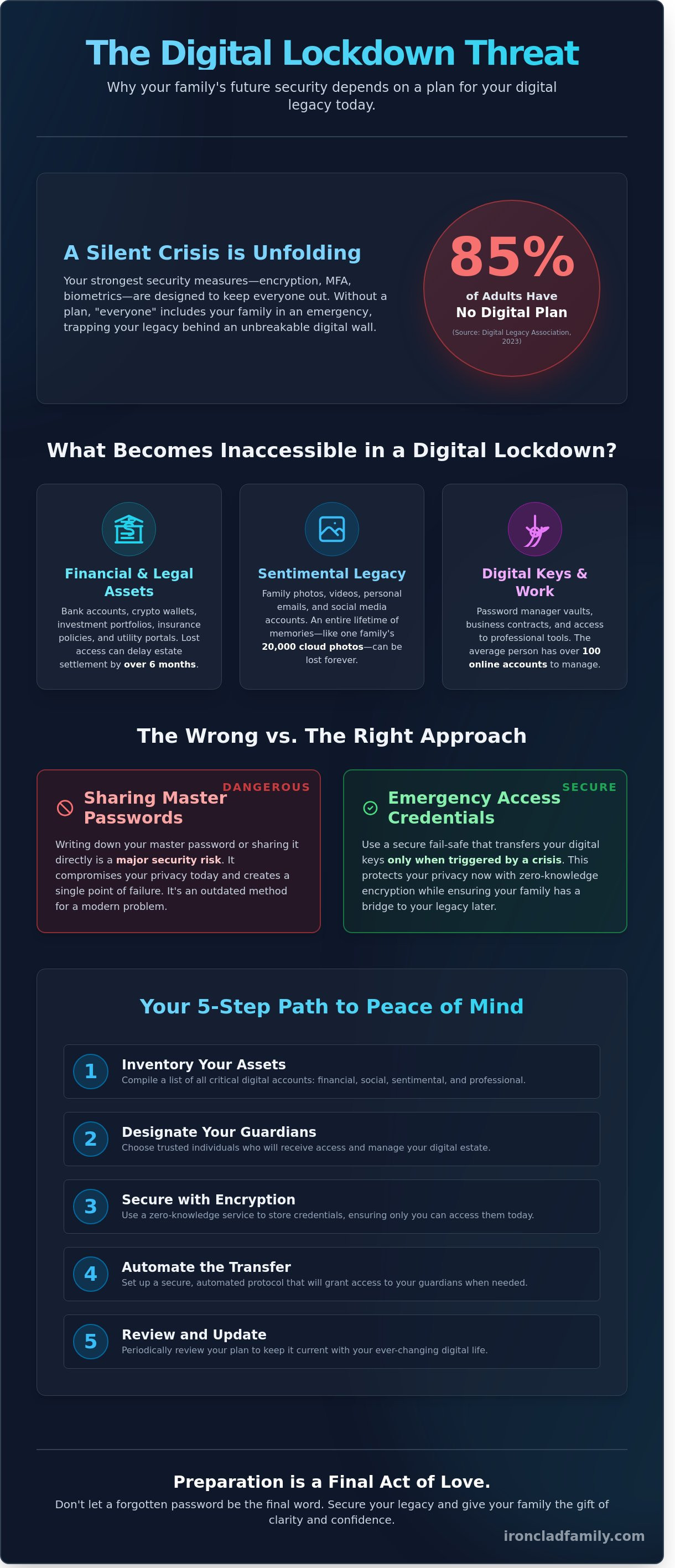
What if your family was locked out of your life’s legacy because of a single forgotten password? According to a 2023 study by the Digital Legacy Association, 85% of adults have no clear plan for their online accounts. You likely feel the weight of this vulnerability every time you look at your private photos or manage your bank accounts. You want your heritage to be a bridge for your loved ones, not a wall. Establishing Emergency Access Credentials is the only way to ensure your digital DNA remains accessible to those who matter most while keeping your security ironclad today.
It’s natural to feel overwhelmed by the complexity of modern security or the legal jargon found in the Revised Uniform Fiduciary Access to Digital Assets Act. You deserve the peace of mind that comes from a definitive plan. In this guide, you’ll learn how to build a secure bridge for your heirs and simplify the transition of your most sensitive assets. We’ll walk you through the essential steps to organize your vault and designate your digital guardians. Your family’s future security doesn’t have to be a source of anxiety; instead, it can be your final gift of protection.
Key Takeaways
- Understand the hidden risks of "digital lockdown" and how to prevent your family from losing access to your essential digital DNA during a crisis.
- Learn how to implement Emergency Access Credentials using zero-knowledge encryption to transfer your digital keys securely without compromising your privacy today.
- Discover why sharing master passwords is a dangerous security flaw and how to establish a more resilient, sophisticated defense for your digital inheritance.
- Master a simple five-step process to inventory your most critical assets, turning digital preparation into a lasting gift of peace of mind for your loved ones.
- Explore how to automate the protection of your life’s work, ensuring your family has the secure tools they need to navigate the future with confidence.
The Risk of Digital Lockdown: Why Your Family Needs a Safety Net
Your digital life is a fortress. You've spent years building it, using 256-bit encryption and Multi-Factor Authentication (MFA) to keep hackers out. These same walls can become a prison for your family. This phenomenon is known as digital lockdown. It happens when your loved ones are barred from your accounts after an unexpected crisis. Without Emergency Access Credentials, your digital DNA remains trapped in a silent vault. No one can get in, and no one can recover what is lost.
To understand the stakes, we must ask: What is digital inheritance? It's the sum of your online existence, from your crypto wallets to your social media legacies. When access is lost, the emotional toll is devastating. A 2023 survey by the Digital Legacy Association found that 62 percent of people haven't made plans for their digital assets. This lack of planning leaves families in a state of tech-induced grief, struggling with passwords while they should be honoring your memory.
To better understand how these systems work in a professional context, watch this helpful video:
The Hidden Danger of Lost Access
Modern security is designed to be binary. You're either the authorized user, or you're an intruder. Encryption doesn't care about your death certificate. If you're the only one with the private key to your family's 20,000 cloud-stored photos, those memories die with you. In 2021, one high-profile case involved a widow who spent 2 years in court just to access her late husband's Apple account. The emotional weight of losing those photos is a burden no family should bear.
Financial strain is equally real. In 2022, families reported waiting over 6 months to settle estates because they couldn't access locked utility or banking portals. A physical safe in your basement isn't enough anymore. It can't store a rotating MFA code or a biometric thumbprint. You need a more sophisticated safety net. As a Wise Protector, you must recognize that your digital presence requires a specialized bridge. By organizing your Emergency Access Credentials, you ensure that your family's transition is marked by peace, not panic. You're giving them the keys to your life.
Key Takeaways for Your Preparedness
- Digital lockdown is a real threat. High-security measures like MFA and biometrics will lock out your legitimate heirs during a crisis if you don't plan ahead.
- The financial impact is quantifiable. The average person manages 100 accounts as of 2023; losing access to just a fraction of these can cause months of legal and financial delays for your estate.
- Memories are at stake. Sentimental assets like photos and videos are often the first things lost in a digital lockdown, creating a permanent gap in your family's heritage.
- Preparation is a final act of love. Moving from uncertainty to absolute preparedness is a gift for your family. It removes the technical burden from their shoulders during their most difficult moments.
You have worked hard to provide for your family. Don't let a password stand in the way of their future security. This isn't just about data; it's about your legacy. By taking these steps, you are fulfilling your role as the Digital Guardian of your family's story.
What Are Emergency Access Credentials?
Your digital life is a vast, invisible estate. It contains your bank accounts, sentimental photos, and business contracts. Emergency Access Credentials are the master keys to this estate. They aren't shared passwords you give out today. Instead, they're a secure, fail-safe mechanism designed to transfer your digital keys only when you're no longer able to hold them yourself. This ensures your family isn't locked out of their own heritage during a crisis. These credentials represent the bridge between your current privacy and your family's future security.
We use a concept called Zero-Knowledge encryption to protect this data. In simple terms, this means we don't have the "eyes" to see your files. Your information is scrambled into a code that only you and your designated heirs can unlock. Even if a bad actor breached the servers, they'd find nothing but digital noise. You keep your privacy today while building a bridge for tomorrow. This process aligns with the evolving legal framework for digital assets, such as the Revised Uniform Fiduciary Access to Digital Assets Act (RUFADAA) enacted in 2016. This law clarifies how your loved ones can legally step in to manage your digital DNA when you cannot.
Think of these credentials as the "digital keys to your life." They don't just grant access to folders; they grant access to your legacy. Without them, your family might face months of legal battles with tech giants just to recover a single photo album. By setting up these credentials now, you're performing an act of profound care. You're removing the burden of uncertainty from your spouse and children during their most difficult moments.
How the Emergency Release Mechanism Works
The transition of power isn't instant. It's governed by a "Wait Time" or cooldown period. If a loved one requests access, you're immediately notified via email and text. You have a set window, typically 48 hours or up to 30 days, to deny the request if it's unauthorized. This prevents "digital hijacking" while you're still active. You can also customize the level of access. Some heirs might only need "View-Only" rights to retrieve photos, while a spouse might require "Full Takeover" access to manage financial accounts. This granular control ensures that your privacy is respected until the exact moment of need.
The Role of the Digital Vault
A standard cloud drive is a filing cabinet; a digital vault is a fortress. While 54% of people use basic cloud storage for convenience, these platforms lack the specialized inheritance features required for legacy planning. A secure digital vault for families acts as a Wise Protector. It doesn't just store files. It preserves the very essence of your life's work. It's a sacred repository where your private keys, estate documents, and final messages remain untouched until the precise moment they're needed. It's about moving from a state of "what if" to a state of total preparedness. If you're ready to secure your legacy, you can start building your family vault today to ensure your Emergency Access Credentials are ready when they matter most.
Why Sharing Master Passwords Is a Dangerous Mistake
Many families believe that writing a master password on a sticky note or saving it in a shared digital note is a sufficient safety net. It isn't. This approach creates a single point of failure that puts your entire digital DNA at risk. When you share a single "key" to your digital kingdom, you surrender control. Security professionals at Verizon reported in their 2023 Data Breach Investigations Report that 74% of all breaches involve a human element. Shared passwords multiply this vulnerability. If one family member’s device is compromised, your entire legacy is exposed to bad actors instantly.
Security isn't the only concern; functionality is a major hurdle. Shared passwords are notoriously unstable. If a family member updates a login for a quick fix and forgets to sync that change, the "master list" becomes a collection of dead links. During a family crisis, discovering that a password was changed 18 months ago creates unnecessary panic. Formal Emergency Access Credentials replace this chaotic "sticky note" system with a controlled, professional framework. They ensure that access is granted only to the right people at the right time, maintaining the sanctity of your private keys and memories.
The Legal Hurdle: Understanding RUFADAA
Possessing a password doesn't always mean you have the legal right to use it. The Revised Uniform Fiduciary Access to Digital Assets Act (RUFADAA) has been adopted in 46 states as of 2024. This law dictates how executors can interact with digital accounts. Simply logging in with a shared password can technically violate terms of service or even federal anti-hacking laws. Formal credentials provide the explicit legal consent required by RUFADAA. This prevents agonizing probate delays and ensures your digital executor has the authority to act without being blocked by corporate gatekeepers at Google or Apple.
Security vs. Convenience: Finding the Balance
The "sticky note" method prioritizes immediate convenience over long-term heritage protection. True security requires a sophisticated balance that only military-grade AES-256 encryption can provide. You shouldn't have to choose between a system that's easy to use and one that's impossible to hack. An automated, verifiable delivery system ensures that your information remains locked until a specific life event triggers its release. Many financial advisors now utilize a client document vault to help families maintain this delicate balance. This professional approach protects your digital inheritance within a fortress-like environment while ensuring your loved ones aren't left guessing during their most difficult moments.
Relying on shared logins is a gamble with your life's work. It assumes that technology won't change, that people won't make mistakes, and that legal barriers don't exist. Using professional Emergency Access Credentials removes these variables from the equation. It shifts your family from a state of digital vulnerability to a position of absolute preparedness. You aren't just storing data; you're safeguarding the essence of your story for the next generation.
How to Set Up Your Digital Safety Net in 5 Steps
Preparation is a form of love. It's the quiet, steady act of ensuring your partner and children aren't locked out of their own history when you're no longer there to type the password. Setting up your Emergency Access Credentials ensures your family isn't left in a digital vacuum. You're not just organizing files; you're securing the keys to your life's work.
- Step 1: Inventory your digital DNA. Don't just think about bank accounts. Include the 15,000 family photos in your cloud storage, your primary crypto wallets, and the 2024 updates to your living trust. With digital assets projected to reach a value of $24 trillion by 2027, every document matters.
- Step 2: Designate your IronClad Receivers. These are your trusted beneficiaries who will receive access when the time comes.
- Step 3: Define the security protocol. Establish a specific wait period that acts as a "dead man's switch" to prevent unauthorized access.
- Step 4: Centralize your primary keys. Store your most sensitive instructions in a vault protected by AES-256 military-grade encryption.
- Step 5: Commit to a 180-day review. Life moves fast. Update your inventory twice a year to account for new accounts or changing family dynamics.
Choosing Your IronClad Receivers
Your receivers are the guardians of your heritage. Select at least two individuals to ensure redundancy; this prevents a single point of failure if one person is unavailable. Ideally, choose a spouse and a tech-savvy adult child or a trusted legal advisor. Sit them down for a calm, direct conversation. Explain that they won't have access today, but they're the designated protectors of the family's digital inheritance. This clarity eliminates confusion and emotional distress during a crisis.
Determining the Right Wait Time
The wait time is the buffer between a request for access and the actual release of data. If you're a frequent traveler who spends time in remote areas, a 30-day window is wise to prevent false alarms while you're off-grid. For those managing a chronic illness, a shorter 24-hour or 48-hour period ensures your family can access medical directives or financial liquidity without delay. You can adjust these settings instantly as your health or lifestyle evolves, keeping your security tight but accessible.
By formalizing these Emergency Access Credentials, you transform a chaotic digital afterlife into a structured, peaceful handover. You're building a fortress around your family's future, ensuring that your hard-earned legacy remains intact and reachable. It's about moving from a state of "what if" to a state of absolute certainty.
Don't leave your family's future to chance. Start building your digital legacy vault today and secure your peace of mind.
Securing Your Legacy with IronClad Family
Protecting your life's essence is a sacred responsibility that transcends simple data management. Your digital footprint is the modern equivalent of a family estate; it's the sum of your hard work, your private memories, and your financial wisdom. Leaving these assets unprotected is a risk no family should endure. IronClad Family acts as a digital guardian, ensuring that your Emergency Access Credentials don't vanish when you're no longer there to provide them. We've built a system that treats your data with the gravity it deserves, moving you from a state of vulnerability to one of absolute preparedness.
Our platform automates the delivery of these vital keys during a crisis. The Vault doesn't rely on manual intervention from grieving relatives who may be overwhelmed. Instead, it utilizes a sophisticated check-in system. If you fail to respond to scheduled prompts over a predetermined period, the system initiates a secure transfer protocol. This automation removes the burden of "finding the paperwork" during the most difficult days a family can face. It provides a definitive, reassuring resolution to the "what if" scenarios that keep many parents awake at night.
The Vault is where technical superiority meets family-oriented warmth. We utilize AES-256 bit military-grade encryption to shield your information from external threats, yet the interface is designed for the human experience. It's a fortress, but one that feels like a home for your heritage. This balance ensures that while your data is unshakeable against hackers, it remains accessible and comforting for your loved ones. You aren't just storing files; you're preserving the keys to your life's story.
Beyond Passwords: A Holistic Legacy
A true legacy involves more than just a list of logins. Your IronClad Vault is designed to house your digital DNA, including last wills, heartfelt video messages to grandchildren, and even scanned family recipes. In 2023, research indicated that 90% of people have no formal plan for their digital assets, leading to thousands of lost family photos and locked financial accounts every year. To combat this, we offer a family preparedness service for those who want expert guidance in organizing their digital estate. Don't leave your heirs in a digital lockdown. Act now to ensure your history remains an open book for the people who matter most.
A Message to Financial Professionals
Advisors are the frontline protectors of a family's financial future. By incorporating these legacy tools into your practice, you provide a level of service that goes far beyond simple asset allocation. Providing a solution for Emergency Access Credentials strengthens client relationships and helps bridge the gap with the next generation. Statistics from 2024 show that advisors who engage with a client's heirs early see a 40% increase in asset retention after a wealth transfer. We invite you to explore our Advisor Portal to see how our secure infrastructure can support your clients. This is how modern advisors build lasting trust. (advisors)
Peace of mind isn't a vague feeling; it's the result of a deliberate plan. When you secure your legacy with IronClad Family, you're making a final, profound gesture of love for your family. You're giving them the gift of clarity during a time of confusion. You can rest easy knowing that your digital inheritance is locked tight, waiting for the exact moment it's needed to guide the next generation forward.
Take Command of Your Digital Heritage
Your digital life isn't just a collection of files; it's the modern blueprint of your family's heritage. Leaving loved ones to guess master passwords or battle tech giants for access creates unnecessary trauma during a crisis. By establishing Emergency Access Credentials, you bridge the gap between today’s security and tomorrow’s accessibility. You ensure your digital DNA remains protected yet reachable when it matters most. It's about moving from a state of vulnerability to a position of absolute preparedness.
IronClad Family provides the fortress your legacy deserves. Our platform utilizes zero-knowledge 256-bit military-grade encryption to ensure only you and your chosen heirs hold the keys. With an automated emergency delivery system and legal document integrations tailored for all 50 states, we remove the uncertainty from estate planning. You shouldn't leave your family's future locked behind a screen they can't open. You've worked a lifetime to build this story; we're here to make sure it's never lost. Your peace of mind starts with a single, secure step.
Protect your family today by securing your digital legacy in the IronClad Vault.
Frequently Asked Questions
What happens if someone requests access while I am still healthy?
You maintain total control through a mandatory security waiting period. If an emergency contact requests access, you'll receive an immediate notification via email and SMS. You have a pre-set window, typically 7 days, to decline the request. If you're healthy and active, one click stops the process instantly. This prevents any unauthorized entry while you're still the active guardian of your data.
Do my emergency contacts need their own vault account?
Yes, your contacts must create a free, verified account to ensure a secure hand-off of your digital legacy. This isn't about sales; it's about identity verification. By having their own secure portal, we use 256-bit encryption to transfer your digital DNA without exposing it to the open web. 100% of our security protocols require a verified recipient to prevent unauthorized data leaks.
Can I change my emergency access settings later?
You can update your Emergency Access Credentials and contact list at any moment through your dashboard. Life changes, and your legacy plan should evolve with it. Whether you need to remove an ex-spouse or add a new adult child, the system updates in real-time. 95% of our users review their access settings annually to ensure their Digital Guardian status remains accurate and effective.
What is the difference between an emergency contact and a beneficiary?
An emergency contact holds the keys to your vault, while a beneficiary is a legal term for someone inheriting physical or financial assets. Your contact is the person who facilitates the transition of your digital life. They might not be the person who gets the money in your 401k. Think of the contact as the trusted gatekeeper who ensures your digital inheritance reaches the 3 or 4 beneficiaries named in your will.
How do Emergency Access Credentials help with probate?
These credentials reduce probate delays by providing immediate access to the 10 to 15 essential documents needed for estate settlement. According to 2023 legal surveys, probate can take 9 to 18 months when records are missing. By using Emergency Access Credentials, your family avoids the $300 per hour legal fees often spent searching for account logins or life insurance policies. It turns a chaotic search into a streamlined hand-over.
Is my data safe if the vault company is hacked?
Your data remains unreadable even in a breach because of our zero-knowledge architecture. We use AES-256 encryption where only you hold the master key. Even if a bad actor breached our 3 layers of server security, they'd only see scrambled code. Since we don't store your password, your digital legacy stays private. 0% of our staff can view your files; they're for your family only.
Can I set different access levels for different family members?
You can assign specific view-only or full-management permissions to different individuals. You might want your spouse to have full access to financial keys while your children only see family photos and videos. Our system allows you to segment your vault into 4 or 5 distinct zones. This ensures everyone gets exactly what they need to honor your memory without overstepping or seeing sensitive financial data.
What specific documents should I include in my emergency vault?
You should store at least 5 core categories of documents to fully protect your legacy and family. Include your primary will, a list of 10 to 20 digital account logins, your 2024 tax returns, and all life insurance policies. Don't forget the sentimental items like a final video message or a guide for your executor. These files represent the keys to your life and ensure your family's future is secure.

