

- 14 mins
What if the only thing standing between a life-saving treatment and a fatal medical error was a three-inch piece of plastic or a digital lock screen? It’s a chilling thought, but with medical errors estimated as the third leading cause of death in the United States as of February 2024, the stakes couldn’t be higher. You want to ensure your family is protected and that first responders have the keys to your life when every second counts.
We understand the quiet anxiety of wondering if a loved one will be notified or if a doctor might miss a critical allergy. This guide clarifies the confusion around an emergency medical information card what to include to bridge the gap between a physical crisis and your digital legacy. You’ll learn exactly which details are vital for 2026 standards, including how to leverage the fact that 94% of medical professionals find these cards essential for point-of-care decision-making. We provide a clear checklist to secure your family’s safety and a plan to keep this living legacy updated within your secure vault.
Key Takeaways
- Identify the "Big Three" factors, allergies, medications, and chronic conditions, that act as your silent advocate during the critical "Golden Hour" of emergency care.
- Discover the specific details for an emergency medical information card what to include, ranging from your full legal name to high-priority life-threatening data like epilepsy or penicillin allergies.
- Establish a robust personal support network by listing both local and out-of-town emergency contacts to ensure notification during any disaster scenario.
- Protect your identity by learning why you shouldn't carry your Social Security Number on a physical card and how to use "Zero-Knowledge" encryption to store your deeper digital DNA safely.
- Transform your medical information from a simple list into a living legacy that ensures first responders have the keys to your life when you cannot speak for yourself.
Key Takeaways: Building Your Life-Saving Card
Preparation is the ultimate act of family protection. In a medical crisis, your clarity becomes your family's greatest asset. A physical card serves as a vital Medical Identification Tag, acting as a silent advocate when you cannot speak for yourself. It bridges the gap between a sudden accident and the informed care required to save a life.
To better understand the life-saving potential of these tools, watch this helpful video:
The "Big Three" and Your Digital DNA
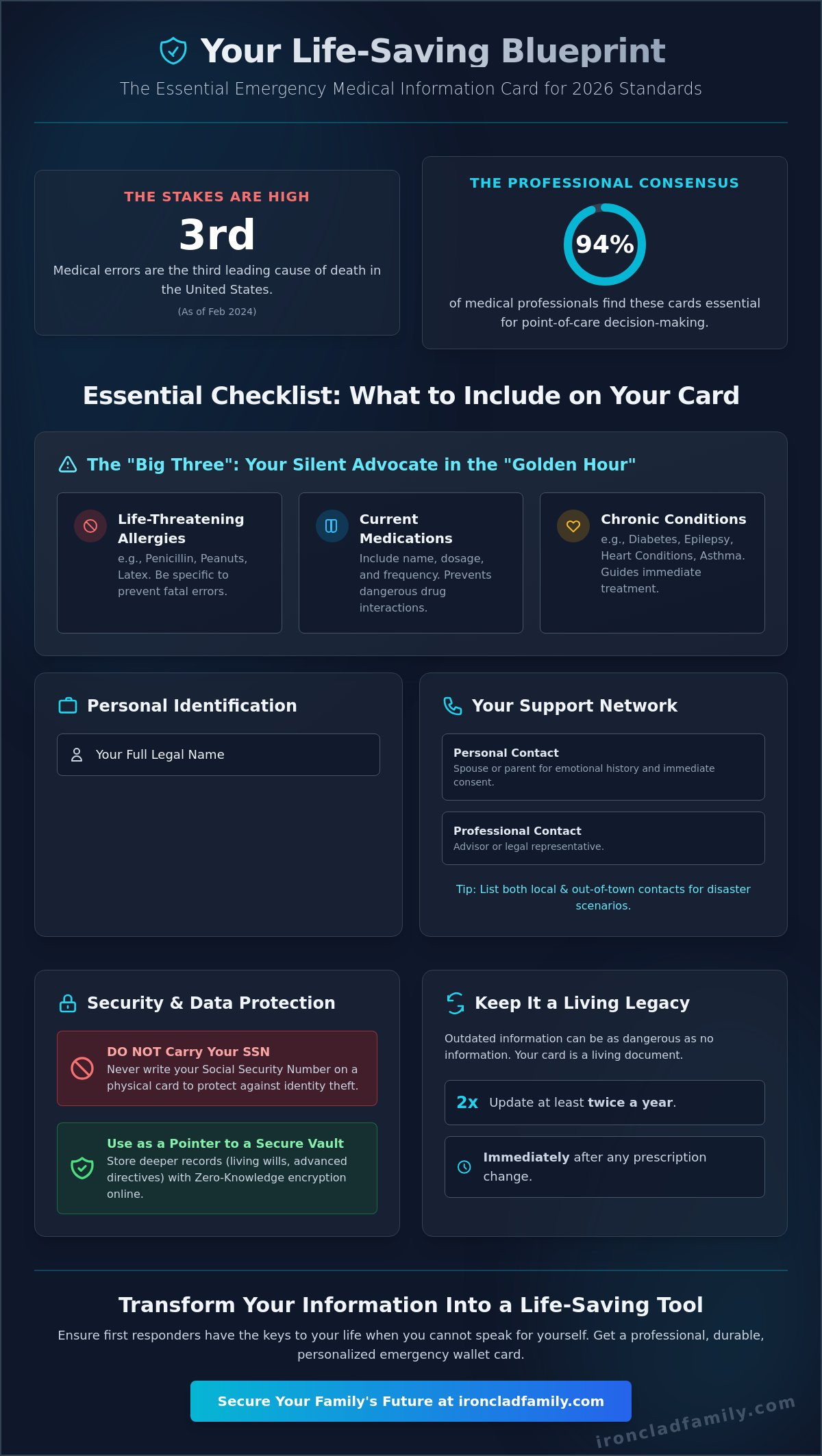
When determining an emergency medical information card what to include, you must prioritize the "Big Three": life-threatening allergies, current medications with dosages, and chronic conditions like diabetes or epilepsy. These specific details are designed to prevent medical errors, which were identified as the third leading cause of death in the United States in February 2024. Providing this information at the point of care helps mitigate the estimated $20 billion annual cost associated with medical mistakes. A 2011 study revealed that 94% of medical professionals believe these cards significantly enhance decision-making and decrease encounter times during emergencies.
Establishing Your Support Network
Your card should not just list data; it should connect people. Prioritize two distinct types of emergency contacts to ensure a fortress-like support system. First, list a personal contact, such as a spouse or parent, who can provide emotional history and immediate consent. Second, include a professional contact or a pointer to your advisor. When you consider an emergency medical information card what to include, remember that local contacts are essential for immediate response, while out-of-town contacts are vital if a local disaster disrupts regional communications.
Maintenance and the Secure Vault
Information is only life-saving if it's accurate. We recommend updating your card at least twice a year or immediately following any prescription change. Think of your card as a physical key to your life. While the card provides immediate rescue data, it should also serve as a pointer to your secure digital vault where deeper records, such as living wills and advanced directives, are stored under military-grade protection. For a professional, durable solution, our personalized emergency wallet card keeps your family's essential "Digital DNA" within reach of first responders at all times.
Table of Contents
- Understanding the Role of an Emergency Card
- The Essential Checklist: What to Include
- Legal and Contact Details
- Security and Storage Best Practices
- The IronClad Family Solution
Understanding the Role of an Emergency Medical Information Card
Your medical card is far more than a simple list of health facts. It serves as your silent advocate during moments when you cannot speak for yourself. In the medical world, the first 60 minutes following a trauma or sudden illness are known as the "Golden Hour." During this critical window, the speed at which first responders access your health history directly dictates your clinical outcome. Having the right data immediately available allows paramedics to move with the calm confidence required to save a life, rather than wasting precious minutes on guesswork.
We view this essential data as your "Digital DNA." These are the foundational keys to your health, your identity, and your family's peace of mind. While many people assume a standard driver's license or a phone's "In Case of Emergency" (ICE) settings are sufficient, these tools often fall short. Incorporating a physical card into your American Red Cross emergency plan ensures that your vital information is accessible even when technology fails. Securing a personalized emergency wallet card creates a reliable bridge between your physical presence and your deeper medical history stored in the vault.
Why a Physical Card Still Matters in 2026
First responders are conditioned by years of training to look for identification in specific places, primarily wallets and around the neck. Despite the prevalence of smartphones, a 2020 study on emergency identification found that while 91% of participants owned a smartphone, only 31% actually used the built-in medical ID features. Even more concerning, only 21% of medical providers surveyed had ever attempted to access a patient's phone during an emergency. Digital devices are vulnerable; they break during accidents, run out of battery, or remain locked behind biometrics that an unconscious patient cannot provide. A physical card requires no power and no password.
The Consequences of Missing Information
When determining an emergency medical information card what to include, the goal is to prevent avoidable tragedy. Missing information leads to dangerous delays. Hospitals may spend hours trying to identify a patient or locate their next of kin, delaying critical surgical consents. More dangerously, unknown medications can lead to lethal drug interactions or allergic reactions to emergency treatments. A 2017 survey revealed that nearly 1 in 10 people who accessed their medical records found errors, highlighting why your patient-verified card is a more reliable source of truth than fragmented hospital databases. This small piece of plastic acts as a fortress, protecting you from the risks of misinformation and fragmented care.
Essential Checklist: Emergency Medical Information Card What to Include
Hierarchy is the foundation of effective emergency care. When paramedics arrive, they aren't looking for a life story; they need a roadmap of your physical vulnerabilities. Knowing exactly an emergency medical information card what to include ensures that your most critical "Digital DNA" is visible within seconds. This checklist prioritizes data by urgency, moving from immediate rescue details to the legal frameworks that protect your long-term medical wishes. We recommend starting with your full legal name, date of birth, and primary address. This information must match your official ID to avoid any confusion during hospital intake.
The core of your card must highlight "Life-Threatening" data. This includes severe allergies to latex, penicillin, or bee stings, alongside chronic conditions such as diabetes, epilepsy, or heart disease. Accuracy here is paramount. A 2019 analysis of medical claims found that incorrect information in Electronic Health Records (EHR) is a rising contributor to patient injury. To combat this, your card should list current medications with precise dosages and frequency. This prevents the hospital from administering a drug that might interact dangerously with your existing regimen. Don't forget to mention medical devices like pacemakers, insulin pumps, or hearing aids that responders need to account for during treatment.
Beyond immediate care, your card acts as a bridge to your broader legal legacy. It should clearly state if you have a Living Will or a Power of Attorney on file. Most standard cards ignore this connection, yet it is vital for ensuring your end-of-life wishes are respected. By pointing rescuers toward your digital vault, you provide them with the keys to your life’s most important documents. This holistic approach moves you from a state of vulnerability to a position of absolute preparedness.
The Front of the Card: Immediate Rescue Data
The front of your card is for split-second decisions. Use high-contrast text, such as black ink on a white or yellow background, to ensure readability in low-light settings. Focus on your name, blood type, and the most critical health alerts. If you have a condition that requires immediate intervention, like a severe nut allergy, place it at the very top in bold. Always include a "See Back for More" note if you are using a double-sided format to ensure no data is overlooked.
The Back of the Card: Secondary Medical Context
The back of the card provides the context needed once the initial crisis is stabilized. List your primary care physician’s name and office phone number so the hospital can coordinate your long-term care. Include insurance information, specifically your carrier name and policy numbers, to streamline the admission process. This side is also the ideal place for a brief history of recent major surgeries or immunizations, providing a more complete picture of your medical heritage for the attending staff.
Critical Legal and Contact Details for Your Card
Your emergency medical information card serves as a tactical chain of command. It isn't just a list of names; it's a map for first responders to find the people who hold the keys to your life. When considering an emergency medical information card what to include, you must identify your "Personal Support Network." This network should consist of at least two individuals authorized to make medical decisions on your behalf. These contacts must be intimately familiar with your medical history and your specific legal wishes regarding life-sustaining treatment. Listing them clearly ensures that your family’s voice is heard even when you are silenced by a crisis.
Strategic redundancy is vital for true family safety. We recommend differentiating between local and out-of-town contacts. A local contact can arrive at the hospital within minutes to provide immediate consent. However, in the event of a regional disaster that disrupts local communications, an out-of-town contact becomes your lifeline. They remain reachable when local cell towers are overwhelmed, serving as a central hub for your family's information. This dual-layered approach is a cornerstone of a robust family emergency plan checklist.
Finally, your card should reflect your final legacy through your organ donor status. Clearly stating "Organ Donor" ensures your wishes are respected without delay. While competitors often suggest carrying your Social Security Number on your card, we advise against this due to the high risk of identity theft. Since HIPAA regulations reaffirmed in May 2026 allow providers to access necessary info in emergencies, you don't need to expose your sensitive data. Instead, use your card as a secure pointer to your digital vault, where your full medical heritage is protected by military-grade encryption.
Emergency Contacts: Who to List
For each contact, include their full legal name, their relationship to you, and two distinct phone numbers. You should choose people who are stoic under pressure and fully understand your healthcare values. It's not enough for them to love you; they must be prepared to act as your guardian in a complex medical environment. Ensure these individuals know they are listed on your card and where your deeper "Digital DNA" is stored.
Linking to Legal Directives
A medical card is the signal, but the legal document is the authority. A simple line such as "Living Will and POA on file with Ironclad Family" provides doctors with the definitive roadmap for your care. This transforms your card into a pointer for your living will, ensuring that your Power of Attorney (POA) can be reached to authorize critical procedures. By linking your physical card to your legal directives, you bridge the gap between immediate rescue and long-term protection.
Security and Storage: Keeping Your Sensitive Data Safe
Protecting your family requires a delicate balance between immediate accessibility and high-level security. While your card must speak for you in a crisis, it should never compromise your financial safety or identity. A common mistake in the industry is the recommendation to include your Social Security Number on physical medical IDs. We firmly advise against this practice. Carrying your SSN in a wallet creates a high identity-theft risk that far outweighs the medical benefits. Since HIPAA regulations were reaffirmed in May 2026 to allow emergency access to records without prior consent, first responders can verify your identity through other means. Your emergency medical information card what to include should focus on life-saving data, not sensitive identifiers that belong in a fortress.
True security in 2026 relies on "Zero-Knowledge" encryption. This technical standard ensures that only you and your authorized "Digital Guardians" hold the private keys to your health history. While a physical card is a passive tool, a modern preparedness system offers a proactive solution that competitors lack: automated notification. When a medical professional accesses your emergency credentials, a secure system can instantly alert your family members. This closes the terrifying gap where a loved one is hospitalized for hours before the family is notified. It transforms your medical data from a static list into a living, responsive legacy.
To ensure you're never without protection, we suggest maintaining strategic redundancy. Create multiple copies of your card. Keep the primary version in your wallet, but place secondary copies in your car's glove box and your work desk. This ensures that even if your wallet is lost during an accident, the "keys to your life" remain within reach of those trying to help you.
Physical vs. Digital Storage
The physical card is designed for the "now," providing the split-second data needed for immediate stabilization. However, the digital vault is for "always," housing the comprehensive medical heritage that simply won't fit on a three-inch card. Many families now use a secure QR code on their physical cards. This code acts as a encrypted pointer, linking rescuers to a password-protected health profile that you can update instantly the moment your health status or prescriptions change. This ensures your "Digital DNA" is always accurate and actionable.
Protecting Your Privacy
Privacy is the bedrock of peace of mind. Only include information on your physical card that is strictly necessary for life-saving care. Avoid listing deeply private details like home security codes or financial account numbers. For a professional, durable solution that balances visibility with discretion, we recommend Ironclad Family’s personalized emergency wallet card. It is designed to act as a stoic defender of your health data, ensuring first responders see what they need while your private life remains under military-grade protection.
Take Command of Your Family’s Medical Future
A medical crisis shouldn't lead to a state of uncertainty. By mastering an emergency medical information card what to include, you empower first responders to act with the precision required during the "Golden Hour." You now understand how to prioritize life-saving alerts and why connecting physical cards to deeper legal directives ensures your medical wishes are never ignored. This is a critical step, as 94% of medical professionals surveyed in 2011 found these cards vital for point-of-care decisions.
Your preparedness is a gift to your next of kin. We protect this gift within a secure vault, using zero-knowledge encryption to safeguard your "Digital DNA." Trusted by families and financial advisors nationwide, our platform ensures automated emergency credential delivery to your loved ones when it's needed most. You can move forward with calm confidence, knowing your legacy is shielded by military-grade protection.
Secure your family’s future with an Ironclad Digital Vault today. You've built the plan; we provide the fortress. Rest easy knowing your family is ready for whatever tomorrow brings.
Frequently Asked Questions
Should I include my Social Security Number on my medical ID card?
No, you should never include your Social Security Number on a physical card. The Identity Theft Resource Center warns that carrying your SSN in a wallet is a primary cause of identity fraud. Instead, rely on your legal name and date of birth, which are sufficient for hospital intake under HIPAA guidelines reaffirmed in May 2026. This keeps your sensitive "Digital DNA" secure while providing rescuers with enough data to identify you.
How often should I update my emergency medical information?
You should update your information at least twice a year or immediately after any change in your prescriptions. An outdated card is a liability that can lead to dangerous drug interactions. We recommend a "seasonal check" every six months to ensure your contact list and medical conditions reflect your current health status. Keeping this living legacy accurate is the only way to maintain a true fortress of protection for your family.
What is the most important thing to include on a medical ID for a child?
The most critical details for a child’s ID are parent contact information and life-threatening allergies. Children often can't communicate their medical history during a crisis. Including a clear note about severe reactions to penicillin or latex can prevent a secondary emergency in the hospital. Ensure the card is attached to their backpack or placed in a clear pocket to be visible to school staff or paramedics.
Can I use a QR code on my emergency medical card?
Yes, a QR code is a highly effective way to link a physical card to your secure digital vault. It acts as a high-tech pointer to your comprehensive medical history, including living wills and advanced directives. When you're deciding on an emergency medical information card what to include, a QR code allows you to store unlimited "Digital DNA" without cluttering the small physical space of the card itself.
Where is the best place to keep my emergency health information card?
The best place is your wallet, positioned directly behind your driver's license. First responders are trained to look for identification first. You should also maintain redundancy by keeping extra copies in your car's glove box and your desk at work. This ensures that the keys to your life are accessible even if your primary belongings are lost during a traumatic event.
Do first responders actually look for medical ID cards?
Yes, paramedics and ER staff are professionally trained to search for medical identification tags and wallet cards. While a 2020 study showed that only 21% of providers successfully accessed smartphone medical IDs, physical cards remain the gold standard for quick identification. A physical card provides immediate rescue data without the barrier of a locked screen or a dead battery, ensuring your protection is never interrupted.
What should I do if I have multiple chronic conditions and they won’t fit?
If you have several chronic conditions, list only the most life-threatening ones on the physical card. Focus on "rescue-critical" data like heart conditions or severe asthma. Use the remaining space to point responders to your advisor or a secure digital repository. This hierarchy ensures that the most vital information is seen first, while your complete health heritage remains accessible through your emergency access credentials.
Is a digital medical ID on my phone better than a physical card?
A physical card is essential because it serves as a fail-safe for your digital medical ID. Smartphones are incredible tools, but they frequently break or run out of power during accidents. When determining an emergency medical information card what to include, remember that the physical version provides the "now" while the digital vault provides the "always." Using both creates a sophisticated, multi-layered defense for your family’s safety.

