

- 13 mins
Did you know that 56% of American adults still don't have a plan for their legacy, and nearly half have left zero instructions for their digital assets? It's a heavy thought. You've worked hard to build a life for your family, but the fear that they might never find your paperwork or that a hacker could steal your private information is real. You want to store last will and testament online safely, yet the legal rules often feel confusing or out of reach.
We understand that protecting your family is your highest priority. You deserve to know that your final wishes are locked away in a digital fortress that your loved ones can actually open when the time comes. This guide shows you how to build a secure system for your documents that balances high-trust security with legal validity. We'll walk through a clear, step-by-step plan to organize your estate so you can finally trade your anxiety for absolute peace of mind.
Key Takeaways
- Learn why a missing physical will can lead to expensive legal battles and how digital backups prevent probate delays for your loved ones.
- Discover the safest methods to store last will and testament online while ensuring your family has the legal authority to access it when needed.
- Understand the RUFADAA laws that govern your digital inheritance and why standard cloud storage accounts often lock families out after a death.
- Get a simple checklist for scanning and organizing your documents so every legal signature is preserved and easy for your executor to find.
- Find out how a dedicated digital vault bridges the gap between your legal papers and your family's future security for true peace of mind.
The Hidden Risks of a Lost Will and Why Storage Matters
A last will and testament is the most important document you'll ever sign. It acts as a silent protector, ensuring your children are cared for and your home passes to the right hands. However, a will is only a piece of paper unless your family can actually find it. When a document goes missing, the law often assumes you destroyed it on purpose. This forces your family into a long, expensive court battle called probate, where a judge decides your legacy instead of you. The emotional cost of this confusion is high, adding deep stress to grieving family members who just want to honor your wishes.
Choosing to store last will and testament online is about more than just keeping a file safe from a house fire. You need a secure way to organize your estate so your family has a clear path to follow. Digital storage is not just a backup scan; it is a living bridge between your intentions and your heirs. By setting up a Digital will or a secure repository, you ensure your executor has the keys to your life's work without searching through dusty boxes or filing cabinets.
To better understand how to protect your documents, watch this helpful video:
Key Takeaways for Secure Storage
- Accessibility matters: If your security is so tight that your family cannot get in, the system has failed. You need a storage method that balances high-tech safety with ease of use for your designated helpers.
- Executor roadmap: A digital copy serves as an essential guide, giving your executor the exact locations of your assets and debts.
- Automated protection: Modern systems prevent your documents from being forgotten during a sudden medical emergency, ensuring the right people are notified instantly.
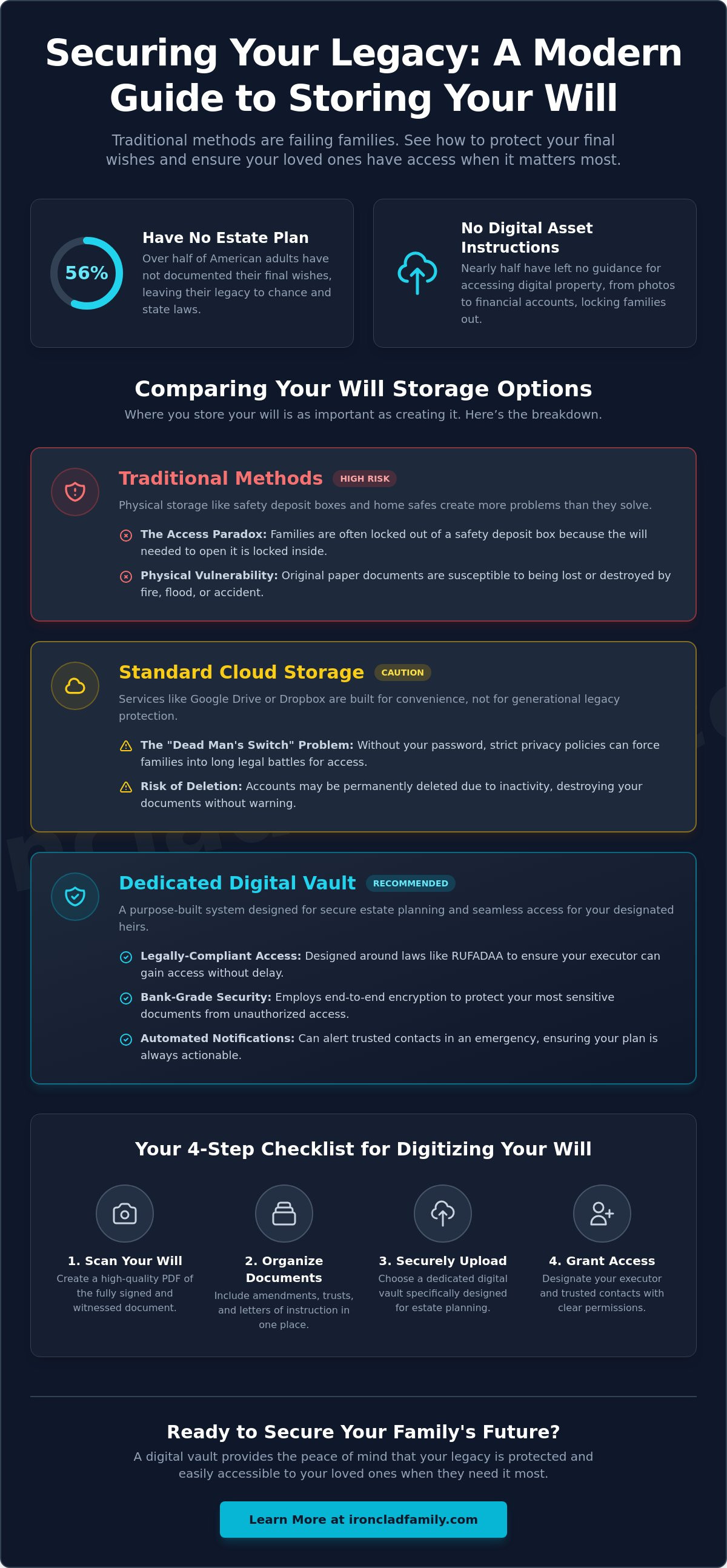
The Danger of Traditional Safety Deposit Boxes
For decades, people believed that a bank vault was the safest place for a will. This created a famous legal "catch-22." Banks often require a court order to open a deceased person's safety deposit box. To get that court order, you usually need the original will. If the will is locked inside the box, your family is stuck in a loop of legal fees and delays. Home safes offer similar hurdles. If you're the only one with the code, your family may have to hire a locksmith or damage the safe just to see your final wishes. When you store last will and testament online, you remove these physical barriers and provide 24/7 accessibility from anywhere in the world.
Why Standard Cloud Storage Often Fails Your Estate Plan
Many people believe that a simple folder in the cloud is the best way to store last will and testament online. It seems easy to just upload a PDF to a standard drive and forget about it. But these services are built for daily business, not for protecting a legacy over decades. If you don't log in for a long time, some providers might mark your account as inactive and delete your files. This is a massive risk for a document that needs to stay safe for twenty or thirty years.
The biggest hurdle is the "dead man switch" problem. If you're the only one with the password, how does your family get in? Standard cloud companies have very strict privacy rules. Even with a death certificate, your family might spend months fighting for access. This is why the Revised Uniform Fiduciary Access to Digital Assets Act (RUFADAA) was created. It helps executors manage your digital life, but it only works if you've clearly granted permission first.
Security vs. Convenience in Online Storage
Typical cloud providers prioritize convenience over deep security. They often have the ability to scan your files for "terms of service" violations. For something as private as your final wishes, you need zero-knowledge security. This means only you and your chosen beneficiaries can see what's inside. A generic folder is just a box; a true vault is a guardian that keeps eyes away from your private data. When you store last will and testament online, you're entrusting your family's future to a digital tool, so it needs to be the right one.
Common Mistakes in Digital Document Management
- The Email Trap: Never store your will in an email "Drafts" folder. Email is one of the most hacked services on the internet.
- The Update Gap: If you change your physical will but forget to update the digital copy, you create a legal nightmare. The two versions must always match.
- The Hidden Key: If you use a digital vault but don't tell your executor it exists, it's just as lost as a paper will in a flood.
Choosing a dedicated digital vault ensures that your family isn't left guessing or locked out during a crisis.
Practical Steps to Store Your Last Will and Testament Online
Once you've finalized your legal documents, the next step is protecting them. You must first ensure your will is signed and witnessed according to your specific state laws. A digital scan is only a backup of a legally binding original, so the physical version must be perfect before you begin. After the ink is dry, you can follow a clear path to store last will and testament online so your family isn't left with a puzzle to solve later.
Creating a high-quality digital scan is the most important part of this process. Don't rely on a simple photo from your phone. Use a scanner to create a clear PDF of every single page, including the witness signatures and notary stamps. If a court can't read the small print or see the seals, the digital copy might not help your executor. Along with the will, you should gather your trusts, powers of attorney, and a list of your assets. Keeping these together in one secure place prevents your heirs from hunting through different folders during a difficult time.
Security is your next priority. You need a platform that uses zero-knowledge encryption. This means only you and the people you choose can see the files. This level of privacy is a requirement for following the Revised Uniform Fiduciary Access to Digital Assets Act (RUFADAA). By naming a "receiver" or beneficiary within your storage system, you ensure the documents move to the right hands automatically when they're needed.
Scanning and Uploading Your Documents
When you upload your files, naming is everything. Use a clear format like "2026_Last_Will_John_Doe.pdf" so your executor knows exactly what the file is. It's also helpful to include a "letter of instruction." This isn't a legal document, but a personal note that explains where you keep your house keys or how you'd like your memorial handled. This simple addition provides much-needed guidance for your family when they're grieving.
Managing Your Digital Asset List
A will often lists your property, but it doesn't give your family the logins they need to reach it. Your online storage should hold the credentials for your bank accounts, social media, and retirement funds. Linking your physical papers to these digital instructions creates a complete picture of your life. Using a system for secure family document storage helps you bridge the gap between your paper files and your digital life. This organization is the best way to ensure your legacy is handled exactly how you intended.
Understanding Digital Vaults and RUFADAA Compliance
When you decide to store last will and testament online, you aren't just saving a file. You're participating in a new legal standard called RUFADAA. This stands for the Revised Uniform Fiduciary Access to Digital Assets Act. It's a law that gives your executor the legal right to manage your digital life, from bank accounts to social media. Without this framework, your family might be locked out of your online world forever, even if they have a paper will in their hands.
A digital vault acts as a legal bridge for your family. Standard cloud storage often ignores the needs of an estate. If a provider doesn't recognize your executor, they may refuse to grant access. A dedicated vault is designed to follow the rules of RUFADAA, making sure your "digital fiduciary" (the person you choose to handle your assets) can step in without a fight. This creates a seamless transition that protects your legacy from being lost in a digital void.
The Legal Framework for Digital Assets
In the past, privacy laws were so strict that families were often blocked from a loved one's accounts. Today, laws have changed to help families, but only if you take the right steps first. Your will should explicitly mention digital access rights so there is no doubt about your wishes. By storing a will online securely, you provide the proof your family needs to claim these rights. This legal clarity saves your heirs from months of frustration and high legal fees.
How Zero-Knowledge Encryption Protects Your Privacy
Think of zero-knowledge encryption like a fortress with no master key. In this system, you are the only person who holds the key to the gate. Even the people who built the fortress cannot see what is inside. This technology is a must for sensitive legal paperwork. It ensures that your private final wishes remain private from hackers and even the storage company itself. Your legacy remains a sacred conversation between you and your chosen family members, exactly as it should be.
The "missing link" in most plans is automated delivery. A standard folder just sits there, but a digital vault can be set to release information when it's needed most. This ensures that your family doesn't have to go on a treasure hunt for passwords during a crisis. It's a proactive way to care for the next generation. If you're ready to secure your family's future, you can start building your own secure digital vault today.
Protecting Your Legacy with IronClad Family
Preparing for the future is one of the most selfless acts you can perform for your loved ones. It's about more than just numbers or legal clauses. Your legacy is a living story made of your values, your hard work, and your dreams for the next generation. IronClad Family serves as a technical guardian for that story. We provide a space where your most sensitive information is treated with the gravity it deserves, moving you from a state of worry to a feeling of absolute preparedness.
One of the biggest hurdles in estate planning is the gap between writing a will and making sure it reaches your family. We solve this through a system of designated Receivers. These are the people you trust most. Instead of leaving them to guess your passwords or search through old files, our system ensures they receive the right documents at exactly the right time. This automated hand-off removes the burden from your grieving family and ensures your wishes are followed without delay.
The IronClad Vault Advantage
Our vault is built on the principle of zero-knowledge security. This means your data is encrypted so deeply that even we cannot see what you've stored. It's a fortress built for your privacy. This system isn't just for individuals. It's also a powerful tool for financial advisors who want to offer their clients a higher level of protection and organization. By using a dedicated vault, you ensure that every emergency instruction and asset login is preserved in a way that generic cloud storage simply cannot match.
Getting Started with Your Family Preparedness
Taking the first step is simpler than you might think. You can begin by uploading your finalized will and assigning your first Receiver. From there, you can slowly add life insurance policies, property deeds, and even personal messages for your children. If you want a more guided experience, our family preparedness service helps you build a complete roadmap for your estate. This white-glove approach ensures no detail is missed and every document is correctly placed.
Don't wait for a crisis to find out if your family is protected. The best time to organize your life's work is while you have the clarity and calm to do it right. When you choose to store last will and testament online with a secure partner, you're giving your family the gift of certainty. You can rest easy knowing that your legacy is locked away safely and that your loved ones will have everything they need when it matters most.
Secure Your Family's Future Today
Organizing your legacy isn't just about the documents; it's about the clarity you leave behind for your heirs. We've explored how physical storage can fail and why standard digital folders aren't enough to satisfy modern laws. By choosing to store last will and testament online through a system built for inheritance, you bridge the gap between today's hard work and tomorrow's security. You now have the steps to scan, secure, and share your final wishes with confidence.
A complete plan ensures that your digital assets and physical property are handled with the same level of care. With the right encryption and delivery tools, you can rest easy knowing your family won't be left with unanswered questions during a crisis. This is your chance to replace uncertainty with a fortress of protection. Take the final step toward preparedness and give your family the gift of a clear, reachable path forward.
Secure your family legacy today with the IronClad Vault
digital-family-vaults-estate-planning, advisors
#EstatePlanning #DigitalLegacy #FamilySecurity #IronCladFamily #PeaceOfMind
Frequently Asked Questions
Is it legal to store a last will and testament online?
Yes, it is legal to keep a digital copy of your will as a backup. Most people choose to store last will and testament online to ensure their family can find the document quickly during a crisis. While the digital copy is a powerful tool for organization, you must still follow your state's rules for signing and witnessing to ensure the document is valid.
Do I still need to keep the original paper copy of my will?
Yes, you should always keep the physical original in a safe place. Most probate courts require the paper document with wet-ink signatures to prove the will is authentic. Your digital vault acts as a guide that shows your family where the paper version is kept and what it says. Keeping both ensures your plan is visible and legally binding.
Who should have the password to my digital document vault?
You should be the only person with your master password. Sharing your login can lead to security gaps or accidental changes to your files. Modern vaults allow you to name specific people as receivers. These individuals get their own unique access only after a certain event occurs, ensuring your privacy remains intact while you are healthy.
What happens if I forget my master password for the vault?
If you lose your password in a zero-knowledge system, the provider usually cannot reset it for you. This is a security feature that keeps your data private from everyone, including the company itself. You must keep your emergency access credentials or backup codes in a secure, physical location. These codes are your only way to recover your legacy if you forget your login.
Can an online will be used for probate in my state?
It depends on your local laws. As of late 2025, about fourteen states have adopted legislation similar to the Uniform Electronic Wills Act. These laws allow for digital wills to be treated as legal originals. In most other states, the digital version acts as a backup that helps your family start the legal process while they search for the paper original.
How often should I update the digital copies of my estate documents?
You should review and update your digital files whenever your life changes significantly. This includes events like getting married, having a child, or buying a new home. Even if life is quiet, it is a good habit to check your vault every three years. This ensures your asset list is current and your designated receivers are still the people you want to handle your legacy.
What is the difference between a digital vault and a cloud drive?
A digital vault is a specialized fortress for your legacy. While a cloud drive is made for daily convenience, a vault is made for long-term protection. When you store last will and testament online in a vault, you gain features like zero-knowledge encryption and beneficiary hand-offs. These tools ensure your data remains private and becomes accessible only when it is needed most.
How does automated delivery work if I am unable to communicate?
Automated delivery works through a secure check-in system or a trusted verifier. If you don't respond to a scheduled check-in, the system can notify your receivers. Alternatively, a designated person can provide proof of a status change to trigger the release of your documents. This proactive approach ensures your family gets your instructions even if you can't speak for yourself.

