

- 12 mins
Imagine sitting at the kitchen table, wanting to ask your father where he keeps his life insurance policy, but the words get stuck in your throat. You don't want him to think you're counting down his days. It's a heavy feeling. Most adult children feel a deep sense of guilt or anxiety when they think about bringing up mortality with the people who raised them.
Learning how to talk to parents about estate planning isn't about being morbid. It's about being a protector of the life they worked so hard to build. You want to ensure their hard work remains a source of security rather than a cause of family conflict. By reading this guide, you'll learn how to approach your parents with empathy and clarity to protect their legacy and your family’s future security. We'll walk through the essential documents you need to organize, explain the 2026 tax law changes, and provide a clear plan for starting the conversation today.
Table of Contents
- • The Real Risks of Avoiding the Estate Planning Conversation
- • Shifting the Mindset: Why This Conversation is a Gift
- • How to Talk to Parents About Estate Planning: Practical Strategies
- • The Essential Checklist: 10 Critical Questions to Ask
- • Protecting the Living Legacy with a Digital Vault
Key Takeaways
- Reframe the conversation as a gift of family preparedness rather than a discussion about loss.
- Learn how to talk to parents about estate planning by choosing a calm setting and leading with your own experience.
- Use a clear checklist to find vital documents and confirm that your parents' wishes are legally documented.
- Protect your family from the stress of probate and high legal fees by addressing the "estate planning gap" now.
- Discover how a digital vault provides a secure, private home for your family’s most sensitive information.
The Real Risks of Avoiding the Estate Planning Conversation
The "estate planning gap" is the distance between what your parents want and what you actually know. It's a silent space filled with assumptions that can eventually lead to family disaster. Many people avoid the topic because it feels heavy, but staying quiet creates a vulnerability that grows over time. Understanding what estate planning is and why it matters is the first step in closing that gap. Preparation is an act of love, not a sign of greed.
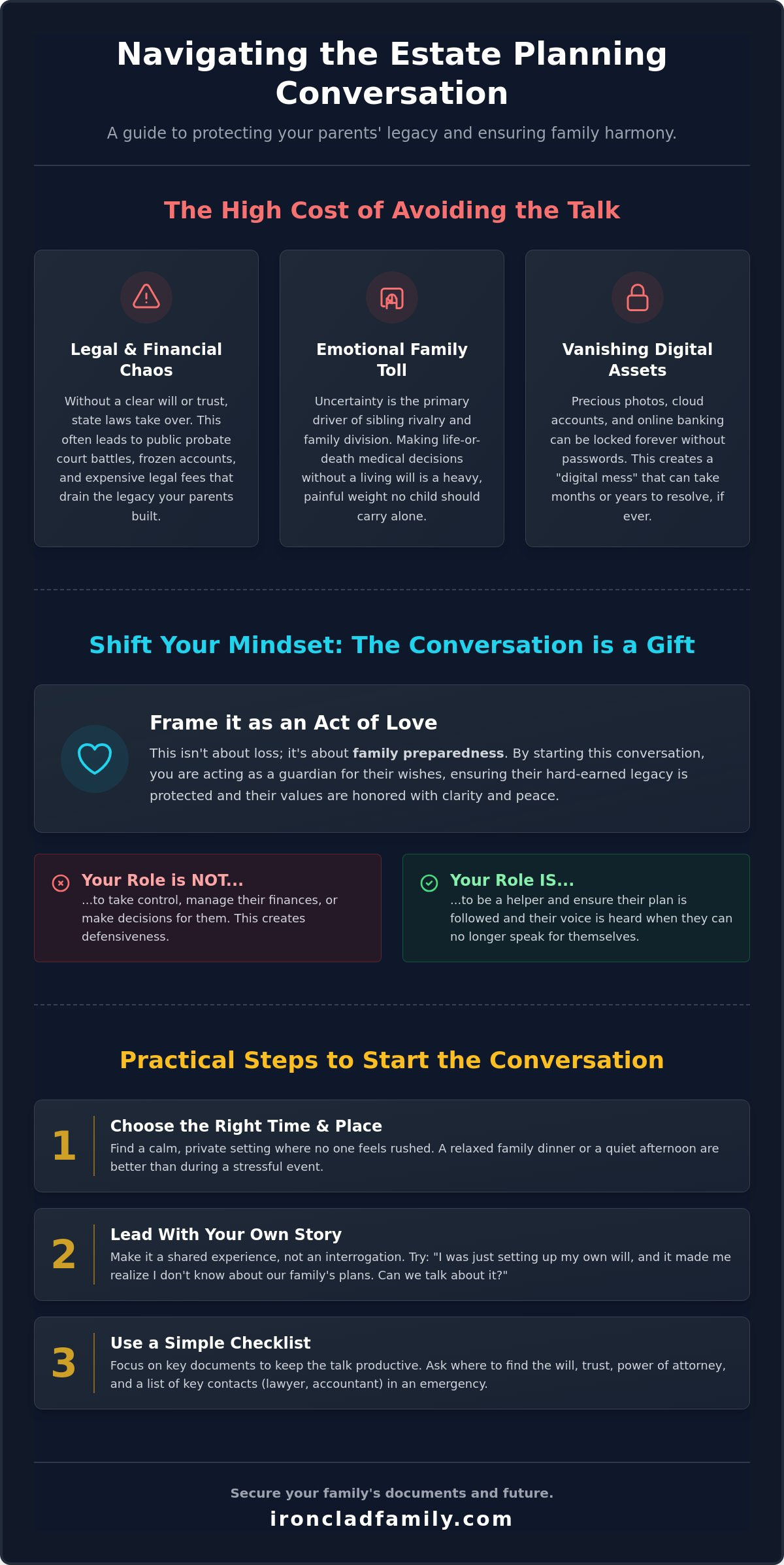
If you don't know how to talk to parents about estate planning, the consequences often fall on your shoulders during a crisis. Silence leads to frozen bank accounts, public probate court battles, and expensive legal fees that drain the very legacy your parents worked to build. It's much harder to find a deed or a password when you're also dealing with a medical emergency.
To better understand why this conversation matters, watch this helpful video:
The Legal and Financial Consequences of Silence
When there's no clear will or trust, state laws take control of the distribution of assets. This process, known as probate, is a public and often lengthy ordeal. In 2026, many states have strict limits on asset values before a full probate is required. For example, in California, estates with real property over $750,000 or cash accounts over $208,850 must go through this court supervised process if no plan exists. Without a designated Power of Attorney, a court might even appoint a guardian to manage your parent's finances. This process is expensive and strips the family of privacy and control.
The Emotional Burden on the Next Generation
The true cost of avoiding this talk isn't just financial. It's emotional. Uncertainty is the primary driver of sibling rivalry and family division. When children are left to guess what a parent would've wanted, resentment often follows. Making life or death medical decisions without a living will is a weight no child should have to carry. A clear plan is a protective shield. It keeps family bonds intact and ensures your parents' values are honored without debate.
The Modern Vulnerability: Lost Digital Legacies
A successful generational wealth transfer now involves much more than just physical property. We live in an era of digital assets that vanish if the passwords aren't shared. Families frequently lose access to precious photos stored in locked cloud accounts or find themselves locked out of online bank accounts forever. Paper documents are no longer enough. If you don't learn how to talk to parents about estate planning in a way that includes digital access, part of their life's work may be permanently deleted. This lockout creates a "digital mess" that can take months or even years to resolve.
Shifting the Mindset: Why This Conversation is a Gift
Many people delay this discussion because they think it's about death. It isn't. This conversation is actually about life, security, and the preservation of everything your parents have worked to build. When you learn how to talk to parents about estate planning, you're really talking about "family preparedness." You're acting as a guardian for their wishes. This shift in perspective turns a difficult topic into a protective act of love.
It's vital to clarify your role early on. You aren't asking to manage their lives or take over their finances. Instead, position yourself as a helper. You're the one who will ensure their plan is followed and their voice is heard when they can't speak for themselves. Remind them that they remain in total control of every decision. You're just there to help build the fortress that keeps those decisions safe. It's a partnership rooted in mutual respect and long term security.
For those feeling stuck on where to begin, you can find practical advice from estate lawyers to help bridge the gap. Approaching the topic with the right tools makes the process feel less like a legal chore and more like a family mission.
From Legal Chore to Living Legacy
An estate is more than a list of bank accounts and property deeds. It's a living legacy. This includes the stories, values, and lessons that define a family's history. Encourage your parents to share the "why" behind their choices. Why is a certain heirloom going to a specific grandchild? What values do they hope their inheritance will support? By focusing on these narratives, you protect the essence of their life's work. It ensures that their wealth is not just transferred, but that their spirit and wisdom move forward with it. Storing these stories in a secure digital vault ensures they aren't lost to time or forgotten by the next generation.
Empowering Your Parents’ Autonomy
A solid estate plan is the ultimate tool for independence. It ensures that your parent's voice is the only one that matters in the future. Without a plan, strangers in a court or distant relatives might make choices for them. Knowing their wishes prevents others from stepping in and causing confusion. You're acting as a protector of their intent. By having this talk now, you're making sure their autonomy is never compromised. It gives everyone involved a sense of calm confidence that the future is secure. This preparedness is the greatest gift a parent can leave behind for their children.
How to Talk to Parents About Estate Planning: Practical Strategies
Timing and environment are the foundations of a successful conversation. Don't bring this up during a busy holiday meal or a loud family gathering. Instead, choose a quiet, private moment where everyone feels relaxed. We've found that the best way to learn how to talk to parents about estate planning is to lead with your own vulnerability. Tell them you've been reviewing your own documents. This shows you're taking responsibility for your own legacy, which makes it easier for them to do the same.
Use "Life Events" as a natural bridge to the topic. Perhaps a friend's family is struggling with probate, or you've recently seen a news story about a lost inheritance. These external examples allow you to discuss the importance of preparation without making it feel like a personal attack. Always give your parents permission to stop the talk if they feel overwhelmed. This respect for their emotional boundaries builds the trust needed for long term planning.
The "Door-Opener" Approach
Avoid the "we need to talk" ultimatum style. It triggers defensiveness and fear. Try a softer script like, "I want to make sure I can honor your wishes exactly as you want them." You can also use your own journey as a catalyst. Mention that you just finished your will and it made you realize how much you value their wisdom. This positions you as a student of their legacy rather than a manager of their assets. It's about protecting their intent, not taking their control.
Handling Resistance and Silence
If they say, "I'm not ready to talk about this," respect that boundary immediately. Pushing will only create a wall. Instead, suggest a professional third party like a financial advisor or an estate lawyer to lead the talk. Sometimes, parents find it easier to discuss sensitive details with a neutral expert. You can also try the incremental approach. Start by discussing medical wishes and health care proxies first. These topics feel more like caretaking than "money talks." You can find expert advice on estate planning conversations to help you navigate these moments of resistance with grace.
Gathering the "Just in Case" Essentials
Once the door is open, your goal is to identify a central location for all vital information. This is where the physical versus digital storage debate happens. While paper deeds are important, they're vulnerable to fire or loss. You need to identify the "Key Holders" for the family. Consider these essential items:
- The location of the original signed Will and Trust documents.
- Access codes for home security and digital accounts.
- Contact information for their attorney and financial advisor.
- A list of all active bank accounts and insurance policies.
Using a family emergency plan checklist provides a neutral, organized way to start this inventory. It turns a potentially awkward interrogation into a practical project for the whole family.
Once you've established trust and opened the door, it's time to move toward specific details. Knowing how to talk to parents about estate planning means asking the right questions before a crisis occurs. These questions act as the blueprint for your family's future security. They ensure that every piece of your parents' legacy is accounted for and protected from court interference. Use the following list as a guide for your next family meeting.The Core Legal and Medical Questions
- Do you have an updated Will and Power of Attorney?
- Where exactly is the physical original of your Will kept?
- Who is named as the Executor of your estate?
- Who is your designated healthcare proxy?
- What are your specific end of life medical wishes?
The Digital and Financial Access Questions
- Do your documents include RUFADAA permissions for digital access?
- How do we access your password manager or account credentials?
- Are there "hidden" assets like digital wallets or crypto accounts?
- What automatic subscriptions or recurring payments are active?
- Who are your trusted professional advisors and how do we contact them?
To ensure you don't miss a single detail, consider using our family preparedness service to walk you through the organization process step by step.
Protecting the Living Legacy with a Digital Vault
Once you've navigated how to talk to parents about estate planning, you must decide where to keep the information you've gathered. A list of passwords on a sticky note or a folder in a desk drawer is a security risk. You need a digital fortress. This is where a digital vault becomes the final piece of your family's security plan. It's not just a place for data. It's a sacred repository for your parents' life's work. A vault ensures that the clarity you've gained through your conversations is never lost to an accident or a disaster.
High trust security is the foundation of this protection. We use zero-knowledge encryption to ensure total privacy. This means that only you and your family hold the keys to your information. Even the service provider cannot see what you've stored. To add another layer of safety, the Automated Delivery feature acts as a fail-safe. It ensures that sensitive credentials and instructions are only released to your loved ones when they are truly needed. This system moves your family from a state of uncertainty to a feeling of absolute preparedness.
Why a Digital Vault Surpasses a Paper Binder
Physical storage is fragile. Fire, flood, or theft can destroy a lifetime of documents in minutes. While many people still rely on paper, you need to know how to store will online securely to ensure it remains accessible yet protected. Updating a digital vault is simple and fast. You don't have to reprint binders or mail documents across the country. You simply upload the new version. This makes it much easier to keep your plan current as laws or family situations change. It's a living system that grows with your family.
IronClad Family: Your Technical Guardian
IronClad Family acts as the central hub for your family narrative. The Vault keeps legal documents, financial credentials, and digital assets in one secure place. But it goes beyond just files. Through Legacy Messages, your parents can leave video or text stories for future generations. It's a way to ensure their voice and values live on forever. This preparation brings a sense of calm confidence. You've learned how to talk to parents about estate planning and you've provided them with a fortress for their legacy. You are no longer just an heir. You are a protector of your family's future security.
Building a Bridge to Lasting Security
Opening a dialogue about the future is the most significant act of protection you can provide for your parents. By moving past the initial anxiety and focusing on family preparedness, you ensure that their voice remains the ultimate authority over their life's work. You now have a clear roadmap for how to talk to parents about estate planning using empathy, practical checklists, and modern digital tools. This clarity replaces the burden of guesswork with the calm confidence of a completed plan.
Securing these sensitive details requires a fortress that honors the weight of a family narrative. Our system provides a high-trust environment where vital documents and legacy stories are guarded by zero-knowledge encryption. With state-specific legal document tools and a dedicated legacy message delivery system, you can be certain that your family’s future is unshakeable. Start protecting your family legacy with the IronClad Vault today. Taking this step now ensures that the people you love are never left to navigate the unknown alone.
#EstatePlanning #FamilyLegacy #DigitalVault #LegacyPlanning #IronCladFamily #EmergencyPreparedness #digital-family-vaults-estate-planning
Frequently Asked Questions
What is the best age to talk to parents about estate planning?
You should begin this conversation as soon as your parents reach retirement age or if they face a new health diagnosis. Waiting for a crisis makes the process much more stressful for everyone. Starting early allows the family to make thoughtful choices without the pressure of an emergency.
My parents refuse to talk about their will. What should I do?
Focus on medical care and healthcare proxies instead of money if you face resistance. Parents often find it easier to discuss who should make health decisions than who gets their assets. Once you build trust around medical topics, you can slowly move toward financial planning.
What documents are absolutely essential to find first?
The three most important documents are the original Will, the Durable Power of Attorney, and the Advance Healthcare Directive. These files give you the legal right to help them when they can't help themselves. Finding these first ensures your family has immediate authority during a medical or financial crisis.
How do I bring up estate planning without sounding greedy?
Frame the discussion as a way to protect their wishes and keep the family united. Learning how to talk to parents about estate planning is about being a helper, not an inheritor. Emphasize that you want to avoid court intervention and ensure their hard work is honored.
Should I ask my parents for a copy of their will?
Yes, asking for a copy or the location of the original is a practical safety step. It ensures you don't waste time searching for documents during a difficult time. Knowing where the files are kept allows you to act quickly and follow their instructions exactly.
What happens if my parents die without a will?
The state government will decide how to distribute their assets according to local laws. This public process often takes months and can be very expensive. Without a will, your parents lose the ability to choose who receives their property or manages their legacy.
How do digital assets fit into a traditional estate plan?
Digital assets require specific legal permissions that older wills often don't include. You must ensure their documents mention digital access laws to allow heirs to enter online accounts. Including these details prevents your family from being permanently locked out of important financial and sentimental digital information.
Can a digital vault replace a physical safe deposit box?
A digital vault provides the immediate access that a physical safe deposit box lacks during an emergency. While a box is for physical items, a vault stores the data needed to manage a life. It serves as a secure, central hub that your family can access from anywhere.

