

- 14 mins
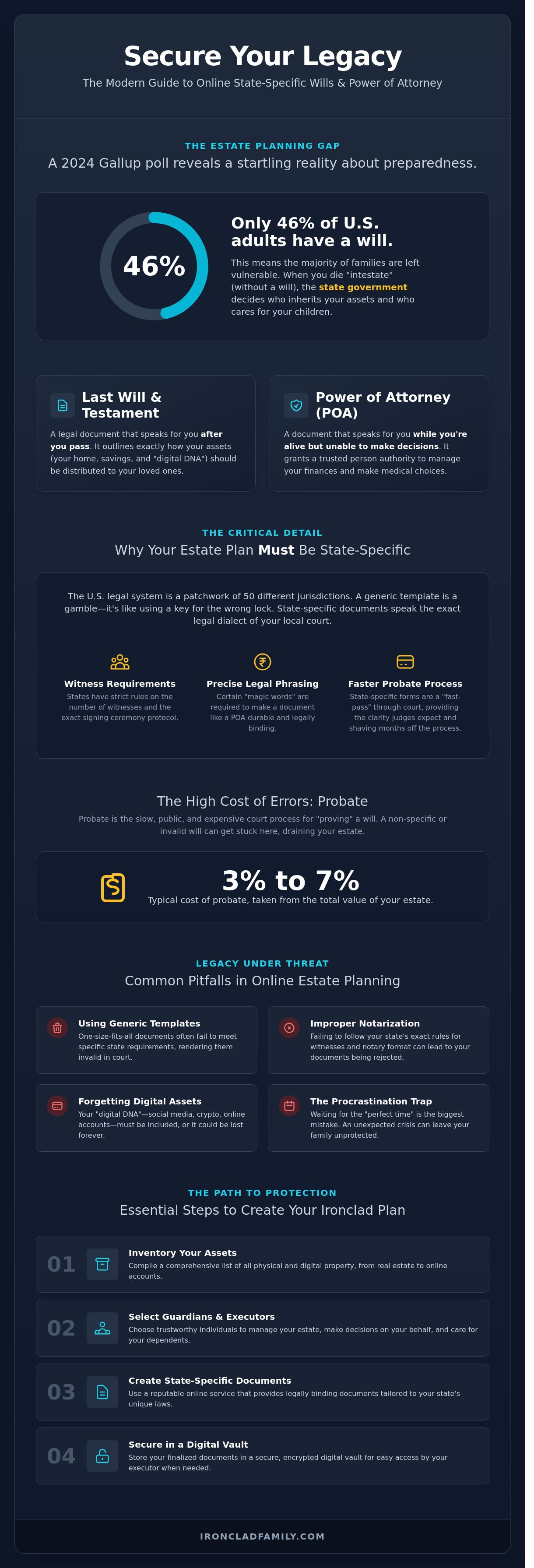
What if the legacy you've built over a lifetime was dismantled in a single afternoon because of a legal technicality? You know that protecting your family is your most sacred duty. Yet, a 2024 Gallup poll found that only 46% of U.S. adults have their final wishes documented. It's natural to feel anxious about leaving a mess behind or fearing that your documents might be ruled invalid in a cold courtroom. Creating an online state specific will and power of attorney shouldn't feel like a gamble with your family's future or a descent into confusing jargon.
We believe your peace of mind is worth more than the 45 minutes you haven't spent yet. You can secure your digital DNA and physical assets with military grade clarity. This guide provides a clear path to creating legally binding, state-specific estate documents that stand as a fortress for your loved ones. We'll explore how to navigate the 2026 legal requirements effortlessly; ensuring your heritage is preserved exactly as you intended.
Key Takeaways
- Discover why state-specific requirements, such as witness counts and precise legal phrasing, are essential for ensuring your estate plan remains legally ironclad.
- Learn the streamlined process for creating a legally binding online state specific will and power of attorney to protect your loved ones and your digital inheritance.
- Identify the common pitfalls of generic templates and improper notarization that could leave your legacy vulnerable to legal challenges.
- Master the essential steps for inventorying your assets and selecting the right guardians to defend your family's future.
- Understand how to secure your life's work within a digital vault, providing a high-tech fortress for your most sensitive legacy documents.
What Is an Online State Specific Will and Power of Attorney?
Securing your family's future shouldn't be a luxury reserved for the ultra-wealthy. An online state specific will and power of attorney is a digital bridge between today's uncertainty and tomorrow's peace of mind. At its core, an online state-specific will is a digital legal document that outlines exactly how your assets, or your "digital DNA," should be distributed after you pass. It isn't a generic template found on a dusty corner of the internet; it's a precision-engineered tool built to satisfy the unique legal codes of your specific residence. To understand the foundational basics of these documents, it helps to look at What is a Will and Testament? to see how legal requirements have evolved into the digital age.
A Power of Attorney (POA) acts as your secondary line of defense. While a will speaks for you after death, a POA speaks for you while you're still alive but unable to make decisions. It grants a "Digital Guardian" or a trusted family member the authority to manage your bank accounts, pay your mortgage, or make medical choices if you're incapacitated. By 2026, these digital tools have become the standard for modern families who value both speed and military-grade security. They're designed for the average household, ensuring that your heritage is protected without the need for a five-figure retainer fee.
Key Takeaways
- Location is everything. State laws in places like Florida or Texas dictate asset distribution if your documents aren't tailored to local statutes.
- Total protection. A Power of Attorney is a vital component of emergency preparedness; it ensures your household continues to run during a crisis.
- Legal integrity. Modern online platforms in 2026 are fully compliant with the Uniform Electronic Wills Act, making them widely accepted by probate courts across 50 states.
The Problem: The Estate Planning Gap
Most families fall into the "procrastination trap." According to a 2024 study by Caring.com, 67% of American adults don't have a will. They wait for a perfect time that never arrives. This delay creates a dangerous gap in family security. When someone passes without an online state specific will and power of attorney, they die "intestate." This means the state government, not your family, decides who gets your home, your savings, and even custody of your children. The emotional toll on survivors is staggering. It adds layers of legal red tape to an already painful grieving process.
Relying on generic, non-state-specific templates is equally risky. A document valid in New York might be rejected in a Georgia probate court because of a missing witness clause or an incorrect notary format. These errors can freeze your estate for months or years. You've spent a lifetime building your heritage; don't leave the keys to your life in a format that the law won't recognize. Modern digital vaults now provide the unshakeable resolution needed to bridge this gap effectively, moving you from a state of vulnerability to absolute preparedness.
Why Your Estate Plan Must Be State-Specific
The legal landscape of the United States isn't a single entity; it's a patchwork of 50 different jurisdictions. If you create a document in New York but move to Texas, your family might face a wall of red tape. A will that lacks the correct number of witnesses or a specific statutory phrase can be declared invalid. For instance, while most states require two witnesses, failing to follow the exact signing ceremony protocol required by your local statutes can lead to a contested estate. Choosing an online state specific will and power of attorney ensures your documents speak the exact dialect of your local court system.
Some states are incredibly rigid about "magic words." To make a Power of Attorney (POA) durable, meaning it stays in effect if you become incapacitated, specific language must be present. Without these precise phrases, the document might lose its power exactly when you need it most. Using a generic template is like trying to use a key for a different lock. It won't turn. It leaves your loved ones locked out of your financial and medical life during a crisis. State-specific forms act as a shield, protecting your family from unnecessary legal battles that can drain an inheritance in months.
The Role of Probate Courts
Probate is the legal process of "proving" your will in court. It's often a slow, public, and expensive ordeal. In 2024, probate costs typically range from 3% to 7% of the total estate value. When a judge reviews your legacy, they look for familiar statutory forms. If your document uses non-standard language, the court may require additional hearings to verify your intent. State-specific documents act as a fast-pass through this system. They provide the clarity judges expect, which can shave months off the distribution process. This efficiency protects your family from the emotional drain of prolonged litigation.
Protecting Your Healthcare and Financial Wishes
A Power of Attorney is only useful if it's accepted. Banks and hospitals are notoriously risk-averse. They often reject documents that don't mirror the specific legal templates they've been trained to recognize. For example, the requirements for a power of attorney under Utah law differ significantly from those in Florida or California. If your agent presents a document that lacks state-mandated disclosures, a bank might freeze your accounts for weeks while their legal department reviews it.
Durability is the cornerstone of this protection. In a medical emergency, every second is a commodity. You need a document that commands immediate respect from medical staff. A state-specific POA ensures your chosen agent has the keys to your life without hesitation. By securing your digital inheritance and legal legacy through localized forms, you eliminate the friction that often plagues generic estate plans. This isn't just about paperwork; it's about building a fortress around your family's future. Local recognition is the only way to guarantee that your voice is heard when you can't speak for yourself. An online state specific will and power of attorney provides the precise legal DNA required to keep your family's story moving forward without interruption.
Common Mistakes in Online Estate Planning
Securing your legacy shouldn't feel like a gamble, yet many people treat their future security as an afterthought. According to a 2024 report by Caring.com, only 32% of Americans have a valid will. Even among those who've taken the step to plan, many rely on flawed digital tools that leave their families vulnerable. When you use an online state specific will and power of attorney, you must navigate the process with precision to ensure your protective "vault" actually holds up when it matters most.
One frequent error involves the technical execution of the document. Every state maintains unique mandates for witnesses and notarization. For instance, while some states transitioned to permanent Remote Online Notarization (RON) by early 2025, others still require physical presence. If you fail to follow these local nuances, your document is just a piece of paper. It won't provide the military-grade protection your family deserves. Another common pitfall is the "set it and forget it" mentality. A 2023 survey found that 15% of estate plans become obsolete because the owner moved across state lines or welcomed a new family member without updating their files. Your digital DNA must evolve as your life does.
- Outdated Templates: Using a "free" form from 2019 won't account for the 2025 changes in federal tax thresholds or state-specific healthcare proxy language.
- Improper Execution: Failing to secure the exact number of witnesses required by your specific jurisdiction.
- Stagnant Planning: Neglecting to refresh your documents after a divorce, birth, or significant asset acquisition.
- The Inaccessibility Gap: Creating a fortress of security but failing to give your loved ones the keys.
The Danger of Generic Forms
A "one-size-fits-all" approach is a legal ticking time bomb. In the legal world, generic forms often lack the specific clauses required by local statutes to bypass lengthy probate. If your online state specific will and power of attorney isn't truly tailored to your home state, your family could face a nightmare. Fixing a contested or invalid will in 2026 can cost an estate upwards of $12,000 in legal fees. This financial drain is entirely preventable by choosing a service that prioritizes state-specific customization over generic convenience. You're not just filling out a form; you're building a heritage.
The "Hidden" Document Problem
Your digital DNA represents the essence of your life's work, but it's useless if it's buried in an unreachable location. A 2025 study on digital inheritance revealed that families spend an average of 420 hours trying to settle an estate when documents are missing or locked behind unknown passwords. Anxiety peaks when loved ones know a plan exists but can't find the "vault" containing it. Accessibility is the final, vital step of your planning journey. You must ensure that your private keys and legal documents are stored in a secure, digital repository that your chosen guardians can access the moment they're needed. True peace of mind comes from knowing the bridge between your intentions and your family's needs is unbreakable.
How to Create Your Online State Specific Will and Power of Attorney
Securing your legacy doesn't have to be a cold, bureaucratic ordeal. By following a structured path, you transform a list of assets into a fortified digital inheritance. The process for creating an online state specific will and power of attorney ensures that your protection is legally binding within your specific borders while remaining accessible to those you love. It's about moving from a state of uncertainty to a feeling of absolute preparedness.
Your first step involves a deep dive into your "digital DNA." In 2026, the average individual manages over 115 digital accounts, ranging from cryptocurrency wallets to sentimental photo clouds. You must inventory these alongside physical assets like real estate or family heirlooms. A 2025 study found that 60% of families lost access to precious memories because login credentials weren't included in estate plans. Your inventory should be exhaustive, covering everything from brokerage accounts to the private keys for your digital archives. Once your inventory is clear, you'll select a reputable platform to generate your documents. These services use logic-based interviews to ensure your online state specific will and power of attorney complies with local statutes, which vary significantly between states like Florida and California.
Choosing Your Representatives
You're selecting the guardians of your life's work. An Executor manages your will after you've passed, while a Power of Attorney Agent makes decisions if you're incapacitated. Choose someone who is organized and emotionally resilient. Always name a backup representative. Statistics show that in 15% of estate cases, the primary representative is unable to serve when needed, making a secondary choice a critical safety net for your family's future security.
Executing Your Documents in 2026
The final legal seal is what turns a digital file into a fortress. As of early 2026, 43 states have fully embraced Remote Online Notarization (RON). This allows you to finalize your documents via a secure video call, eliminating the need for travel. Most states still require two adult witnesses who aren't beneficiaries. If the technical requirements feel overwhelming, the Family Preparedness Service provides expert guidance to ensure every signature meets the highest legal standards. Your documents aren't valid until they're signed, witnessed, and notarized according to your state's specific mandates.
Execution is only half the battle. After the documents are signed, you must secure them in a location where your family can access them instantly. A document hidden in a dusty drawer or a forgotten hard drive is a liability, not an asset. You need a secure, encrypted vault where your family can access these "keys to your life" the moment a crisis hits. Digital inheritance requires military-grade protection paired with easy access for your loved ones. You've spent a lifetime building your heritage; don't leave the access codes to chance.
Take the first step toward total family security. Secure your digital DNA and legacy by visiting Ironclad Family to start your protection plan today.
Securing Your Legacy with a Digital Vault
Completing your online state specific will and power of attorney is a massive milestone. It represents hours of thoughtful decision-making about your future and the people you love. But a legal document is only as effective as its accessibility. If your family can't find your directives during a crisis, your hard work stays hidden. This is why the essential next step is moving your documents into a digital vault. Think of this vault as a secure, encrypted fortress for your life’s most critical files.
IronClad Family provides this level of protection using zero-knowledge encryption. This technical standard means that only you hold the private keys to your data. Even the platform providers can't see what's inside your vault. In a world where 2,365 cyberattacks occur every day on average, military-grade security isn't a luxury; it's a necessity for your digital DNA. Storing your documents on a local hard drive or in an unencrypted email folder is a gamble. If that hardware fails or a password is forgotten, your intent dies with the device. A digital vault acts as a perpetual guardian, ensuring your digital inheritance remains intact for decades.
The true power of this system lies in automated delivery. You designate "Receivers" who are granted access to specific folders. They don't see your sensitive information today. Instead, the system triggers access only when a specific life event occurs or after a pre-set period of inactivity. This ensures your legacy moves forward exactly when your family needs it most. It eliminates the frantic search for paperwork during an already emotional time.
Why a Safe Deposit Box Is Not Enough
Physical storage creates physical barriers. A 2022 survey showed that 33% of heirs struggle to locate essential estate documents after a death. Bank safe deposit boxes often require a court order to open if the sole owner passes away, causing weeks of expensive legal delays. Digital storage bypasses these hurdles entirely. Beyond just PDFs, you can leave Legacy Messages and video instructions. These personal touches transform a cold legal document into a living guide for your family. You can learn how to protect their family’s most important documents to ensure your voice is never lost to a fire, flood, or a misplaced key.
The Peace of Mind Conclusion
Estate planning is an act of love. It's a gift of clarity for the people you leave behind. By using a state-specific plan, you eliminate the legal gray areas that often trigger family disputes. It's about taking control before control is taken from you. Finalizing your online state specific will and power of attorney is the first step toward total family security. You aren't just filing papers; you're building a fortress around your family's future. This level of preparedness brings a sense of peace that no other financial investment can match. Your legacy is now protected, organized, and ready for the next generation.
Take Command of Your Family’s Future
Your legacy deserves more than a generic template. In 2026, legal standards demand a precise online state specific will and power of attorney to ensure your digital DNA remains protected under 50 unique sets of state statutes. You've identified the risks of outdated forms and the necessity of localized compliance. Now, you can transform these documents from static files into a living legacy. Ironclad Family provides state-specific legal document generation backed by zero-knowledge encryption, ensuring your private keys remain inaccessible to anyone but you. Our system utilizes automated emergency delivery to bridge the gap between your intent and your family's needs. Don't leave your heritage to the uncertainty of probate. You've built a life worth protecting; we provide the fortress to keep it safe.
Learn how to protect your family’s most important documents by visiting our Digital Vault. You're ready to secure your peace of mind.
Frequently Asked Questions
Is an online will legally binding in my state?
Yes, an online state specific will and power of attorney is legally binding in all 50 states as long as you follow your specific state's execution laws. For example, Florida Statute 732.502 requires two witnesses to sign in your presence to make the document valid. Following these precise rules ensures your digital DNA remains protected and your family avoids the 12 to 18 month probate process typical for estates without a clear plan.
What is the difference between a Will and a Power of Attorney?
A Will governs your legacy after death, whereas a Power of Attorney protects you while you're still living. Data from 2024 indicates that 1 in 4 adults will face a period of incapacity before they reach age 65. Your Will acts as the final instruction manual for your physical assets; however, your Power of Attorney ensures a trusted guardian manages your financial accounts and medical care when you're unable to speak for yourself.
Do I need a lawyer to make my will and POA official?
You don't need a lawyer to draft these documents, but you must meet the formal signing requirements mandated by your jurisdiction. In 2026, 42 states allow for electronic notarization, which makes the process more accessible than ever. Using a high security platform provides the military grade protection your family deserves without the $300 hourly fees often charged by traditional law firms. It's about securing your heritage with professional precision at your own pace.
How often should I update my state-specific estate documents?
You should review your estate documents every 3 to 5 years to account for shifts in your family's story. If your assets grow by more than 15 percent or you welcome a new grandchild, your existing plan might become a relic that doesn't reflect your current wishes. Regular updates ensure your protective shield remains unshakeable as tax laws and personal relationships evolve. This proactive approach transforms a static file into a living legacy.
What happens if I move to a different state after making my will?
Your documents usually remain valid under the Full Faith and Credit Clause of the Constitution, but local probate courts prefer documents that mirror their specific statutes. If you move from a community property state like Arizona to one of the 41 common law states, your spouse's rights to 50 percent of the estate might change. Securing an online state specific will and power of attorney for your new home prevents legal friction and ensures your family's security.
Can I include digital assets like Bitcoin in my online will?
You can and should include digital assets like Bitcoin, Ethereum, or even sentimental photo archives in your estate plan. Research suggests that $20 billion in digital legacy assets are lost annually because owners didn't provide access to their private keys. By listing these in your digital vault, you ensure your heirs don't lose the keys to your life's work. You're not just passing on money; you're preserving your family's entire digital inheritance.