
More of life now happens online than on paper — bank accounts, insurance policies, investment portfolios, medical records, photos, and the passwords that tie it all together. That makes one question more important every year: where do you keep the information that matters most, and who can reach it when it counts?
That's the job of a secure digital vault. This guide explains what a secure digital vault is, its purpose, the components that make it secure, and how to choose one for your family.
What Is a Secure Digital Vault?
A secure digital vault is a protected online space for storing and organizing sensitive documents and information. Unlike ordinary cloud storage, it's built around two things: keeping your information private, and making sure the right people can reach it at the right time.
Not all secure vault storage is equal. The key question is who holds the key:
- Standard encryption: your files are encrypted, but the company holds the key. They can recover your account — and they can technically read your files.
- Zero-knowledge encryption: your files are encrypted on your own device before they're uploaded. The company never has the key, so nobody there can read what's inside.
For personal and family records — wills, account details, medical information — zero-knowledge is the standard worth looking for.
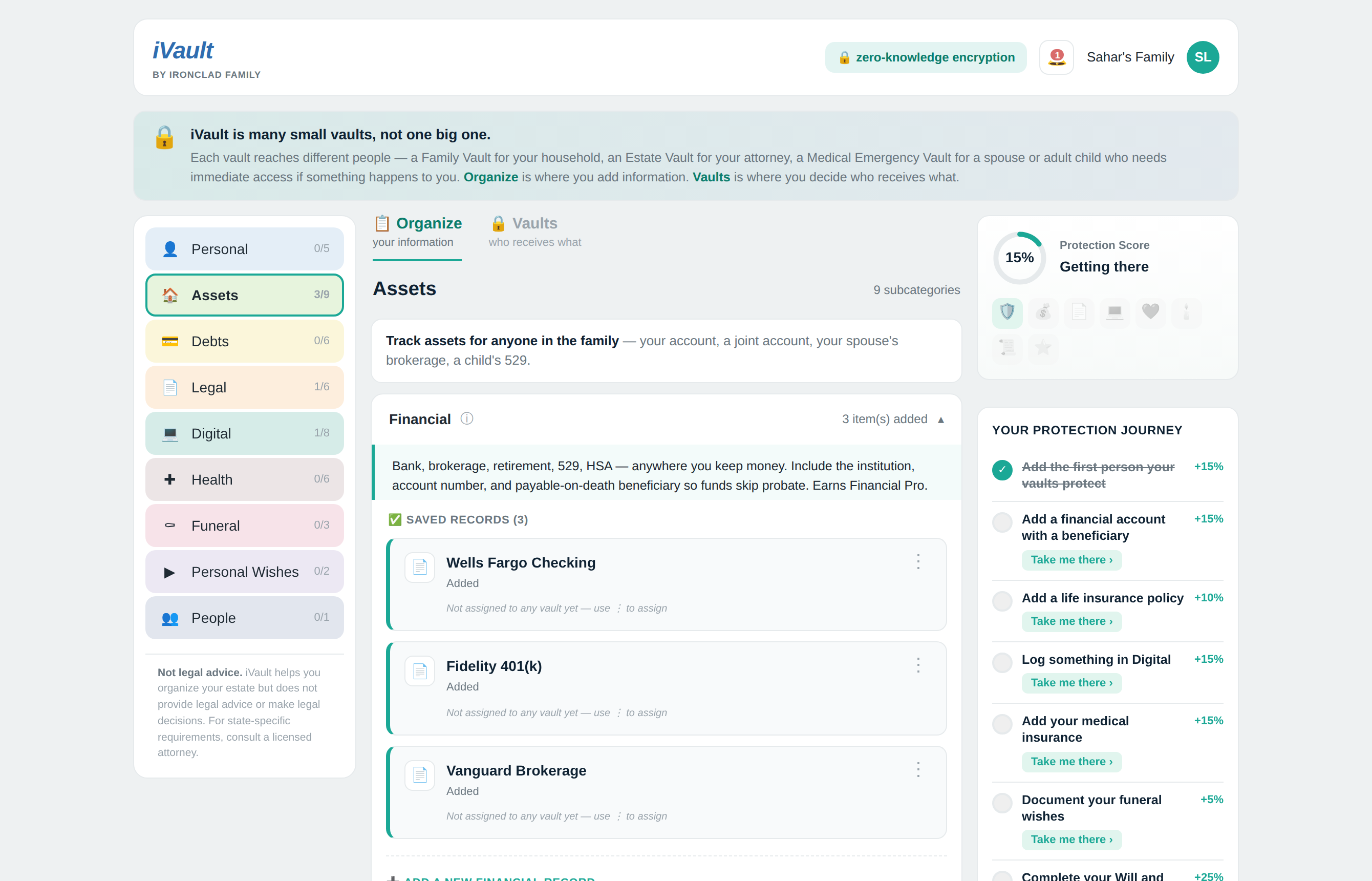
A secure digital vault organized by category, with a protection score showing what's still missing.
The Purpose of Secure Digital Vaults
A secure digital vault has one overall purpose: to keep your most important information safe, private and intact — and available to the people who need it. That breaks down into five goals.
1. Data Protection
The vault stops unauthorized people from getting in. Strong encryption means that even if someone reached the stored files, they'd find scrambled data that's useless without the key. Two-factor authentication adds a second check at the door.
2. Confidentiality
Confidentiality means your information stays private — including from the company storing it. This is where zero-knowledge encryption matters most. If a provider can't read your files, it can't leak them, sell them, or be forced to hand them over.
3. Data Integrity
Your records should stay exactly as you left them. A secure vault protects files from being altered or corrupted, so the account numbers and instructions your family finds are the ones you actually wrote.
4. Availability
A vault is only useful if it's there when needed. Secure vaults store data redundantly across multiple locations, so a single failure — or a fire or flood at home — doesn't take your records with it.
5. Delivery to the People You Choose
This is the purpose most vaults ignore, and the one families need most. A family vault doesn't just protect information; it delivers it. You decide who receives what, and when — on a date you choose, or on your passing — so your family isn't left searching for accounts they didn't know existed.
Components of a Secure Digital Vault
When you compare electronic vaults and online vaults, these are the components that separate secure from merely convenient.
Encryption Mechanisms
Encryption converts readable data into ciphertext that can only be unlocked with the right key. Look for AES-256, the widely used standard for protecting sensitive data — and, just as important, for encryption that happens on your device rather than on the company's servers.
Authentication and Access Control
Authentication confirms who you are when you log in; two-factor authentication makes that much harder to fake. Access control decides who can see what. In a family vault, that means separate vaults for separate people — so your executor, your spouse and your adult children each see only what's meant for them.
Auditing and Monitoring
Good vaults keep track of what's happening inside them. For families, the most useful version is simple: knowing what's complete, what's missing, and what needs updating after a life change. A protection score or completeness checklist turns that into something you can act on.
Redundancy and Backup
Redundancy means storing data in more than one place, often across geographic regions, so no single failure causes loss. It's one of the clearest advantages a secure digital vault has over a filing cabinet or a single hard drive.
Example of a Digital Vault: A Family Legacy Vault
Password managers are sometimes called digital vaults, but they solve a different problem. They store logins so you can get into your own accounts. A family legacy vault is designed for what happens when someone else needs to.
| Cloud storage | Password manager | Family legacy vault | |
|---|---|---|---|
| Built for | Storing files | Your own logins | Your family’s whole picture |
| Can the company read it? | Usually yes | Depends on the provider | No, with zero-knowledge |
| Organized for an estate | No | No | Yes — assets, legal, health, digital, wishes |
| Reaches your family | Only if they can log in as you | Limited emergency access | Delivered automatically to people you choose |
IronClad Family's iVault is an example of a family legacy vault:
- Zero-knowledge, AES-256 encryption. Files are encrypted on your device, and nobody at IronClad can read them.
- Two U.S. patents, covering automated posthumous delivery and the encryption behind it.
- Nine categories — personal, assets, debts, legal, digital, health, funeral, personal wishes and people — so nothing important gets missed.
- Many small vaults, not one big one. A Family Vault for your household, an Estate Vault for your executor, a Medical Vault for emergencies.
- A question only they can answer. Each person unlocks their vault with a shared memory — like the street you grew up on.
- Preview delivery. See exactly what each person will receive, today, and send them the preview.
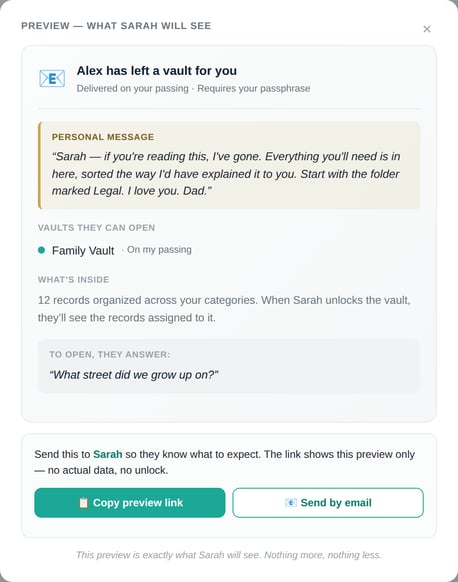
The preview a family member receives — no real data, no unlock.
How to Choose the Most Secure Digital Vault
Whether you're comparing online vaults for yourself or looking for the most secure home vault for family documents, ask these questions:
- Who holds the encryption key? If the company does, they can read your files. Zero-knowledge means they can't.
- Where is the data encrypted? On your device is stronger than on their servers.
- Is the data stored redundantly? Multiple regions protect against a single point of failure.
- How does your family get access? If the answer is "they log in as you," that's not a plan.
- Can you control who sees what? Your attorney and your children shouldn't necessarily see the same things.
- Does it cover digital assets? Email, cloud accounts, devices and crypto are now a large part of any estate.
For a deeper comparison, see our overview of digital legacy vaults vs. physical documents.
Conclusion
The purpose of a secure digital vault is simple: keep your most important information protected, private and intact — and make sure it reaches the people who need it. For families, that last part matters most. The best secure digital solutions don't just lock information away; they make sure your family isn't left searching for it.
Try it yourself. Set up your own secure digital vault, free for 14 days with no card to sign up. Then $189 a year, billed once.
Start your free trial →
Or let us help. Book a free 30-minute call and leave with a written Family Protection Plan — your readiness score, your biggest gaps, and exactly what to do next.
Get my family's plan — free →
FAQs
1. Are digital vaults only for businesses?
No. Businesses use secure vaults for customer and company data, but families benefit just as much — from protecting financial records and legal documents to making sure loved ones can reach them in an emergency.
2. What is the difference between a digital vault and cloud storage?
Cloud storage is built for convenience: the provider usually holds the encryption key and can access your files. A secure digital vault is built for privacy and control — ideally with zero-knowledge encryption, so only you and the people you choose can read what's inside. A family vault also delivers information to your chosen recipients.
3. Can digital vaults be hacked?
No system is completely immune. But with zero-knowledge encryption, a breach of the company's servers exposes only encrypted data that can't be read without keys the company never holds. That's a very different risk from a service that stores readable files.
4. Are there free digital vault options available?
Some services offer free tiers with limited features, usually without zero-knowledge encryption or family delivery. IronClad Family offers a free 14-day trial with no card to sign up, then $189 a year, billed once.
5. How can I choose the right digital vault for my needs?
Start with who holds the key, how your family would get access, and whether the vault covers digital assets as well as documents. For families, look for zero-knowledge encryption, separate vaults for different people, and automatic delivery. Learn more about digital vaults and estate planning.
6. Can IronClad Family see what's in my vault?
No. Your files are encrypted on your device before they reach us, and we never hold the key. IronClad Family is not a law firm and does not provide legal advice; the vault organizes the information your legal documents rely on.

