- 13 mins
Imagine your grandson, twenty years from now, sitting in his first home and hearing your voice describe the day he was born. It's a powerful thought, yet 76% of adults in 2026 still have no plan for their digital legacy. You might have thought about recording video messages for family, but the fear of technical glitches or not knowing what to say often stops you from starting. It's natural to feel anxious about where these precious files will end up or if they'll even work a decade from now.
You want to be a presence in your family's future, not just a fading memory in a forgotten account. This guide will show you how to capture your wisdom and stories in a way that stays protected and reaches your loved ones exactly when they need it most. We'll walk through a clear plan for what to say on camera, how to handle the technical side without stress, and how to ensure your legacy is delivered to the right person with absolute peace of mind.
Key Takeaways
- Learn why waiting for the perfect moment can lead to your family stories being lost forever.
- Use the Legacy Framework to plan your messages so you feel confident and clear when you start recording.
- Discover how recording video messages for family creates a living legacy that stays safe from technical failures or accidental deletion.
- Understand how a secure delivery system ensures your loved ones receive your messages at the exact right time.
- Protect your voice with a digital fortress that keeps your private memories secure for future generations.
The Silent Loss of Family History and Why Your Voice Matters
Your family's history is more than just names on a family tree. It's the sound of your laughter, the way you tell a joke, and the specific advice you give when life gets hard. Sadly, many of these moments are disappearing every day. Recording video messages for family is about capturing your essence before it's too late. When a loved one passes, their physical assets are often distributed according to a will, but their personal wisdom often vanishes. This silent loss leaves a void that no amount of inheritance can fill. Think about the comfort of a parent's voice during a crisis. Without these recordings, that comfort is gone forever.
To better understand how video can bridge the gap between generations, watch this video on the impact of shared messages:
The Fragility of Digital Memories
We often assume the cloud is a permanent home for our memories. It isn't. Most people manage over 300 online accounts, and without a clear plan, those videos are trapped behind passwords your heirs may never find. Digital decay is a real threat. Files can become corrupted, or accounts can be deleted due to inactivity. A phone left in a drawer isn't a legacy; it's a locked box that might never be opened again. Saving a file to a standard cloud service doesn't guarantee it will be there in twenty years. You need a system that acts as a technical guardian for your most precious assets.
The Power of Hearing a Loved One’s Voice
Hearing a familiar voice provides a level of comfort that a written document simply cannot match. It's a biological connection. Research shows that audiovisual memories help families process grief by maintaining a sensory link to the person they lost. By engaging in Oral History through modern video, you provide a roadmap for future generations. Your children and grandchildren will care far more about your stories and values than they will about your physical assets. Recording video messages for family moves you from simple data storage to intentional legacy protection. A written will handles your money, but a video message handles your heart. You are giving them a guide for their own lives, ensuring your presence is felt during their most important milestones.
Common Mistakes When Recording Video Messages for Family
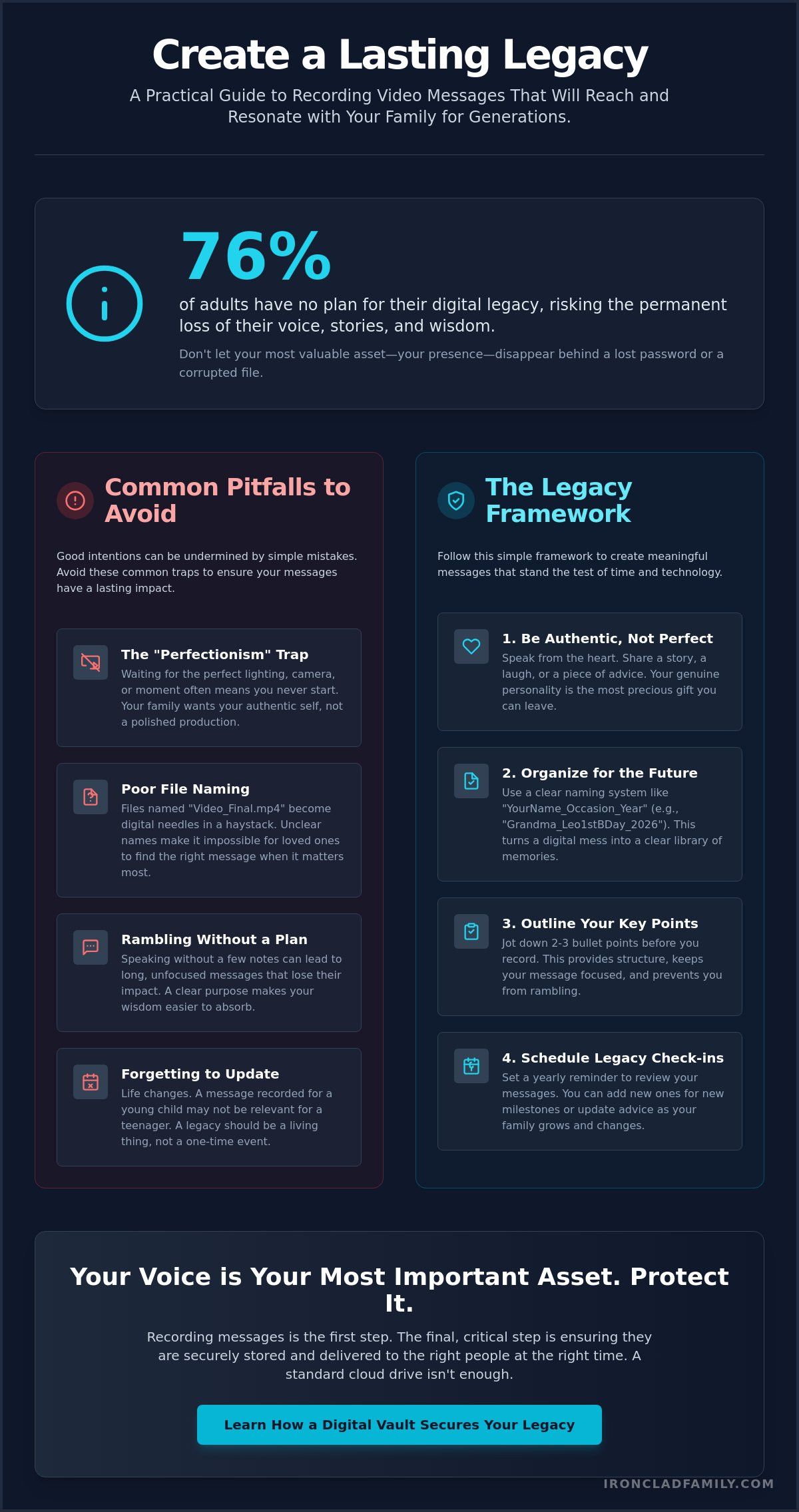
Good intentions don't always lead to a successful legacy. Many people feel a deep urge to share their stories but stumble during the execution. The process of recording video messages for family is deeply personal, yet it requires a bit of practical discipline to be effective. If your loved ones can't find the file, or if the message is too long to hold their attention, the impact is lost. Avoiding a few common pitfalls ensures your voice remains a clear guide for the next generation.
The "Perfectionism" Trap
The most frequent mistake is waiting for the perfect moment. You might tell yourself you'll hit record once you lose ten pounds, fix the lighting, or buy a better camera. Your family doesn't want a polished Hollywood production. They want to see the real you. They want to hear your natural laugh and see the familiar expressions they love. When you focus too much on how you look, you lose the emotional connection. Try to treat the camera like a chair where your favorite person is sitting. This simple shift helps you move past camera shyness and speak from the heart.
The Hidden Danger of Poor File Naming
A file named "Video123.mp4" is a legacy disaster waiting to happen. In an emergency, your family won't have the time or emotional energy to click through hundreds of generic files. Since the average adult now manages over 300 online accounts, your specific messages can easily get buried. Proper organization is a form of protection. Use a clear naming system like "Name_Occasion_Year" to keep things simple. For example, "Sarah_WeddingDay_2026" tells a story before the video even starts. Using a secure digital vault ensures your carefully labeled files are actually reachable when the time comes.
Other common errors include:
- Rambling without a plan: Without a few notes, it's easy to lose your train of thought. Keep your messages focused and purposeful.
- Forgetting to update: Life changes quickly. A message recorded for a toddler might not address the needs of a teenager ten years later.
- Lack of context: Tell the viewer why you are recording this specific message. Explain the "why" behind your wisdom so it carries more weight.
Legacy planning is a marathon, not a sprint. You don't need to record everything in one day. Start small and stay consistent. If you've already started with recording video messages for family, take a moment to review your existing files. Ensure they are dated, labeled, and stored in a place where your family has clear instructions on how to access them. A message that stays hidden on a forgotten hard drive cannot provide the comfort your family deserves.
A Step-by-Step Guide to Recording Your Legacy
Creating a legacy shouldn't feel like a chore. It's a gift you're preparing for the future. When you begin recording video messages for family, focus on the connection rather than the technology. You don't need a professional studio to make an impact. A quiet corner and a few minutes of your time are all that's required to build a bridge to the next generation. By following a simple structure, you can ensure your voice remains clear and your intentions are fully understood.
What to Say: The Legacy Framework
- The "I Love You" Message: This is a simple and timeless recording. Focus on how much your family means to you. These are the words they will want to hear most during difficult times.
- The "Life Lesson" Message: Share the values and principles that guided your journey. This is a vital part of a successful generational wealth transfer, as it passes down wisdom alongside physical assets.
- The "Special Occasion" Message: Record messages for future milestones you might not attend. Imagine your granddaughter watching a video from you on her wedding day or your son seeing your face when he graduates college.
Technical Tips for the Non-Tech Savvy
You don't need expensive equipment to capture a high-quality message. Your smartphone is more than enough if you use it correctly. Position your camera at eye level by propping it up on a stack of books. This creates a natural feel, as if you are looking directly at the person you love. Avoid holding the phone in your hand, as shaky footage can be distracting.
Lighting and sound are your two best friends. Use the "Window Trick" by facing a window during the day. This provides soft, natural light that makes you look clear without any harsh shadows. More importantly, check your audio. Sound is actually more important than video quality. A family member can forgive a grainy image, but they need to hear your voice clearly. Record in a room with carpets or curtains to minimize echoes.
Finally, record your videos in 1080p resolution rather than 4K. While 4K looks sharp, the files are massive and can be difficult to store or send in the future. 1080p is the gold standard for long-term storage efficiency. Once you finish, save and secure the file immediately. Don't leave it sitting in your phone's camera roll where it could be accidentally deleted.
Solving the Delivery Problem: Ensuring Your Family Sees Your Message
Recording video messages for family is a profound act of love. However, the most beautiful message is worthless if it never reaches its destination. Many people assume that simply filming a video is enough. In reality, the "delivery problem" is the biggest hurdle in legacy planning. You need a way to ensure your voice reaches your loved ones at the exact moment they need it, even years or decades into the future. Relying on a hope and a prayer isn't a strategy. It's a risk your legacy shouldn't take.
One powerful solution is the concept of a "Dead Man’s Switch." This is a digital safety net that triggers a specific action, like sending a file, when certain conditions are met. It ensures your messages stay private while you are here but become accessible when you are not. This timing is everything. You don't want a "Special Occasion" message for a future wedding to be seen too early. You want it to be a surprise from the past that provides comfort in the future. This system acts as a technical guardian for your most private thoughts.
The Problem with Standard Cloud Sharing
Many people think Google Drive or iCloud is a safe place for legacy storage. This is a common mistake. Standard cloud links often break over time. Accounts can be deleted due to inactivity or missed payments. There is also the legal hurdle of RUFADAA. As of early 2026, 47 U.S. states have enacted the Revised Uniform Fiduciary Access to Digital Assets Act. This law helps your heirs access your digital life, but only if you have explicitly granted permission. Without a formal plan, your videos could remain locked behind a wall of privacy settings forever. You shouldn't rely on a USB drive either. Hardware gets lost, damaged, or becomes obsolete as technology changes.
Creating an Emergency Protocol
Your legacy messages should be a key part of your family emergency plan checklist. This protocol identifies "Receivers." These are the trusted individuals you choose to receive your digital inheritance. Unlike a password that can be forgotten, a managed delivery system provides a guaranteed path for your stories. It moves your videos from being simple data files to becoming a living legacy. It gives you the confidence that your wisdom won't be lost in the shuffle of an emergency.
Don't leave your family's future to chance. You can secure your legacy messages today and ensure they are delivered with absolute certainty. By designating your receivers now, you give your family the peace of mind they deserve during life's most difficult transitions.
Securing Your Voice in the IronClad Vault
Your voice is the most personal asset you own. It carries your history, your values, and your love for the next generation. Recording video messages for family is a sacred task that requires a secure home. It's not enough to just record the files; you must place them in a digital fortress that can withstand the test of time. The Vault by IronClad Family serves as this fortress. It's designed to protect your living legacy with the same gravity you would use for a physical heirloom. By choosing a dedicated repository, you move your memories from the uncertainty of a phone's camera roll to a state of absolute preparedness.
Why Zero-Knowledge Encryption Matters
Privacy is often misunderstood in the digital world. Most standard cloud services and social media platforms have the ability to scan or view your files. Zero-knowledge encryption is different. It's a high-trust security standard that ensures only you and your loved ones have the digital key to your messages. Even the technicians at IronClad Family cannot see what you've recorded. This level of cryptographic safety is vital when you are sharing sensitive life lessons or private family stories. It's the difference between leaving a letter on a desk and locking it in a secure safe. You deserve to know that your private conversations stay private until the moment they are meant to be heard.
Next Steps for Your Family Legacy
Building a legacy is a slow and thoughtful process. You don't need to record your entire life story in a single afternoon. Start with one single message today. Focus on a simple "I love you" or a quick story from your past. Once you've taken that first step, you can Explore the Digital Vault to see how easily you can organize these assets. The system is built for families, not tech experts, making it accessible for every generation. This ensures your wisdom is preserved without the headache of complex software.
The final step is inviting your family members to be Receivers in your vault. A Receiver is a designated person who will receive your digital inheritance when the time is right. By naming them now, you eliminate the anxiety of "what if" scenarios. You gain the peace of mind that comes from knowing your voice will reach the right person, at the right time, without fail. IronClad Family acts as your technical guardian, bridging the gap between your present and your family's future. Don't let your stories fade away. Secure them in a place where they will be protected for a lifetime and beyond.
Build a Bridge to Your Family's Future
Your voice is a biological treasure that deserves a digital fortress. You've learned that recording video messages for family doesn't require a film crew or a perfect script; it just requires your presence. By moving past perfectionism and using a clear framework, you transform simple data into a living legacy. Remember that storage is only half the battle. You need a system that handles the legal complexities of RUFADAA and ensures your messages are delivered exactly when your loved ones need them most.
Don't let your stories be part of the 76% of digital legacies that are lost to time. You can take control of your narrative by using a platform that prioritizes your privacy through zero-knowledge encryption and automated emergency delivery. It's about more than just files; it's about the peace of mind that comes from knowing your wisdom is safe and accessible to the next generation.
Secure your family’s legacy today with The Vault from IronClad Family. Our RUFADAA-compliant digital estate planning ensures your voice remains an unshakeable guide for generations to come. Start with one message today and build a future where your family always feels your presence.
Frequently Asked Questions
How long should a legacy video message be?
Aim for three to five minutes per video. Keeping your messages short and focused on one core theme makes them easier to record and more meaningful for your family to watch. It's better to have several short videos about specific memories than one long, rambling recording that might lose the viewer's attention.
What is the best file format for long-term video storage?
MP4 is the best choice for long-term compatibility. Specifically, using the H.264 codec ensures that your video can be played on almost any device in the future. As mentioned earlier, recording in 1080p rather than 4K helps manage file size while keeping the quality high enough for future generations to enjoy.
Can I record messages for my children to see when they turn 18?
Yes, you can set specific delivery triggers for your recordings. Using a secure delivery system allows you to designate a future date or a specific life event for the message to be released. This ensures your children receive your wisdom exactly when they reach adulthood or another significant milestone you've chosen.
Is it safe to store sensitive family videos in the cloud?
Standard cloud storage is often vulnerable, but zero-knowledge encryption makes recording video messages for family much safer. This technology ensures that you are the only one with the key to your files. Unlike social media sites, a dedicated digital vault protects your privacy by making the data unreadable to anyone else, including the service provider.
What happens to my video messages if I lose my password?
You should set up Emergency Access Credentials to prevent being locked out of your legacy. A secure vault system usually includes a recovery process or a designated secondary contact who can help verify your identity. This safety net ensures that your family history isn't lost due to a simple forgotten password.
How do I tell my family that I have recorded these messages for them?
Be direct and tell them you have secured a digital vault for the family's future. You don't have to share the content of the videos now. Simply let them know that you've prepared a living legacy and explain how they can access it in an emergency. This removes uncertainty and gives everyone peace of mind.
Can I update or delete a video message once it is in the vault?
Yes, you have full control over your vault as long as you are able to manage it. Your digital inheritance is a living project that can change as your family grows. You can add new messages for new grandchildren or replace old videos with updated advice as your own perspectives evolve over time.
What is a "Legacy Receiver" and how do I choose one?
A Legacy Receiver is a trusted person who will be granted access to your messages after a specific event. When recording video messages for family, choose someone who is organized and likely to be around for the long term. This person acts as the guardian of your digital assets, ensuring they reach the intended family members safely.

