

- 11 mins
Suppose an emergency strikes tonight and your loved ones need to find your will or a critical account password. Would they know where to look, or would they be met with locked drawers and "access denied" screens? It's a heavy thought that causes real anxiety for many parents. You likely feel the weight of protecting your family's future, yet the fear of identity theft often leads to indecision. Finding a reliable method for secure family document storage is essential now that 20 U.S. states have enacted their own complex data privacy laws as of early 2026.
You deserve a clear system that combines high-level security with the warmth of a family legacy. This guide will show you how to protect your most important records so your loved ones are never left without answers. We'll walk through the practical steps to organize your digital assets and ensure your legacy is both unshakeable and accessible when it matters most. By the end, you'll have a roadmap to total peace of mind and preparedness.
Key Takeaways
- Understand why standard cloud tools are built for sharing rather than long-term protection and how to avoid permanent account lockouts.
- Learn how zero-knowledge encryption ensures that you are the only person who can ever access your family's most private records.
- Identify the "Vital Five" documents you need to gather today to protect your legacy and simplify life for your heirs.
- Discover the essential steps to setting up secure family document storage so your loved ones have the information they need during a crisis.
- Shift from a state of uncertainty to absolute preparedness by building a digital vault designed for multi-generational security.
Key Takeaways
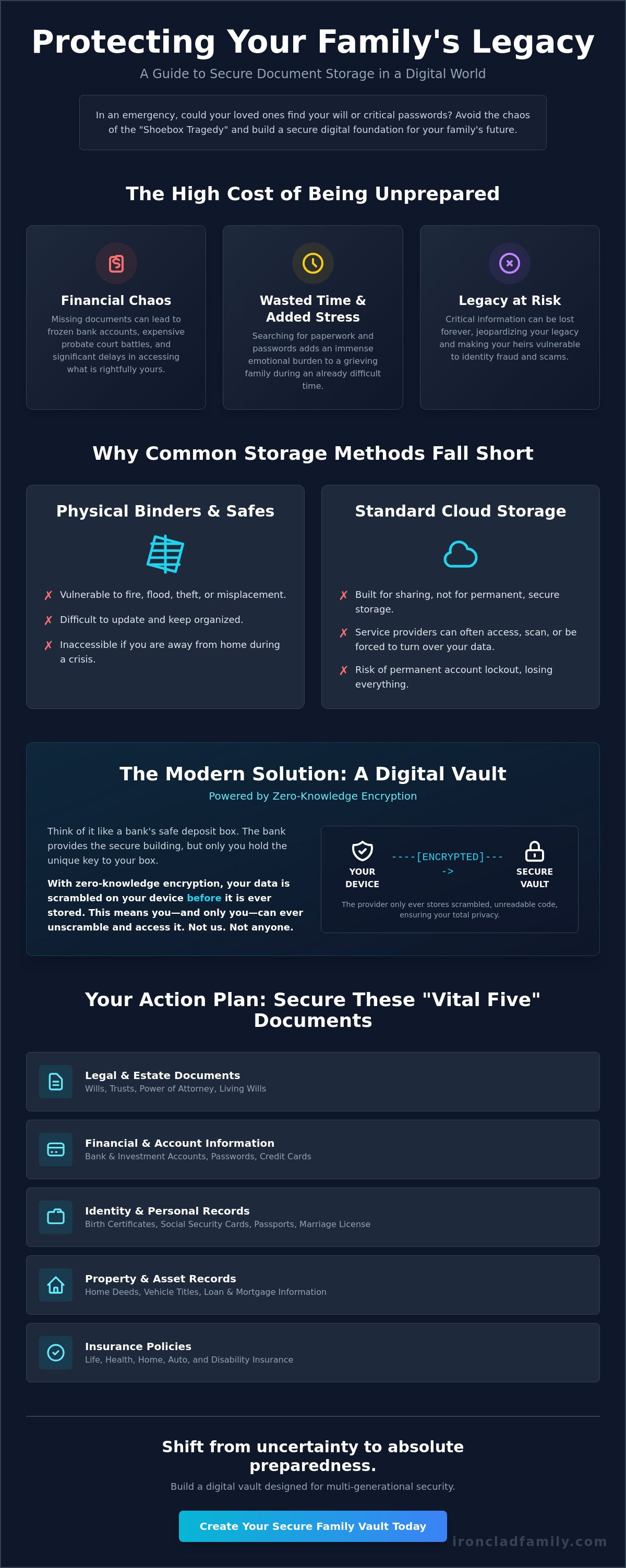
- Missing legal documents can lead to frozen bank accounts and expensive probate delays for your heirs.
- Physical storage methods like binders are vulnerable to fire, floods, and identity theft.
- Relying on memory for passwords creates an avoidable crisis for a grieving spouse or children.
- A digital vault ensures your legacy is protected and accessible to the right people at the right time.
The Risks of Losing Access to Critical Family Documents
When a crisis happens, time is your most precious asset. Many families experience what we call the "Shoebox Tragedy." This happens when a loved one passes away and the survivors are left digging through dusty boxes or old file folders looking for a Will or a life insurance policy. If they can't find these papers, the consequences are immediate and painful. Banks may freeze accounts. Life insurance payouts could be delayed for months. Without a clear plan for secure family document storage, your family might face a long, expensive battle in probate court just to access what is rightfully theirs.
To better understand how to protect your files, watch this helpful video:
The financial impact of missing papers is often measured in thousands of dollars in legal fees. It's not just about the money, though. It's about the emotional toll on a grieving spouse who has to hunt for digital keys while trying to hold the family together. In 2025, identity fraud and scams totaled $38 billion in losses. If your heirs can't prove their identity or access your accounts quickly, they become even more vulnerable to these threats during a time of high stress.
Why a "Just in Case" Binder Is Not Enough
Many people believe they're prepared because they have a physical binder on a shelf. However, paper is fragile. Binders can be lost in fires, destroyed in floods, or simply misplaced during a move. Even worse, paper documents are easy targets for identity thieves if they aren't locked in a heavy safe. A modern family emergency plan checklist must include digital backups. This ensures that even if your home is damaged, your life's work remains safe in a digital environment.
The Problem with Remembering Everything Yourself
Relying on your memory for passwords and account locations is a major risk for your children. You might know exactly where the deed to the house is, but does anyone else? If you are the only one with the "keys" to the family's digital life, you're leaving behind a puzzle that your heirs may never solve. This is why secure family document storage is so vital. Using a system with zero-knowledge encryption ensures that only you and your chosen loved ones have the power to unlock your information. Organizing these details today prevents a massive crisis for your children tomorrow.
What Is Zero-Knowledge Encryption and Why Families Need It?
When you look for a system for secure family document storage, you'll likely see the term "zero-knowledge encryption." It sounds like technical jargon, but the concept is actually quite simple and deeply protective. In this system, you are the only person who holds the "key" to your files. Not even the company storing your data can see what's inside. If a government agency or a curious employee tried to look at your documents, they would only see scrambled, unreadable code. This level of privacy is essential for the records that define your life.
Think of it like a traditional bank vault. The bank provides the building, the thick steel walls, and the security guards to keep the facility safe. However, you are the only person with the key to your specific deposit box. The bank manager doesn't have a copy, and they can't peek inside to see your family heirlooms. That's exactly how your digital files should be treated. You can explore how this works in practice by looking at a secure digital vault designed specifically for families.
Privacy vs. Security: Knowing the Difference
It's easy to confuse privacy with security, but they serve different roles in protecting your legacy. Security is about building a wall to keep hackers and criminals out. Privacy is about making sure the people who built the wall can't see what you're doing behind it. Many large tech companies offer security, but they often lack true privacy. They might scan your files to show you targeted ads or train artificial intelligence. You don't want a corporation reading your Last Will and Testament just to decide which products to market to you. Zero-knowledge encryption provides both: it locks the door and hides the windows.
How Encryption Protects Your Digital Legacy
Your digital legacy is more than just a collection of files; it's the living history of your family. In 2025, there were 3,322 data compromises in the United States alone. When a big company suffers a data breach, hackers often steal everything on their servers. If those files aren't encrypted, your identity is wide open. A secure digital vault for estate planning acts as a digital shield. Even if a breach occurs, your scrambled data remains useless to a thief. In 2026, protecting your digital essence is just as vital as locking your front door. It ensures that your secure family document storage remains a private sanctuary for generations to come.
Why Standard Cloud Storage Is Not Enough for Your Legacy
Standard cloud tools like Google Drive or Dropbox are excellent for sharing vacation photos or collaborating on work projects. However, they weren't built for secure family document storage or long-term legacy preservation. These platforms focus on speed and convenience rather than deep, multi-generational protection. If you treat a standard cloud folder like a digital safe, you might be surprised to find the door locked when your family needs it most.
Unlike a private vault, these platforms can be legally forced to share your data with third parties. Because many of these companies hold the keys to your information, they can be compelled to hand over your private files if they receive a legal request. You have no way of knowing who is looking at your records. This lack of control is the opposite of the sanctuary your family legacy deserves.
The Danger of Terms of Service for Families
Most major cloud providers have strict "inactive account" policies. If you don't log in for a specific period, the company might delete your entire account to save server space. This is a hidden trap for digital inheritance. Your family needs a service that understands RUFADAA, which is the law governing how heirs access digital assets. Without a system built for these specific legal requirements, your children could spend years fighting tech giants just to access your legal papers or family memories. Getting access to a locked Google or Apple account after a death is a notoriously difficult and painful process for grieving relatives.
Organization vs. Storage: The Big Difference
There's a massive difference between a pile of files and a working system. Storage is just a place where data sits. Organization is a roadmap that guides your family through their hardest moments. A general cloud drive usually relies on a "search" function that quickly turns into a cluttered mess. If your spouse doesn't know the exact name of a file, they won't find it.
A true legacy vault uses specific categories like "Legal," "Financial," and "Legacy Messages." This structure tells your family exactly where the Will is located without them having to guess. It also acts as a guide for you, prompting you to upload the specific documents you might have forgotten. This ensures your secure family document storage is complete, organized, and ready for an emergency. You aren't just saving files; you're providing a clear path forward for those you love.
A Step-by-Step Guide to Organizing Your Secure Digital Vault
Moving from uncertainty to absolute preparedness doesn't have to be overwhelming. It's a journey of small, intentional steps that build a fortress around your family's future. Choosing the right platform for secure family document storage is the foundation of this process. Once you have a secure space, you can begin the work of gathering the pieces of your legacy. Follow this simple guide to ensure nothing is left to chance.
- Step 1: Gather your "Vital Five." Start with the documents your family will need first: your Will, Power of Attorney, insurance policies, account passwords, and property deeds. These are the roots of your family's financial and legal security.
- Step 2: Choose a zero-knowledge vault. Select a storage system that uses zero-knowledge encryption. This ensures that you, and only you, hold the keys to your private information.
- Step 3: Scan and upload. Use your phone or a scanner to create digital copies. Give each file a clear name, such as "Mom's Life Insurance Policy 2026," so your heirs don't have to guess what's inside.
- Step 4: Designate your "Receivers." These are the trusted people who will receive access to your vault in an emergency. You're choosing the guardians of your legacy.
- Step 5: Set up an "Emergency Trigger." This is a verification system that releases your information if you become unable to manage it yourself. It's the final safety net for your loved ones.
What Documents Should Every Family Store?
A complete vault covers three main areas. First, legal papers like Wills, Trusts, and Powers of Attorney are essential for avoiding probate delays. Second, financial records including bank account details, crypto keys, and life insurance policies ensure your family can pay bills and stay stable. Finally, include "Legacy" items. These are the sentimental treasures like letters to your children, family recipes, or your final wishes for a memorial service. These items provide emotional comfort when it's needed most.
Keeping Your Vault Up to Date
A digital vault is a living repository, not a static folder. You should perform a "Digital Spring Cleaning" once a year to check for outdated documents. If you buy a new home, change insurance providers, or welcome a new grandchild, your vault needs to reflect those changes. You also need to update your list of beneficiaries if family situations shift. A family preparedness service can help you stay on track with these vital updates so your plan never gathers dust. Start your journey toward total peace of mind by exploring our secure digital vault today.
Protecting Your Legacy with IronClad Family Document Storage
IronClad Family provides more than just a place to put your files. It's a complete system designed to shield your life's work and protect your family's future. The IronClad Vault, also known as iVaultX, uses the zero-knowledge security we discussed earlier. This means your private documents remain invisible to everyone but you and your chosen heirs. Most storage services stop at the "locking" phase, but a true protector thinks about what happens when you can't be there to turn the key yourself. We believe that security is only half the battle; the other half is ensuring your loved ones have access when it matters most.
This system acts as a digital guardian for your most sensitive records. It bridges the gap between high-tech encryption and the human need for connection. Beyond just storing data, it allows you to leave Legacy Messages for future generations. These are digital letters or videos that carry your voice and wisdom forward. It turns your information into a living history that your grandchildren can one day cherish. This approach transforms a simple utility into a sacred digital repository for your family narrative.
The Power of Automated Emergency Delivery
The biggest flaw in most estate plans is the delivery problem. If your spouse doesn't have the login for the mortgage or the location of your Will, the best security won't help them during a crisis. IronClad Family solves this with Emergency Credential Delivery. This feature acts as a digital executor. It sends your vital information to your loved ones exactly when they need it based on your specific instructions. This removes the heavy burden of hunting for papers during a time of grief. Your family can focus on honoring your memory instead of fighting with account recovery screens or locked drawers. It's a definitive resolution to a modern vulnerability.
A Simple Start for a Lifetime of Security
Setting up a secure digital vault is a straightforward process. In fact, it often takes less time than a trip to the local bank. You don't need to be a technical expert to build a fortress for your family. By organizing your "Vital Five" and setting your emergency triggers today, you move from a state of uncertainty to a feeling of absolute preparedness. You're creating a multi-generational bridge that ensures your hard work is never lost to a forgotten password or a misplaced file.
Preparing for the future is an act of deep love and stoic responsibility. By choosing a system for secure family document storage, you're ensuring that your legacy is never silenced. It's the greatest gift you can leave for your heirs: the gift of clarity, security, and total peace of mind.
#DigitalEstatePlanning #FamilyLegacy #SecureStorage #EmergencyPreparedness #IronCladFamily #iVaultX
Secure Your Family's Future Today
Your digital records are more than just files; they are the living legacy of your family's journey. By choosing zero-knowledge encryption, you lock out intruders while keeping the windows open for those you love. You now understand that storage without a delivery plan is only half a solution. True protection means ensuring your mortgage logins, Wills, and sentimental messages reach your heirs exactly when a crisis hits.
Implementing secure family document storage is the final step in moving from a state of worry to a feeling of absolute preparedness. It is the most practical way to honor your life's work and provide a clear roadmap for your children. You can start building this digital sanctuary in less time than it takes to visit a bank. This simple act of organization removes the heavy burden of "hunting for papers" from your grieving family later.
Start protecting your family legacy today. You've done the hard work of building a life. Now, take the simple step to make sure it is never forgotten. Your family deserves the peace of mind that comes from knowing you are ready for whatever the future holds.

