

- 13 mins
Last summer, a family in Houston realized they couldn't find their insurance policies as floodwaters rose toward their porch. Without a clear plan, the people you love most are left digging through junk drawers for life-saving information during a crisis. Knowing exactly what to include in a 'just in case' binder isn't just about organization; it's about providing a roadmap for your family when they are most vulnerable. You likely feel overwhelmed by piles of paper and the dozens of digital accounts that make up your life. It is natural to worry that your loved ones might lose access to your "digital DNA" if you aren't there to help.
This guide will show you how to build a secure system that replaces uncertainty with absolute preparedness. Following the latest standards from FEMA's March 13, 2026, Emergency Financial First Aid Kit, you'll learn how to organize your most critical documents into a single, accessible source. We will walk through the essential legal papers, financial keys, and digital inheritance steps required to protect your family's future. By the end, you will have a complete checklist to ensure your legacy remains protected and easy for your beneficiaries to navigate.
Key Takeaways
- Identify the four essential pillars of documentation and learn exactly what to include in a 'just in case' binder to protect your family's daily life.
- Understand why a physical binder alone is incomplete and how to secure your "digital DNA" for future generations.
- Establish a simple maintenance schedule to ensure your emergency records stay current as your life changes.
- Discover how zero-knowledge encryption provides a higher level of protection for your most sensitive legal and financial data compared to paper files.
What is a 'Just in Case' Binder and Why Does Your Family Need One?
A 'Just in Case' binder is your family’s survival manual for life’s most difficult moments. It acts as a central repository for the "keys to your life," ensuring that vital information is available exactly when you aren't. Most families operate with a dangerous "Information Gap." This occurs when one person holds all the knowledge about bills, passwords, and legal plans in their head. If that person is suddenly incapacitated, the rest of the family is left in the dark. Understanding what to include in a 'just in case' binder is the first step in closing that gap and protecting your heritage.
Section Highlights
- A binder bridges the gap between chaos and clarity during a family crisis.
- Preparedness reduces the emotional burden on grieving or stressed loved ones.
- Every adult, from parents to business owners, needs a centralized legacy plan.
The core purpose of this system is to move you from a state of constant anxiety to one of calm confidence. You shouldn't have to worry about your spouse losing access to the mortgage portal or your children not knowing your medical history. True emergency management starts at home. It is the slow and thoughtful process of gathering your digital DNA and physical records into a fortress of information. This isn't just about paperwork; it is about the peace of mind that comes from knowing your loved ones are never left guessing. Setting up a family preparedness service ensures that your life's work is never lost to silence.
The Real-World Risks of Being Unorganized
Disorganization carries heavy consequences. Missing medical records can lead to dangerous errors during a health crisis. If your family cannot access financial accounts, essential bills go unpaid and your assets might end up trapped in probate court. The emotional toll is even higher. When family members are panicked, they shouldn't have to hunt through dusty filing cabinets for a life insurance policy. A lack of preparation forces them to make impossible choices during their most vulnerable hours.
Who Needs a Preparedness Binder?
Every household needs a plan, but some situations are more urgent. Parents with minor children must have guardianship instructions clearly stated. Without these, the state might decide who raises your kids. Adult children caring for aging parents also need a binder to manage medical history and power of attorney documents effectively. Finally, business owners need a binder as a succession plan. It details how to keep daily operations running so your life’s work doesn't fail if you are away. Deciding what to include in a 'just in case' binder ensures that your responsibilities are met, no matter what happens tomorrow.
Essential Checklist: What to Include in a 'Just in Case' Binder
Knowing exactly what to include in a 'just in case' binder is a task that requires both precision and care. You are building a bridge for your family. This bridge must be strong enough to carry them through a medical emergency or a natural disaster. To be effective, your binder should be organized into four distinct pillars: Personal, Legal, Financial, and Medical. While digital copies are helpful, you must prioritize original documents or certified copies for legal matters. A simple photocopy of a birth certificate often won't suffice when dealing with government agencies or banks.
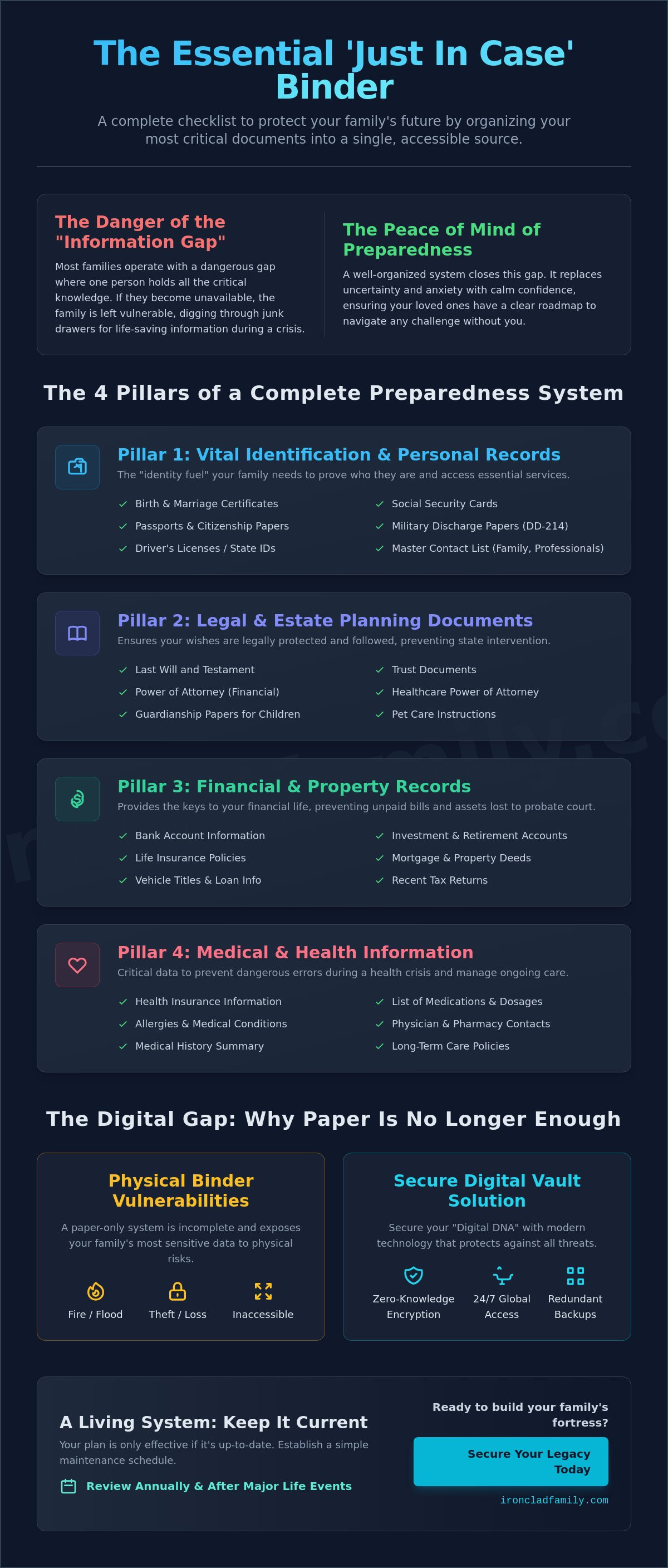
Pillar 1: Vital Identification and Personal Records
Identification is the foundation of your plan. You need birth certificates, Social Security cards, and marriage licenses for everyone in the household. If you have served in the military, include your DD-214 discharge papers. Passports and citizenship records are also vital. Don't forget a master contact list. This should include phone numbers for your lawyer, CPA, and primary doctors. Just as you would pack a basic emergency supply kit with water and food, this section provides the "identity fuel" your family needs to move forward.
Pillar 2: Legal and Estate Planning Documents
Your legal pillar ensures your wishes are followed. This includes your Last Will and Testament and any Trust documents. You also need a Power of Attorney for both healthcare and finances. If you have children, guardianship papers are the most important document in the entire binder. Pet care instructions are also a thoughtful addition. Because physical papers can be lost in a fire or flood, many families are learning how to store a will online securely to create a redundant backup for their legacy.
Pillar 3: Financial and Asset Information
Financial clarity prevents accounts from being frozen when they are needed most. List every bank account, credit card, and outstanding loan. Include your insurance policies for life, health, home, and auto. Make sure the agent's contact info is right there. Finally, add your real estate deeds and vehicle titles. Having these in one place prevents your assets from becoming "lost" in the system. Organizing these records is a heavy lift, but you don't have to do it alone. Using a family preparedness service can help you verify that no critical document is left behind.
Pillar 4: Medical History and Care Instructions
The final pillar focuses on health. Include a summary of current medications, known allergies, and immunization records for each family member. This section should also house your health insurance cards and any "Letter of Intent" regarding your long-term care preferences. During a medical crisis, having this information ready can save hours of dangerous uncertainty.
The Digital Gap: Why Paper Binders Are No Longer Enough
Many people make the mistake of thinking a physical three-ring binder covers every part of their life. In reality, modern life is largely digital. While you must know what to include in a 'just in case' binder regarding physical deeds and certificates, you cannot ignore your "digital DNA." This is the trail of data you leave online, from banking portals to family photo clouds. If a crisis hits, your family won't just need your birth certificate; they'll need the keys to your digital existence. Relying solely on paper creates a dangerous gap that can leave your loved ones locked out of essential accounts for months.
Protecting your legacy also means protecting it from physical threats. A paper binder is vulnerable to fire, flood, and even simple theft. The IRS suggests that your financial records and tax information should be part of any preparedness plan. However, storing these sensitive documents in a physical folder is a major security risk. If an unauthorized person finds your binder, they have immediate access to your Social Security numbers and bank details. You need a "Digital Guardian" to manage the parts of your life that paper simply cannot hold.
Protecting Your Digital Assets
Your digital assets require a specific management plan. This includes login credentials for your primary email and master passwords for any "vault" systems you use. If you own cryptocurrency, your private keys must be accessible to your heirs but hidden from everyone else. You should also set up "Legacy Contacts" on social media platforms and ensure your family can access cloud-stored photos. Without these digital keys, your family's history could be deleted by a service provider after a period of inactivity.
The Security Flaw of Physical Binders
Physical binders have a significant flaw: they're static. Life moves fast, and passwords or account balances change frequently. Updating a paper binder is a chore that most people eventually ignore. This leads to outdated information that is useless during an emergency. Sharing a physical binder is also difficult if your family lives in another state. If you're in a hospital in Florida and your binder is in a safe in New York, the information is effectively lost. When considering what to include in a 'just in case' binder, you must account for how that information will actually reach the people who need it.
Organizing and Maintaining Your Preparedness System
A binder is only useful if it works during a crisis. Building your system starts with gathering the physical documents we discussed, but the real work lies in making sure those records are current. When you decide what to include in a 'just in case' binder, you are creating a living legacy. It isn't a "set it and forget it" project. You must verify that your documents are still legally valid and that your family knows how to use them. A great way to stay on track is to use a family emergency plan checklist to guide your monthly or yearly reviews.
The best way to ensure your system stays relevant is to set a recurring schedule. Many families use the start of Daylight Savings as their trigger. During this check-up, look for major life changes like marriages, births, or new property purchases. If your circumstances have shifted, your binder must shift with them. Verification is the shield that protects your family from legal headaches later. An outdated will or an expired power of attorney can be just as damaging as having no documents at all.
Setting Up Your Emergency Protocols
Who holds the keys to your life? You must choose trusted recipients who can access your binder when you can't. It's best to have at least two people who live in different locations. Once you choose them, run an "In Case of Emergency" (ICE) drill. Ask your recipients to locate a specific piece of information within the binder. If they struggle, your organization needs adjustment. You can also include "Legacy Messages." These are personal notes or videos intended for your family to find only after you are gone, providing comfort when they need it most.
The 'Update' Checklist
As of April 2026, your maintenance routine should include several specific checks. First, look at your identification. Routine passport processing currently takes 4 to 6 weeks, so don't wait until a trip is near to renew. Second, check your REAL ID status. While the full enforcement deadline was proposed for May 5, 2027, you should ensure your state-issued ID is compliant now to avoid travel delays. Third, review your beneficiary designations. People often forget to update these on retirement accounts after a divorce or death in the family. Finally, verify that your Power of Attorney still reflects your current wishes. If you find that managing physical papers is becoming too complex, a secure digital vault provides an automated way to keep your records organized and accessible.
Beyond the Binder: The IronClad Family Digital Vault
A physical binder is a powerful starting point for any family. However, a paper system cannot protect your entire digital legacy or follow you across the globe. IronClad Family serves as the modern, secure alternative to the traditional three-ring binder. By moving your "digital DNA" into a secure environment, you ensure that your most sensitive information is protected by military-grade security while remaining accessible to those who need it most. When you think about what to include in a 'just in case' binder, the shift from paper to a digital vault is the final step in achieving absolute peace of mind.
The core of this security is zero-knowledge encryption. This means that your data is scrambled into a code that only you and your designated recipients can read. Not even the service technicians can see your files. It's a level of privacy that a physical safe simply cannot provide. Additionally, the system features automated delivery. If you are incapacitated or cannot be reached, the vault can automatically send specific instructions and documents to your loved ones. This removes the "Information Gap" and ensures your family is never left guessing during their most difficult moments.
Why a Digital Vault Beats a Physical Safe
Physical safes and safe deposit boxes have significant limitations. A bank vault is only open during business hours, which is useless if an emergency happens on a holiday or at midnight. A digital solution provides instant access from anywhere in the world. If you are traveling and need your medical records or insurance details, they're just a few clicks away. Updating your records is also much simpler. Instead of re-printing hundreds of pages, you can simply upload a new version of your will or trust. This ensures your family preparedness service stays accurate and effective without the clutter of outdated paperwork.
Taking the First Step Toward Peace of Mind
Building a fortress for your family doesn't have to happen overnight. You can start small by selecting your most critical documents, such as your power of attorney and birth certificates. If you work with a professional, the advisor portal allows your financial planner or estate lawyer to help you organize your assets securely. The goal is to move from a state of uncertainty to a feeling of absolute preparedness. By deciding what to include in a 'just in case' binder and then securing it digitally, you are protecting your family's heritage for generations to come.
Protect Your Legacy with Confidence
True preparedness is a gift you leave for your family. By organizing the four pillars of your life, you ensure that your spouse and children are never forced to navigate a crisis without a map. You now understand what to include in a 'just in case' binder, from vital identification to the digital keys that unlock your modern life. A physical binder is a strong start, but it is only half the solution. To truly protect your digital DNA, you need a system that is as unshakeable as your commitment to your loved ones.
IronClad Family provides the fortress your heritage deserves. Our zero-knowledge encryption ensures total privacy for your most sensitive records. We also offer state-specific legal document tools and automated emergency credential delivery to ensure your instructions reach the right people at the right time. Ready to secure your family's future? Start building your secure Digital Vault with IronClad Family today. You have done the hard work of planning. Now, take the final step to ensure your family is protected forever.
Frequently Asked Questions
Is a physical 'just in case' binder safe from identity theft?
No, a physical binder is not inherently safe because it centralizes your most sensitive data in an unencrypted format. If a thief finds your binder, they have immediate access to your Social Security numbers and bank details. This is why deciding what to include in a 'just in case' binder must involve a serious talk about security. Physical papers lack the protection of military-grade encryption found in modern digital vaults.
How often should I update the documents in my emergency binder?
You should update your binder at least once a year or immediately after any major life event. Many families choose Daylight Savings or the start of the year to review their records. Life events like a birth, marriage, or a new home purchase in 2026 require an instant update. Regular maintenance ensures your family isn't relying on an expired Power of Attorney or outdated financial information.
What is the difference between a legacy binder and a will?
A will is a legal document that tells the court how to distribute your assets, while a legacy binder is a practical guide for daily life. The binder usually contains your will, but it also includes insurance policies, passwords, and medical history. Think of the will as the legal "what" and the binder as the practical "how." It bridges the gap so your family knows how to manage your household immediately.
Can I store my digital passwords in a physical binder?
You can store passwords in a binder, but it is a major security risk to keep them on plain paper. If you must store them physically, use a code or only write down hints that only your family would understand. A much safer solution is a secure digital vault. This type of system manages your credentials with zero-knowledge encryption, ensuring your digital inheritance stays private even if your physical home is compromised.
Where is the best place to keep a physical emergency binder?
Keep your binder in a fireproof and waterproof safe that is easy to grab during an evacuation. FEMA recommends keeping your emergency records in a location that is known to all adult family members. Avoid hiding it so well that it can't be found during a fire or flood. Ensure it is stored alongside your basic emergency supply kit so you can take it with you if you have to leave quickly.
Who should I tell about the location of my 'just in case' info?
You should inform at least two trusted individuals, such as your spouse and a secondary successor or executor. These people need to know exactly how to access the binder or the digital vault in an emergency. It is a smart move to run a quick drill with them. This ensures they can find the keys to your life without struggling when emotions are high and time is short.
What happens if my family can't find my binder in an emergency?
If the binder is lost or destroyed, your family may face months of legal delays and frozen bank accounts. Without a clear guide on what to include in a 'just in case' binder, they will have to petition courts for access to your assets. This is why redundancy is vital. Having a digital backup ensures that even if your house is lost to a disaster, your family's roadmap remains safe and accessible.
Should I include original documents or copies in my binder?
You should include original documents for your will and power of attorney, but use certified copies for birth certificates and marriage licenses. Many government agencies and banks will not accept a standard photocopy of a vital record. Keep the originals in a secure, fireproof location. If you use a digital system, scan these originals at a high resolution so all seals and signatures are clearly visible to your beneficiaries.