
- 15 mins
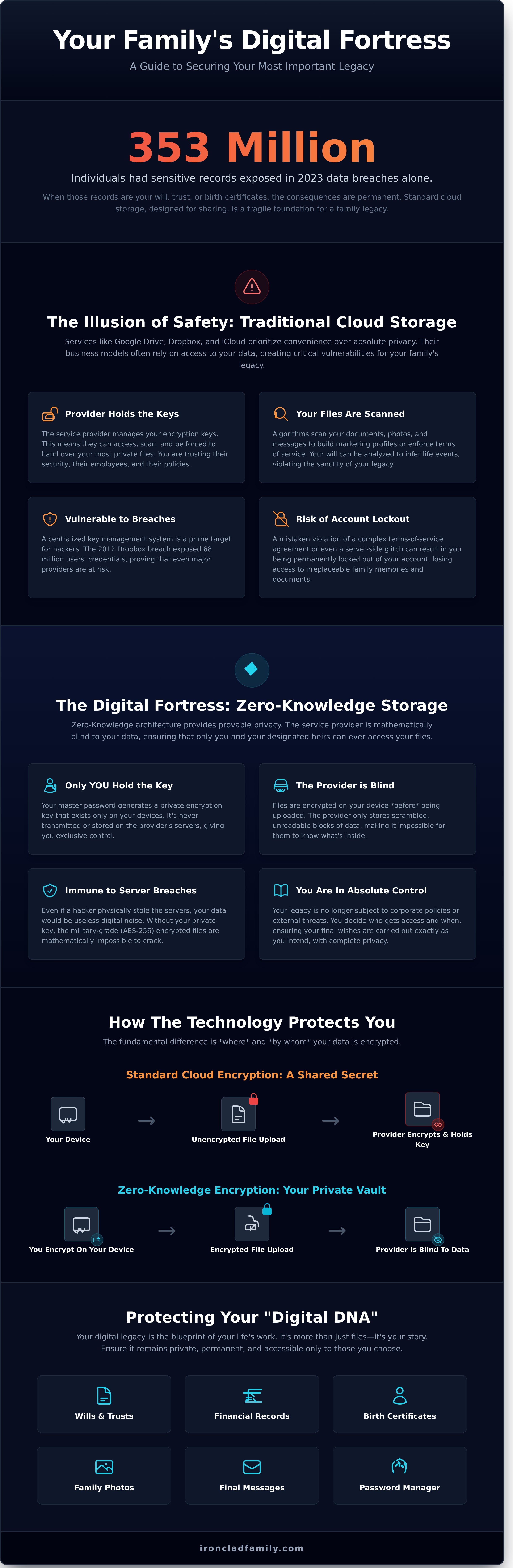
A 2023 report from the Identity Theft Resource Center found that data breaches exposed the sensitive records of over 353 million individuals. What happens when those records are your will, your trust, or your child's birth certificate? It's a chilling thought. You've spent a lifetime building a legacy, only to have its most critical components stored on servers that can be compromised by hackers or scanned by the tech giants who own them.
Your family’s digital DNA deserves a true sanctuary. This guide will show you how to build that fortress. You will discover how zero-knowledge encryption storage provides absolute, unshakeable privacy, ensuring the keys to your life are held only by you and those you designate. We'll explore how this technology makes your most important documents invisible to everyone but you, granting you the peace of mind that your digital inheritance is finally secure.
Key Takeaways
- Understand the critical privacy gap in standard cloud storage and why even trusted providers may expose your family's sensitive files.
- Discover how zero-knowledge encryption storage creates a digital vault where the service provider is blind to your data, ensuring only you hold the keys.
- Identify common but dangerous mistakes in digital asset protection, such as over-relying on a single password manager for your entire legacy.
- Learn a simple framework for inventorying your family's "Digital DNA" and choosing a provider built specifically for legacy, not just file sharing.
The Problem with Traditional Cloud Storage for Family Documents
You’ve stored the keys to your life in the cloud. Your will, your children’s birth certificates, decades of family photos, and sensitive financial records all sit on servers owned by Google, Apple, or Dropbox. It feels safe. It feels modern. But this convenience comes at a steep, often invisible, price: your family’s absolute privacy.
These services were not built to be digital vaults. They were built for mass-market file sharing, and their architecture reflects that. While they talk about security, their business models often depend on having access to your data. They hold the master key to your digital life, and you have to trust they’ll never use it, lose it, or be forced to hand it over. This is a fragile foundation upon which to build a permanent legacy.
The hard truth is that your most personal documents are viewed as data points. An algorithm can scan the contents of your last will to infer life events, feeding that information into a vast marketing profile. The system isn't malicious; it's just business. But when the subject is your family's heritage, that distinction doesn't matter. The sanctity of your memories is violated.
Even worse is the risk of a complete lockout. A mistaken violation of a 2,000-page terms-of-service agreement can lead to a frozen account. In a 2022 incident, numerous Google Photos users were suddenly locked out due to a server-side issue, temporarily losing access to years of irreplaceable memories. When this happens, there's often no one to call and no simple recourse. Your digital legacy could be erased by a corporate decision you have no control over.
Why Standard Encryption Isn’t Enough
Most cloud providers use “encryption-at-rest.” This means your files are encrypted on their servers, which protects them if a thief physically steals a hard drive. But the provider manages the encryption keys. This centralized model is a critical point of failure. The 2012 Dropbox breach that exposed the credentials of over 68 million users is a stark reminder of this vulnerability. True security requires a system where only you hold the key. This is the foundation of zero-knowledge encryption storage, a system built on a fundamentally different principle of provable privacy. It relies on a cryptographic method known as a zero-knowledge proof, which allows a system to verify identity without ever seeing the private key itself.
The Impact on Your Digital Legacy
Your digital estate is more than just files; it’s your family’s story. When this story is stored in a system that lacks true privacy, the consequences are profound. Passing these assets to your heirs becomes a complex legal and technical challenge, often requiring them to navigate a corporate bureaucracy just to access what is rightfully theirs. But the emotional cost is higher. Knowing that your most intimate moments—a child’s first steps, a letter to a loved one—are being scanned by impersonal algorithms devalues their meaning. Your “Digital DNA” is the blueprint of your life’s work and love. It doesn't just deserve protection; it demands a fortress.
What is Zero-Knowledge Encryption Storage?
Imagine a bank vault where only you hold the key. The bank manager can see the vault door, but has no ability to open it, no master key, and no knowledge of what’s inside. This is the simple, powerful promise of zero-knowledge encryption storage. It’s a system built on a foundational principle: your privacy is absolute because the service provider is mathematically blind to your data.
This "Blind Provider" model is the new gold standard for digital protection. Unlike typical cloud services that hold encryption keys on your behalf, a zero-knowledge provider stores only scrambled, unreadable blocks of data. They have zero access to the keys that can decipher it. For your most sensitive digital legacy, like a Last Will and Testament or final messages to loved ones, this isn't a luxury. It's a necessity. It ensures that your final wishes remain exactly that: yours, and yours alone, until you decide who inherits the key.
How the Technology Protects You
Your digital DNA is locked down before it ever leaves your computer. When you upload a document, it's encrypted directly on your device using your unique private key. Only this unreadable, scrambled version is sent to the cloud. This is a critical distinction from standard end-to-end encryption, which primarily protects data in transit. Zero-knowledge encryption protects your data while it's at rest on the server, making it useless to anyone who might steal it. To a hacker who breaches the server, your family’s digital inheritance is nothing more than digital noise.
The Math Behind the Privacy
The fortress walls of this technology are built with AES-256, the same military-grade encryption algorithm trusted by the U.S. government since 2001 to protect classified information. Your master password isn't just a simple login; it acts as the seed to generate your private encryption key. This key is created and stored only on your device. It is never transmitted or saved on our servers. This entire security model is based on advanced cryptographic principles, often referred to in academia as zero-knowledge proofs, which prove ownership without revealing the secret itself.
This is precisely why we can't reset your password. If you forget it, we cannot help you recover your account because we have zero knowledge of your key. This isn't a design flaw; it's the ultimate proof of your exclusive control. This level of absolute security is a profound responsibility, underscoring why a complete legacy plan must include clear instructions for your loved ones. Learn how to structure your digital estate with a system built on this uncompromising foundation.
Common Mistakes in Digital Asset Protection
Your digital legacy is too important to be left to chance. Yet, even the most well-intentioned plans can fail due to common, and entirely avoidable, oversights. These aren't technical failures; they are failures of foresight. They represent the gap between having digital assets and having a true digital inheritance plan. Protecting your family's future means identifying and eliminating these vulnerabilities before they become permanent losses.
Here are the four critical errors that can jeopardize your family's access to their digital heritage:
- Relying on a single password manager. Your daily password manager is a tool for convenience, not a fortress for your legacy. It's designed for one person: you. Placing your family's entire digital future inside a system not built for inheritance creates a single, catastrophic point of failure. A 2023 security analysis of zero-knowledge systems by cryptology researchers revealed that even major platforms have architectural weaknesses, making them an unsound foundation for something as sacred as your family’s digital DNA.
- Storing sensitive documents in email. Your email inbox is a communication channel, not a vault. Treating it like a secure storage locker is a dangerous mistake. With over 26 billion records exposed in the "Mother of all Breaches" in early 2024 alone, it's clear that email providers are a primary target for cybercriminals. Storing a will, a trust, or property deeds in an email folder is like leaving the keys to your kingdom on a park bench.
- Forgetting the "Bus Factor." What happens if you're suddenly gone or incapacitated? The "Bus Factor" is a stark but necessary question. If you are the only person who holds the keys, your family is locked out. Your digital life, from financial accounts to precious family photos, effectively vanishes the moment you are no longer able to provide access.
- Using "Zero-Access" systems that create a permanent lockout. There's a critical difference between security and inaccessibility. Some platforms promise "zero-access" encryption so strong that if you lose your key, the data is gone forever. While secure for an individual, this is a fatal flaw for a legacy plan. It guarantees that your heirs will never recover what you've saved for them. A proper zero-knowledge encryption storage solution ensures the provider can't see your data, but it must also include a secure protocol for your designated heirs to gain access when the time comes.
The Danger of Total Lockout
Extreme encryption can become a digital tomb. When security is absolute, it can accidentally erase your family's history by making recovery impossible. The key is balancing military-grade protection with reliable recovery for your loved ones. This is achieved by formally appointing designated "Receivers" in your digital plan, creating a secure and verifiable path for them to access your vault without compromising its integrity during your lifetime.
Legal and Regulatory Pitfalls
How you store your digital assets has profound legal consequences. Under laws like the Revised Uniform Fiduciary Access to Digital Assets Act (RUFADAA), adopted in over 45 states, your executor may need specific permissions to manage your online accounts. A digital vault provides a clear, legally defensible container for these assets, complementing your will. It doesn't replace it. Relying on informal methods like a shared spreadsheet creates "shadow IT" within your family, a practice that leaves your most critical documents unregulated, unprotected, and outside the clear instructions of your estate plan.
How to Set Up a Zero-Knowledge Vault for Your Family
Your digital life is a fortress. But what happens when you’re no longer there to guard it? Without a plan, your family faces a locked gate. A 2022 McAfee report revealed the average digital estate is valued at over $55,000, yet most families have no plan to access it. Building a digital legacy vault isn’t a task for tomorrow; it's a protective measure for today. Follow these five steps to construct a secure, accessible inheritance for your loved ones.
Step 1: Map Your Digital DNA. Before you can protect your assets, you must identify them. This isn't just about files; it's about the complete blueprint of your life. Inventory everything from legal documents like wills and property deeds to financial instruments like brokerage account logins and cryptocurrency private keys. Don't forget the irreplaceable: family photos, videos, and personal letters that carry your true legacy.
Step 2: Choose a Legacy-Focused Provider. Standard cloud storage is built for syncing files, not securing an inheritance. You need a platform designed specifically for the unique challenge of posthumous data transfer. Choosing the right provider for your zero-knowledge encryption storage is the most critical decision you'll make. Look for services that offer verified, secure protocols for releasing information to designated heirs only when specific conditions are met.
Step 3: Create a Master Key Strategy. The core strength of zero-knowledge systems is that only you can access the data. This also presents its greatest challenge: if your key is lost, the vault is sealed forever. Your strategy must be a precise protocol for your spouse or heirs. This isn't about sharing your password. It’s about establishing a secure, offline method for them to receive the master key when they need it, and not a moment before.
Step 4: Organize for Clarity Under Duress. When your family needs to access the vault, they will be under immense emotional stress. A chaotic digital shoebox will only add to their burden. Structure your vault with absolute clarity. Create top-level folders that are instantly understandable: Legal, Financial, Personal, and Legacy. This simple organization transforms a data archive into a clear, actionable roadmap for settling your affairs.
Step 5: Test Your Emergency Delivery System. A plan is only a theory until it's tested. Run a "fire drill" for your digital legacy. Go through the process with your designated heir or executor to ensure they understand the steps and that the technology works as expected. This single act of verification provides the ultimate peace of mind, confirming your fortress is not only secure but also accessible to the right people at the right time.
Identifying Your Most Important Documents
Begin by securing the absolute essentials. Your vault must contain your will, trust documents, life insurance policies, property deeds, and a master list of all online accounts and passwords. Crucially, distinguish between active files (daily work) and legacy documents (finalized records). Remember, a final video message or a letter to a loved one holds a value that transcends any financial asset; it’s the part of your legacy that will echo for generations.
Securing the Human Element
The most advanced zero-knowledge encryption storage is useless if the human protocol fails. Teach your family the why behind the security, not just the how, to foster respect for the system. For complex estates, a trusted financial advisor can serve as a professional co-fiduciary, ensuring your instructions are executed precisely. Finally, enforce multi-factor authentication (MFA) on your vault account. It’s a non-negotiable layer of defense against unauthorized access.
Don't leave your family's future to chance. Build your Ironclad digital legacy vault today and ensure your life's work is protected.
IronClad Family: Security Built for Your Legacy
Understanding the theory behind zero-knowledge encryption is one thing. Seeing it applied to protect what matters most is another. Your life’s work, your memories, your financial access, and your final wishes are not just data. They are your Digital DNA. At IronClad Family, we’ve engineered a platform that treats this legacy with the gravity it deserves, moving beyond simple storage to create a true digital stronghold for your family’s future.
The foundation of our promise is a private, impenetrable Vault. This isn't just a folder in the cloud; it's a purpose-built zero-knowledge encryption storage system where you, and only you, hold the key. Using AES-256 bit encryption, the same standard trusted by government agencies for top-secret files, your information is scrambled before it ever leaves your device. We can't see your documents. We can't access your passwords. We can't read your letters. Your privacy is absolute, mathematically guaranteed.
But protection in life is only half the battle. A legacy is defined by what you pass on. Our platform solves the critical challenge of digital inheritance with an automated, secure delivery system. You designate beneficiaries, or "Digital Heirs," for specific pieces of your Digital DNA. Upon a verified life-ending event, our protocol initiates a secure transfer of access, delivering the right credentials and documents to the right people at the right time. Your family won't be locked out of your digital life, and your executor will have exactly what they need, instantly.
This is our "Digital Guardian" approach. We provide more than just a safe; we provide a comprehensive framework for modern estate planning. Families across all 50 states trust the IronClad Vault to protect their most critical legal instruments because our security ensures their final wishes remain confidential and untampered with. This includes:
- Legally-binding, state-specific wills and living trusts.
- Durable financial and healthcare powers of attorney.
- Inventories of digital assets, from cryptocurrency wallets to social media accounts.
- Final letters and personal messages for loved ones.
The IronClad Difference
We combine military-grade security with a deep understanding of family. The result is a service that feels both unbreachable and deeply human. This is the peace of mind that comes from knowing your legacy is truly "IronClad." For those who want a guided experience, our family preparedness service offers a white-glove setup to ensure every detail is perfectly in place from day one.
Taking the First Step Toward Protection
Organizing your life's most important information doesn't have to be a monumental task. Our intuitive platform makes it simple to begin securing your digital inheritance today. The small amount of time you invest now provides a lifetime of security for you and generations of certainty for your loved ones. It is an act of profound care and responsibility.
Your legacy is the sum of your life’s work. It’s your story, your assets, and your final instructions. In a world of constant data breaches and digital uncertainty, keeping it private is the final, most important act of protection. Secure it with the mathematical certainty it deserves.
Forge Your Digital Legacy with Unbreakable Security
Your family's story shouldn't be left vulnerable in standard cloud storage, where company access and data breaches are a constant threat. The digital keys to your life, from birth certificates to last wishes, demand absolute privacy and a seamless transfer to the next generation. Avoiding common mistakes, like sharing passwords or using insecure services, starts with choosing the right foundation. This guide has shown that the only way to guarantee this is through zero-knowledge encryption storage, a technology that makes your data mathematically unreadable to everyone but you and your chosen heirs. It's the definitive answer to protecting your digital DNA.
IronClad Family was built on this unshakeable principle. Trusted by families and financial advisors for comprehensive legacy planning, our platform provides the fortress your heritage deserves. The process is simple, but the peace of mind is profound. Learn how to protect your family’s most important documents with IronClad Family’s digital vault.
Don't wait for a crisis to protect what matters most. Take control of your digital inheritance today, and ensure your legacy is preserved for generations to come.
Frequently Asked Questions
Is zero-knowledge encryption actually unhackable?
No system is 100% unhackable, but a zero-knowledge architecture is the closest you can get to an impenetrable digital fortress. Encryption happens on your device before your data ever reaches our servers. We never see your password or your private encryption key. This means even in the event of a breach of our systems, which are protected by AES-256 encryption, hackers would only find scrambled, useless data. Your protection depends on your secrecy, not ours.
What happens if I forget my master password for a zero-knowledge vault?
If you lose your master password, your data will be permanently inaccessible. This is not a flaw; it's the most critical feature of this security model. Because we have "zero knowledge" of your password, we have absolutely no way to recover it for you. This is the ultimate proof of your privacy. It’s why we guide every client to store their password offline in a secure physical location, like a safe, and share its location with a trusted executor.
Can I share specific folders with my lawyer or family members?
Yes, you can grant secure, time-limited access to specific folders or even individual pieces of your digital DNA. Our platform allows you to create unique, encrypted sharing permissions for designated recipients. You control who can view what, ensuring your attorney can access your will or your spouse can find insurance documents without ever seeing the rest of your private vault. It's precise control for your most sensitive information.
How is zero-knowledge different from a regular password manager?
A password manager secures your daily logins, while zero-knowledge encryption storage is built to protect the very substance of your life’s work. While both use strong encryption, their purpose is fundamentally different. A password manager is a tool for convenience. Our vault is a sanctuary for your legacy: wills, deeds, photos, and final wishes. Think of it as the difference between a key to your car and the fireproof safe that holds your family's most irreplaceable treasures.
Is it legal to store my Last Will and Testament in a digital vault?
Yes, storing a digital copy of your will is legal and highly recommended, but it doesn't replace the physically signed original in most jurisdictions. According to the American Bar Association, over 45 states still require a "wet signature" on the original will for it to be legally binding in probate court. Storing a digital copy in your vault ensures your executor has immediate access to your wishes, preventing confusion and delay while the original is located.
Can my financial advisor help me manage my zero-knowledge storage?
Your advisor can help you organize the financial documents you'll store, but they should never have your master password or direct access to your vault. The security of your digital estate depends on your exclusive control. You can, however, use our secure sharing feature to grant your advisor temporary, read-only access to specific financial folders. This gives them the information they need without ever compromising the integrity of your entire vault.
How much storage space do I really need for family documents?
Most families find that 5 to 10 gigabytes (GB) is more than sufficient to secure a lifetime of essential documents and treasured memories. A 20-page legal contract is typically less than 1 megabyte (MB), and even 1,000 high-resolution family photos will only use about 3 to 5 GB of space. Our plans are designed to accommodate your entire digital legacy, from property deeds to priceless family videos, ensuring you have a single, fortified place for everything that matters.
Is zero-knowledge encryption storage worth the extra cost?
Yes, the modest premium is an investment in absolute certainty and peace of mind for your family's future. Standard cloud storage, often costing less than $10 a month, leaves your data vulnerable to company data breaches and internal snooping. For a slightly higher price, our zero-knowledge encryption storage guarantees that no one but you and your designated heirs can ever access your legacy. The price of ensuring your family's digital inheritance is completely protected is priceless.

