

- 10 mins
What if the everyday cloud storage holding your family's most sensitive records can read, scan, and expose every document you upload? You already know how stressful it is to protect wills, financial accounts, and medical directives while still ensuring your loved ones can find them during an unexpected crisis. A zero knowledge family vault solves this problem by ensuring that only you and your designated heirs hold the keys to view your files. Neither the storage company nor an outside intruder can read what you store.
Safeguarding your household records shouldn't require an advanced degree in cybersecurity or hours of complicated file management. In this guide, you'll discover how a zero-knowledge setup shields your private files from data breaches, keeps corporate scans away from your life, and guarantees a calm, orderly handover to your loved ones when they need it most.
Key Takeaways
- Standard commercial cloud platforms hold the master keys to your files, leaving personal records vulnerable to internal scans and data breaches.
- A zero knowledge family vault encrypts every document on your device before upload, meaning no outside company or intruder can ever view your records.
- Relying solely on paper files, notes, or bank safe deposit boxes risks severe delays, as physical boxes are routinely frozen upon an owner's passing.
- Building a resilient repository starts with gathering core identity papers, property deeds, and valid estate planning documents in one secure location.
- True legacy protection pairs client-side encryption with clear emergency access protocols, ensuring your loved ones receive vital accounts without stress.
Why Leaving Family Records Unprotected Threatens Generational Security
Most households assume their sensitive documents are safe because they sit behind a password on a popular drive. That assumption creates a false sense of security. Centralized platforms hold the keys to decrypt your files on their servers, turning personal paperwork into targets for data breaches. To genuinely protect important documents, families need architecture that locks everyone else out by design.
The Hidden Vulnerabilities of Standard Cloud Drives
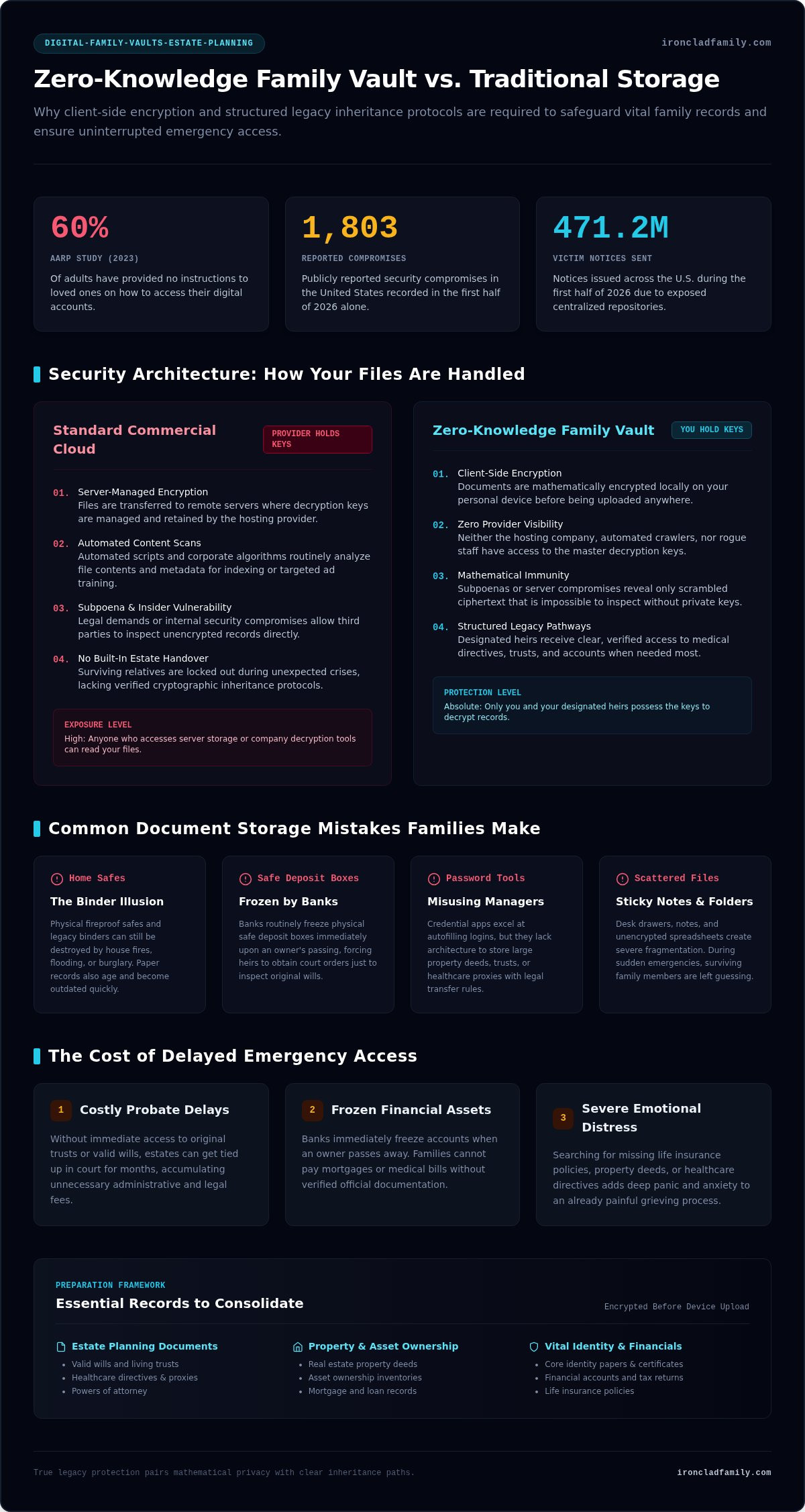
Standard cloud providers encrypt files during transmission and storage, but they manage the master decryption keys. Because they control the keys, rogue staff or automated scripts can inspect your documents. Many consumer platforms quietly analyze files to extract metadata for targeted advertising or service training.
This design creates serious privacy issues. If a tech provider receives a legal subpoena or experiences an internal compromise, your unencrypted records can be viewed. Unlike an architecture rooted in cryptographic security, traditional consumer drives simply don't satisfy the strict privacy requirements necessary for wills, tax returns, and asset ownership lists.
The Real Cost of Delayed Emergency Access
Privacy is only half the battle; accessibility during an emergency is the other. In the first half of 2026, over 1,803 publicly reported compromises caused 471.2 million victim notices across the United States. While external hacks cause immense financial stress, disorganization causes immediate human suffering. When a sudden medical crisis occurs, surviving relatives are often left locked out of crucial records.
Grieving loved ones shouldn't have to hunt through messy folders or guess passwords to find healthcare directives. The consequences of lost paperwork are steep:
- Costly probate delays: Without immediate access to original trusts or wills, estates can get tied up in court for months, racking up unnecessary administrative fees.
- Frozen financial assets: Banks freeze accounts when owners pass, leaving families unable to pay mortgages or medical bills without official documentation.
- Severe emotional distress: Searching for missing insurance policies or deeds adds deep anxiety to an already painful grieving process.
A proper zero knowledge family vault eliminates these vulnerabilities. It pairs high-grade mathematical privacy with clear inheritance paths, ensuring your household stays both completely private and prepared for whatever tomorrow brings.
Common Mistakes Families Make When Storing Vital Records
Most households try their best to keep records safe, but good intentions often lead to fragile systems. Scattered sticky notes, desk drawers, and unencrypted spreadsheets seem harmless until a crisis hits. A 2023 AARP study revealed that 60% of adults haven't provided instructions to loved ones on how to access their digital accounts. When vital information is fragmented across different places, simple emergencies quickly turn into administrative nightmares.
The Illusion of the Home Safe and Physical Binder
A heavy fireproof safe or a physical legacy binder feels reassuring on a shelf. Yet physical storage carries real vulnerabilities. Floods, house fires, and burglaries can destroy original deeds and birth certificates in minutes. Bank safe deposit boxes create another hurdle. Banks routinely freeze these boxes upon an owner's death, often forcing grieving heirs to obtain court orders just to read a will. Paper records also get outdated quickly, requiring constant printing and sorting to stay current.
Misusing Password Managers for Comprehensive Family Planning
Another common misstep is expecting standard password software to organize an entire estate. Credential apps excel at filling website logins, but they aren't designed to store large property deeds, healthcare proxies, or legal trusts. They also lack built-in legacy protocols to transfer critical assets to a surviving spouse or adult child. Official guidance on digital security for your family emphasizes layered defenses, yet simple autofill tools don't provide the estate coordination families need during health events.
Adopting a zero knowledge family vault fixes these gaps by pairing high-level privacy with structured legacy delivery. Instead of leaving your loved ones to search through drawers or guess passwords, using a dedicated family document protection system ensures your life's work remains accessible, organized, and completely secure.
What Is a Zero Knowledge Family Vault and How Does It Work?
Behind the technical name lies a straightforward concept: absolute mathematical privacy. A zero knowledge family vault encrypts sensitive personal files right on your phone or laptop before they ever travel over the internet. The host provider holds encrypted data blocks, but they never possess your master password, private keys, or plain text records.
Definition: A zero-knowledge architecture is a security framework where data is scrambled on the user's local device before upload. Because the service provider does not hold the decryption keys, they have mathematically zero knowledge of the stored files, making unreadable text the only thing sitting on their servers.
The Bank Safety Deposit Box Analogy
Think of this framework like a bank safety deposit box, but with a critical difference. In a traditional bank, a branch manager holds a master key that can open your box alongside yours. In a zero-knowledge structure, there is no second key. Only you and your chosen recipients possess the physical brass keys to open the lock. If an outside party or even a court orders the storage provider to show your documents, the company mathematically cannot comply. They cannot read or deliver files they cannot open.
Core Security Layers of a Zero-Knowledge Architecture
This fortress-like privacy relies on proven protective layers working together seamlessly in the background:
- Client-side encryption: Industry standards like AES-256 turn deeds and living wills into scrambled code directly on your local device before transmission, matching the federal recommendations outlined in the NIST guide to storage encryption.
- Transport Layer Security: TLS 1.3 protects the scrambled data stream as it travels between your hardware and the cloud servers, preventing interception.
- Multi-factor authentication: Hardware keys or authenticator apps block bad actors from guessing account access logins.
- Emergency recovery keys: Because the provider holds no backdoor passwords, users receive a master emergency key during setup. Storing this recovery code safely ensures you never lose access to your own records.
By shifting encryption to your personal device, a zero knowledge family vault transforms personal legacy planning. It turns a static collection of PDFs into a protected digital sanctuary that keeps corporate eyes out while preserving everything your family values.
Practical Steps to Organize Your Zero-Knowledge Family Vault
Taking control of your family's records doesn't have to feel overwhelming. When you break the process into manageable stages, establishing a zero knowledge family vault becomes an empowering household project. Follow these practical steps to build a complete, protected archive for the people you love.
Step 1: Inventory and Digitize Vital Household Records
Start by gathering foundational identity documents. Locate birth certificates, passports, marriage licenses, Social Security cards, vehicle titles, and real estate deeds. Use a smartphone scanning app or a desktop scanner to create clean, high-resolution PDF copies. Name each file clearly with the person's name and document type, such as "Doe_Jane_Passport.pdf," to prevent confusion later.
Step 2: Consolidate Legal Directives and Financial Records
Next, assemble the legal instruments that protect your decisions. Upload valid wills, durable powers of attorney, healthcare proxies, and living wills. Learning how to store family records safely alongside your broader estate plan ensures these documents are instantly available during a medical crisis.
Catalog your active financial accounts next. Include mortgage paperwork, life insurance policy numbers, retirement funds, and pension statements. Make sure to record key digital assets as well, such as domain registrations, email credentials, and cryptocurrency recovery seeds.
Step 3: Establish Authorized Beneficiary Permissions
A secure vault is only useful if the right people can reach it when an emergency occurs. Select trusted family members or your chosen digital executor to act as designated beneficiaries. Configure granular permissions so recipients only access the specific folders intended for them.
Set up protective safeguards, like verified waiting periods and multi-factor approval steps, before files unlock. Finally, schedule an annual household review every January to update old policies, remove obsolete accounts, and add newly acquired assets. Take the first step to protect your household legacy by visiting ironcladfamily.com today.
Choosing the Right Solution: Private Protection for Generations
Selecting the right digital safe requires balancing impenetrable security with practical, human accessibility. Many technical products offer strong encryption but fail completely when a non-technical spouse or adult child needs to retrieve documents. To ensure your records survive unexpected life events, you need a solution built specifically for multi-generational preparedness.
Essential Criteria for a Household Digital Safe
General cloud storage apps simply aren't designed for legacy succession. When evaluating platforms to protect your household, look for these specific capabilities:
- True client-side zero knowledge: Ensure the software scrambles information locally on your device before transmission. If the platform holds a master password reset that reveals your files, it's not zero-knowledge.
- Automated emergency protocols: Look for built-in release triggers, such as inactivity timers and designated secondary approvals, to deliver records to verified beneficiaries.
- Professional advisor collaboration: Choose a system that lets your estate attorney or financial planner review files directly through dedicated, permission-controlled portals without exposing your entire vault.
- Legally compliant estate tools: Verify that the platform supports state-specific legal documents and remote online notarization, keeping all your planning under one roof.
How IronClad Family Protects Your Living Legacy
IronClad Family was created to solve these exact estate planning and storage dilemmas. Built around a private zero knowledge family vault architecture, the platform treats your household records as a living legacy rather than cold, isolated files.
Through The Vault, families can store everything from property titles and account credentials to deeply personal Legacy Messages meant for future generations. It provides state-specific Last Will and Testament and Living Will creation, backed by remote online notarization capabilities. When critical moments arrive, verified beneficiaries receive clear instructions without legal bottlenecks or technical confusion. By combining mathematical privacy with thoughtful family handover features, IronClad Family gives households true peace of mind that lasts across generations.
Take the First Step to Protect Your Generational Legacy
Preparing for life's unexpected turns is one of the greatest gifts you can give the people you love. Moving away from scattered folders, paper binders, and vulnerable commercial cloud drives removes unnecessary confusion before a crisis occurs. When your household records are structured properly, your loved ones won't have to navigate costly court delays, frozen accounts, or painful searches during an emergency.
Adopting a zero knowledge family vault gives your household uncompromising safety. Through an end-to-end zero-knowledge encryption model, your sensitive records remain entirely invisible to third parties, software providers, and outside intruders. Built-in emergency access triggers guarantee that verified family beneficiaries receive vital documents right when they need them. With support for state-specific legal forms and remote notarization across the country, you can protect what matters most with calm confidence.
Learn how to protect your family’s most important documents with a secure digital vault.
Frequently Asked Questions
What does zero knowledge encryption mean for a family vault?
Zero-knowledge encryption means your documents are scrambled on your personal phone or computer before reaching the cloud. The platform provider never holds the encryption keys or master password. Even if unauthorized actors breach the server host, your files look like meaningless gibberish. In a zero knowledge family vault, absolute confidentiality is mathematically guaranteed because only you hold the keys.
Can the vault provider recover my files if I lose my master key?
No, the service provider cannot recover your files because they mathematically lack access to your decryption keys. This strict rule protects you from unauthorized snooping and data leaks. When you establish your account, you receive a master recovery code. It is critical to write this code down and store it in a secure location, ensuring you retain account recovery capability without sacrificing privacy.
How do family members get access in an unexpected emergency?
Family members gain access through predetermined emergency access protocols that you configure in advance. You designate verified beneficiaries and set specific release conditions, such as an inactivity timer or mandatory waiting period. If an unexpected crisis occurs, designated heirs verify their identity and receive access credentials to specific folders, preventing costly delays without exposing your private passwords while you are active.
Is a zero knowledge family vault better than Google Drive or Dropbox?
Yes, standard cloud drives like Google Drive or Dropbox manage server-side decryption keys, meaning staff or automated algorithms can scan files for metadata. A zero knowledge family vault scrambles every file locally before upload, preventing third-party inspection entirely. Dedicated family vaults also include structured estate organization, legal document generation, and emergency handover triggers that generic cloud storage accounts completely lack.
What documents should be stored inside a digital family vault?
You should store vital identity documents, legal directives, and asset records. Essential files include passports, birth certificates, property deeds, and vehicle titles. You should also upload estate planning paperwork such as wills, living wills, and durable powers of attorney. Finally, add life insurance policies, pension documentation, mortgage statements, and digital credentials for financial accounts and password managers.
Can financial advisors or estate planners access my family vault?
Yes, but only with your explicit permission and through controlled settings. Platforms feature dedicated advisor portals that let estate attorneys, financial planners, or accountants collaborate on specific records. You decide exactly which folders professionals can review, ensuring your broader financial legacy stays coordinated while preserving absolute privacy for personal family records, medical directives, and private legacy messages.
Are digital copies of wills and powers of attorney legally valid?
Digital copies serve as vital emergency references, but specific legal validity depends on state laws. Many states now recognize digital wills and remote online notarizations as legally binding when executed through compliant platforms. However, probate courts often require original physical signatures for certain wills. Storing high-resolution digital copies ensures your heirs and physicians have immediate guidance while original paperwork is retrieved.
