

- 13 mins
Imagine your children needing your trust documents during a midnight emergency, only to find the "safe" spot in the attic was destroyed by a burst pipe. Learning how to store will and trust documents safely is about more than just fireproofing a box. It's about making sure your life's work is reachable the moment your family needs it. With major banks like Chase and Santander phasing out safe deposit boxes in 2026, the old ways of hiding papers are quickly disappearing.
You want the peace of mind that comes from knowing your legacy is secure but not invisible. It's frustrating to choose between a bank vault that's closed on Sundays and a home safe that might be forgotten. You'll learn the best ways to protect your legal papers using a mix of physical and digital tools. This guide covers new 2026 electronic will laws, common storage mistakes to avoid, and a clear plan to ensure your family has access without any confusion.
- The Hidden Risks of Where You Store Your Will and Trust
- Traditional Storage Methods: Home Safes vs. Law Offices
- The Safe Deposit Box Catch: Why Physical Access is Not Enough
- A Step-by-Step Plan to Store Will and Trust Documents Safely
- How a Digital Vault Completes Your Family Protection Plan
- Frequently Asked Questions
Key Takeaways
- Balance physical protection with easy access to ensure your heirs aren't locked out of important files during a family crisis.
- Evaluate the trade-offs of using fireproof home safes versus keeping original documents in your estate lawyer's secure office.
- Learn how to store will and trust documents safely by avoiding the legal traps of bank safe deposit boxes that often restrict access after a death.
- Create a multi-layered defense plan that combines protected physical originals with secure digital backups for total peace of mind.
- Discover how a digital vault acts as a bridge between your paper files and your family’s need for instant information when it matters most.
The Hidden Risks of Where You Store Your Will and Trust
True security isn't just about keeping things locked away. It's about finding the perfect balance between keeping your papers safe and keeping them reachable. When you think about how to store will and trust documents safely, you might picture a heavy safe or a secret spot in the attic. However, if your heirs can't find your legal document when the time comes, it's as if it never existed. Documents that are buried too deep can't help the people they were meant to protect.
Missing original documents can lead to massive probate delays. In many states, courts require the physical original will to prove your wishes. If your family only has a copy, they may face extra legal hurdles and higher attorney fees. Hiding your documents too well is a common mistake that creates unnecessary stress during an already difficult time. Real protection means your family knows exactly where to look when the clock is ticking.
To better understand this concept, watch this helpful video:
Why Your Hiding Spot Might Be Too Secret
Many people choose "secret" spots like the bottom of a closet or under a mattress. These areas are high-risk for accidental loss or being thrown away during a house cleaning. Your family members will likely be struggling with grief when they need these papers. If they spend days searching for a hiding spot they weren't told about, it can lead to frustration and family arguments. A lost estate plan often results in the state deciding how your assets are split, which rarely matches your actual intent.
Natural Disasters and Your Legal Papers
Paper is fragile. Fire and water can destroy decades of planning in just a few minutes. Most standard metal file cabinets aren't built to withstand intense heat; they actually act like ovens, charring the paper inside. Even if you have a fireproof box, a major flood or a pipe burst can still lead to mold and rot. Understanding how to store will and trust documents safely means recognizing that a single physical location is a single point of failure. You need a backup strategy that ensures your legacy survives even if your home faces a disaster.
Traditional Storage Methods: Home Safes vs. Law Offices
Physical papers are the foundation of your legacy. Even with digital backups, many states still require the original paper document to start the probate process. Deciding how to store will and trust documents safely usually leads people to two traditional choices: a heavy home safe or their lawyer's office. Both options offer physical security, but they also come with hidden risks that could leave your family in a bind.
Choosing the Right Home Safe
A home safe provides immediate access, but not all safes are equal. You should look for a safe with a UL-rated fire protection label for at least one hour. This ensures the internal temperature stays low enough to protect paper during a typical house fire. Be careful with airtight safes, though. These can trap moisture inside, leading to mold or mildew that eats away at your signatures. Placing a few silica gel packs inside the safe can help keep your documents dry and readable.
The biggest risk with a home safe isn't fire; it's the lock. If you are the only person who knows the combination, your family is locked out. They might have to pay a professional to drill the safe open. In 2026, some banks charge as much as $250 for drilling services, and private safe technicians often charge even more. Always share your code or a spare key with a trusted person or a family preparedness professional who can help manage these details.
Leaving Documents with Your Attorney
Many people prefer to leave the original documents with the lawyer who wrote them. This keeps the papers in a professional environment and ensures they are ready for probate. However, this method relies on the law firm staying in business. Over twenty or thirty years, lawyers retire, firms merge, and offices move. If your lawyer closes their practice without notifying you, your documents could end up in a storage unit or lost in a transition.
You can also check if your local probate court allows you to "deposit" your will for safekeeping. This is a low-cost option provided by some counties, but it doesn't cover other important papers like your living trust or power of attorney. No matter which traditional method you choose, you need a backup plan. Relying on a single physical location is a gamble your family shouldn't have to take. Knowing how to store will and trust documents safely requires a strategy that survives even if your lawyer's office closes its doors.
The Safe Deposit Box Catch: Why Physical Access is Not Enough
For generations, bank vaults were seen as the gold standard for security. However, when you're looking at how to store will and trust documents safely, the safe deposit box often creates a "Catch-22" situation. This is the biggest reason estate planners advise against using them for original wills. When a bank learns of a customer's death, they are legally required to freeze the box immediately. This happens even if you have a joint owner in some states, creating a wall between your family and your final wishes.
The Legal Hurdles of Bank Storage
The problem is simple but devastating: the bank needs to see your will to know who the executor is, but the will is locked inside the box. To get it out, your family often must go to court to get a specific order just to open the box. This legal process can take weeks, leaving your heirs in a state of limbo. While they wait for a judge to sign a paper, they cannot move forward with your estate.
During those weeks, important decisions are stalled. Your family might need your funeral instructions or medical guidance that you carefully wrote down, but those papers are trapped behind a steel door. This delay adds a heavy burden of stress to an already grieving family. Safe deposit boxes should only hold items that aren't needed the moment you pass away, such as physical jewelry or property deeds. They are a poor choice for the documents that guide your family through the first few days of loss.
Who Has the Key? The Problem of Physical Barriers
Physical keys are a single point of failure. If your family can't find the key or forgets which bank holds the box, they face massive roadblocks. If the key is lost, the bank must hire a professional to drill the lock. In 2026, drilling fees can range from $150 to $250 depending on the bank. This isn't just a financial cost; it's a physical barrier that prevents your family from carrying out your legacy. Relying on a single piece of metal to protect your life's work is a risk you don't have to take.
A physical key can be lost, stolen, or even accidentally thrown away during a move. If you want to know how to store will and trust documents safely, you must look beyond metal and stone. A keyless digital backup provides a bridge that physical storage cannot offer. It ensures that even if a physical barrier like a frozen bank box exists, the information your family needs is still reachable. True security is about removing these hurdles before they become a crisis for your loved ones.
A Step-by-Step Plan to Store Will and Trust Documents Safely
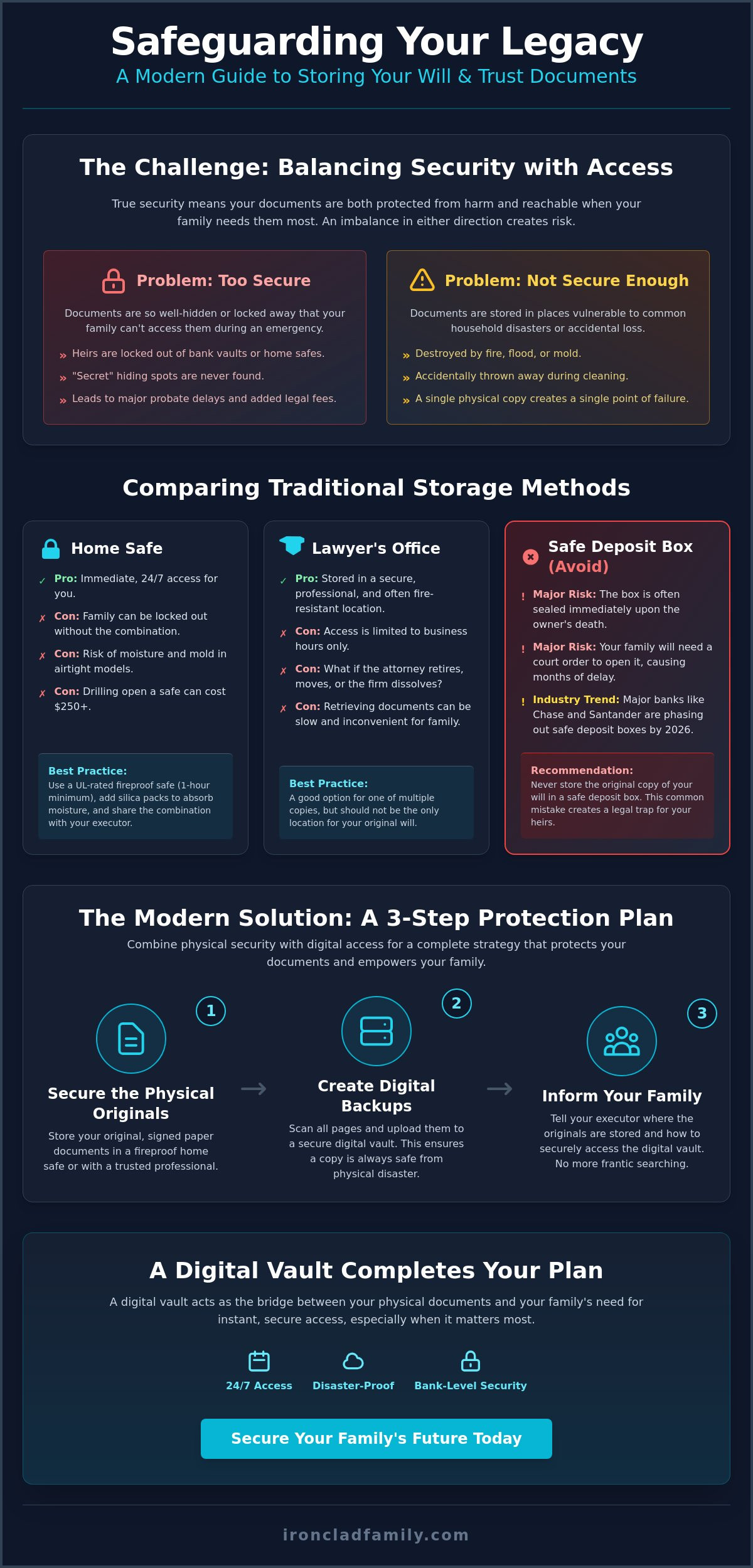
Mastering how to store will and trust documents safely requires a system that works even if you aren't there to explain it. You need a two-tier framework that protects the physical originals while providing immediate digital access. This plan ensures that your legacy isn't just a stack of paper, but a reachable roadmap for your loved ones. By following these five steps, you move from a state of worry to absolute preparedness.
- Step 1: Secure the physical original. Place your signed documents in a fireproof safe at home or leave them in the custody of your estate attorney.
- Step 2: Digitize every page. Create high-quality scans of your documents. Ensure every signature and notary seal is clearly visible.
- Step 3: Create a "Just in Case" binder. Organize non-legal instructions like pet care, funeral wishes, and a list of your monthly bills.
- Step 4: Upload to a digital vault. Use a secure platform to bridge the gap between your physical files and your heirs.
- Step 5: Empower your receivers. Tell your trusted family members exactly how to access this information when the time comes.
Organizing Your Physical Documents
Gathering your papers is much easier when you use a family emergency plan checklist. This helps you find everything from property deeds to life insurance policies without feeling overwhelmed. Once you have your papers, label your folders with large, clear text. Your heirs shouldn't have to guess what is inside a manila envelope. A master list acts as a table of contents for your entire life, showing the exact location of every safe, key, and legal folder in your home.
Digital Backups: The Modern Safety Net
USB drives and personal email accounts are the weakest links in modern security. They are either too easy to lose or too easy to hack. Learning how to store will online securely means using high-level encryption that protects your family’s privacy. These digital copies also simplify life when you are choosing between a trust and will, allowing you to share updates with your advisors instantly without driving to their office.
To start organizing your digital legacy right now, you can explore The Vault as your secure home base.
How a Digital Vault Completes Your Family Protection Plan
A digital vault is the final piece of your family's safety net. It acts as a digital fortress that protects your most sensitive information from both digital threats and physical disasters. While a home safe protects the paper, a vault ensures the information inside those papers is always reachable. When you decide how to store will and trust documents safely, adding a digital layer means your family is never left in the dark during a crisis.
IronClad Family provides this security by using a high-level system that bridges the gap between your lawyer's office and your home. It moves your estate plan from a static folder to a living legacy. This ensures that your hard work isn't just stored, but is actively ready to serve your heirs the moment they need guidance. Physical locks can fail, but a well-managed digital defense stands firm.
Zero-Knowledge Encryption Explained Simply
Zero-knowledge encryption is the gold standard for privacy. Think of it like a high-tech lockbox where you are the only person on earth with the key. Even the engineers at the company cannot peek inside your files. This is a massive step up from standard cloud storage. Most common cloud services keep a master key that could be stolen or misused. In a true vault, your data is scrambled before it even leaves your computer. It stays unreadable to everyone except you and the people you choose to trust.
Connecting Your Loved Ones to Your Legacy
The real power of a vault is how it connects your family to your wishes. You can name specific people as IronClad Receivers. These are the trusted individuals who will gain access to your documents exactly when the time is right. You can set up automated triggers that release your information during an emergency. This completely removes the legal hurdles of a frozen bank box. Your family gets the information they need without having to wait for a court order or a bank manager's permission.
You can use your digital vault to store more than just legal papers, such as legacy messages. This turns your document storage into a meaningful narrative for the next generation. For those working with professionals, the Advisor Portal allows your estate planner to help you stay organized. This ensures your entire team is on the same page, protecting your wealth and your family's future for decades to come.
Securing Your Legacy for the Next Generation
You now have a clear roadmap for how to store will and trust documents safely by balancing physical protection with digital accessibility. Relying on a single hiding spot or a frozen bank box is a risk your family doesn't need to take. By combining fireproof physical storage with a secure digital backup, you ensure your heirs have the information they need without the stress of a long search or court delays.
IronClad Family offers the tools to make this plan a reality. With zero-knowledge encryption and automated emergency delivery, your legacy is protected by a technical guardian that understands the depth of your familial bonds. You can also use state-specific document tools to stay ahead of changing laws as we move through 2026.
Secure your family's future with the IronClad Vault today.
Taking these simple steps now provides the ultimate gift for your loved ones: absolute peace of mind.
Frequently Asked Questions
Is it better to keep the original will or a copy?
You must keep the original physical document because most probate courts require the "wet ink" signatures to prove the will is valid. While digital copies are excellent for sharing with your family and executors, relying only on a copy can lead to long legal delays. If the court cannot find the original, they may assume you intended to cancel it, which can put your entire estate plan at risk.
Can I store my will in a safe deposit box at the bank?
It is generally not recommended to store an original will in a bank safe deposit box. Banks often freeze these boxes immediately when they learn of a death, even if you have a joint owner. This creates a difficult situation where your family needs the will to get court permission to open the box, but the will is locked inside. It is better to use a fireproof home safe or your lawyer's office.
How do I make sure my family can find my trust documents?
The best way to ensure your family finds your documents is to use a "master list" that identifies every storage location. Keep your physical trust papers in a clearly labeled folder inside a fireproof safe. Then, upload digital copies to a secure platform. Tell your trusted family members exactly where the safe key is kept and how they can access your digital backups during an emergency.
What is a digital vault and is it safe for legal documents?
A digital vault is a high-security online repository that uses zero-knowledge encryption to protect your legacy. It is a vital tool for how to store will and trust documents safely because it ensures that only you and your designated heirs can see the files. Unlike basic cloud storage, a vault keeps your data private even from the service provider, making it a fortress for your most sensitive legal information.
Should I give my executor a key to my home safe?
Yes, your executor needs a reliable way to access your documents without a struggle. You don't necessarily have to give them a physical key right now, but you must tell them exactly where the key or the combination is stored. Many families choose to store safe codes in a secure digital environment that only releases the information to the executor when it is actually needed.
What happens if my original will is destroyed in a fire?
If your original will is destroyed, you should sign a new one as soon as possible to ensure your wishes remain legally binding. In 2026, states like North Carolina allow electronic versions to be admitted to probate if the original is lost, but this is still a complex legal process. Having a high-quality digital backup makes it much easier for your attorney to recreate the document and get it resigned quickly.
How often should I check my stored documents for updates?
You should review your storage plan at least once a year or after any major life change like a marriage or a new grandchild. These regular check-ups ensure that your physical safe is still in good condition and that your digital passwords are up to date. It's also a good time to confirm that the people you've chosen to access your documents are still the right ones for the job.
Is an online notary legal for signing my trust documents?
Online notarization is legal in most states as of 2026 and is a common way to finalize estate plans. This process uses a secure video call to verify your identity and watch you sign the documents digitally. While this is a convenient option, you must ensure the service you use follows your specific state's laws. Some states have different rules for wills than they do for other legal papers like trusts.