

- 13 mins
What if the most important pieces of your life were locked in a vault that your family didn't know how to open? When you start organizing important family documents, you're doing more than just cleaning a desk; you're securing your family's future. With identity theft occurring every 4.9 seconds in 2026, the risk of losing your legacy to a hacker or a house fire is a heavy burden to carry. You likely feel overwhelmed by the mountains of paper and the endless list of digital accounts that grow every year. It's natural to worry that your heirs might be locked out of the assets you worked hard to build.
This guide will show you how to sort, secure, and share your most critical papers so your family is never left in the dark during a crisis. We'll walk through a clear, repeatable system for your physical files and explain how to protect your digital DNA so your legacy remains ironclad for the next generation. By the end of this article, you will have a roadmap to move from a state of uncertainty to a feeling of absolute preparedness and peace of mind.
Table of Contents
Key Takeaways
- Understand how to prevent an "Information Lockout" by ensuring your family can prove identity and ownership during a medical or financial crisis.
- Master a simple, two-step system for organizing important family documents by sorting essential records and purging unnecessary paperwork.
- Avoid common security mistakes, such as relying on your memory or using standard cloud storage that lacks zero-knowledge encryption.
- Identify why physical folders are no longer enough to protect modern assets like cryptocurrency, online-only bank accounts, and your digital legacy.
- Move from a state of document chaos to a feeling of absolute preparedness, knowing your heirs have the keys to your life when they need them most.
Why Organizing Important Family Documents is a Matter of Security
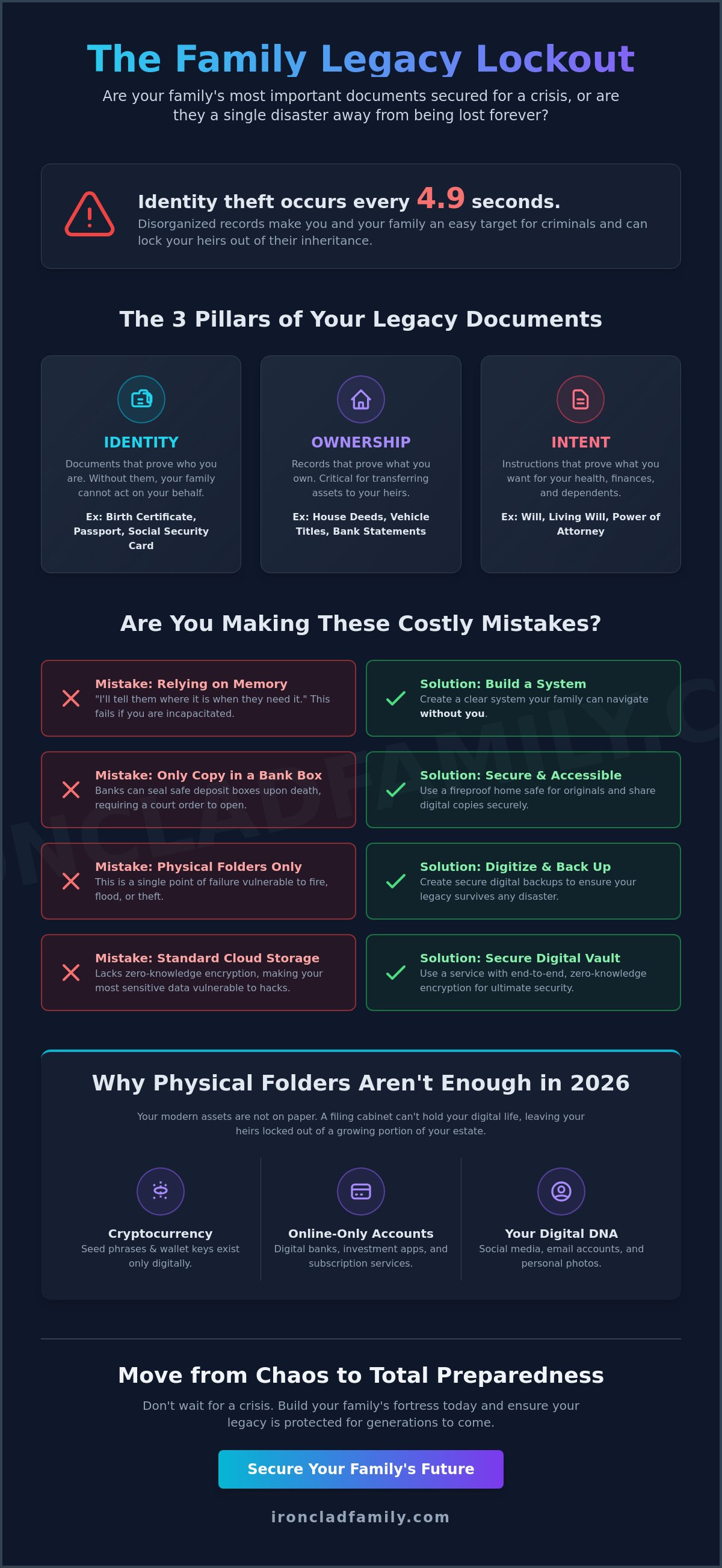
When we talk about organizing important family documents, we're discussing the keys to your life. These records fall into three essential categories: identity, ownership, and intent. Your birth certificate proves who you are. A house deed proves what you own. A living will proves your intent for your medical care. Without these papers, your family is effectively locked out of their own heritage. Security isn't just about a lock on the front door; it's about ensuring your loved ones have access to the right information at the exact moment a crisis hits.
The "Information Lockout" is a silent threat that many families face during a medical emergency. If you're in the hospital and can't speak, your family needs to find your health directives and insurance details immediately. If those records are buried in a random drawer, the delay can be devastating. In 2024, there were 1,135,291 identity theft reports in the United States. Disorganized records make it easier for criminals to steal your "digital DNA" and much harder for your family to recover. By focusing on personal archiving, you build a fortress around your family's most sensitive data.
To better understand how a simple system can save you hours of frustration, watch this helpful video:
Key Takeaways for Immediate Action
- Categorize first, digitize second, secure third. Don't try to scan everything at once. Group your papers by type before moving to a digital format.
- Build a system that works without you. Your filing method must be so clear that a family member can find a document even if you aren't there to explain it.
- Physical storage is a single point of failure. A house fire or flood can destroy a paper trail in minutes. You need a secure digital backup to ensure your legacy survives any disaster.
The Consequences of the "I Will Do It Later" Mindset
Many people wait for a "perfect time" to start, but that time rarely comes. Delaying this task places a massive emotional burden on grieving family members. They shouldn't have to hunt through dusty boxes for a life insurance policy while mourning a loss. Disorganization also has a high financial cost. Unorganized records often lead to "unclaimed property." Billions of dollars sit in state treasuries because bank accounts or insurance benefits were forgotten by heirs. Using a family emergency plan checklist acts as a roadmap to prevent these losses. This guide will show you how to move from chaos to becoming the Digital Guardian of your home.
Common Mistakes in Document Management
Most people start organizing important family documents with good intentions, but they often fall into traps that make their efforts useless during a real crisis. The biggest mistake is relying on memory. You might think you'll always be there to tell your spouse where the life insurance policy is or which drawer holds the house deed. If an emergency happens, your memory goes with you. This creates a massive hurdle for your loved ones who are already dealing with stress.
Another common error is keeping the only copy of a will in a bank's safe deposit box. While it feels secure, banks often seal these boxes immediately after a death. Your family might need a court order just to get the document that tells them what to do next. This delay can take weeks and cost thousands in legal fees. When planning for financial readiness for emergencies, accessibility is just as vital as security.
Many families also use basic cloud storage like Google Drive or Dropbox for their sensitive records. While convenient, these services often lack "zero-knowledge encryption." This means the service provider could technically access your files, and if their system is hacked, your data is exposed. In 2023, financial losses from identity fraud reached $43 billion, impacting more than 16 million victims. Your most sensitive "digital DNA" deserves a higher level of protection than a standard folder.
The "Fireproof Safe" False Sense of Security
A heavy safe in the basement provides a feeling of strength, but it isn't a perfect solution. Fireproof boxes are often rated for only one or two hours of heat. In a major house fire, the contents can still char or melt. These safes are also prime targets for thieves who can carry the entire box away to open later. If you don't share the code with a trusted heir, the physical safe becomes a permanent barrier rather than a resource. A physical safe should be your first line of defense, but never your only one.
Why Basic Folders Fail During Emergencies
Traditional filing systems often focus on categories like "Taxes" or "Utilities." While this helps with daily life, it doesn't help an executor understand your final wishes. There's often a "Digital Gap" where paper records are tidy, but online accounts are invisible. Your cryptocurrency, social media legacies, and online-only bank accounts won't show up in a manila folder. Building a secure digital vault ensures that every part of your life's work is visible and accessible to the right people when it matters most.
A Step-by-Step Guide to Organizing Your Legacy
The process of organizing important family documents begins with a single, clear space. Clear off a large table or desk where you can spread out your papers without distraction. You'll move through a five-step system designed to turn your scattered records into a secure, accessible fortress. This isn't just about tidying up; it's about building a bridge between your physical life and your digital inheritance.
The first step is The Great Sort. You must gather every scrap of paper from junk drawers, home safes, and mail piles. Once everything is in one place, move to The Purge. You only need to keep records that prove identity, ownership, or legal intent. Shred utility bills older than 12 months and old ATM receipts immediately. Someone in the United States becomes a victim of identity theft every 4.9 seconds, so disposing of unnecessary data is a vital security measure. After purging, group your papers into the five essential categories listed below. Step four is Digitization, where you scan your final pile into high-quality PDFs. Finally, perform a Verification check. This ensures your "receivers"—the people you trust most—actually know how to enter the system when you aren't there to guide them.
The Five Essential Categories
- Legal: This bucket holds your will, living trusts, powers of attorney, and birth certificates. These are the foundation of your estate plan.
- Financial: Include bank statements, investment records, and a list of all debts. This helps heirs locate assets and settle accounts.
- Property: Keep your home deeds, vehicle titles, and current insurance policies together.
- Medical: This category is for your living will, health proxy forms, and immunization records. It's critical for emergency care.
- Personal: Don't ignore your story. Store legacy messages, family photos, and funeral instructions here to provide emotional clarity for your family.
Practical Tips for Faster Sorting
Efficiency is the enemy of anxiety. Use the "Touch It Once" rule: when you pick up a document, decide to file it, shred it, or act on it immediately. Don't let "maybe" piles grow on your table. If a document needs a signature or a phone call before it's ready for the vault, put it in a separate "Working Folder." This keeps your main project moving forward while you handle active tasks. Using an online family document organizer helps you manage these categories in a way that physical binders simply can't match. It ensures that your digital DNA is just as organized as your paper files.
Why Physical Folders Aren’t Enough in 2026
While the physical sorting we discussed is a vital first step, a paper binder is no longer enough to protect a modern life. Americans now estimate the average value of their digital assets at $191,516. This value includes things that don't exist on paper, such as cryptocurrency wallets, online investment accounts, and digital photo archives. If you only focus on organizing important family documents in a physical folder, you are leaving a massive part of your legacy at risk. IronClad Family provides a way to bridge this gap by creating a secure home for your digital DNA.
A digital vault provides a fortress for your most sensitive information, making the process of organizing important family documents complete. Physical papers can be lost, stolen, or destroyed, but a digital repository ensures your state-specific legal documents are accessible from anywhere in the world. Whether you are at home or traveling, your family can reach the records they need during a crisis without hunting through a filing cabinet.
The Power of a Secure Digital Vault
A digital vault acts as a fortress for your most sensitive records. Unlike a standard cloud drive, a high-security vault uses zero-knowledge encryption. This means only you and your chosen receivers have the keys to unlock the data. Even the company storing the files cannot see them. You can start building your own IronClad Family digital vault to serve as the central hub for your family's organization.
Automated Delivery: The Ultimate Safety Net
One of the biggest flaws of a physical binder is that it can't find your family when they need it. If a house fire occurs or if you move and the binder is lost, your legacy disappears. IronClad Family solves this through "IronClad Receivers." This system allows for the automated delivery of your digital keys and credentials when they are needed most. It ensures that your loved ones aren't left guessing or hunting for passwords during their darkest hours. Knowing that your life's work is protected by a Digital Guardian provides a level of peace that a plastic folder simply cannot offer.
Ready to protect your heritage for the next generation? Secure your digital legacy today.
Taking the Next Step Toward Total Family Preparedness
Moving from a pile of unsorted mail to a complete legacy system is a vital journey. You've shifted from uncertainty to a place where you are the active protector of your family's history. By organizing important family documents, you ensure that your digital DNA is safe and your loved ones won't be left in the dark during a crisis. This process is a gift to your future self and your heirs, removing the burden of a document hunt during their most difficult moments.
To keep this momentum, follow a simple three-part plan: Sort, Scan, and Secure. First, finish sorting your physical papers using the five categories we established. Second, scan those records into high-quality digital files. Third, secure them in a vault that uses zero-knowledge encryption. This repeatable system ensures that as your life changes, your records stay current. Whether you buy a new home or open a new account, you now have the framework to protect those assets immediately.
Professional Help for Complex Legacies
Some families have complex assets or simply don't have the time to manage every detail. If you feel overwhelmed, you aren't alone. Many financial advisors use a dedicated portal to help their clients stay organized and secure. This allows your professional team to see the big picture of your estate while keeping your data under military-grade protection. For those who want a done-for-you approach, a white-glove preparedness service can ensure your document protection is complete without the stress of doing it yourself.
Your Legacy is Worth Protecting
Don't feel like you have to finish the entire project tonight. Start small. Pick just one category, like your medical records, and get it into your vault today. Every document you secure is one less worry for your spouse or children. It's an act of love that saves them from a document hunt during their most difficult moments. Organizing important family documents is the foundation of a strong estate plan. Don't leave your family's future to chance. Your legacy is worth the effort.
Ready to protect your heritage for the next generation? Secure your family’s legacy with the IronClad Vault today.
#EstatePlanning #FamilySecurity #DigitalLegacy #DocumentOrganization #IronCladFamily
Building Your Ironclad Legacy Today
Taking control of your records is one of the most selfless acts you can perform for your loved ones. You've learned that a simple physical folder is a single point of failure in a world where identity theft happens every 4.9 seconds. By organizing important family documents through a structured system of sorting, scanning, and securing, you remove the burden of uncertainty from your heirs. Your digital DNA deserves a home that is as unshakeable as your commitment to your family.
A secure vault provides more than just storage; it offers a Digital Guardian that works when you can't. With zero-knowledge encryption, your private keys remain yours alone. Automated emergency delivery ensures your credentials reach the right people at the right time; meanwhile, state-specific legal tools keep your planning accurate. Don't wait for a crisis to test your preparedness. Secure your family’s legacy with the IronClad Vault today. Your future self and your family will thank you for the absolute peace of mind you've built today.
Frequently Asked Questions
How long should I keep tax documents when organizing family records?
You should keep most tax records for three years from the date you filed your original return. However, it's safer to keep them for seven years if you claim a loss from worthless securities or bad debt. When organizing important family documents, keeping seven years of records ensures you're fully prepared for any deep audit from the IRS.
What is the best way to store a Last Will and Testament?
Store your original physical Will in a fireproof home safe or with your estate attorney. Avoid safe deposit boxes because banks often seal them immediately after a death, which can delay probate for weeks. Always keep a high-quality digital scan in a secure vault so your family can read your instructions even if they can't get to the paper original yet.
Can I just use a regular cloud service for my legal documents?
You shouldn't use basic cloud services for sensitive legal papers because they often lack zero-knowledge encryption. Standard providers can technically see your files, and their security isn't always enough to stop high-level identity theft. A specialized digital vault is a better choice because it ensures only you and your chosen heirs have the keys to your digital inheritance.
What documents should be in an emergency "grab-and-go" bag?
Your emergency bag needs physical copies of passports, birth certificates, and a list of all current medical prescriptions. You should also include a waterproof card that contains the login instructions for your digital vault. This ensures you can prove your identity and access insurance funds even if your home is unreachable after a disaster.
How do I ensure my family can access my digital passwords after I pass?
The most reliable method is to use a system that offers automated emergency delivery of your credentials. This tool releases your "digital DNA" to your chosen receivers only when it's confirmed that you can't manage the accounts yourself. It prevents your family from being locked out of bank accounts or losing years of family photos stored in locked devices.
Is it legal to keep digital copies of birth certificates and deeds?
Digital copies are legal for proving information, but they usually won't replace a certified original for official business. Most government agencies still require a paper copy with a raised seal for things like getting a passport or selling a house. Use your digital copies for organizing important family documents and daily reference, but keep the physical originals in a secure, dry place.
What is a "Digital Executor" and do I need one?
A Digital Executor is a person you name to manage your online accounts and digital assets after you pass away. You need one because a traditional executor might not have the passwords or technical knowledge to close social media profiles or manage cryptocurrency. This role gives someone the legal right to handle your online legacy according to your wishes.
How often should I update my organized family document system?
You should review and update your document system at least once a year. Major life changes like a new child, a home purchase, or opening a new investment account should trigger an immediate update. Setting a specific date each year, such as your birthday or during tax season, ensures your family's protection never expires.