


- 13 mins
If you were suddenly unable to speak for yourself tomorrow, who would pay your mortgage or talk to your doctor? Many people assume their family can just step in, but without the right legal tools, the court system often takes control instead. In 2026, 42% of Americans say they wouldn't know how to handle a family member's affairs in a crisis. This uncertainty usually stems from confusion over a power of attorney vs will and which one offers the best protection for their unique situation.
It's natural to feel anxious about legal terms or worry about who will manage your bills if you become ill. You want to shield your children and your money without falling into a trap of complex jargon. We believe your legacy is more than just information; it's the foundation of your family's future and the essence of your life's work. You deserve a plan that feels like a fortress for your loved ones.
In this guide, you'll learn the simple differences between a power of attorney and a will so you can keep your family safe during health crises and after you pass away. We will break down how each document functions, why you need both to be fully secure, and how to create a simple plan that provides absolute peace of mind.
Key Takeaways
- A Power of Attorney acts as a legal permission slip while you are alive, ensuring someone you trust can manage your bills and healthcare if you cannot speak for yourself.
- A Will serves as your final letter of instruction, allowing you to name guardians for your children and decide how your life's work is shared after you pass away.
- Understanding the timing and purpose of a power of attorney vs will is essential because one protects you during a health crisis while the other secures your legacy later.
- Legal documents only work if they are accessible; learn why storing these papers in a secure digital vault is the final step in protecting your family from the court system.
- Discover how to avoid family conflict and ensure your money stays in the right hands by setting up both documents before an emergency happens.
What Is the Main Difference Between a Power of Attorney and a Will?
Most people start their estate planning by thinking about a will. While a will is vital, it's often useless during a medical emergency. The primary difference when looking at a power of attorney vs will is when each document actually starts working. You can think of a Power of Attorney as a legal permission slip for the living, while a will is a letter of instruction for after you pass away. One protects your life and your daily needs; the other protects your legacy and your belongings. It's also vital to know that a Power of Attorney ends the very moment a person dies. It cannot be used to handle funeral arrangements or give away money once you're gone. That is when the will takes over the responsibility. Understanding the power of attorney vs will balance ensures your family is never left without a guide.
When a Power of Attorney Takes Control
A Power of Attorney becomes active while you're still alive but cannot speak for yourself. This might happen due to a sudden illness, an accident, or a long-term health issue like dementia. In these moments, your bills still need to be paid and medical decisions must be made. To make this work, you name a person you trust to act on your behalf. This person is known as your Agent. Your Agent can step into your shoes to talk to banks or doctors, ensuring your life stays on track even when you're sidelined. Without this document, your family might have to go to court just to access your bank account to pay for your care.
When a Will Takes Effect
A will only begins its work after you've passed away. Until that moment, it is simply a private document that has no legal power over your choices or your money. Once you're gone, the will serves as the voice of your legacy. It tells the court exactly how you want your house, savings, and personal items shared among your loved ones. For parents, the will is the only legal place to name a guardian for minor children. It provides a clear roadmap that helps your family avoid painful fights. However, a will must go through a court process called probate to become official. This process proves the document is real and gives your chosen representative the power to carry out your last wishes.
How a Power of Attorney Protects You While You Are Alive
Many people assume they only need legal papers when they are old. This is a dangerous mistake. Every adult needs a plan for the "what if" moments of life. If you are in a hospital bed, your bank doesn't care that your spouse needs to pay the mortgage. Without a legal document, they may freeze your accounts. This creates a second crisis for your family when they are already stressed by your health. It is a gap in planning that leaves your life's work vulnerable to red tape.
If you don't have a Power of Attorney, a judge may have to pick someone to help you. This process is called guardianship. It is often slow, public, and very expensive. By choosing your own helper now, you keep the court out of your private life. When you look at the power of attorney vs will debate, the POA is what protects your daily life while you are still here. It gives you the calm confidence that your household will keep running. Most people don't realize that a power of attorney vs will comparison isn't about choosing one over the other; it's about covering two different parts of your story.
Financial Power of Attorney: Managing the Money
This document lets a person you trust handle your finances. They can sign checks, pay your monthly bills, or talk to your bank about your mortgage. It ensures your family doesn't lose access to the money they need for groceries or rent. You can even set this up as a "springing" Power of Attorney. This means the document stays inactive until a doctor signs a letter saying you are too sick to handle things yourself. It's a secure safety net that stays tucked away until it is truly needed. Storing a digital copy in The Vault ensures your family can find it the moment a crisis hits, avoiding any delay in care.
Healthcare Power of Attorney: Making Medical Choices
A Healthcare Power of Attorney allows someone to speak with your medical team. They make sure the doctors follow your specific wishes regarding treatments and care. This person doesn't just guess what you want; they act as your legal voice. This document is often paired with a Living Will, which lists your specific medical preferences for end-of-life care. You can learn more about those details in our Living Will Guide. Having this protection in place means your loved ones won't have to argue with hospital staff during an already emotional time. It provides a clear path forward for everyone involved.
How a Will Protects Your Family After You Pass Away
Once you have passed away, the Power of Attorney you carefully chose loses its authority immediately. This is the moment where the power of attorney vs will dynamic shifts from protecting your life to securing your legacy. Your will becomes the definitive voice for your final wishes. It is the only legal document that can guide your family through the heavy lifting of closing your estate. Without it, your loved ones are left guessing. This confusion often leads to painful conflict during an already difficult time for the people you love most.
You also need to choose a reliable Executor. This person acts as the manager of your final affairs. They handle the paperwork, pay your final debts, and make sure your life's work reaches the right hands. A will isn't just for big assets like houses or retirement accounts. It is also the place where you protect sentimental items that hold deep family meaning. Whether it's your grandmother's wedding ring or a collection of family photos, your will ensures these treasures go to the person you intended. This prevents family squabbles over 'who gets what' and keeps your family bonds strong.
Naming a Guardian for Your Children
For parents of young children, a will is a sacred duty. It is the only document where you can legally name a guardian for your minor kids. If you don't make this choice, a judge who doesn't know your family or your values will decide who raises them. This is often the most emotional part of estate planning, but it is also the most important. Our How to Make a Will guide walks you through this step-by-step. Choosing a guardian yourself provides the ultimate safety net for your children's future and ensures they are raised by the people you trust most.
The Reality of Probate Court
Probate is the legal process where a court checks your will to make sure it is valid. Think of it as a legal waiting room where your assets sit before they can be given to your heirs. During this time, your will becomes a public document that anyone can see. While probate is a standard step, it can be slow and frustrating without a clear plan. Understanding the power of attorney vs will transition is key to avoiding the 'preparedness gap' that affects so many families. In 2026, 42% of Americans report they wouldn't know what to do if a family member passed away today. Having a clear will helps your family move through this process with calm confidence. You can find more details in our guide on Understanding Probate.
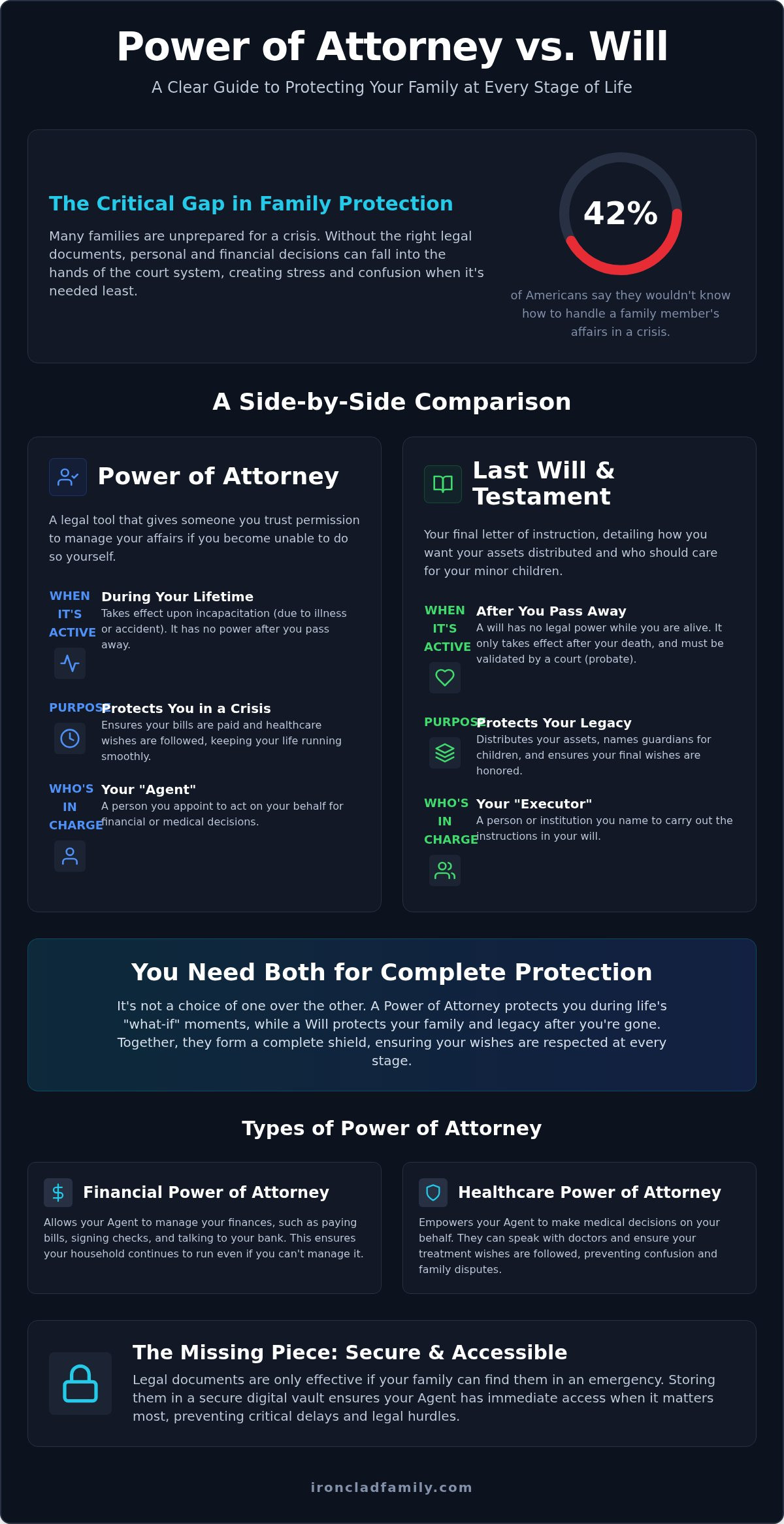
Power of Attorney vs Will: A Side-by-Side Comparison
Choosing between a power of attorney vs will is not a matter of picking the best one. These two documents perform completely different jobs at different times. The most significant difference is the timeline. A Power of Attorney is active only while you are alive. It allows someone to step in if you are sick or injured. A will, however, sits quietly until you pass away. It has no legal power to help you during a medical crisis. While the POA focuses on your personal care and monthly bills, the will focuses on sharing your assets and naming guardians for your children.
Privacy is another area where these documents differ. A Power of Attorney is a private contract between you and the person you trust. You usually only show it to your bank or your doctor. A will eventually becomes a public record. Once it enters the probate court process, anyone can look up the details of what you owned and who you left it to. Understanding the power of attorney vs will distinction helps you realize that a complete plan must address both your life and your legacy.
Why You Need Both for Full Protection
Think of these documents as two halves of a single shield. A Power of Attorney handles the "now," and a will handles the "later." If you have a will but no POA, you fall into the "Gap of Uncertainty." This is the period when you are alive but cannot manage your own affairs. In this gap, your family is often locked out of your bank accounts and medical records. They may have the instructions for what to do after you pass, but they have no authority to help you while you are still here. The cost of setting up these documents today is a fraction of the thousands of dollars in legal fees your family would pay for a court-ordered guardianship later.
The Cost of Doing Nothing
Waiting until a crisis happens is a high-risk strategy. Without a POA, your family must ask a judge for permission to help you through a guardianship hearing. This process is expensive, slow, and adds massive stress to a family already dealing with a health emergency. In 2026, a survey of 5,000 U.S. adults found that 56% have no estate planning documents at all. This lack of preparation leaves families vulnerable to the court system. 2026 is the year to move from uncertainty to absolute preparedness. You can start securing your family's future today by using a family preparedness service to organize your essential legal papers.
Why a Secure Digital Vault is the Missing Piece of Your Estate Plan
A legal document is only as strong as your family's ability to find it. You might spend hours debating the power of attorney vs will pros and cons, but if those papers are buried in a filing cabinet during a crisis, they can't help you. Traditional storage methods like safe deposit boxes often fail because they are locked when you are incapacitated or gone. IronClad Family provides a modern fortress for these vital records through The Vault. By using zero-knowledge encryption, we ensure that your private life stays private. Hackers cannot see your data; only you and your chosen loved ones hold the keys.
The true strength of a digital vault is the Emergency Delivery feature. In a medical emergency, your family needs your Power of Attorney instantly. Our system is designed to deliver your credentials and documents to your loved ones automatically when they need them most. This removes the frantic search for paperwork and allows your family to focus on your care. It turns your digital information into a living legacy that protects your family in real time.
The Danger of Paper-Only Planning
Relying on a "Just in Case" binder or a physical folder is a risk. House fires, floods, or simple forgetfulness can destroy years of planning in minutes. Digital copies in a secure vault are now the standard for safety. This is especially true when considering RUFADAA compliance. These laws govern how your family can access your digital assets, like online accounts and photos. Without explicit permission stored in a secure place, your family might be locked out of your digital life forever. A secure vault bridges the gap between your physical papers and your digital world.
Starting Your Legacy with IronClad Family
You can combine a state-specific will with high-tech digital storage to create a complete safety net. IronClad Family helps you move beyond just distributing money by offering Legacy Messages. These allow you to leave videos, stories, and wisdom for the next generation. It is about protecting the essence of your life's work. When you weigh the power of attorney vs will, remember that both need a home where they are safe and accessible. Don't leave your family's future to chance. You can secure your family's legacy today and gain the peace of mind that comes with being truly prepared.
Take the Next Step Toward Absolute Preparedness
You now understand that a Power of Attorney protects your daily life and health, while a will secures your legacy for the next generation. Balancing a power of attorney vs will is not about choosing one; it's about building a complete shield for your family. Without these tools, you leave your life's work vulnerable to the court system and unnecessary family stress. True security comes from having a plan that works both while you are alive and after you have passed away. It's about ensuring your children are cared for and your bills are paid even when you can't speak for yourself.
IronClad Family helps you bridge the gap with state-specific legal documents and high-trust security. By using zero-knowledge encryption and an automated emergency delivery system, we ensure your family is never left searching for answers in a crisis. You can secure your family's legacy with The Vault today and move from uncertainty to a feeling of total protection. Your family's future is a narrative you are still writing. We are here to help you make sure the next chapter is safe, certain, and full of peace. You've built a life worth protecting; now is the time to make it unshakeable.
Frequently Asked Questions
Can I have a power of attorney and a will at the same time?
Yes, you can and should have both a power of attorney and a will at the same time. These documents work together to provide a complete shield for your family. When you compare a power of attorney vs will, you'll see they handle different phases of your life. Having both ensures there's never a gap in your protection. It's the most responsible way to organize your legacy and keep the court system out of your private life.
Does a power of attorney override a will?
No, a power of attorney doesn't override a will because they operate on different timelines. A power of attorney is only active while you're alive and becomes void the moment you pass away. At that exact second, your will becomes the primary legal document. They're designed to pass the baton from one to the other, ensuring your wishes are followed during your life and after your passing.
What happens if I die without a power of attorney?
If you pass away without a power of attorney, it doesn't affect your estate because the document would have expired at death anyway. However, if you become sick or injured without one while you're still alive, your family faces a crisis. They may have to pay for an expensive court process to get permission to help you. The real danger is forgetting that you need protection for your life, not just for your death.
Is a power of attorney valid after death?
No, a power of attorney is never valid after death. Its legal power ends the instant the person it represents passes away. This is a common point of confusion for many families. Once death occurs, the person you named in your will to be in charge is the only one with legal authority. This person is called the executor. This clear handoff is why understanding the power of attorney vs will transition is vital for a smooth family experience.
Do I need a lawyer to create a power of attorney or a will?
You don't necessarily need a lawyer to create these essential documents. Many families use secure, state-specific tools to generate their paperwork without high legal fees. IronClad Family provides state-specific wills and powers of attorney that meet legal standards. These tools allow you to create a professional plan from the comfort of your home. If your situation is very complex, you might still choose to consult with a professional for extra guidance.
What is the difference between a medical POA and a living will?
A medical POA names a specific person to make health choices for you, while a living will lists the specific treatments you do or don't want. Think of the medical POA as choosing the "who" and the living will as choosing the "what." Most families need both to ensure their medical wishes are clear. Using these together prevents your loved ones from having to make agonizing guesses during a high-stress medical emergency.
How do I store my power of attorney so my family can find it?
The best way to store your documents is in a secure digital vault like The Vault. Paper copies can be lost in fires or floods, and safe deposit boxes are often locked when families need them most. A digital vault uses zero-knowledge encryption to keep your papers safe from hackers. It also features automated delivery to ensure your loved ones get the right documents exactly when a crisis happens, providing absolute peace of mind.
Does a will cover my digital accounts and social media?
A traditional will often fails to cover digital accounts like social media or cryptocurrency unless it specifically mentions them. To protect these assets, your plan should be RUFADAA compliant. This law gives your executor the legal right to manage your digital life. Storing your login credentials in a secure place like The Vault ensures your family can preserve your photos and legacy without fighting tech companies for access after you're gone.

